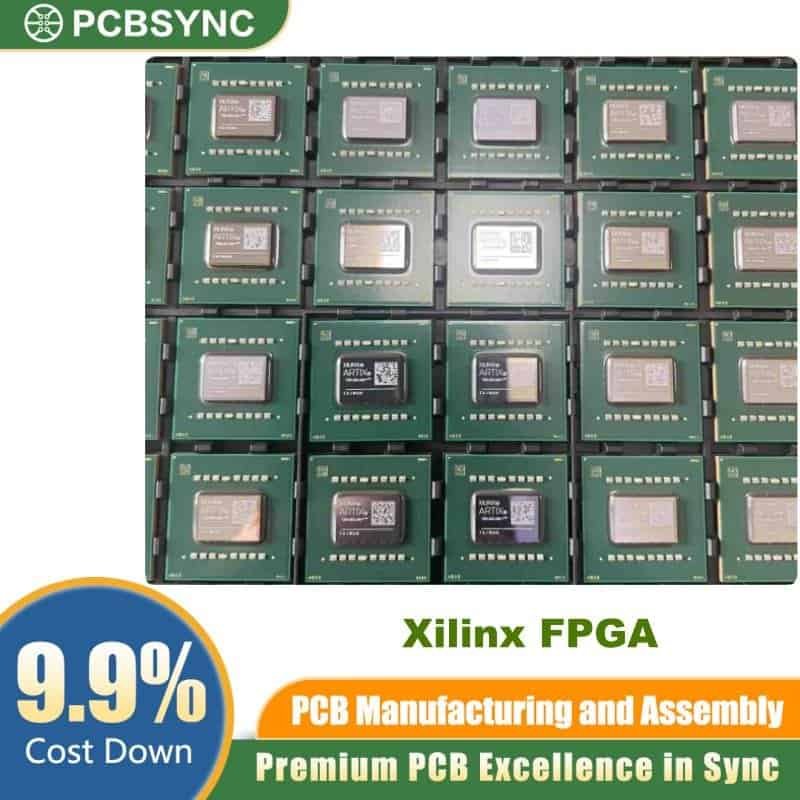
Overview of the XA3S50-4VQG100Q Automotive FPGA
The XA3S50-4VQG100Q is a high-reliability automotive-grade Field Programmable Gate Array (FPGA) from the Xilinx XA Spartan-3 family. Designed specifically for demanding automotive electronic applications, this FPGA delivers exceptional performance with 50,000 system gates, 1,728 logic cells, and advanced 90nm process technology. The device operates at 1.2V and comes in a compact 100-pin VTQFP (Very Thin Quad Flat Pack) package, making it ideal for space-constrained automotive designs.
As part of the Xilinx FPGA automotive portfolio, the XA3S50-4VQG100Q meets stringent AEC-Q100 qualification standards and offers extended temperature operation from -40°C to +125°C (Q-grade), ensuring reliable performance in harsh automotive environments.
Key Technical Specifications
Core Architecture Features
| Specification |
Value |
| System Gates |
50,000 gates |
| Logic Cells |
1,728 cells |
| Block RAM |
72 Kbits |
| Distributed RAM |
12 Kbits |
| DCMs (Digital Clock Managers) |
2 |
| Maximum User I/O |
76 pins |
| Process Technology |
90nm CMOS |
| Core Voltage (VCCINT) |
1.2V ± 5% |
Package and Temperature Specifications
| Parameter |
Details |
| Package Type |
VTQFP (Very Thin Quad Flat Pack) |
| Pin Count |
100 pins |
| Temperature Grade |
Q-grade: -40°C to +125°C (TJ) |
| Speed Grade |
-4 (highest performance) |
| AEC-Q100 Qualified |
Yes |
| RoHS Compliant |
Lead-free packaging |
Why Choose the XA3S50-4VQG100Q for Automotive Applications
Automotive-Grade Reliability
The XA3S50-4VQG100Q is specifically engineered for automotive electronics, meeting AEC-Q100 automotive qualification standards. This certification ensures the FPGA can withstand extreme temperature fluctuations, mechanical stress, and electromagnetic interference common in automotive environments.
Extended Temperature Range Operation
With Q-grade temperature qualification supporting junction temperatures from -40°C to +125°C, this automotive FPGA maintains stable operation in engine control units, transmission systems, and other high-temperature automotive applications where commercial-grade components would fail.
Cost-Effective Programmable Logic Solution
Compared to ASIC (Application-Specific Integrated Circuit) development, the XA3S50-4VQG100Q eliminates high initial NRE (Non-Recurring Engineering) costs and lengthy development cycles. The programmable nature allows for field upgrades and design modifications without hardware replacement, significantly reducing lifecycle costs.
Performance Capabilities
Clock Management and Timing
The XA3S50-4VQG100Q features two Digital Clock Managers (DCMs) that provide advanced clock synthesis, phase shifting, and frequency multiplication capabilities. These DCMs enable designers to generate multiple synchronized clock domains essential for complex automotive control systems.
Memory Resources
| Memory Type |
Capacity |
Configuration |
| Block RAM |
72 Kbits |
Four 18-Kbit dual-port blocks |
| Distributed RAM |
12 Kbits |
Configurable as RAM or ROM |
The dual-port block RAM architecture supports simultaneous read/write operations, making it ideal for buffering data streams in automotive communication protocols like CAN, LIN, and FlexRay.
I/O Capabilities and Standards
The XA3S50-4VQG100Q supports up to 76 user I/O pins with multiple I/O standards:
- LVCMOS (3.3V, 2.5V, 1.8V, 1.5V, 1.2V)
- LVTTL
- SSTL-2, SSTL-3
- HSTL Class I, III, IV
- Differential signaling (LVDS, mini-LVDS, RSDS)
This flexibility enables direct interfacing with sensors, actuators, displays, and communication buses without requiring external level shifters.
Target Automotive Applications
Advanced Driver Assistance Systems (ADAS)
The XA3S50-4VQG100Q provides the processing power and I/O flexibility required for ADAS applications including:
- Camera processing and object detection
- Radar signal processing
- Sensor fusion algorithms
- Lane departure warning systems
- Adaptive cruise control
Infotainment and Instrument Clusters
With sufficient logic resources and memory, this automotive FPGA handles:
- Display controller interfaces (TFT, OLED)
- Audio processing and codec interfaces
- Touchscreen controller integration
- Graphics rendering engines
- Multiple video input processing
Gateway and Communication Modules
The XA3S50-4VQG100Q excels in automotive gateway applications:
- Protocol conversion (CAN to LIN, FlexRay to Ethernet)
- Message routing and filtering
- Diagnostic interfaces (OBD-II, UDS)
- Security gateway functions
Engine Control and Powertrain Systems
Temperature-tolerant design makes it suitable for:
- Engine control unit (ECU) logic
- Transmission control
- Fuel injection timing
- Ignition system control
Design Advantages Over Alternative Solutions
Versus ASICs and ASSPs
| Factor |
XA3S50-4VQG100Q FPGA |
ASIC/ASSP |
| Development Time |
Weeks to months |
12-24 months |
| Initial Cost (NRE) |
Low |
$500K – $5M+ |
| Design Flexibility |
Full reprogrammability |
Fixed function |
| Field Updates |
Supported |
Not possible |
| Obsolescence Risk |
Lower |
Higher |
Versus Microcontrollers
While microcontrollers offer CPU-based sequential processing, the XA3S50-4VQG100Q provides true parallel processing capabilities. This makes it superior for:
- Real-time signal processing
- Multiple simultaneous protocol handling
- High-speed data acquisition
- Custom peripheral implementation
Development Tools and Support
Xilinx ISE Design Suite
The XA3S50-4VQG100Q is fully supported by Xilinx ISE Design Suite, providing:
- Schematic and HDL-based design entry
- Synthesis and place-and-route tools
- Timing analysis and optimization
- Power estimation utilities
- ChipScope Pro integrated logic analyzer
Programming and Configuration
The FPGA supports multiple configuration modes:
- Master/Slave Serial
- Master/Slave Parallel
- JTAG boundary scan
- Platform Flash (non-volatile storage)
- SPI Flash memory
Quality and Compliance Standards
AEC-Q100 Automotive Qualification
The XA3S50-4VQG100Q undergoes rigorous automotive qualification testing including:
- Temperature cycling (-40°C to +150°C)
- High-temperature operating life (HTOL)
- Early life failure rate (ELFR)
- Electrostatic discharge (ESD) protection
- Latch-up immunity testing
Environmental Compliance
- RoHS compliant (lead-free)
- REACH compliant
- Conflict minerals reporting
Power Consumption Characteristics
Operating Power Specifications
| Condition |
Typical Power |
Maximum Power |
| Static Current (VCCINT) |
5 mA |
20 mA |
| Dynamic Power |
Design dependent |
Varies with utilization |
| I/O Power (per bank) |
1-50 mA |
Design dependent |
The 90nm process technology provides an optimal balance between performance and power consumption, essential for automotive battery-powered and hybrid vehicle applications.
Package Information and PCB Integration
VTQFP-100 Package Details
- Package body: 14mm × 14mm × 1.4mm
- Lead pitch: 0.5mm
- Recommended PCB footprint provided in datasheet
- Compatible with standard SMT assembly processes
- Moisture sensitivity level: MSL 3
Thermal Management
- Junction-to-ambient thermal resistance (θJA): 45°C/W
- Junction-to-case thermal resistance (θJC): 12°C/W
- Adequate for most automotive applications with proper PCB design
- Thermal vias recommended for high-utilization designs
Ordering Information and Part Number Breakdown
XA3S50-4VQG100Q
- XA = Automotive grade (AEC-Q100 qualified)
- 3S50 = Spartan-3 family, 50K gates
- -4 = Speed grade (highest performance)
- VQ = Very thin quad flat pack
- 100 = 100 pins
- Q = Q-grade temperature (-40°C to +125°C TJ)
Storage and Handling Requirements
To maintain component reliability:
- Store in moisture barrier bag with desiccant
- Baking required if exposed beyond floor life
- ESD precautions mandatory during handling
- Follow IPC/JEDEC J-STD-020 soldering guidelines
Comparison with Related Xilinx Automotive FPGAs
| Part Number |
Gates |
Logic Cells |
Block RAM |
I/O Pins |
Temp Range |
| XA3S50-4VQG100Q |
50K |
1,728 |
72 Kb |
76 |
-40°C to +125°C |
| XA3S200-4VQG100Q |
200K |
4,320 |
216 Kb |
76 |
-40°C to +125°C |
| XA3S400-4PQG208Q |
400K |
8,064 |
288 Kb |
141 |
-40°C to +125°C |
| XA3S1000-4FG456Q |
1M |
17,280 |
432 Kb |
333 |
-40°C to +125°C |
Frequently Asked Questions
What makes the XA3S50-4VQG100Q different from standard Spartan-3 FPGAs?
The XA (Automotive) variant undergoes additional qualification testing to meet AEC-Q100 standards, offers extended temperature operation, and includes production lot traceability required for automotive applications.
Can this FPGA be used in safety-critical automotive systems?
While the XA3S50-4VQG100Q is automotive-qualified, it is not certified for functional safety standards like ISO 26262. For safety-critical applications, additional system-level safety measures and redundancy are required.
What is the expected lifespan in automotive environments?
When operated within specified parameters, the XA3S50-4VQG100Q typically exceeds the 15-year lifespan requirement for automotive electronics, with proper derating and thermal management.
Does the FPGA support in-system reprogramming?
Yes, the XA3S50-4VQG100Q fully supports in-system programming through JTAG or configuration memory updates, enabling field software updates and bug fixes.
Conclusion: Ideal Automotive FPGA for Demanding Applications
The XA3S50-4VQG100Q represents an optimal choice for automotive engineers seeking reliable, cost-effective programmable logic for next-generation vehicle electronics. With AEC-Q100 qualification, extended temperature operation, comprehensive I/O capabilities, and proven Spartan-3 architecture, this automotive-grade FPGA delivers the performance and reliability required for modern automotive systems.
Whether designing advanced driver assistance systems, infotainment platforms, gateway modules, or powertrain controllers, the XA3S50-4VQG100Q provides the flexibility and robustness needed to meet today’s automotive challenges while maintaining the adaptability to accommodate future requirements through field-programmable updates.
For automotive electronics designers seeking a proven, qualified FPGA solution that balances performance, cost, and reliability, the XA3S50-4VQG100Q stands as a compelling choice backed by Xilinx’s decades of FPGA leadership and automotive expertise.