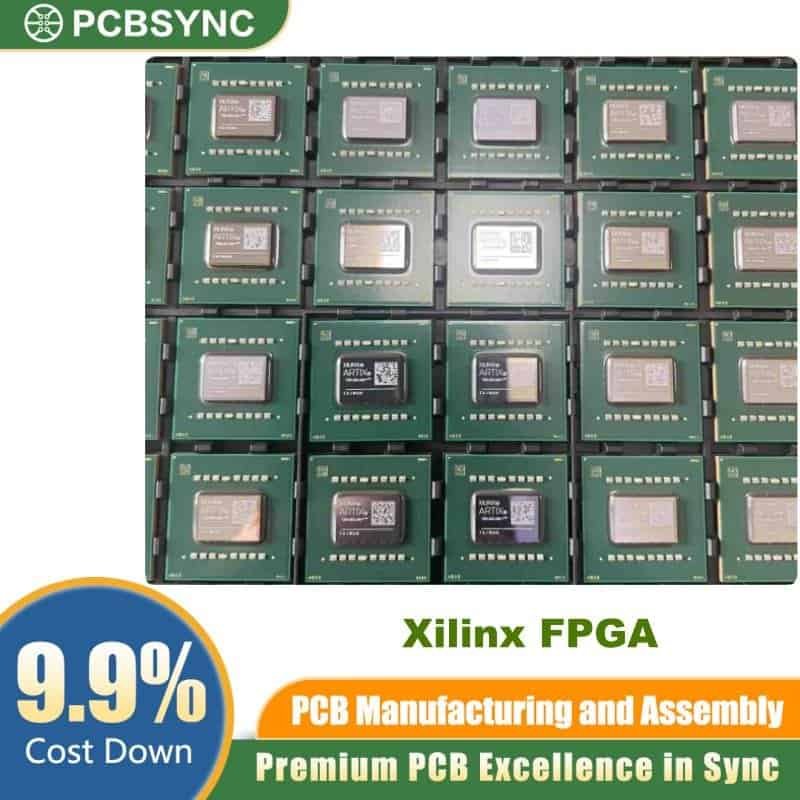
The XC2S200-6FGG1285C is a cornerstone of the Xilinx Spartan-II family, designed to provide a cost-effective, high-volume solution for logic integration. This Field Programmable Gate Array (FPGA) bridges the gap between complex programmable logic devices (CPLDs) and high-end FPGAs by offering a rich feature set, including flexible I/O standards and on-chip block RAM.
Built on a 0.22µm/0.18µm CMOS process, the Spartan-II XC2S200 series is optimized for performance-critical applications where budget constraints are tight but logic density requirements remain high.
Key Technical Specifications of XC2S200-6FGG1285C
The XC2S200-6FGG1285C offers a significant amount of logic resources, making it suitable for digital signal processing (DSP), glue logic, and custom interface controllers. Below is a detailed breakdown of the core specifications:
Table 1: Core Architecture and Logic Density
| Feature |
Specification |
| System Gates |
200,000 |
| Logic Cells |
5,292 |
| CLB Array (Rows x Cols) |
28 x 42 |
| Total Distributed RAM Bits |
75,264 |
| Total Block RAM Bits |
56,320 |
| Number of Dedicated Block RAMs |
14 |
| Maximum User I/O |
Up to 284 (Package Dependent) |
Table 2: Electrical and Operating Conditions
| Parameter |
Rating |
| Internal Supply Voltage (Vccint) |
2.5V |
| I/O Supply Voltage (Vcco) |
1.5V to 3.3V |
| Speed Grade |
-6 (Standard Performance) |
| Operating Temperature |
0°C to +85°C (Commercial) |
| Package Type |
FGG1285 (Fine-Pitch Ball Grid Array) |
Advanced Architecture and Features
The architecture of the XC2S200-6FGG1285C is derived from the Virtex series, ensuring a robust and well-documented design environment. It consists of three main elements: Configurable Logic Blocks (CLBs), Input/Output Blocks (IOBs), and Programmable Interconnect.
Configurable Logic Blocks (CLBs)
The heart of the XC2S200-6FGG1285C lies in its CLBs. Each CLB contains four logic cells organized in two slices. Each logic cell includes a 4-input Look-Up Table (LUT), carry logic, and a storage element (flip-flop). This structure allows for the efficient implementation of complex arithmetic functions and synchronous state machines.
SelectI/O Technology
One of the most powerful features of this Xilinx FPGA is its SelectI/O capability. The XC2S200-6FGG1285C supports up to 16 different high-performance I/O standards, including:
This versatility eliminates the need for external level shifters and allows the FPGA to communicate directly with various memory types and bus architectures.
Dedicated Block RAM
Unlike standard CPLDs, the XC2S200-6FGG1285C features dedicated 4,096-bit synchronous dual-port RAM blocks. These are essential for implementing:
Optimized Power Management and Design Efficiency
The XC2S200-6FGG1285C is designed for low power consumption without sacrificing speed. By utilizing a 2.5V core voltage, the device reduces power dissipation compared to older 3.3V or 5V logic families.
Delay-Locked Loops (DLLs)
To maintain high-speed signal integrity, the device includes four dedicated DLLs. These provide:
-
Clock De-skew: Synchronizing internal clock signals with external sources.
-
Frequency Synthesis: Multiplying or dividing clock frequencies.
-
Phase Shifting: Adjusting clock phases for high-speed memory interfaces.
Typical Applications for XC2S200-6FGG1285C
Due to its high gate count and versatile I/O, the XC2S200-6FGG1285C is frequently found in the following sectors:
-
Telecommunications: Network interface cards, protocol converters, and base station controllers.
-
Industrial Automation: High-speed motor control, PLC expansion modules, and sensor fusion.
-
Consumer Electronics: Digital video processing, set-top boxes, and high-fidelity audio equipment.
-
Legacy System Support: Replacing obsolete ASIC components or outdated CPLDs in long-lifecycle industrial systems.
Conclusion and Design Support
The XC2S200-6FGG1285C remains a reliable choice for engineers seeking a balance between cost and capability. Its compatibility with Xilinx ISE design tools ensures a streamlined development workflow, from VHDL/Verilog synthesis to place-and-route.
When integrating this FPGA into your next project, ensure proper decoupling of the Vccint and Vcco rails and follow recommended PCB layout guidelines for high-speed differential signaling to maximize the performance of the SelectI/O banks.