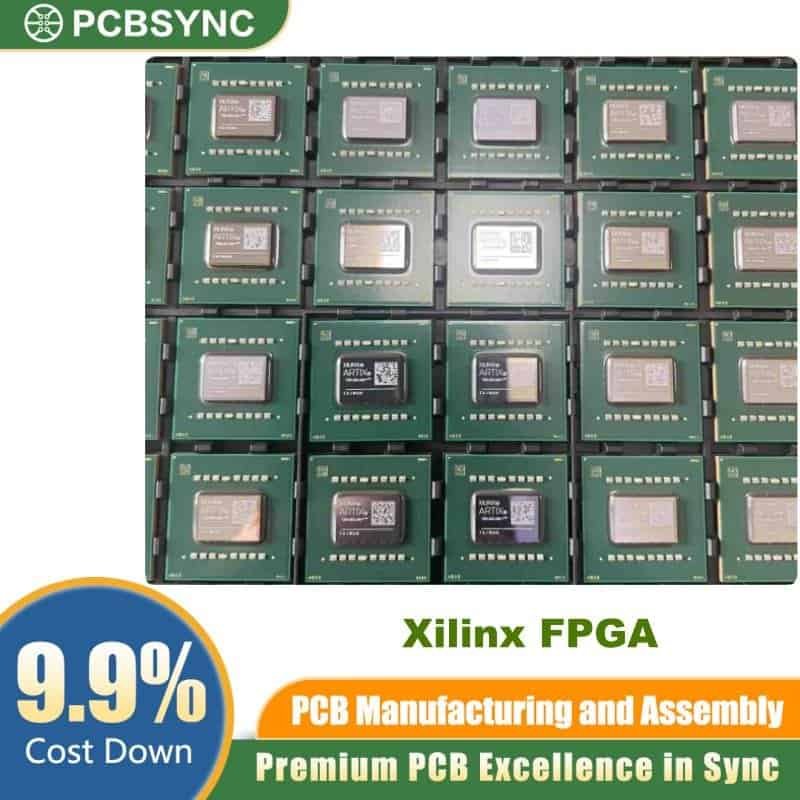
The AMD XC2S200-6FGG542C is a high-performance field-programmable gate array from the renowned Spartan-II FPGA family. This programmable logic device delivers exceptional versatility for digital design applications, offering engineers a cost-effective alternative to traditional ASICs with the flexibility of in-system reprogrammability.
XC2S200-6FGG542C Product Overview and Key Specifications
The XC2S200-6FGG542C belongs to the Spartan-II family, built on advanced 0.18µm CMOS technology. This Xilinx FPGA operates at 2.5V core voltage while supporting multiple I/O voltage standards, making it ideal for interfacing with diverse system components.
Core Architecture Specifications
| Parameter |
Value |
| System Gates |
200,000 |
| Logic Cells |
5,292 |
| CLB Array |
28 x 42 |
| Total CLBs |
1,176 |
| Maximum User I/O |
284 |
| Distributed RAM |
75,264 bits |
| Block RAM |
56 Kbits |
| Package Type |
Fine-Pitch Ball Grid Array (FGG) |
| Pin Count |
542 |
| Speed Grade |
-6 |
| Process Technology |
0.18µm |
| Core Voltage |
2.5V |
Spartan-II FPGA Architecture Features
Configurable Logic Blocks (CLBs)
The XC2S200-6FGG542C incorporates 1,176 configurable logic blocks arranged in a 28 x 42 array. Each CLB contains multiple logic cells featuring four-input look-up tables (LUTs), flip-flops, and dedicated carry logic for arithmetic operations. This architecture enables efficient implementation of complex digital functions including counters, shift registers, and state machines.
Block RAM Memory Resources
This FPGA provides 56 Kbits of dedicated block RAM organized in multiple 4,096-bit memory blocks. Engineers can configure these memory resources as single-port RAM, dual-port RAM, or ROM to accommodate various data storage and buffering requirements in their designs.
Distributed RAM Capability
Beyond block RAM, the XC2S200-6FGG542C offers 75,264 bits of distributed RAM implemented within the CLB structure. This distributed memory architecture provides low-latency access for register files, FIFOs, and small lookup tables scattered throughout the design.
Clock Management and Delay-Locked Loops
Four Integrated DLLs
The device features four Delay-Locked Loops positioned at each corner of the die. These DLLs provide essential clock management capabilities:
Clock Deskew: Eliminates clock distribution delays across the FPGA fabric, ensuring synchronous operation throughout the device.
Frequency Synthesis: Generates clock frequencies at multiples or fractions of the input clock, supporting applications requiring various clock domains.
Phase Shifting: Offers precise phase adjustment for timing-critical interfaces and data capture applications.
Duty Cycle Correction: Maintains accurate 50/50 duty cycle on doubled clock outputs for reliable DDR interfaces.
Flexible I/O Standards Support
Multi-Standard I/O Capability
The XC2S200-6FGG542C input/output blocks support numerous signaling standards for seamless integration with external components:
| I/O Standard |
Description |
Typical Application |
| LVTTL |
Low-Voltage TTL (3.3V) |
General-purpose chip-to-chip |
| LVCMOS |
Low-Voltage CMOS (2.5V) |
Digital interfaces |
| PCI 3.3V/5V |
Peripheral Component Interconnect |
PC and embedded systems |
| GTL/GTL+ |
Gunning Transceiver Logic |
Backplane, processor interfaces |
| HSTL |
High-Speed Transceiver Logic |
Memory interfaces |
| SSTL2/SSTL3 |
Stub Series Terminated Logic |
DDR SDRAM, SDRAM |
| CTT |
Center-Tapped Termination |
Backplane, memory |
| AGP-2X |
Accelerated Graphics Port |
Graphics processors |
5V Tolerant Inputs
The LVTTL, LVCMOS, and PCI standards provide 5V input tolerance, enabling direct interfacing with legacy 5V logic systems without external level shifters.
XC2S200-6FGG542C Speed Grade Performance
The -6 speed grade represents the fastest performance tier available for this device in the commercial temperature range. This speed designation indicates optimized internal routing delays and enhanced switching characteristics for demanding timing requirements.
Temperature Range
Commercial Grade: Operating junction temperature from 0°C to +85°C, suitable for typical industrial and commercial environments.
Package Information and Pinout
Fine-Pitch Ball Grid Array
The FGG542 package utilizes fine-pitch ball grid array technology with 542 solder balls arranged in a grid pattern. This package configuration offers several advantages:
High Pin Density: Maximizes I/O availability in a compact footprint.
Excellent Signal Integrity: Short bond wire lengths minimize parasitic inductance.
Thermal Performance: Enhanced heat dissipation through the BGA structure.
Board-Level Reliability: Proven solder joint reliability for production environments.
Design Development Tools
ISE Design Suite Compatibility
The XC2S200-6FGG542C is fully supported by the ISE Design Suite, providing comprehensive design entry, synthesis, implementation, and verification capabilities. Engineers can develop designs using industry-standard HDL languages including VHDL and Verilog.
Configuration Options
The device supports multiple configuration modes for loading the design bitstream:
Master Serial Mode: Autonomous configuration from external serial PROM.
Slave Serial Mode: Configuration controlled by external processor or CPLD.
Slave Parallel Mode: High-speed 8-bit parallel configuration interface.
Boundary Scan (JTAG): Configuration and debug through IEEE 1149.1 interface.
Target Applications
The XC2S200-6FGG542C Spartan-II FPGA serves diverse application segments:
Telecommunications: Protocol bridging, signal processing, and interface conversion.
Industrial Control: Motor drives, process automation, and sensor interfaces.
Consumer Electronics: Video processing, display controllers, and audio systems.
Automotive Systems: Infotainment, driver assistance, and body electronics.
Medical Equipment: Imaging systems, patient monitoring, and diagnostic instruments.
Aerospace and Defense: Avionics, radar processing, and secure communications.
Advantages Over ASIC Solutions
Reduced Development Risk
Unlike mask-programmed ASICs requiring expensive tooling and lengthy fabrication cycles, the XC2S200-6FGG542C eliminates NRE costs and enables rapid prototyping to production transitions.
Field Upgradability
The SRAM-based configuration allows unlimited reprogramming cycles. Engineers can implement design changes, bug fixes, and feature enhancements without hardware modifications—impossible with traditional ASIC approaches.
Faster Time-to-Market
Programmable logic dramatically shortens development timelines compared to custom silicon, enabling faster product launches and competitive advantages.
Ordering Information
Part Number Decode
XC2S200: Spartan-II family, 200K system gates
-6: Speed grade (fastest commercial)
FGG: Fine-pitch Ball Grid Array with Pb-free balls
542: Pin count
C: Commercial temperature range (0°C to +85°C)
Technical Documentation
Comprehensive documentation supports successful implementation:
DS001 Data Sheet: Complete electrical specifications, timing parameters, and pinout information across four modules covering introduction, functional description, DC/AC characteristics, and package pinouts.
User Guide: Implementation guidelines, PCB layout recommendations, and configuration procedures.
Application Notes: Design best practices and reference implementations.
Summary
The AMD XC2S200-6FGG542C represents an excellent choice for engineers requiring substantial programmable logic resources in a cost-effective package. With 200,000 system gates, 5,292 logic cells, and comprehensive I/O flexibility, this Spartan-II FPGA enables sophisticated digital designs across telecommunications, industrial, consumer, and embedded applications. The combination of proven 0.18µm technology, robust configuration options, and extensive tool support makes this device a reliable foundation for both new designs and legacy system maintenance.