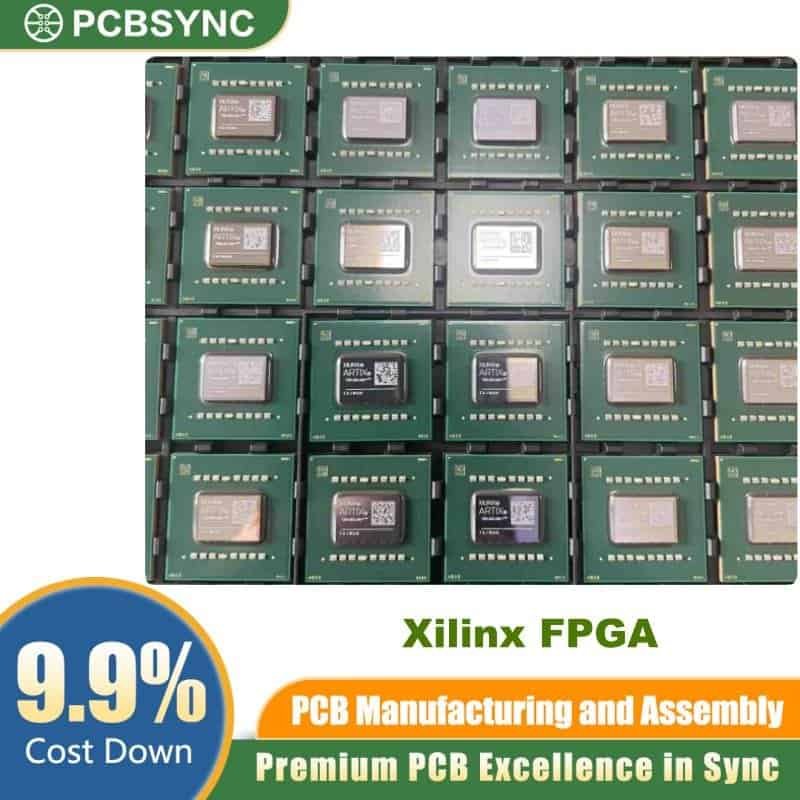
The XC3S400-4FT256I is a high-performance, cost-optimized Xilinx FPGA from the Spartan-3 family, manufactured by AMD (formerly Xilinx). Designed for industrial-grade applications requiring reliable programmable logic, this device delivers 400,000 system gates in a compact 256-ball Fine-pitch Ball Grid Array (FTBGA) package. Whether you are developing embedded systems, signal processing circuits, or industrial control boards, the XC3S400-4FT256I offers the performance, density, and I/O flexibility to meet demanding design requirements.
XC3S400-4FT256I Overview and Key Highlights
The XC3S400-4FT256I belongs to AMD Xilinx’s Spartan-3 generation — a family built to deliver powerful programmable logic at an accessible price point. The “I” suffix designates the Industrial temperature grade, making this device well-suited for environments with harsh thermal conditions. The “-4” speed grade indicates a standard performance tier within the Spartan-3 lineup.
Why Choose the XC3S400-4FT256I?
- 400K system gates with 8,064 logic cells for complex digital designs
- Industrial temperature range (–40°C to +100°C) for robust deployment
- 256-ball FTBGA package enabling compact PCB footprints
- 141 user I/O pins for flexible peripheral interfacing
- Four integrated DCM (Digital Clock Manager) blocks for precise clock control
- Supported by Xilinx ISE Design Suite for streamlined FPGA development
XC3S400-4FT256I Electrical and Functional Specifications
Core Specifications Table
| Parameter |
Value |
| Manufacturer |
AMD (Xilinx) |
| Part Number |
XC3S400-4FT256I |
| Series |
Spartan-3 |
| Package |
256-Ball FTBGA (Fine-pitch BGA) |
| System Gates |
400,000 |
| Logic Cells |
8,064 |
| CLB Array |
56 × 72 |
| CLBs (total) |
3,584 |
| Flip-Flops |
16,776 |
| Maximum User I/O |
141 |
| Distributed RAM |
231 Kb |
| Block RAM |
288 Kb |
| Multipliers (18×18) |
16 |
| Digital Clock Managers (DCM) |
4 |
| Speed Grade |
-4 |
| Temperature Grade |
Industrial (I) |
| Operating Temperature |
–40°C to +100°C |
| Core Voltage (VCCINT) |
1.2 V |
| I/O Voltage (VCCO) |
1.2 V – 3.3 V |
| RoHS Status |
RoHS Compliant |
Package Information: 256-Ball FTBGA
Package Dimensions and Mechanical Data
| Parameter |
Value |
| Package Type |
FTBGA (Fine-pitch Thin Ball Grid Array) |
| Ball Count |
256 |
| Body Size |
17 mm × 17 mm |
| Ball Pitch |
1.0 mm |
| Package Height |
1.55 mm (max) |
| PCB Pad Diameter |
0.55 mm (recommended) |
| Soldering Method |
SMT (Surface Mount) |
The FTBGA-256 package enables high-density PCB integration compared to leaded alternatives, and its 1.0 mm pitch makes it compatible with standard PCB manufacturing processes.
Logic Architecture: Spartan-3 CLB Structure
The Spartan-3 architecture is built around Configurable Logic Blocks (CLBs), each containing four slices organized in a 2×2 arrangement. Each slice includes two 4-input Look-Up Tables (LUTs), two storage elements (flip-flops or latches), and carry/control logic.
CLB and Slice Breakdown
| Resource |
Count |
| CLB Columns |
56 |
| CLB Rows |
72 |
| Total CLBs |
3,584 |
| Slices per CLB |
4 |
| Total Slices |
14,336 |
| LUTs per Slice |
2 |
| Total LUTs |
28,672 |
| Flip-Flops per Slice |
2 |
| Total Flip-Flops |
16,776 |
Distributed RAM Capability
Each LUT in the Spartan-3 architecture can function as a 16×1-bit synchronous RAM or a 16-bit shift register, providing distributed memory resources tightly integrated with the logic fabric. The XC3S400-4FT256I provides 231 Kb of total distributed RAM capacity.
Block RAM (BRAM) Resources
The XC3S400-4FT256I includes 16 dedicated Block RAM modules, each providing 18 Kb of dual-port memory. Block RAM is ideal for FIFOs, data buffers, lookup tables, and embedded memory in SoC designs.
Block RAM Summary
| Parameter |
Value |
| Number of Block RAMs |
16 |
| Capacity per Block RAM |
18 Kb |
| Total Block RAM |
288 Kb |
| Port Width (max) |
×36 (with parity) |
| Port Configuration |
True Dual-Port |
| Read/Write Modes |
Read-First, Write-First, No-Change |
Dedicated Multipliers
For DSP and arithmetic-intensive applications, the XC3S400-4FT256I integrates 16 dedicated 18×18-bit multiplier blocks. These hardware multipliers support signed and unsigned multiplication with 36-bit outputs, delivering significantly better performance and lower resource usage compared to LUT-based multiplier implementations.
Multiplier Block Specifications
| Parameter |
Value |
| Multiplier Count |
16 |
| Input Width |
18 bits × 18 bits |
| Output Width |
36 bits |
| Type |
Signed / Unsigned |
| Cascadable |
Yes |
Digital Clock Manager (DCM)
The four integrated Digital Clock Managers (DCMs) in the XC3S400-4FT256I provide comprehensive clock management capabilities, including:
- Clock multiplication and division – generate custom frequencies from a reference clock
- Phase shifting – adjust clock edges in fine increments
- Duty-cycle correction – normalize clock duty cycles to 50%
- Clock deskew – eliminate clock insertion delay for synchronous design
DCM Feature Summary
| Feature |
Details |
| Number of DCMs |
4 |
| Clock Multiplication |
Integer and fractional |
| Clock Division |
Integer |
| Phase Shift |
Fixed or dynamic |
| Input Frequency Range |
24 MHz – 350 MHz (typical) |
| Duty Cycle Correction |
Yes |
| Deskew Mode |
Yes |
I/O Resources and Standards
The XC3S400-4FT256I supports up to 141 user I/O pins, organized into four I/O banks. Each bank can be independently configured to a different I/O standard voltage level, enabling interfacing with a wide range of external devices.
Supported I/O Standards
| I/O Standard |
Description |
| LVCMOS 3.3 V / 2.5 V / 1.8 V / 1.5 V |
Low-Voltage CMOS |
| LVTTL |
Low-Voltage TTL |
| LVDS |
Low-Voltage Differential Signaling |
| RSDS |
Reduced Swing Differential Signaling |
| SSTL 2 / SSTL 18 |
Stub Series Terminated Logic |
| HSTL Class I / III |
High-Speed Transceiver Logic |
| PCI |
3.3 V PCI Compatible |
| GTL / GTL+ |
Gunning Transceiver Logic |
I/O Bank Configuration
| Bank |
Available User I/O |
| Bank 0 |
Up to 34 |
| Bank 1 |
Up to 35 |
| Bank 2 |
Up to 34 |
| Bank 3 |
Up to 38 |
| Total |
141 |
Power Supply Requirements
Voltage Rails
| Power Rail |
Nominal Voltage |
Description |
| VCCINT |
1.2 V |
Core logic supply |
| VCCO |
1.2 V – 3.3 V |
I/O output supply (per bank) |
| VCCAUX |
2.5 V |
Auxiliary circuits (DCM, DCI, etc.) |
Proper power sequencing and decoupling are critical for reliable operation. Xilinx recommends dedicated low-ESR bypass capacitors placed close to each power pin.
Configuration Methods
The XC3S400-4FT256I supports multiple configuration modes to suit different system architectures:
| Configuration Mode |
Description |
| Master Serial |
FPGA loads from SPI-compatible serial Flash |
| Slave Serial |
External host drives configuration data |
| Master SelectMAP (Parallel) |
8-bit parallel configuration from Flash |
| Slave SelectMAP |
8-bit parallel host-driven configuration |
| JTAG |
Boundary-scan and in-system programming |
| Master SPI |
Direct SPI Flash interface |
JTAG-based configuration is ideal during prototyping and debugging. For production systems, SPI Flash or parallel Flash modes are commonly used.
Operating Conditions
| Parameter |
Min |
Typical |
Max |
Unit |
| VCCINT |
1.14 |
1.20 |
1.26 |
V |
| VCCO |
1.14 |
— |
3.465 |
V |
| VCCAUX |
2.375 |
2.50 |
2.625 |
V |
| Junction Temperature (Tj) |
–40 |
— |
+100 |
°C |
| Storage Temperature |
–65 |
— |
+150 |
°C |
Typical Applications of the XC3S400-4FT256I
The XC3S400-4FT256I is widely used across multiple industries and application domains, including:
Industrial Control Systems
Its industrial temperature rating and robust I/O make it ideal for motor controllers, PLCs, and industrial automation equipment operating in wide temperature environments.
Embedded Processing
When combined with a soft-core processor such as MicroBlaze (implemented in the FPGA fabric), the device can serve as a full-featured embedded processing platform.
Communications and Networking
The device supports high-speed differential I/O standards (LVDS, HSTL) suitable for Ethernet interfaces, serial data links, and protocol bridging applications.
Test and Measurement Equipment
The 16 hardware multipliers and large LUT resources support real-time signal processing, waveform generation, and data acquisition functions.
Video and Image Processing
Block RAM resources and fast I/O enable frame buffering and pixel pipeline processing for machine vision and display controller applications.
Prototyping and Development
The Spartan-3 family is a popular platform for FPGA learning and hardware prototyping due to its well-documented architecture and ISE toolchain support.
Ordering Information and Part Number Breakdown
Understanding the Xilinx part number structure helps in selecting the right variant for your design.
| Field |
Code |
Meaning |
| Family |
XC3S |
Spartan-3 series |
| Gate Count |
400 |
400,000 system gates |
| Speed Grade |
-4 |
Standard speed (slower = more negative) |
| Package |
FT |
Fine-pitch Thin BGA |
| Pin Count |
256 |
256 solder balls |
| Temperature |
I |
Industrial (–40°C to +100°C) |
Available Grade Variants
| Part Number |
Speed Grade |
Temperature Grade |
| XC3S400-4FT256C |
-4 |
Commercial (0°C to +85°C) |
| XC3S400-4FT256I |
-4 |
Industrial (–40°C to +100°C) |
| XC3S400-5FT256C |
-5 |
Commercial |
| XC3S400-5FT256I |
-5 |
Industrial |
Development Tools and Design Support
Xilinx ISE Design Suite
The XC3S400-4FT256I is fully supported by the Xilinx ISE Design Suite, which provides:
- HDL synthesis (VHDL, Verilog)
- Place-and-route implementation
- Timing analysis and constraint management
- Bitstream generation and configuration file creation
- ChipScope Pro for in-system logic analysis
Third-Party EDA Tool Support
The device is also compatible with leading third-party synthesis and simulation tools including Synopsys Synplify, Mentor ModelSim, and Cadence tools.
IP Core Ecosystem
Xilinx provides a rich catalog of free and licensed IP cores optimized for Spartan-3 devices, including:
- MicroBlaze soft processor
- LocalLink DMA interfaces
- UART, SPI, I²C, GPIO peripherals
- DDR/SDRAM memory controllers
- Ethernet MAC
Comparison: XC3S400 vs Other Spartan-3 Densities
| Device |
Gates |
Logic Cells |
Block RAM |
Multipliers |
Max I/O |
| XC3S50 |
50K |
1,728 |
72 Kb |
4 |
124 |
| XC3S200 |
200K |
4,320 |
216 Kb |
12 |
173 |
| XC3S400 |
400K |
8,064 |
288 Kb |
16 |
264 |
| XC3S1000 |
1M |
17,280 |
432 Kb |
24 |
391 |
| XC3S1500 |
1.5M |
29,952 |
576 Kb |
32 |
487 |
Note: Maximum I/O shown for largest available package per device. XC3S400 in FT256 package supports 141 user I/O.
Frequently Asked Questions (FAQ)
Q: Is the XC3S400-4FT256I RoHS compliant? Yes. This part is manufactured to meet RoHS (Restriction of Hazardous Substances) compliance standards.
Q: What is the difference between the “C” and “I” suffix? The “C” suffix denotes Commercial temperature grade (0°C to +85°C junction temperature), while the “I” suffix denotes Industrial temperature grade (–40°C to +100°C junction temperature). The XC3S400-4FT256I is the industrial variant.
Q: Can the XC3S400-4FT256I be programmed in-circuit? Yes. The device supports JTAG-based in-system programming (ISP), allowing reconfiguration without removing the device from the PCB.
Q: What programming software is required? Xilinx ISE Design Suite (free download for Spartan-3 support) includes iMPACT, the primary tool for JTAG-based device programming.
Q: Is this device still in production? The Spartan-3 family is a mature product line. Check with authorized distributors for current stock and lead-time availability.
Summary
The XC3S400-4FT256I is a proven, industrial-grade programmable logic device delivering 400K gates, 288 Kb of block RAM, 16 dedicated multipliers, and four DCMs in a compact 256-ball FTBGA package. Its industrial temperature rating, broad I/O standard support, and robust Xilinx tool ecosystem make it a reliable choice for embedded control, communications, and signal processing applications where long-term stability and design flexibility are essential.