Inquire: Call 0086-755-23203480, or reach out via the form below/your sales contact to discuss our design, manufacturing, and assembly capabilities.
Quote: Email your PCB files to Sales@pcbsync.com (Preferred for large files) or submit online. We will contact you promptly. Please ensure your email is correct.
Notes: For PCB fabrication, we require PCB design file in Gerber RS-274X format (most preferred), *.PCB/DDB (Protel, inform your program version) format or *.BRD (Eagle) format. For PCB assembly, we require PCB design file in above mentioned format, drilling file and BOM. Click to download BOM template To avoid file missing, please include all files into one folder and compress it into .zip or .rar format.
Power Resistor: Types, Selection & Heat Dissipation Guide
In the world of electronics, every component has a limit. But when you need to dissipate significant energy—whether it’s braking a 5kW motor or managing the inrush current of a massive capacitor bank—a standard 1/4 watt resistor is just a fuse waiting to happen.
Enter the power resistor. These robust components are the heavy lifters of the circuit board, designed not just to resist current, but to survive the intense heat generated by doing so. If you are designing a power supply, an electric vehicle drive, or an industrial load bank, understanding how to select and cool these components is critical to preventing thermal runaway and field failures.
This guide, written from the perspective of a PCB engineer, covers the types of high power resistors, how to read a derating curve properly, and the art of keeping them cool.
While there is no strict industry cutoff, generally, any resistor rated for 1 Watt or higher enters the “power” category. However, in industrial contexts, we typically refer to “high power resistors” as those capable of handling 5 Watts to hundreds of Kilowatts.
Unlike signal resistors, where precision (tolerance) and noise are the primary concerns, power resistors are judged by:
Thermal Efficiency: How fast can it move heat from the core to the surface?
Pulse Capability: Can it handle a 1000W spike for 10 milliseconds without exploding?
Physical Ruggedness: Can it survive thermal cycling?
Types of High Power Resistors
Choosing the right material is the first step. A wirewound resistor acts very differently from a thick film resistor, even if they have the exact same resistance and power rating.
Type
Power Range
Strengths
Weaknesses
Best Application
Wirewound
1W – 1kW+
Excellent pulse handling; High temperature stability; Robust.
High inductance (acts like a coil); Bulky.
Motor braking, Inrush limiting, Power supplies.
Thick Film (Power)
1W – 100W
Non-inductive (good for HF); High density; Cheap.
Poor pulse handling (film vaporizes); Needs good heatsink.
RF loads, Snubber circuits, Switching power supplies.
Metal Oxide
1W – 10W
Better pulse handling than film; Flameproof options.
Moderate accuracy; Limited high power range.
General purpose power supply, Mains protection.
Ceramic Composition
1W – 20W
Extreme pulse durability; Non-inductive.
High tolerance (10-20%); Resistance drifts with heat.
Engineer’s Note: Never use a standard wirewound resistor in a high-speed switching circuit (like a Snubber). The internal coil creates inductance, which causes voltage spikes that can kill your MOSFETs. Always look for “Non-Inductive” wirewound or use Thick Film power resistors for these applications.
Selection Guide: Avoiding the “Magic Smoke”
Selecting a resistor isn’t just about matching the Ohm value. It requires calculating the safe operating area.
1. The 50% Derating Rule
The power rating on the datasheet (e.g., “50 Watts”) is usually defined at a case temperature of 25°C.
Real-world reality: Your enclosure is likely 40°C, and the resistor itself will get hot.
Rule of Thumb: Always derate by 50%. If you need to dissipate 10 Watts, choose a 20 Watt resistor. This keeps the component cooler, extends its life, and prevents it from desoldering itself from the PCB.
2. Understanding the Derating Curve
Every datasheet has a “Derating Curve.” It shows how much power the resistor can handle as temperature rises.
Standard Curve: Usually flat up to 70°C, then drops linearly to zero at 155°C or 275°C.
The Trap: If your ambient environment is 100°C, a 100W resistor might effectively become a 50W resistor. You must check this graph.
3. Pulse vs. Continuous Power
If your application involves pulses (like capacitor discharge), the continuous power rating is irrelevant. You need to look at the “Pulse Energy” or “One-Shot Energy” rating, measured in Joules.
Wirewound: The wire mass absorbs heat well. Great for pulses.
Film: The thin film heats up instantly. Even a short overload can vaporize the film before the heat reaches the substrate.
Heat Dissipation: The Art of Thermal Management
A 50W resistor is only a 50W resistor if you can get the heat out of it. Without a heatsink, a “50W” chassis-mount resistor might burn out at 5W.
Chassis Mount (Aluminum Housed)
These are the gold or aluminum “bricks” you often see. They rely on conduction.
Mounting: They must be bolted to a metal surface (chassis) or a heatsink.
Thermal Paste: You must use thermal grease. Air gaps between the resistor and the heatsink act as insulators. A thin layer of white lithium grease or silicone thermal compound is mandatory.
Calculating Thermal Resistance
To verify your design, use the thermal resistance formula to predict the internal temperature ($T_j$):
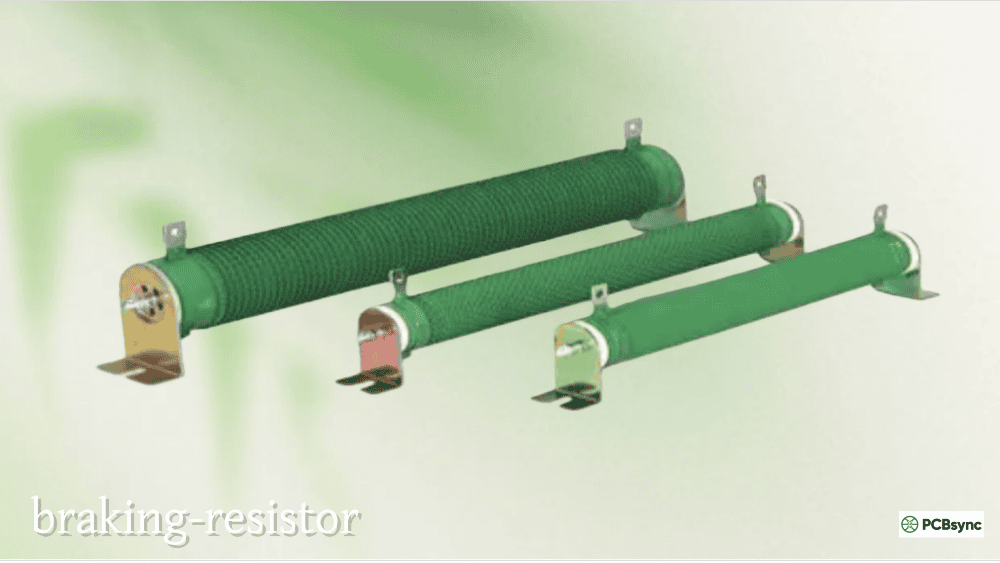
When a VFD (Variable Frequency Drive) slows down a motor, the motor acts as a generator, pumping energy back into the drive. If this energy isn’t dissipated, the VFD trips on “Overvoltage.”
Selection: High pulse capability is key. Wirewound resistors on ceramic cores or large “toaster” style grid resistors are used here.
Key Stat: Peak Braking Power (often 150% of motor KW).
2. Current Sensing (Shunt)
These are low-value power resistors (e.g., 0.01 Ohms) used to measure current.
Selection: Low TCR (Temperature Coefficient of Resistance) is vital. As the resistor heats up, you don’t want the resistance value to change, or your measurement will drift. Look for Manganin or Metal Element shunts.
3. Inrush Limiting
Used to prevent input fuses from blowing when turning on a power supply with large capacitors.
Selection: The resistor must handle the massive initial energy spike (Joule rating) but then run cool during normal operation. Specialized Ceramic Composition or NTC thermistors are often used here.
Useful Resources
For engineers looking to spec these parts, rely on these databases and tools:
DigiKey / Mouser: Filter by “Power Rating” and “Technology” (Wirewound vs Film).
Search Tip: Search for Chassis Mount Resistors for high power (>10W) needs.
Vishay / Dale: The industry standard for high-reliability power resistors. Their “Pulse Energy Calculator” is invaluable.
TE Connectivity: Excellent whitepapers on “Aluminum Housed Resistor Derating”.
Saturn PCB Toolkit: Great for calculating PCB trace width needed to feed these power resistors without burning the board.
Frequently Asked Questions (FAQ)
1. Why is my 10W resistor getting extremely hot at only 5W?
This is normal. Resistors are designed to run hot. A typical power resistor might reach 100°C to 150°C at full load. However, if it is melting adjacent plastic parts or the PCB, you need to either derate further (use a 20W resistor) or improve airflow.
2. Can I use a power resistor without a heatsink?
Only if you stay well below the “Free Air” rating. Most aluminum-housed resistors are rated for their full wattage only when mounted to a specific size heatsink (e.g., a 12×12 inch aluminum plate). In free air, a 50W resistor might only be rated for 20W. Always check the datasheet for the “Free Air” curve.
3. What is the difference between “Inductive” and “Non-Inductive” power resistors?
Standard wirewound resistors are coils of wire, essentially making them air-core inductors. At high frequencies (like in audio amps or switching power supplies), this inductance impedes signals. Non-inductive versions use a special winding technique (Ayrton-Perry winding) where two wires are wound in opposite directions to cancel out the magnetic fields.
4. How do I test a high power resistor?
You cannot accurately test a very low ohm (e.g., 0.1Ω) power resistor with a standard multimeter due to the resistance of your probe leads. You must use a 4-Wire Kelvin connection or a dedicated milliohm meter. For general testing of higher values (e.g., 100Ω), a standard multimeter is fine, but measure it when cool, as heat changes the value.
5. What happens if I exceed the pulse rating?
If you exceed the pulse energy rating, the internal wire or film can suffer “adiabatic heating”—it heats up faster than the heat can move to the ceramic core. This causes the element to melt or fracture open instantly, often silently, leaving you with an open circuit.
Inquire: Call 0086-755-23203480, or reach out via the form below/your sales contact to discuss our design, manufacturing, and assembly capabilities.
Quote: Email your PCB files to Sales@pcbsync.com (Preferred for large files) or submit online. We will contact you promptly. Please ensure your email is correct.
Notes: For PCB fabrication, we require PCB design file in Gerber RS-274X format (most preferred), *.PCB/DDB (Protel, inform your program version) format or *.BRD (Eagle) format. For PCB assembly, we require PCB design file in above mentioned format, drilling file and BOM. Click to download BOM template To avoid file missing, please include all files into one folder and compress it into .zip or .rar format.