Inquire: Call 0086-755-23203480, or reach out via the form below/your sales contact to discuss our design, manufacturing, and assembly capabilities.
Quote: Email your PCB files to Sales@pcbsync.com (Preferred for large files) or submit online. We will contact you promptly. Please ensure your email is correct.
Notes: For PCB fabrication, we require PCB design file in Gerber RS-274X format (most preferred), *.PCB/DDB (Protel, inform your program version) format or *.BRD (Eagle) format. For PCB assembly, we require PCB design file in above mentioned format, drilling file and BOM. Click to download BOM template To avoid file missing, please include all files into one folder and compress it into .zip or .rar format.
Power Management IC (PMIC): Complete Selection Guide
Every PCB I’ve designed in the last decade has included at least one power management IC. Whether it’s a simple IoT sensor node or a complex automotive control unit, the PMIC sits at the heart of the system, quietly ensuring every component gets the clean, stable power it needs. Getting this selection wrong can mean the difference between a reliable product and endless debugging sessions chasing down mysterious reset issues or thermal problems.
This power management IC guide walks through everything you need to know about selecting, implementing, and troubleshooting PMICs in your designs. We’ll cover the fundamentals, compare topologies, examine key specifications, and work through practical PCB layout considerations that separate good designs from great ones.
A power management IC is an integrated circuit designed to manage, regulate, and distribute electrical power within electronic systems. Unlike discrete power solutions where you might use separate voltage regulators, battery chargers, and supervisory circuits, a PMIC consolidates these functions into a single chip.
Think of the PMIC as your board’s central power coordinator. It takes raw input power from a battery, USB port, or wall adapter and converts it into multiple stable voltage rails that feed your processor, memory, sensors, and other components. Beyond simple voltage conversion, modern PMICs handle power sequencing, fault protection, battery management, and system monitoring.
The semiconductor industry sometimes describes the PMIC as the “heart” of an electronic system. Just as the heart pumps blood to organs, the PMIC distributes appropriate voltage levels to each circuit block, keeping everything functioning properly.
Core Functions of a PMIC
Modern power management ICs typically integrate several key functions:
Function
Description
Why It Matters
DC-DC Conversion
Steps voltage up (boost) or down (buck) efficiently
Maximizes battery life, minimizes heat
LDO Regulation
Provides low-noise linear voltage regulation
Critical for analog circuits, RF, and precision ADCs
Power Sequencing
Controls startup and shutdown order of voltage rails
Prevents latch-up, ensures reliable boot
Battery Management
Handles charging, fuel gauge, and cell balancing
Extends battery life, ensures safety
Protection Circuits
Overcurrent, overvoltage, thermal shutdown
Prevents damage during fault conditions
Power Monitoring
Tracks voltage, current, and temperature
Enables diagnostics and adaptive power management
The integration level varies significantly across PMIC products. Some are essentially collections of independent regulators in a single package, while others include sophisticated digital control with I²C or SPI interfaces that allow real-time configuration and monitoring.
Types of Power Management ICs
Understanding PMIC categories helps narrow down your selection quickly. Each type serves different applications and comes with distinct trade-offs.
Voltage Regulator ICs
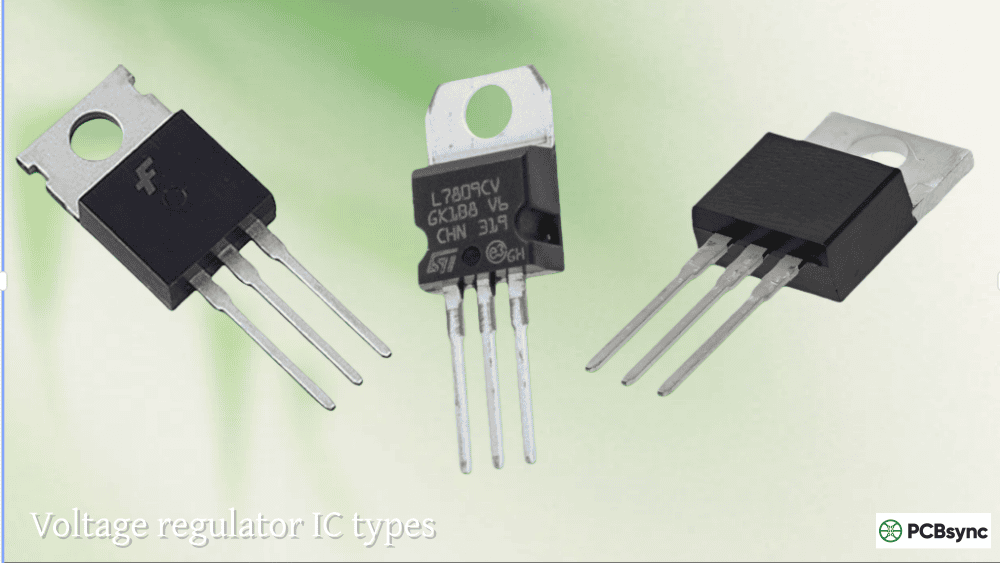
Voltage regulators form the backbone of power management. Two main topologies dominate: linear regulators (LDOs) and switching regulators (DC-DC converters).
Low-Dropout Regulators (LDOs) operate by dissipating excess voltage as heat. They’re simple, inexpensive, and produce very clean output with minimal noise. LDOs excel when the input-output voltage differential is small and current requirements are modest.
DC-DC Converters use high-frequency switching and energy storage elements (inductors and capacitors) to achieve much higher efficiency. Buck converters step down voltage, boost converters step up, and buck-boost types handle both directions.
Multi-Channel PMICs
These devices integrate multiple regulators, sequencing logic, and supervisory functions into a single package. They’re designed to power complex SoCs, FPGAs, and application processors that require numerous voltage rails with specific startup sequences.
Multi-channel PMICs from vendors like Texas Instruments, Analog Devices, and Renesas often target specific processor families, offering plug-and-play solutions with validated reference designs.
Battery Management ICs
Battery management ICs handle the specialized requirements of rechargeable battery systems. They incorporate charging algorithms (CC/CV for lithium cells), fuel gauging, cell balancing for multi-cell packs, and safety protection against overcharge, over-discharge, and overcurrent conditions.
Application-Specific PMICs
Certain applications demand specialized power management. Automotive PMICs, for instance, must meet stringent reliability standards (AEC-Q100) and include features like fail-safe operation and diagnostic reporting. Camera PMICs optimize for the unique voltage sequencing and noise requirements of image sensors.
LDO vs DC-DC Converter: Making the Right Choice
This decision comes up in every power design, and getting it wrong has real consequences. Here’s a practical framework I use when evaluating options.
When to Choose an LDO
LDOs make sense when:
The input-output voltage differential is small (ideally under 1V)
Current requirements are low to moderate (typically under 500mA, though some LDOs handle several amps)
Output noise must be minimal (ADCs, PLLs, RF circuits, audio)
PCB space is extremely limited
Cost is a primary concern for low-power rails
The efficiency of an LDO is approximately VOUT/VIN. If you’re regulating 3.3V from a 5V input, efficiency maxes out around 66%. That means a third of your input power converts directly to heat, which becomes problematic at higher currents.
Quick efficiency check: Power dissipation = (VIN – VOUT) × IOUT. When this exceeds roughly 0.5-1W, thermal management becomes a real concern, and you should consider switching to a DC-DC converter.
When to Choose a DC-DC Converter
Switching regulators win when:
Large voltage step-down ratios are required
High currents demand efficiency for thermal reasons
Battery life is critical
You need to boost voltage (LDOs can only step down)
Wide input voltage range must be accommodated
Modern DC-DC converters routinely achieve 85-95% efficiency across a broad operating range. This translates directly to longer battery life in portable devices and smaller thermal solutions in high-power applications.
The trade-off is complexity and noise. Switching regulators require inductors and careful layout. They generate switching noise that can interfere with sensitive analog circuits. Many designs cascade a DC-DC converter followed by an LDO, using the switcher for efficient bulk conversion and the LDO to provide a clean, low-noise final rail.
LDO vs DC-DC Comparison Table
Parameter
LDO
DC-DC Converter
Efficiency
30-70% (depends on VIN/VOUT ratio)
80-95%
Output Noise
Very low
Higher (switching noise)
Component Count
Minimal (input/output caps)
Higher (inductor, caps, feedback network)
PCB Area
Small
Larger
Cost
Lower
Higher
Boost Capability
No
Yes
Load Transient Response
Excellent
Good to excellent
Best Application
Low-noise, low current, small differential
High efficiency, high current, battery-powered
Key Specifications for PMIC Selection
When evaluating PMICs for your design, these parameters deserve careful attention.
Input Voltage Range
The PMIC must accommodate your entire input voltage range, including transients. For battery-powered devices, consider the full discharge curve. A single lithium cell varies from 4.2V fully charged to around 3.0V at cutoff. Automotive 12V systems can see transients exceeding 40V during load dump events.
Always verify the absolute maximum ratings and ensure adequate margin. A PMIC rated for 6V input won’t survive long on a poorly regulated 5V rail that occasionally spikes higher.
Output Voltage Accuracy
Typical tolerances range from ±1% to ±3% across temperature, load, and line variations. High-performance processors often specify tighter tolerances that require precise voltage references and careful feedback network design.
Check whether the specified accuracy includes all sources of error (reference tolerance, feedback resistor tolerance, line and load regulation) or just the reference.
Output Current Capability
Datasheets specify maximum continuous output current, but real applications have transient requirements too. Verify that the PMIC can handle your peak current demands, including startup inrush.
Consider the thermal derating at elevated ambient temperatures. A regulator rated for 3A at 25°C might only safely deliver 2A at 85°C without additional heatsinking.
Efficiency Across Load Range
Don’t just look at peak efficiency. Your device probably operates at light load most of the time. A PMIC with 95% peak efficiency but poor light-load performance may actually waste more energy than a seemingly less efficient part.
Look for features like pulse-frequency modulation (PFM) or burst mode that maintain reasonable efficiency at light loads.
Quiescent Current
For battery-powered devices, quiescent current (the current consumed by the PMIC itself with no load) directly impacts standby battery life. Values range from under 1µA for ultra-low-power PMICs to hundreds of microamps for feature-rich devices.
Power Sequencing Requirements
Modern SoCs often mandate specific power-up and power-down sequences. Applying I/O voltage before core voltage, for example, can cause latch-up and permanent damage. Verify that your PMIC supports the required sequencing, either through hardware configuration or programmable registers.
Protection Features
Essential protection functions include:
Overcurrent Protection (OCP): Limits output current during shorts or overloads
Overvoltage Protection (OVP): Prevents damage from input transients
Undervoltage Lockout (UVLO): Ensures clean startup by holding off until input is adequate
Thermal Shutdown: Protects against damage from excessive temperature
Soft Start: Limits inrush current during power-up
Communication Interface
Programmable PMICs typically communicate via I²C or SPI. Consider whether your system can accommodate these interfaces and whether you need real-time configurability or just one-time programming.
PMIC Applications Across Industries
Power management IC technology serves virtually every electronics sector, with the global market valued at approximately $40 billion in 2024 and projected to exceed $70 billion by 2033.
Consumer Electronics
Consumer devices account for over 40% of PMIC demand. Smartphones alone integrate multiple PMICs managing upwards of 15 separate voltage rails. Each rail must meet specific noise, accuracy, and transient response requirements for processors, RF front-ends, displays, and sensors.
Wearables push the envelope on integration and efficiency, demanding PMICs that deliver clean power while consuming minimal quiescent current to maximize battery life from tiny cells.
Automotive Electronics
The automotive sector shows the fastest growth, driven by vehicle electrification and advanced driver-assistance systems (ADAS). Electric vehicles require sophisticated battery management, while autonomous driving systems demand redundant power architectures meeting functional safety standards like ISO 26262.
Automotive PMICs must handle harsh operating conditions including wide temperature ranges (-40°C to +125°C), voltage transients, and decades-long reliability requirements.
Industrial and IoT
Industrial automation relies on PMICs for motor drives, sensor interfaces, and programmable logic controllers. IoT endpoints often require ultra-low-power operation with energy harvesting capability, starting from input voltages as low as 380mV.
Medical Devices
Medical applications prioritize reliability and low noise. Implantable devices demand sub-microamp quiescent current, while diagnostic imaging equipment requires exceptionally clean power for sensitive analog front-ends.
For implementing complex power trees in processor-based designs, PMICs work alongside programmable logic devices. When your design includes an Altera FPGA, matching the PMIC to the specific voltage rail requirements and sequencing constraints becomes critical for reliable operation.
PCB Layout Considerations for PMICs
Proper PCB layout can make or break your power design. These guidelines apply across most PMIC implementations.
Component Placement Strategy
Start with a floor plan that groups power components together. Place the PMIC close to its input supply connection to minimize trace inductance. Position output capacitors and inductors as close as practical to the IC pins.
Avoid placing sensitive analog circuits near switching regulators. The electromagnetic fields from inductor switching can couple into nearby traces, degrading signal integrity.
Thermal Management
PMICs dissipate power and generate heat. Even high-efficiency switching regulators produce thermal losses that require management.
Key thermal design practices:
Use adequate copper area: The exposed thermal pad (if present) should connect to large copper pours on internal and external layers
Include thermal vias: An array of vias under the thermal pad transfers heat to internal ground planes. Typical configurations use 0.3-0.5mm diameter vias on 1mm spacing
Separate hot and cold zones: Keep temperature-sensitive components away from high-power PMICs
Consider airflow: Orient components to benefit from any available forced or natural convection
The thermal resistance from junction to ambient (θJA) determines how hot the IC gets for a given power dissipation. Always calculate expected junction temperature and verify it stays within datasheet limits across your operating conditions.
Grounding and Power Distribution
Ground return paths matter enormously in power designs. High-frequency switching currents must find a low-impedance path back to the source. Inadequate grounding causes voltage drops, noise, and EMI issues.
Best practices include:
Use unbroken ground planes directly beneath power components
Keep power stage loops (input capacitor, switch node, inductor, output capacitor) as tight as possible
Separate analog and digital grounds if required, connecting them at a single point near the PMIC
Provide dedicated vias for high-current paths
Input and Output Capacitor Selection
Capacitor placement and selection directly impact regulator stability and noise performance.
Input capacitors must handle the RMS ripple current from switching operation. Ceramic capacitors work well for bulk filtering, but verify they’re rated for the expected ripple. Place them as close as possible to the VIN and GND pins.
Output capacitors affect load transient response and output ripple. The effective capacitance of ceramic capacitors decreases with applied DC voltage, so derate appropriately. Many designs combine ceramics for high-frequency filtering with additional bulk capacitance for transient energy storage.
Inductor Considerations
For switching regulators, inductor selection and placement affect both electrical performance and EMI.
Choose inductors rated for the expected peak current with adequate margin
Consider saturation current at elevated temperatures
Shielded inductors reduce radiated EMI
Orient inductors to minimize coupling to sensitive circuits
Keep the switch node (between IC and inductor) short to minimize ringing and radiation
After reviewing countless designs, certain mistakes appear repeatedly.
Insufficient Input Voltage Margin
Designers sometimes select PMICs with maximum input ratings just barely above nominal input voltage. This leaves no margin for transients, startup conditions, or supply tolerance variations. Always allow at least 10-20% margin on input voltage ratings.
Ignoring Light-Load Efficiency
Optimizing for peak efficiency while ignoring light-load performance wastes battery life in devices that spend most of their time in standby or idle modes. Evaluate efficiency across your actual operating profile, not just at maximum load.
Inadequate Thermal Design
Thermal issues often emerge late in development when production units operate in enclosures without adequate ventilation. Calculate power dissipation early, design appropriate thermal paths, and verify temperatures under worst-case conditions.
Improper Sequencing
Modern processors and FPGAs specify strict power-up sequences. Violating these requirements can cause permanent damage or unreliable operation. Carefully review the load device requirements and verify your PMIC supports the necessary sequencing.
Layout Errors
Common layout mistakes include routing high-current paths through thin traces, placing capacitors far from their associated pins, breaking ground planes under switching nodes, and running sensitive signals near noisy power stages.
Major PMIC Manufacturers and Resources
Several semiconductor companies dominate the PMIC market, each with particular strengths.
Manufacturer
Strengths
Notable Products
Texas Instruments
Broad portfolio, design tools, documentation
TPS65xxx series, LP87xxx automotive PMICs
Analog Devices
High performance, precision
ADP5xxx, LTCxxxx (from Linear Technology)
Renesas
Automotive, processor-matched solutions
ISL/RAA series, Dialog acquisition products
Infineon
Automotive, power semiconductors
OPTIREG, TLE series
STMicroelectronics
Consumer, industrial
STPMIC1, SPSBxxx automotive
Microchip
MCU companion PMICs, analog
MCP16xxx, MIC series
Qorvo
Programmable PMICs, mobile
ACT88xxx series
NXP
Automotive, i.MX processor PMICs
PF series
Useful Design Resources
When starting a PMIC design, these resources prove invaluable:
Design Tools and Calculators:
TI WEBENCH Power Designer: Automated power supply design with component selection
Analog Devices LTspice: Free SPICE simulator with comprehensive component libraries
Infineon Designer: Online power supply design tool
Technical Documentation:
Manufacturer application notes covering specific design challenges
Reference designs validated for particular processors and applications
Evaluation board documentation and schematics
Component Databases:
DigiKey, Mouser, Arrow: Parametric search and datasheet access
Octopart: Component aggregator for availability and pricing
FindChips: Cross-reference and lifecycle data
Industry Standards:
JEDEC: Semiconductor packaging and testing standards
AEC-Q100: Automotive qualification requirements
IEC 62368-1: Safety requirements for audio/video and IT equipment
Frequently Asked Questions About PMICs
What is the difference between a PMIC and a regular voltage regulator?
A voltage regulator performs a single function: converting an input voltage to a stable output voltage. A PMIC integrates multiple regulators along with supporting functions like power sequencing, fault protection, battery charging, and system monitoring. The PMIC coordinates these functions to implement a complete power management solution, whereas discrete regulators require external circuitry for sequencing, supervision, and protection. For simple designs with one or two voltage rails, individual regulators may suffice. For complex systems with multiple rails and specific sequencing requirements, a PMIC significantly simplifies the design.
How do I determine the right number of output rails for my PMIC?
Count the distinct voltage domains in your system, then consider which rails share similar characteristics. A typical microcontroller system might need 3.3V for I/O, 1.8V for core voltage, and possibly an analog supply. Complex application processors often require six or more rails with specific sequencing relationships. Don’t forget standby rails that must remain powered during sleep modes. Start by documenting every voltage requirement in your system, including tolerances, current needs, and noise sensitivity. This power tree analysis reveals whether a multi-channel PMIC fits your requirements or if a combination of PMICs and discrete regulators makes more sense.
What efficiency should I expect from a modern PMIC?
Switching regulators within a PMIC typically achieve 80-95% efficiency at optimal operating points. Actual efficiency depends heavily on input-output voltage differential, load current, and switching frequency. Light-load efficiency can drop significantly unless the device includes power-saving modes like PFM or burst mode. LDO sections have efficiency approximating VOUT/VIN, which can be quite low for large voltage differentials. For battery-powered designs, calculate the weighted average efficiency across your actual usage profile rather than focusing solely on peak efficiency.
How do PMICs handle power sequencing in complex systems?
PMICs implement sequencing through several mechanisms. Hardware-based sequencing uses fixed delays or power-good signal chains to ensure rails turn on in the correct order. Programmable PMICs allow configuration of sequence order, ramp rates, and delays via registers accessed through I²C or SPI. Some PMICs support both configurable and slot-based sequencing where each regulator is assigned to a group that turns on at specific times. The power-good outputs of earlier rails often gate the enable inputs of subsequent rails, creating dependent chains. For processor applications, always verify that your PMIC supports the exact sequencing specified in the processor datasheet.
What protection features are essential in a PMIC?
Essential protection features include overcurrent protection (OCP) to handle output shorts, overvoltage protection (OVP) for input transients, undervoltage lockout (UVLO) to ensure clean startup, and thermal shutdown to prevent damage from overheating. Additional valuable features include output discharge for quick rail collapse during shutdown, soft-start to limit inrush current, and power-good monitoring for each rail. For battery applications, add overcharge protection, over-discharge protection, and cell balancing for multi-cell packs. The appropriate protection level depends on your application environment and reliability requirements. Automotive and industrial applications typically demand more comprehensive protection than consumer devices.
Inquire: Call 0086-755-23203480, or reach out via the form below/your sales contact to discuss our design, manufacturing, and assembly capabilities.
Quote: Email your PCB files to Sales@pcbsync.com (Preferred for large files) or submit online. We will contact you promptly. Please ensure your email is correct.
Notes: For PCB fabrication, we require PCB design file in Gerber RS-274X format (most preferred), *.PCB/DDB (Protel, inform your program version) format or *.BRD (Eagle) format. For PCB assembly, we require PCB design file in above mentioned format, drilling file and BOM. Click to download BOM template To avoid file missing, please include all files into one folder and compress it into .zip or .rar format.