Inquire: Call 0086-755-23203480, or reach out via the form below/your sales contact to discuss our design, manufacturing, and assembly capabilities.
Quote: Email your PCB files to Sales@pcbsync.com (Preferred for large files) or submit online. We will contact you promptly. Please ensure your email is correct.
Notes: For PCB fabrication, we require PCB design file in Gerber RS-274X format (most preferred), *.PCB/DDB (Protel, inform your program version) format or *.BRD (Eagle) format. For PCB assembly, we require PCB design file in above mentioned format, drilling file and BOM. Click to download BOM template To avoid file missing, please include all files into one folder and compress it into .zip or .rar format.
If you’ve ever worked on a high-speed PCB design running at 5 Gbps or faster and wondered why your signals were degrading despite a clean layout, chances are via stubs were the culprit. PCB back drilling is one of those PCB manufacturing techniques that separates boards that barely work from boards that work flawlessly at multi-gigabit speeds.
I’ve spent years designing high-frequency boards for telecom and data center applications, and I can tell you that understanding back drilling isn’t optional anymore—it’s essential. In this guide, I’ll walk you through everything you need to know about PCB back drilling, from the fundamental concepts to practical design parameters that actually work in production.
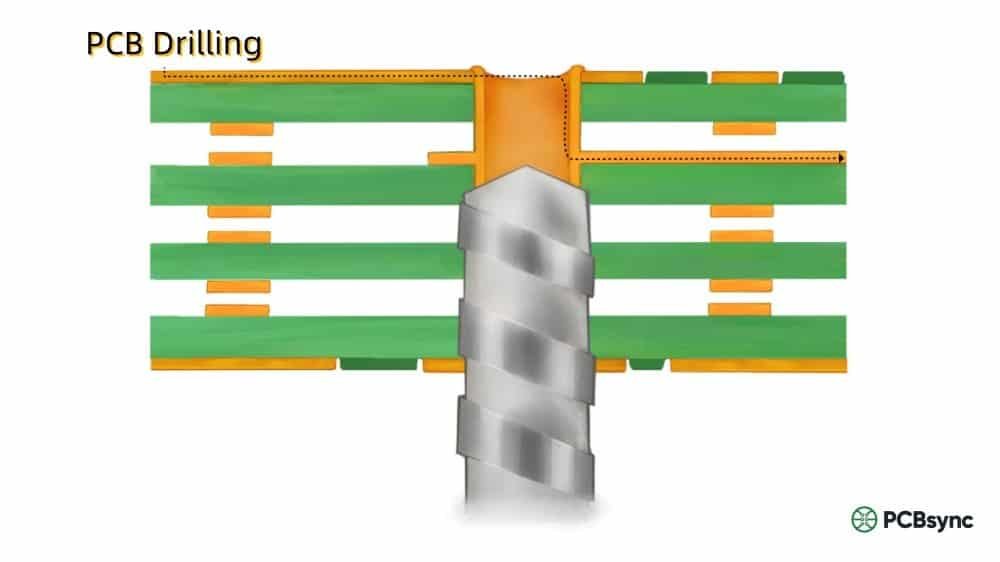
PCB back drilling, also known as controlled depth drilling (CDD), is a secondary manufacturing process used to remove unused portions of plated through-hole (PTH) vias. These unused sections—called via stubs—act like tiny antennas that reflect signals and cause serious integrity problems in high-speed designs.
Here’s what happens technically: when you drill a standard through-hole via in a 12-layer board but only need the connection from layer 1 to layer 4, you’re left with 8 layers of unused copper barrel. That unused section doesn’t just sit there harmlessly—it creates impedance discontinuities and resonates at specific frequencies, destroying your carefully designed signal path.
The back drilling process uses a slightly larger drill bit (typically 8-10 mils bigger than the original hole) to remove this stub from the opposite side of the board. The result is a via that only extends to where it’s actually needed, dramatically improving signal integrity.
Why Via Stubs Matter More Than You Think
Via stubs cause problems through several mechanisms that compound at higher frequencies:
Signal Reflection: When a high-speed signal hits the stub, part of the energy reflects back toward the source. Eric Bogatin’s well-known rule of thumb states that stub lengths in inches should be kept below 0.3/Gbps to avoid significant issues. For a 10 Gbps signal, that means stubs longer than 30 mils become problematic.
Resonance Effects: Stubs create quarter-wavelength resonances that appear as notches in your insertion loss plot. If one of these notches happens to land near your Nyquist frequency, you’re looking at high bit error rates or complete link failure.
Impedance Mismatch: The extra capacitance from via stubs disrupts your carefully controlled impedance, causing additional reflections and signal distortion.
Deterministic Jitter: In clocked systems, via stubs introduce timing errors that accumulate across channels. This deterministic jitter directly increases your bit error rate (BER), sometimes pushing a marginally compliant link into failure.
EMI Radiation: Via stubs act as unintended antennas, radiating energy that can cause electromagnetic interference issues. In products requiring EMC compliance, unaddressed stubs can lead to failed radiated emissions testing.
Crosstalk: Adjacent vias with long stubs couple energy between channels, creating aggressor-victim relationships that weren’t present in your simulation models (which likely assumed ideal via structures).
When Does Your Design Need PCB Back Drilling?
Not every board needs back drilling, and adding it unnecessarily just inflates your manufacturing costs. Here’s how I evaluate whether back drilling makes sense for a project:
Data Rate and Frequency Thresholds
Signal Speed
Back Drilling Recommendation
< 1 Gbps
Generally not required
1-3 Gbps
Consider for critical signals
3-10 Gbps
Strongly recommended
> 10 Gbps
Essential for signal integrity
> 25 Gbps
Required, with tight stub tolerances
Board Characteristics That Indicate Back Drilling
Based on my experience and industry data, PCB back drilling is typically applied to boards with these characteristics:
Layer count: 8 to 50 layers (thick multilayer constructions)
Board thickness: Above 2.5mm (where stub lengths become significant)
Signal types: High-speed differential pairs, SerDes interfaces, DDR4/DDR5 memory buses
The Stub Length Calculation You Need to Know
Here’s a practical formula I use during design reviews:
Maximum allowable stub length = (Signal wavelength in FR4) ÷ 10
For a 25 Gbps signal with a wavelength of approximately 24mm in FR4, you need to remove any stub longer than 2.4mm (about 95 mils). That’s a significant length that’s easily exceeded in thick boards.
Understanding the manufacturing process helps you design boards that are actually manufacturable. Here’s what happens at the fab house:
Step 1: Initial Via Creation and Plating
The board goes through standard drilling to create through-hole vias. These are then electroplated to make them conductive across all layers. At this point, you have full-length vias extending from top to bottom.
Step 2: Back Drill Setup and Alignment
The CNC drilling machine is programmed with the specific vias marked for back drilling. Alignment is critical—the machine needs to hit the exact center of each existing via. Most fabricators use X-ray verification systems to check registration.
Step 3: Controlled Depth Drilling
Using a drill bit slightly larger than the original hole (typically 0.15-0.25mm larger), the machine drills from the opposite side to a precisely controlled depth. Modern equipment achieves depth tolerances of ±0.05mm (±2 mils).
Step 4: Inspection and Cleaning
After drilling, the board undergoes inspection (often using X-ray or cross-sectioning of test coupons) to verify stub removal. The holes are cleaned to remove debris that could cause shorts.
Where Back Drilling Fits in the Manufacturing Flow
Process Step
Position
Lamination
Before
Initial drilling
Before
Plated through hole (PTH) process
Before
Back drilling
Here
Desmearing
After
Pattern plating
After
Outer layer processing
After
Final finishing
After
This sequencing matters because the holes need to be plated first (otherwise there’s nothing to remove), and back drilling must happen before desmearing to ensure clean holes.
PCB Back Drilling Design Parameters and Rules
Getting the design parameters right is where many engineers struggle. Here are the specifications I’ve validated across dozens of production boards:
Critical Dimensions Table
Parameter
Standard Spec
Advanced Spec
Notes
Back drill oversize
8-10 mils (0.2-0.25mm)
4-6 mils (0.1-0.15mm)
Larger than original via
Residual stub length
<10 mils (0.25mm)
<5 mils (0.13mm)
After drilling
Stub length tolerance
±3 mils (±0.075mm)
±2 mils (±0.05mm)
Manufacturing variation
Depth tolerance
±3 mils (±0.075mm)
±2 mils (±0.05mm)
CNC accuracy
Min. clearance to traces
10 mils (0.25mm)
8 mils (0.2mm)
Prevent accidental drilling
Min. dielectric to “don’t cut” layer
10 mils (0.25mm)
8 mils (0.2mm)
Safety margin
Drill Depth Calculation
The theoretical drilling depth follows this formula:
Drilling depth = (Distance from board surface to target layer) – (Safety margin) – (Drill bit length compensation)
For example, in a 1.6mm thick board where you need to back drill from the bottom to just above layer 5:
Measure the thickness from bottom surface to layer 5
Subtract 0.05mm compensation (safety margin)
This gives your controlled drilling depth
The key insight: reducing back drill depth by 1 mil (increasing residual stub by 1 mil) costs you approximately 0.25% signal loss. That adds up quickly at high frequencies.
Design Rules for Your CAD System
When setting up back drilling in your PCB design software (Altium, Cadence, or others), configure these settings:
Identify back drill candidates: Only high-speed vias and differential pairs above 3 Gbps
Set drill span: Specify start and stop layers clearly
Define oversize: Typically 8 mils over original via diameter
Specify stub length: Target 10 mils or less
Add clearance rules: 10 mil minimum from back drill edge to adjacent traces/planes
Signal Loss and Stub Length Relationship
Here’s real data showing how residual stub length impacts signal integrity at 6.25 Gbps (typical backplane construction):
Signal Loss vs. Stub Length Table
Residual Stub Length
Approximate Signal Loss
Impact Level
5 mils (0.13mm)
<1%
Minimal
10 mils (0.25mm)
~2.5%
Acceptable
20 mils (0.5mm)
~5%
Noticeable
40 mils (1.0mm)
~10%
Significant
60 mils (1.5mm)
~15%
Problematic
100 mils (2.5mm)
~20%+
Unacceptable
This data explains why the industry targets <10 mils residual stub—it keeps losses within acceptable bounds for most high-speed applications.
PCB Back Drilling vs. Alternative Solutions
Back drilling isn’t the only solution for via stub problems. Here’s how it compares to alternatives:
Comparison Table: Back Drilling vs. Other Via Technologies
Feature
Back Drilling
Blind Vias
Buried Vias
Microvias (Laser)
Stub elimination
Excellent (< 10 mils)
Complete
Complete
Complete
Cost impact
+10-20%
+30-50%
+40-60%
+50-100%
Layer count flexibility
High
Medium (aspect ratio limits)
Medium
Low (sequential build)
Manufacturing complexity
Low
Medium
High
High
Hole size options
Wide range
Limited
Limited
Very small only
Best for
Thick boards, backplanes
Thin HDI boards
Internal connections
Ultra-fine pitch
When to Choose Back Drilling
Thick multilayer boards (>8 layers) where blind vias aren’t practical
Cost-sensitive production where blind/buried via costs are prohibitive
Designs requiring larger via sizes (>8 mils)
Retrofit of existing designs that weren’t originally planned for high speeds
Backplanes and midplanes where back drilling is industry standard
When Alternatives Make More Sense
HDI designs with fine-pitch BGAs (microvias)
Thin boards where blind vias achieve the same result more economically
Designs already using sequential lamination for other reasons
Common PCB Back Drilling Problems and Solutions
After reviewing hundreds of back-drilled boards, I’ve seen the same issues repeatedly. Here’s how to avoid them:
Problem 1: Residual Stubs After Drilling
Cause: Incorrect depth settings, drill wear, or stackup variations
Solution:
Verify back drill depth calculations match actual stackup
Use fresh drill bits (worn bits deflect and under-drill)
Request X-ray inspection of first articles
Specify tighter tolerances for critical applications
Problem 2: Over-Drilling Into Signal Layers
Cause: Depth control imprecision, incorrect stackup data
Solution:
Include 0.1mm (4 mils) safety margin above the “don’t cut” layer
Back drill diameter: Let fabricator determine based on via size
Drill count: Include separate drill table for back drilled holes
Example Fab Note
BACK DRILLING REQUIREMENTS:- Drill from bottom side of board- Don’t cut layer 4 (preserve L4 pad/barrel interface) – Target stub length: 0.25mm (10 mils) maximum- Back drill tolerance: ±0.075mm (±3 mils)- See drill chart for back drill locations and counts
Important: Never specify a distance from the surface—let the fabricator calculate this based on actual stackup measurements. They know their material variations better than your theoretical calculations.
Industry Applications for PCB Back Drilling
PCB back drilling has become standard practice in several key industries where signal integrity directly impacts product performance:
Telecommunications and Networking
100G/400G Ethernet switches and routers require back drilling to meet IEEE compliance for insertion loss and return loss. Without proper stub removal, designs fail compliance testing even when the layout is otherwise correct.
Modern optical transceiver modules operating at 56 Gbps PAM4 signaling have near-zero margin for via stub effects. These designs typically specify residual stubs below 5 mils. The telecommunications industry has been an early adopter of advanced back drilling techniques because compliance testing catches stub problems immediately.
Data Centers and Cloud Infrastructure
High-performance servers handling massive data throughput use back-drilled PCBs for memory buses, processor interconnects, and network interfaces. The density requirements make back drilling more practical than blind/buried via alternatives.
Key applications include DDR5 memory interfaces running at 4800 MT/s and beyond, PCIe Gen5/Gen6 lanes at 32-64 GT/s, CXL interconnects requiring ultra-low latency, and high-speed backplanes connecting blade servers.
Aerospace and Defense
Mission-critical systems demand maximum signal reliability. Back drilling is specified in many military standards for high-frequency applications where failure isn’t an option.
Radar systems, electronic warfare equipment, and satellite communications all rely on PCB back drilling to achieve the required signal fidelity. These applications often specify the tightest tolerances (5 mil residual stubs with ±2 mil tolerance) and require extensive first-article inspection with cross-sectioning.
Medical Electronics
High-speed imaging systems and diagnostic equipment increasingly require multi-gigabit interfaces that benefit from proper via stub management. Medical ultrasound equipment, MRI data acquisition systems, and high-resolution endoscopy all use back-drilled PCBs.
Automotive Electronics
Advanced driver assistance systems (ADAS) require high-bandwidth sensor interfaces and in-vehicle networks. Automotive radar at 77 GHz and camera interfaces at multi-gigabit speeds have driven adoption of PCB back drilling in automotive electronics.
Real-World PCB Back Drilling Example
Let me walk you through a practical example that illustrates how back drilling decisions are made in actual production designs.
Scenario: 12-Layer Backplane Design
Consider a 12-layer backplane with the following characteristics:
Total thickness: 3.2mm (126 mils)
Signal layers: L1, L3, L5, L8, L10, L12
Ground/power layers: L2, L4, L6, L7, L9, L11
Data rate: 25 Gbps SerDes channels
Via drill size: 10 mils (0.25mm)
Analysis
A high-speed differential signal routes from layer 3 to layer 10 through a via. The standard through-hole via creates:
Top stub: L1 to L3 = approximately 12 mils
Bottom stub: L10 to L12 = approximately 12 mils
Using the 0.3/Gbps rule: maximum stub = 0.3/25 = 0.012 inches = 12 mils
Both stubs are right at the threshold, but combined with the via’s inherent impedance discontinuity, this design will likely fail compliance testing. Back drilling from both sides is recommended.
Implementation
Top back drill: Remove stub from L1 toward L3, leaving 8-mil residual
Bottom back drill: Remove stub from L12 toward L10, leaving 8-mil residual
Back drill diameter: 18 mils (original 10 mils + 8 mil oversize)
Fab notes: Specify “DON’T CUT L3” for top drill and “DON’T CUT L10” for bottom drill
Results
After back drilling, simulation shows insertion loss improved by 1.2 dB at 12.5 GHz (Nyquist frequency for 25 Gbps NRZ), bringing the channel within IEEE 802.3bj compliance margins.
Advanced Considerations for Complex Designs
Differential Pair Via Back Drilling
When back drilling differential pairs, maintain consistent stub length between P and N vias. Asymmetric stubs cause common-mode conversion that degrades signal quality beyond what insertion loss numbers show. Specify same-side drilling and identical depths for paired vias.
Back Drilling in Sequential Lamination Builds
Some complex HDI designs use sequential lamination with buried vias. In these constructions, back drilling can still be applied to through vias, but you need careful coordination with your fabricator to ensure the back drill doesn’t interfere with buried via structures. Always review cross-section drawings before finalizing design.
Thermal Considerations
Removing the via stub also removes some copper that contributes to thermal conductivity. For power delivery vias in high-current applications, evaluate whether the thermal impact of back drilling is acceptable. In most signal applications, this isn’t a concern, but it’s worth considering for power architecture.
Useful Resources and Tools
Design and Simulation Tools
Keysight ADS: Industry standard for high-speed signal integrity simulation, including stub modeling
Ansys HFSS: 3D electromagnetic simulation for via characterization
Cadence Sigrity: SI/PI analysis with back drilling support
Mentor HyperLynx: Signal integrity analysis with via stub modeling
Standards and Guidelines
IPC-2221: Generic standard on printed board design (includes via recommendations)
IPC-6012: Qualification and performance specification for rigid PCBs
IPC-2226: Sectional design standard for HDI and microvia structures
Online Calculators and Reference Data
Several free resources can help with back drilling calculations:
Saturn PCB Toolkit: Free Windows application with via impedance and stub length calculators
TXLINE (from Cadence): Transmission line calculator useful for estimating wavelength in PCB materials
Rogers Corporation Design Calculators: Helpful for high-frequency laminate applications
Manufacturer Resources
Most major PCB fabricators publish detailed back drilling design guides. Check design guidelines from:
Sierra Circuits (extensive application notes)
TTM Technologies
Sanmina
AT&S
Multek
Technical Papers and Further Reading
For deeper technical understanding, these resources provide excellent background:
Signal Integrity Journal articles on via optimization
DesignCon conference papers on high-speed interconnect design
IEEE 802.3 Ethernet working group documents (for compliance specifications)
Cost Considerations for PCB Back Drilling
Understanding cost drivers helps you make informed decisions:
Cost Impact Factors
Factor
Impact on Cost
Number of back-drilled vias
Higher count = higher cost
Number of drill depths
Each unique depth adds setup time
Stub length tolerance
Tighter tolerance = higher cost
Inspection requirements
X-ray verification adds cost
Board complexity
More layers = more precision needed
Typical Cost Increase
Back drilling typically adds 10-20% to board cost depending on via count and tolerance requirements. This is significantly less than the 30-60% premium for blind and buried via construction.
Cost Optimization Tips
Limit back drilling to truly high-speed nets (>3 Gbps)
Consolidate drill depths where possible (reduces setup time)
Consider routing critical signals on outer layers to avoid vias entirely
Work with your fabricator early to understand their capabilities and pricing breaks
Frequently Asked Questions About PCB Back Drilling
Q1: At what data rate should I start considering PCB back drilling?
The conservative guideline is to consider back drilling for signals above 1 Gbps and definitely implement it above 3 Gbps. However, the actual threshold depends on your specific stub length, which is determined by board thickness and layer stackup. Use the 0.3/Gbps rule of thumb: if your stub length in inches exceeds 0.3 divided by your data rate in Gbps, back drilling is recommended.
Q2: Can I back drill from both sides of the board?
Yes, double-sided back drilling is possible and sometimes necessary. If your signal connects two internal layers (for example, layer 4 to layer 9 in a 12-layer board), you may need to remove stubs from both top and bottom. This adds cost and complexity, so verify it’s actually needed through simulation.
Q3: What’s the minimum achievable stub length after back drilling?
A capable fabricator can achieve 5-7 mil (0.13-0.18mm) residual stub length under controlled conditions. The industry standard target is 10 mils (0.25mm) or less. It’s physically impossible to achieve zero stub length because you must preserve the barrel-to-pad interface on the last connected layer.
Q4: Do blind vias require back drilling?
No. Blind vias are drilled to a controlled depth and don’t extend through the entire board, so they don’t create stubs on the opposite side. That’s actually one advantage of blind vias—they inherently solve the stub problem that back drilling addresses.
Q5: How do I specify back drilling in my PCB design software?
Most modern PCB design tools (Altium, Cadence Allegro, Mentor PADS) support back drilling definition in the layer stackup manager. You create a back drill span that specifies which vias get back drilled and from which side. The software generates appropriate drill files and fabrication notes. Consult your tool’s documentation for specific procedures—the exact workflow varies by vendor.
Conclusion
PCB back drilling has evolved from a specialized technique to an essential process for anyone designing high-speed boards. As data rates continue climbing—10 Gbps is now routine, and 56 Gbps is increasingly common—proper via stub management isn’t optional anymore.
The key takeaways from this guide:
Back drilling removes unused via stubs that cause signal reflections and resonance
Target residual stub length of 10 mils or less for most applications
Use the 0.3/Gbps rule to determine if back drilling is needed
Communicate requirements clearly to your fabricator with proper fab notes
Consider cost vs. performance tradeoffs against alternative via technologies
If you’re working on designs above 3 Gbps and experiencing unexplained signal integrity issues, via stubs should be near the top of your investigation list. Proper back drilling specification and execution can be the difference between a board that passes compliance testing and one that requires expensive respins.
Inquire: Call 0086-755-23203480, or reach out via the form below/your sales contact to discuss our design, manufacturing, and assembly capabilities.
Quote: Email your PCB files to Sales@pcbsync.com (Preferred for large files) or submit online. We will contact you promptly. Please ensure your email is correct.
Notes: For PCB fabrication, we require PCB design file in Gerber RS-274X format (most preferred), *.PCB/DDB (Protel, inform your program version) format or *.BRD (Eagle) format. For PCB assembly, we require PCB design file in above mentioned format, drilling file and BOM. Click to download BOM template To avoid file missing, please include all files into one folder and compress it into .zip or .rar format.