Inquire: Call 0086-755-23203480, or reach out via the form below/your sales contact to discuss our design, manufacturing, and assembly capabilities.
Quote: Email your PCB files to Sales@pcbsync.com (Preferred for large files) or submit online. We will contact you promptly. Please ensure your email is correct.
Notes: For PCB fabrication, we require PCB design file in Gerber RS-274X format (most preferred), *.PCB/DDB (Protel, inform your program version) format or *.BRD (Eagle) format. For PCB assembly, we require PCB design file in above mentioned format, drilling file and BOM. Click to download BOM template To avoid file missing, please include all files into one folder and compress it into .zip or .rar format.
If you’ve spent any time at a soldering station, you know that flux isn’t optional—it’s essential. But walk into any electronics supply shop or browse online, and you’re hit with a wall of options: rosin flux, no-clean flux, water-soluble flux, organic acid flux… the list goes on.
After 12 years of designing and assembling PCBs across consumer electronics, industrial controls, and aerospace applications, I’ve learned that choosing the right flux isn’t just about picking whatever’s on the shelf. The wrong choice can mean the difference between a product that lasts decades and one that fails within months.
I remember a project back in 2018 where we switched from water-soluble to no-clean flux to save on cleaning costs. Six months later, we had a 3% field return rate from units used in high-humidity environments. The “no-clean” residue was absorbing moisture and causing intermittent shorts. Lesson learned: flux selection requires understanding your entire product lifecycle, not just the assembly process.
This guide breaks down everything you need to know about no-clean flux versus clean flux types—when to use each, whether “no-clean” actually means you don’t need to clean, and how to properly remove flux residues when cleaning is required. Whether you’re a hobbyist building your first PCB or a manufacturing engineer optimizing a production line, the principles covered here will help you make better decisions.
Before we dive into the no-clean vs. clean flux debate, let’s establish what flux actually does during soldering.
Flux is a chemical cleaning agent applied during the soldering process that serves three critical functions:
Removes oxidation from metal surfaces (copper pads, component leads)
Prevents re-oxidation during heating by forming a protective barrier
Reduces surface tension of molten solder to improve wetting and flow
Without flux, solder won’t properly wet the copper surfaces. You’ll end up with cold joints, poor adhesion, and unreliable connections. Every experienced engineer has seen the results of inadequate flux activity—those dull, grainy solder joints that fail under thermal cycling.
The Chemistry Behind Flux Action
When you heat flux during soldering, the activators in the flux formulation react with metal oxides on the copper surface. This chemical reaction converts the oxide layer into metal salts that either float to the surface of the molten solder or dissolve into the flux residue.
The base material in the flux (rosin, resin, or organic compounds) then creates a protective blanket over the cleaned metal surface, preventing new oxide formation during the brief window when solder needs to wet and flow.
The challenge comes after soldering. All flux leaves behind some residue—the spent activators, base materials, and reaction byproducts. What you do about that residue—and which flux you choose in the first place—depends heavily on your application requirements and operating environment.
Understanding Flux Classification: The IPC J-STD-004 System
The electronics industry uses IPC J-STD-004 to classify flux types. Understanding this system helps you decode product datasheets and make informed decisions.
Flux Classification Breakdown
Code Element
Meaning
Options
First 2 letters
Flux composition
RO (Rosin), RE (Resin), OR (Organic), IN (Inorganic)
Most no-clean flux products fall into the ROL0, ROL1, or ORL0 categories. Clean flux types—those requiring post-solder cleaning—are typically ROM1, REH1, or ORH classifications.
No-Clean Flux: The Low-Residue Solution
What Makes Flux “No-Clean”?
No-clean flux is formulated to leave minimal, benign residue after soldering. The idea is simple: if the residue is non-conductive, non-corrosive, and cosmetically acceptable, why spend time and money cleaning it off?
The key characteristics of no-clean flux include:
Low solids content: Typically 1-5% versus 15-35% for traditional rosin flux
Mild organic activators: Less aggressive than water-soluble formulations
Designed for thermal activation: Activators oxidize into inert residues during proper reflow profiles
No-Clean Flux Composition
Component
Purpose
Typical Content
Solvent carrier
Delivers flux to joint, evaporates during preheat
80-95%
Rosin/resin base
Provides protective barrier during soldering
2-8%
Organic activators
Remove oxides from surfaces
0.5-3%
Rheology modifiers
Control viscosity and flow
0.1-1%
Advantages of No-Clean Flux
Production efficiency is the primary driver for no-clean adoption:
Eliminates cleaning equipment investment and maintenance
Reduces cycle time by removing post-solder washing steps
Lower operating costs (no cleaning chemicals, water treatment, drying)
Simplified process flow in high-volume manufacturing
Reduced floor space requirements (no cleaning stations needed)
Lower environmental compliance burden (no wastewater treatment)
According to industry estimates, eliminating the cleaning step can reduce assembly costs by 10-25% depending on production volume and existing infrastructure.
Material compatibility is another significant benefit:
Safe for components that can’t withstand water exposure
No risk of trapped moisture under low-standoff components
Compatible with most conformal coatings (when residues are minimal)
Reduced thermal stress on components (no additional heating for drying)
Suitable for assemblies with unsealed components like certain electrolytic capacitors
Limitations of No-Clean Flux
It’s not all upside. No-clean flux comes with trade-offs:
Lower activity levels mean reduced wetting on oxidized surfaces
Narrower process window requires tighter control of thermal profiles
Residue visibility can create cosmetic concerns for some applications
Harder to clean when cleaning IS required (ironically)
Potential reliability concerns in extreme environments
When No-Clean Flux Works Well
No-clean flux is appropriate for:
Consumer electronics (IPC Class 1-2)
Standard operating environments (controlled temperature/humidity)
Surface mount assemblies with adequate component spacing
Applications where post-solder cleaning isn’t practical
High-volume production where efficiency matters
Clean Flux Types: When Aggressive Chemistry Is Needed
Water-Soluble Flux
Water-soluble flux (also called organic acid flux) uses stronger activators to achieve superior wetting performance. The trade-off? These residues are corrosive and must be completely removed after soldering.
Characteristic
Water-Soluble Flux
No-Clean Flux
Activity level
High (ORH, INH)
Low (ROL, ORL)
Solids content
11-35%
1-5%
Residue corrosivity
Highly corrosive
Non-corrosive
Cleaning requirement
Mandatory
Usually optional
Wetting performance
Excellent
Good
Process window
Wide
Narrower
Rosin Flux (Traditional)
Rosin-based flux has been the industry standard for decades. Derived from pine tree resin, it provides excellent soldering performance with residues that are less aggressive than water-soluble types.
Rosin flux categories:
R (Rosin): Mildest, non-activated
RMA (Rosin Mildly Activated): Contains mild activators, most common
RA (Rosin Activated): Higher activity, more aggressive residues
While rosin flux residues aren’t as dangerous as water-soluble types, they can still cause issues if left on high-reliability boards—especially in humid environments or under conformal coating.
When Clean Flux Is the Better Choice
Choose water-soluble or rosin flux (with cleaning) for:
Aerospace, military, medical devices: Where reliability is non-negotiable
High-density assemblies: Fine-pitch components where residue entrapment is likely
Boards requiring conformal coating: Most coatings won’t adhere properly over flux residues
Heavily oxidized surfaces: When stronger activation is needed for proper wetting
Through-hole assemblies: Wave soldering typically leaves more residue
The Truth About “No-Clean” Flux: Does It Actually Need Cleaning?
Here’s where things get controversial. Despite the name, no-clean flux often requires cleaning—and many engineers learn this the hard way.
Why “No-Clean” Can Be Misleading
The “no-clean” designation means the flux was designed to leave benign residues under ideal conditions. Those conditions include:
Proper thermal profile: Activators must reach full activation temperature
Machine soldering: Controlled preheat and reflow processes
Adequate component spacing: Residues can flow and fully encapsulate
Standard operating environment: Moderate temperature and humidity
When any of these conditions aren’t met, problems arise.
Scenarios Where No-Clean Flux MUST Be Cleaned
Scenario
Why Cleaning Is Required
Hand soldering and rework
Inconsistent heating prevents full activator encapsulation
Temperature extremes or humidity can reactivate residues
In-circuit testing (ICT)
Tacky residues interfere with test probe contact
High-frequency circuits
Even small residue amounts can affect signal integrity
The Hand Soldering Problem
This is where most hobbyists and rework technicians get burned. No-clean flux is designed for machine soldering where:
The entire board goes through controlled preheat (120-150°C)
Reflow temperatures are precisely controlled (230-250°C for lead-free)
Cooling rates follow manufacturer specifications
During hand soldering, you’re heating a localized area. The flux activators may not fully oxidize into their inert state. What’s left behind can be conductive, hygroscopic (moisture-absorbing), and problematic.
My rule of thumb: If you’re hand soldering with no-clean flux, clean it anyway. The 30 seconds you spend with IPA is cheap insurance against future failures.
How to Clean No-Clean Flux: Step-by-Step Methods
When cleaning is required, here’s how to do it right. The method you choose depends on your production volume, flux type, and cleanliness requirements.
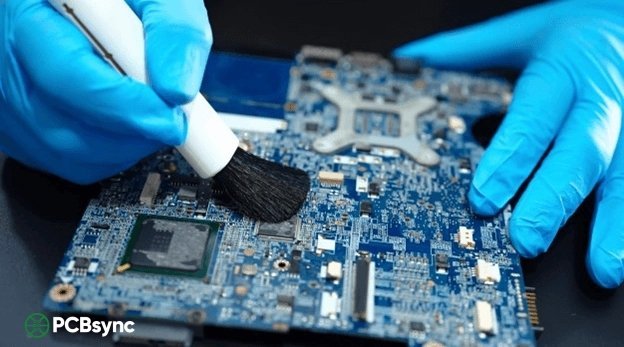
Method 1: Isopropyl Alcohol (IPA) Cleaning
Best for: Rosin flux, no-clean flux, hand soldering rework, low-volume production
Materials needed:
Isopropyl alcohol (90% or higher—99% preferred)
Soft-bristle brush (ESD-safe recommended)
Lint-free wipes or Kimwipes
Compressed air or warm air blower
Safety glasses and nitrile gloves
Procedure:
Apply IPA liberally to the flux residue area
Let it sit for 10-15 seconds to dissolve the flux
Gently scrub with the brush in circular motions
Wipe with lint-free cloth to remove dissolved flux
Repeat if residue remains
Final rinse with fresh IPA
Dry thoroughly with compressed air
Pro tip: Work quickly. IPA evaporates fast, and partially dissolved flux that dries back down is even harder to remove. Keep the board wet with solvent until you’re ready for the final wipe-down.
Cost consideration: At roughly $15-20 per gallon for 99% IPA, this is the most economical approach for low-volume cleaning. A gallon can clean hundreds of small boards.
Method 2: Commercial Flux Remover
Best for: Stubborn no-clean residues, professional applications, lead-free assemblies
Commercial flux removers (MG Chemicals, Chemtronics Flux-Off, Techspray, MicroCare VeriClean) are formulated specifically for flux removal. They’re more expensive than IPA but often more effective, especially for lead-free no-clean residues that can be surprisingly tenacious.
Why commercial cleaners work better:
Higher solvency (measured in Kb value)—typically 80-100 versus IPA’s ~50
Formulated to attack specific flux chemistries
Often include surfactants for better penetration under components
Many are nonflammable for safer workplace use
Application tips:
Spray liberally, keeping the area wet
Use the included brush attachment if available
Work in sections on larger boards
Always finish with a rinse pass using fresh solvent
Ensure complete drying before power-on
Method 3: Water Wash (For Water-Soluble Flux Only)
Best for: Water-soluble/OA flux residues, high-volume production
Procedure:
Rinse with hot deionized water (50-65°C)
Add saponifier if needed (reacts with acid residue to form soap)
Agitate or scrub to remove residue
Rinse thoroughly with fresh DI water—at least 3 rinse cycles
Dry completely—trapped moisture causes more problems than the original flux
Equipment options:
Equipment Type
Volume
Cost Range
Pros/Cons
Manual spray bottle
Prototype
$20-50
Simple, but labor intensive
Batch washer
Low-medium
$5K-25K
Consistent results, moderate throughput
Inline washer
High
$50K-200K
Maximum throughput, minimum labor
Critical warning: Never use water to clean rosin or no-clean flux. It won’t dissolve the residue and can spread contamination or trap moisture under components where it causes corrosion.
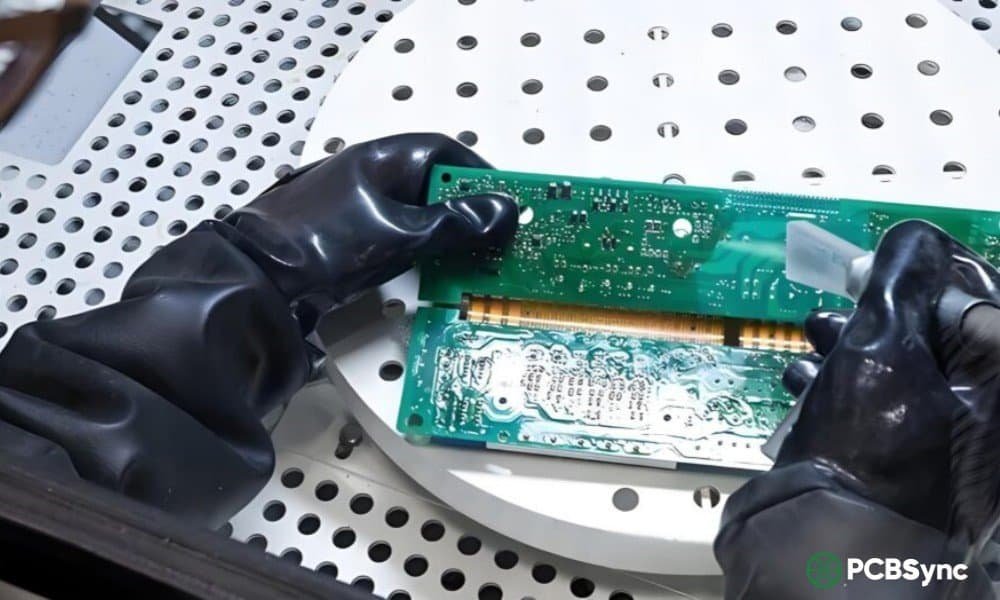
Method 4: Ultrasonic Cleaning
Best for: High-volume production, complex assemblies, thorough cleaning
Ultrasonic cleaners use high-frequency sound waves to create cavitation—microscopic bubbles that implode and blast away contaminants. This reaches areas manual cleaning can’t.
Parameter
Recommendation
Frequency
40 kHz typical
Temperature
40-60°C
Solution
IPA or commercial flux remover
Duration
3-10 minutes
Caution: Some components (crystal oscillators, certain MEMs devices) can be damaged by ultrasonic energy. Check component datasheets before proceeding.
Verifying Cleaning Effectiveness: Testing Methods
For high-reliability applications, visual inspection isn’t enough. Here are the standard methods for verifying cleanliness.
Visual Inspection
The first line of defense. Under bright light (preferably with magnification), inspect for:
Visible residue or discoloration around solder joints
Tackiness or stickiness on board surface
White residue (indicates incomplete activation or improper cleaning)
ROSE testing measures ionic contamination by washing the board with a solvent-water mixture and measuring the resistivity of the resulting solution.
Cleanliness Level
Ionic Contamination (µg NaCl eq/cm²)
Excellent
< 1.0
Good
1.0 – 1.5
Acceptable
1.5 – 3.0
Marginal
3.0 – 10.0
Unacceptable
> 10.0
IPC-TM-650 Method 2.3.25 provides the standard procedure for ROSE testing.
SIR Testing (Surface Insulation Resistance)
SIR testing is the gold standard for high-reliability applications. It measures the resistance between test patterns under controlled temperature and humidity conditions over time.
Pass criteria per J-STD-004: SIR must remain above 100 megohms after 168 hours at 40°C/90% RH with 10V bias.
Troubleshooting Common Flux Problems
White Residue After Soldering
Cause: Incomplete thermal activation of flux activators, or flux not matched to thermal profile.
Solution:
Verify your thermal profile against flux manufacturer specs
Increase preheat time/temperature for better activation
If residue is already present, clean with IPA or commercial flux remover
Consider switching to a flux designed for your specific thermal profile
Sticky/Tacky Residue
Cause: No-clean flux not fully activated, or wrong flux type for application.
Solution:
Clean with IPA or commercial cleaner
Review thermal profile—tacky residue usually means insufficient heat
For hand soldering, always clean regardless of flux type
Solder Balls in Residue
Cause: Solder paste slump, excessive flux, or reflow profile issues.
Solution:
Clean thoroughly with agitation to dislodge trapped solder balls
Review stencil thickness and aperture design
Optimize reflow profile to reduce solder ball formation
Corrosion or Oxidation After Storage
Cause: Flux residue absorbing moisture, inadequate cleaning of water-soluble flux.
Solution:
For existing corrosion, assess damage severity (may be irreparable)
Store cleaned boards in controlled humidity environment
Consider conformal coating for field protection
No-Clean Flux vs Clean Flux: Quick Comparison Table
Factor
No-Clean Flux
Water-Soluble Flux
Rosin Flux
Activity level
Low
High
Low-Moderate
Wetting performance
Good
Excellent
Very Good
Residue corrosivity
Non-corrosive
Highly corrosive
Mildly corrosive
Cleaning required
Sometimes
Always
Recommended
Process cost
Lower
Higher
Moderate
Reliability risk
Low-Moderate
Low (if cleaned)
Low (if cleaned)
Environmental impact
Lower
Higher (water treatment needed)
Moderate
Best for
Consumer, commercial
High-reliability, THT
General purpose
How to Choose the Right Flux for Your Application
Decision Framework
Ask yourself these questions:
1. What’s the reliability requirement?
Consumer electronics → No-clean acceptable
Medical, aerospace, military → Use water-soluble with rigorous cleaning
2. Will the board be conformally coated?
Yes → Clean before coating (even no-clean residue)
No → No-clean may be left in place
3. What’s the assembly method?
Automated SMT reflow → No-clean works well
Wave soldering → Water-soluble often preferred
Hand soldering/rework → Clean regardless of flux type
4. What’s the component density?
Standard pitch → No-clean acceptable
Fine-pitch (<0.5mm) → Consider cleaning even no-clean
5. What’s the operating environment?
Climate controlled → No-clean acceptable
Outdoor/harsh environment → Clean flux preferred
Application-Specific Recommendations
Application
Recommended Flux
Cleaning
Hobby/prototyping
No-clean (ROL0/ROL1)
Optional but recommended
Consumer electronics
No-clean
Not required
Industrial controls
No-clean or water-soluble
Application dependent
Automotive electronics
Water-soluble
Required
Medical devices
Water-soluble
Required + verification
Aerospace/military
Water-soluble
Required + SIR testing
Common Mistakes to Avoid
Mistake 1: Never Cleaning Water-Soluble Flux
This is the cardinal sin of flux management. Water-soluble flux residue is actively corrosive. Left on a board, it will continue reacting with moisture in the air, eventually causing:
Copper corrosion and pad lifting
Dendrite growth between traces
Electrochemical migration and shorts
Complete board failure
If you use water-soluble flux, you MUST clean it. No exceptions.
Mistake 2: Assuming All No-Clean Flux Is Safe to Leave
As discussed above, no-clean flux can cause problems in many scenarios. When in doubt, clean it.
Mistake 3: Using the Wrong Cleaning Agent
Flux Type
Correct Cleaner
Wrong Cleaner
Rosin
IPA, commercial flux remover
Water
No-clean
IPA, commercial flux remover
Water
Water-soluble
DI water + saponifier
IPA (won’t work)
Mistake 4: Incomplete Drying
Moisture trapped under components after cleaning is arguably worse than the original flux residue. Always ensure boards are completely dry before power-on or coating.
Mistake 5: Using Acetone on PCBs
Acetone is a powerful solvent—too powerful. It can:
1. Can I use rubbing alcohol instead of isopropyl alcohol for flux cleaning?
Rubbing alcohol (typically 70% IPA) contains water and other additives that can leave residues and don’t evaporate cleanly. Always use 90% or higher purity IPA, with 99% being ideal for electronics cleaning. The water content in 70% IPA can actually spread contamination rather than removing it.
2. How do I know if my PCB is clean enough after flux removal?
For critical applications, use ionic contamination testing (ROSE test) or Surface Insulation Resistance (SIR) testing per IPC-TM-650. For general use, visual inspection under good lighting should show no visible residue, tackiness, or discoloration. The board surface should feel smooth and dry, not sticky.
3. Is no-clean flux compatible with conformal coating?
It depends. Most conformal coating manufacturers recommend cleaning all flux residues before coating, including no-clean. The residue can prevent proper adhesion and create voids where moisture collects. If you must coat over no-clean residue, verify compatibility with both the flux and coating manufacturers, and perform adhesion testing.
4. Why does my no-clean flux leave white residue after soldering?
White residue typically indicates incomplete thermal activation of the flux activators. This happens when the soldering temperature was too low, heating time was too short, or the flux wasn’t designed for your thermal profile. White residue can be conductive and should be cleaned. Check your soldering parameters against the flux manufacturer’s recommended profile.
5. Can I mix different flux types on the same board?
This is generally not recommended. Different flux chemistries can interact unpredictably, and mixing cleaning requirements complicates post-solder processing. If you must rework a board assembled with water-soluble flux, use a compatible water-soluble flux for touchup, not no-clean. Consistency in flux chemistry simplifies reliability assessment.
Conclusion
Choosing between no-clean flux and clean flux isn’t just about picking the easiest option—it’s about matching your flux chemistry to your application requirements, assembly process, and reliability expectations.
No-clean flux offers significant production advantages for consumer and commercial electronics where cleaning infrastructure isn’t practical. But understand its limitations: it’s designed for machine soldering with proper thermal profiles, and “no-clean” doesn’t mean “never clean” for all applications.
Clean flux types—whether water-soluble or traditional rosin—provide superior wetting performance and are essential for high-reliability applications where you can’t risk any residue-related failures.
The bottom line? Know your application requirements, understand your assembly process, and when in doubt, clean it anyway. The few minutes spent on proper flux removal is trivial compared to the cost of field failures.
Inquire: Call 0086-755-23203480, or reach out via the form below/your sales contact to discuss our design, manufacturing, and assembly capabilities.
Quote: Email your PCB files to Sales@pcbsync.com (Preferred for large files) or submit online. We will contact you promptly. Please ensure your email is correct.
Notes: For PCB fabrication, we require PCB design file in Gerber RS-274X format (most preferred), *.PCB/DDB (Protel, inform your program version) format or *.BRD (Eagle) format. For PCB assembly, we require PCB design file in above mentioned format, drilling file and BOM. Click to download BOM template To avoid file missing, please include all files into one folder and compress it into .zip or .rar format.