Inquire: Call 0086-755-23203480, or reach out via the form below/your sales contact to discuss our design, manufacturing, and assembly capabilities.
Quote: Email your PCB files to Sales@pcbsync.com (Preferred for large files) or submit online. We will contact you promptly. Please ensure your email is correct.
Notes: For PCB fabrication, we require PCB design file in Gerber RS-274X format (most preferred), *.PCB/DDB (Protel, inform your program version) format or *.BRD (Eagle) format. For PCB assembly, we require PCB design file in above mentioned format, drilling file and BOM. Click to download BOM template To avoid file missing, please include all files into one folder and compress it into .zip or .rar format.
MPU9250 Arduino: Complete 9-Axis Motion Sensor Guide for Your Projects
If you’ve been working on drones, robotics, or any motion-tracking project, you’ve probably come across the MPU9250. This little chip has saved me countless hours on PCB designs where I needed reliable orientation data without cluttering my board with multiple sensors. In this guide, I’ll walk you through everything you need to know about interfacing the MPU9250 Arduino setup, from basic wiring to advanced sensor fusion techniques.
The MPU9250 is a System-in-Package (SiP) that combines two dies into a single QFN package. One die houses the MPU-6500 (3-axis gyroscope and 3-axis accelerometer), while the other contains the AK8963 (3-axis magnetometer). This integration gives you a full 9-DOF (Degrees of Freedom) IMU in a package smaller than your fingernail.
What makes the MPU9250 stand out from individual sensors is its Digital Motion Processor (DMP). This onboard processor handles complex motion processing calculations, freeing up your Arduino for other tasks. Having worked with separate accelerometer and gyroscope chips on custom PCBs, I can tell you that the noise reduction and synchronization benefits of an integrated solution like this are significant.
MPU9250 Key Technical Specifications
Parameter
Specification
Gyroscope Range
±250, ±500, ±1000, ±2000 °/sec
Accelerometer Range
±2g, ±4g, ±8g, ±16g
Magnetometer Range
±4800 µT
ADC Resolution
16-bit for all axes
Communication
I2C (up to 400 kHz), SPI (up to 20 MHz)
Operating Voltage
2.4V to 3.6V
Current Consumption
3.5mA typical (all sensors active)
Operating Temperature
-40°C to +85°C
Understanding 9-DOF Motion Sensing
Each sensor in the MPU9250 serves a specific purpose in motion tracking:
Accelerometer measures linear acceleration along three axes. When stationary, it reads the gravitational force (about 9.8 m/s² on the Z-axis when flat). This allows you to calculate pitch and roll angles.
Gyroscope measures angular velocity in degrees per second. It tells you how fast the sensor is rotating around each axis. Gyroscopes are excellent for detecting rapid movements but suffer from drift over time.
Magnetometer acts as a digital compass, detecting the Earth’s magnetic field. This provides heading information (yaw angle) that the accelerometer and gyroscope cannot determine on their own.
MPU9250 Module Pinout and Hardware Overview
Most MPU9250 breakout boards you’ll find online include voltage regulators and level shifters, making them compatible with 5V Arduino boards. Here’s the typical pinout:
Pin
Function
Description
VCC
Power
3.3V or 5V (check your module)
GND
Ground
Connect to Arduino GND
SDA
I2C Data
Serial data line
SCL
I2C Clock
Serial clock line
AD0
Address Select
LOW = 0x68, HIGH = 0x69
INT
Interrupt
Data ready interrupt output
NCS
SPI Chip Select
For SPI mode only
FSYNC
Frame Sync
External frame synchronization
The AD0 pin is particularly useful when you need multiple MPU9250 sensors on the same I2C bus. By pulling one high and leaving the other low, you can address two sensors individually.
Wiring the MPU9250 to Arduino
For most projects, I2C is the way to go. It only requires two data lines and works reliably at 400 kHz. Here’s the connection diagram for Arduino Uno:
MPU9250 Arduino Uno Wiring Table
MPU9250 Pin
Arduino Uno Pin
VCC
5V (or 3.3V)
GND
GND
SDA
A4
SCL
A5
AD0
GND (optional)
INT
D2 (optional)
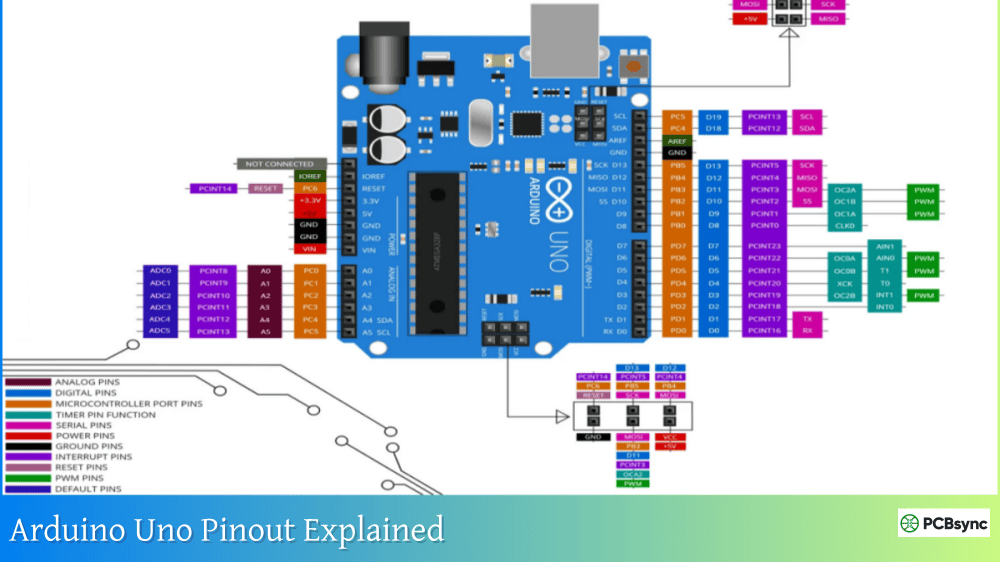
For other Arduino boards, the I2C pins differ:
Arduino Board
SDA Pin
SCL Pin
Uno, Nano, Pro Mini
A4
A5
Mega 2560
20
21
Leonardo
2
3
Due
20
21
Important hardware notes from experience: Always double-check your module’s voltage compatibility. Some cheap modules lack proper voltage regulation and can be damaged by 5V. When in doubt, use a logic level converter. Also, if you’re running long I2C cables (more than 20cm), consider adding external 4.7kΩ pull-up resistors on SDA and SCL lines.
Installing MPU9250 Arduino Libraries
Several excellent libraries exist for the MPU9250. Here are the most reliable options I’ve used:
Option 1: Bolder Flight Systems MPU9250 Library
This is my go-to library for production projects. It’s well-maintained, efficient, and supports both I2C and SPI communication.
Installation steps:
Open Arduino IDE
Go to Sketch → Include Library → Manage Libraries
Search for “MPU9250” by Bolder Flight Systems
Click Install
Option 2: Kriswiner’s MPU9250 Library
Kriswiner’s library includes advanced features like AHRS sensor fusion with Madgwick and Mahony filters. It’s ideal for projects requiring accurate orientation estimation.
Installation:
Download from GitHub: github.com/kriswiner/MPU9250
Extract to your Arduino libraries folder
Restart Arduino IDE
Option 3: SparkFun MPU9250 Library
SparkFun’s library offers good documentation and example sketches, making it beginner-friendly.
Basic MPU9250 Arduino Code Example
Let’s start with a simple sketch that reads all sensor data:
#include “MPU9250.h”
MPU9250 IMU(Wire, 0x68);
int status;
void setup() {
Serial.begin(115200);
while (!Serial) {}
status = IMU.begin();
if (status < 0) {
Serial.println(“IMU initialization failed!”);
Serial.print(“Status: “);
Serial.println(status);
while (1) {}
}
}
void loop() {
IMU.readSensor();
Serial.print(“AccX: “);
Serial.print(IMU.getAccelX_mss(), 2);
Serial.print(” AccY: “);
Serial.print(IMU.getAccelY_mss(), 2);
Serial.print(” AccZ: “);
Serial.print(IMU.getAccelZ_mss(), 2);
Serial.print(” GyroX: “);
Serial.print(IMU.getGyroX_rads(), 2);
Serial.print(” GyroY: “);
Serial.print(IMU.getGyroY_rads(), 2);
Serial.print(” GyroZ: “);
Serial.print(IMU.getGyroZ_rads(), 2);
Serial.print(” MagX: “);
Serial.print(IMU.getMagX_uT(), 2);
Serial.print(” MagY: “);
Serial.print(IMU.getMagY_uT(), 2);
Serial.print(” MagZ: “);
Serial.println(IMU.getMagZ_uT(), 2);
delay(100);
}
Upload this sketch and open the Serial Monitor at 115200 baud. You should see sensor readings updating in real-time. If the sensor is lying flat and stationary, the accelerometer Z-axis should read approximately 9.8 m/s² (1g).
MPU9250 Sensor Calibration Guide
Raw sensor data is rarely accurate out of the box. Each MPU9250 has manufacturing variations that require calibration. Here’s how to calibrate each sensor:
Accelerometer and Gyroscope Calibration
For the accelerometer and gyroscope, you need to determine the offset (bias) values:
Magnetometer calibration is more involved because you need to account for both hard iron and soft iron effects:
Hard iron effects come from permanent magnets or magnetized materials near the sensor. They create a constant offset in readings.
Soft iron effects come from materials that distort the magnetic field, causing the sensor readings to form an ellipsoid instead of a sphere.
To calibrate:
Rotate the sensor slowly through all orientations (figure-8 pattern works well)
Record the minimum and maximum values for each axis
Calculate offsets: offset = (max + min) / 2
Calculate scale factors: scale = (max – min) / 2
This calibration is crucial for accurate heading calculations. I’ve seen projects fail spectacularly because engineers skipped magnetometer calibration and wondered why their compass heading was 30 degrees off.
Sensor Fusion with AHRS Algorithms
Raw sensor data from accelerometers and gyroscopes each have limitations. Accelerometers are noisy and affected by motion accelerations, while gyroscopes drift over time. Sensor fusion combines data from all sensors to produce stable, accurate orientation estimates.
Complementary Filter
The simplest fusion approach combines gyroscope integration with accelerometer angles:
For production applications, the Madgwick filter provides excellent results with minimal computational overhead. It uses all nine axes to estimate orientation as a quaternion, which avoids gimbal lock issues.
Kriswiner’s library includes both Madgwick and Mahony filter implementations. The Madgwick filter achieves update rates over 1000 Hz on an 8 MHz Arduino Pro Mini, which is impressive for a platform with no floating-point hardware.
MPU9250 Arduino Project Applications
The MPU9250’s combination of sensors makes it suitable for numerous applications:
Drone Flight Controllers
The MPU9250 provides the orientation feedback necessary for stable flight. Combined with a barometer for altitude hold, it forms the core of many DIY flight controllers. The magnetometer enables heading hold and return-to-home features.
Self-Balancing Robots
Two-wheeled balancing robots use the accelerometer and gyroscope to maintain balance. The fast response time of the MPU9250 (up to 8 kHz sample rate) provides the tight control loop timing these applications need.
Virtual Reality and Motion Capture
Head tracking for VR headsets and motion capture gloves benefit from the MPU9250’s low latency and full orientation sensing. The DMP can offload quaternion calculations, reducing system latency.
Vehicle Navigation and Tracking
Combined with GPS, the MPU9250 enables dead reckoning during GPS signal loss (tunnels, parking garages). The magnetometer provides compass heading when GPS heading is unavailable at low speeds.
Gesture Recognition
Wearable devices can recognize hand gestures and movements using pattern recognition on MPU9250 data. The low power consumption (as low as 8.4µA in low-power mode) enables battery-powered operation.
Troubleshooting Common MPU9250 Arduino Issues
After years of working with these sensors, here are the most common problems and their solutions:
“WHO_AM_I” Returns Wrong Value
The MPU9250 should return 0x71 when you read register 0x75. If you get 0x70, you likely have an MPU6500 (no magnetometer). If you get 0x73, you have an MPU9255.
Magnetometer Not Responding
The AK8963 magnetometer has its own I2C address (0x0C) and requires enabling bypass mode in the MPU9250. Some libraries handle this automatically, but if you’re writing low-level code, you need to:
Write 0x00 to USER_CTRL (0x6A) to disable I2C master
Write 0x02 to INT_PIN_CFG (0x37) to enable bypass mode
I2C Communication Failures
Common causes include:
Missing or incorrect pull-up resistors
Voltage level mismatch
Long wire runs causing signal degradation
I2C address conflicts
Run an I2C scanner sketch to verify the sensor is detected at 0x68 (or 0x69 if AD0 is high).
Noisy or Drifting Readings
If your readings are excessively noisy:
Enable the internal digital low-pass filter
Ensure stable power supply (decoupling capacitors help)
Keep the sensor away from motors and high-current traces
For gyroscope drift, implement proper bias calibration at startup when the sensor is stationary.
What is the difference between MPU9250 and MPU6050?
The MPU6050 is a 6-axis sensor with only accelerometer and gyroscope. The MPU9250 adds a 3-axis magnetometer (AK8963), enabling compass functionality and more accurate yaw estimation. The MPU9250 also has improved gyro noise performance (3x better than competitors) and lower power consumption.
Can I use MPU9250 with 5V Arduino boards?
Most MPU9250 breakout modules include onboard voltage regulators and can accept 5V input. However, the I2C lines may need level shifting on some modules. Always check your specific module’s specifications. If using the bare chip, it requires 2.4V-3.6V and level shifters for 5V logic.
How do I get accurate heading from the MPU9250 magnetometer?
Accurate heading requires proper magnetometer calibration for hard and soft iron effects, setting the correct magnetic declination for your location, sensor fusion with gyroscope data to filter out noise, and mounting the sensor away from motors, speakers, and ferromagnetic materials.
Why does my MPU9250 show address 0x68 but libraries can’t connect?
This usually indicates the sensor responds to address probes but fails during data transfer. Check for stable power supply voltage, proper pull-up resistor values (typically 4.7kΩ for 3.3V or 2.2kΩ for 5V systems), and try reducing I2C clock speed to 100kHz. Some clone sensors have timing issues at 400kHz.
Is the MPU9250 still available or discontinued?
The MPU9250 is marked as End of Life (EOL) by InvenSense/TDK, but modules remain widely available. The recommended successor is the ICM-20948, which offers similar functionality with improved specifications. For new designs, consider the ICM-20948, though the MPU9250 will likely remain available from third-party sellers for several years.
Conclusion
The MPU9250 Arduino combination remains one of the most accessible ways to add sophisticated motion sensing to your projects. While the chip is technically EOL, its mature ecosystem, abundant documentation, and proven reliability make it an excellent choice for hobbyist and prototyping work.
For production designs, I’d recommend evaluating the ICM-20948 as a drop-in successor. But for learning motion sensing fundamentals and building proof-of-concept projects, the MPU9250 delivers exceptional value and capability.
Whether you’re building a quadcopter, a balancing robot, or a VR controller, understanding how to properly interface, calibrate, and fuse data from a 9-axis IMU will serve you well throughout your engineering career. The principles you learn with the MPU9250 translate directly to working with any modern IMU sensor.
Inquire: Call 0086-755-23203480, or reach out via the form below/your sales contact to discuss our design, manufacturing, and assembly capabilities.
Quote: Email your PCB files to Sales@pcbsync.com (Preferred for large files) or submit online. We will contact you promptly. Please ensure your email is correct.
Notes: For PCB fabrication, we require PCB design file in Gerber RS-274X format (most preferred), *.PCB/DDB (Protel, inform your program version) format or *.BRD (Eagle) format. For PCB assembly, we require PCB design file in above mentioned format, drilling file and BOM. Click to download BOM template To avoid file missing, please include all files into one folder and compress it into .zip or .rar format.