Inquire: Call 0086-755-23203480, or reach out via the form below/your sales contact to discuss our design, manufacturing, and assembly capabilities.
Quote: Email your PCB files to Sales@pcbsync.com (Preferred for large files) or submit online. We will contact you promptly. Please ensure your email is correct.
Notes: For PCB fabrication, we require PCB design file in Gerber RS-274X format (most preferred), *.PCB/DDB (Protel, inform your program version) format or *.BRD (Eagle) format. For PCB assembly, we require PCB design file in above mentioned format, drilling file and BOM. Click to download BOM template To avoid file missing, please include all files into one folder and compress it into .zip or .rar format.
After twenty years specifying passive components for military and aerospace programs, I’ve learned that MIL-STD-202 is the foundation that ensures capacitors, resistors, relays, and other passive components can survive the brutal environments our equipment faces. While MIL-STD-883 handles microcircuits and MIL-STD-750 covers discrete semiconductors, MIL-STD-202 provides the test methods for everything else—the passive components that often get overlooked until they fail.
This guide provides a thorough examination of MIL-STD-202, breaking down its test categories, individual methods, practical applications, and how it fits into the broader military qualification framework.
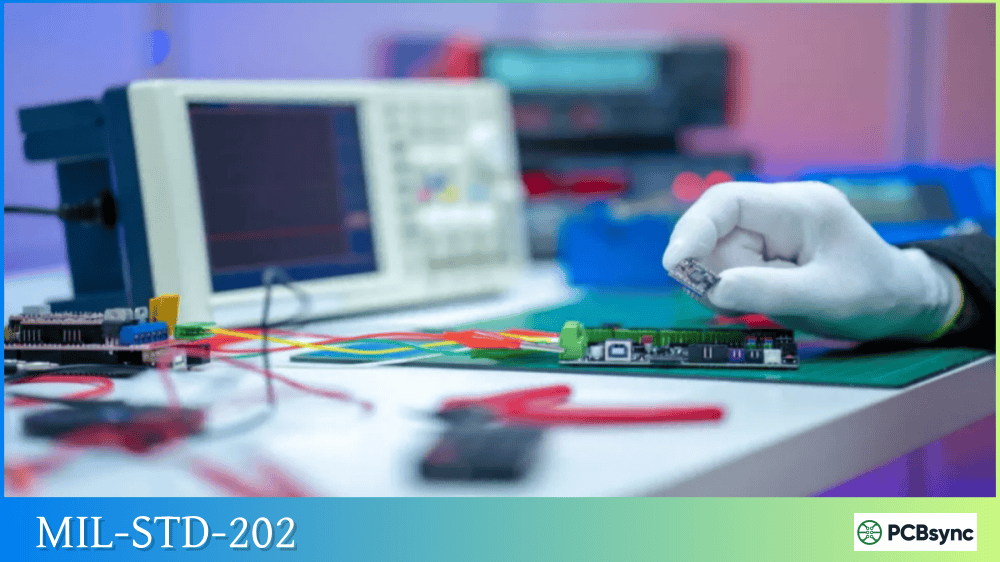
MIL-STD-202, officially titled “Test Method Standard, Electronic and Electrical Component Parts,” establishes uniform methods for testing electronic and electrical component parts. The standard covers basic environmental tests to determine resistance to deleterious effects of natural elements and conditions surrounding military operations, along with physical and electrical tests.
For the purpose of MIL-STD-202, the term “component parts” includes capacitors, resistors, switches, relays, transformers, inductors, connectors, and similar items. The standard applies to small component parts weighing up to 300 pounds or having a root mean square test voltage up to 50,000 volts, unless otherwise specifically invoked.
Core Objectives of MIL-STD-202
The test methods in MIL-STD-202 were developed to serve several fundamental purposes:
Objective
Description
Simulate Field Conditions
Specify laboratory conditions that produce test results equivalent to actual service conditions in the field
Ensure Reproducibility
Obtain consistent and repeatable test results across different laboratories and test facilities
Consolidate Test Methods
Unify all test methods of similar character from various joint and single-service component specifications
Universal Application
Provide test methods applicable to parts not covered by other military specifications
Conserve Resources
Standardize equipment, procedures, and facilities to reduce duplication of testing efforts
The standard acknowledges that laboratory tests cannot perfectly replicate every operational environment. The test methods represent conditions that provide results equivalent to field service, but the only definitive test for a specific application is actual service operation at that location.
MIL-STD-202 Test Method Structure
MIL-STD-202 organizes its test methods into three distinct classes, each identified by a specific number range. This structure makes it straightforward to identify the type of test based on its method number.
Test Method Classification
Class
Method Numbers
Coverage
Environmental Tests
101-199
Salt atmosphere, humidity, thermal shock, life testing, seal, sand/dust, explosion
Dielectric withstanding voltage, insulation resistance, DC resistance, capacitance, contact resistance
Test Method Numbering and Revisions
Test method revisions are indicated by a letter following the method number. For example, the original moisture resistance test is Method 106; the first revision is 106A, the second revision 106B, and so on. Starting with Revision H, the preferred method to reference a test is MIL-STD-202-xxx (for example, MIL-STD-202-106), though the older format “MIL-STD-202, Method 106” remains acceptable.
This modular structure allows individual test methods to be updated without revising the entire standard—a significant improvement introduced in Revision H.
MIL-STD-202 Environmental Test Methods (100 Series)
The 100 series establishes uniform test methods for environmental testing of electronic and electrical components, evaluating their resistance to natural elements and operational conditions.
Key Environmental Test Methods
Method
Title
Purpose
101
Salt Atmosphere (Corrosion)
Evaluate protective coating uniformity and corrosion resistance
103
Humidity (Steady State)
Examine material properties influenced by moisture absorption
104
Immersion
Determine seal effectiveness of component parts
105
Barometric Pressure (Reduced)
Evaluate ability to avoid dielectric failures at reduced pressure
106
Moisture Resistance
Evaluate resistance to humidity and heat in tropical climates
107
Thermal Shock
Determine resistance to extreme temperature cycling
108
Life (Elevated Ambient Temperature)
Determine effects of elevated temperature during operation
109
Explosion
Evaluate ability to contain internal explosions
110
Sand and Dust
Evaluate resistance to fine particulate exposure
111
Flammability (External Flame)
Determine flame resistance characteristics
112
Seal
Evaluate hermetic seal integrity
Method 106: Moisture Resistance Testing
Method 106 is one of the most comprehensive environmental tests in MIL-STD-202, evaluating materials and their ability to withstand the adverse effects of high humidity and heat typical of tropical environments. The test can reveal defects including:
Corrosion of metal components
Physical distortion of materials
Breakdown of organic materials
Leaching of plasticizers
Electrical performance degradation
Insulation resistance deterioration
The moisture resistance test subjects components to 10 continuous cycles, each combining elevated temperature, high humidity, and temperature cycling. A low-temperature subcycle is incorporated into at least 5 of the 10 cycles.
Method 107: Thermal Shock Testing
Thermal shock testing evaluates a component’s ability to withstand exposure to extreme high and low temperatures, as well as the shock of rapidly alternating between these extremes. This simulates conditions such as moving equipment from a heated interior to Arctic environments.
Test Condition
Cold Temperature
Hot Temperature
Typical Application
A
-65°C
+85°C
General purpose
B
-65°C
+125°C
Extended temperature
C
-65°C
+150°C
High-temperature applications
D
-65°C
+200°C
Extreme temperature
E
-55°C
+85°C
Standard military
Components are monitored for physical damage such as cracks, fractures, and delamination, as well as changes in electrical characteristics including resistance changes and insulation degradation.
The 200 series covers mechanical and physical testing of components, evaluating their ability to withstand shock, vibration, acceleration, and other physical stresses encountered during handling, transportation, and operation.
Key Physical Test Methods
Method
Title
Purpose
201
Vibration
Determine effects of vibration within field service frequency ranges
203
Random Drop
Evaluate resistance to repeated random impact during handling
204
Vibration, High Frequency
Assess effects of vibration across various frequency ranges
206
Life (Rotational)
Determine effects of rotation on component parts
207
High-Impact Shock
Evaluate resistance to severe mechanical shock
208
Solderability
Verify terminal solderability for assembly
209
Radiographic Inspection
Non-destructive internal examination
210
Resistance to Soldering Heat
Evaluate ability to withstand soldering thermal stress
211
Terminal Strength
Assess terminal and lead mechanical strength
212
Acceleration
Determine effects of sustained acceleration stress
213
Shock (Specified Pulse)
Evaluate response to specified shock pulses
214
Random Vibration
Assess resistance to random vibration stress
215
Resistance to Solvents
Verify marking legibility after solvent exposure
217
PIND
Detect loose particles inside sealed packages
218
Board Flex
Evaluate resistance to PCB flexing during assembly
Method 213: Shock (Specified Pulse)
Method 213 evaluates how component parts perform when subjected to mechanical shocks similar to those from rough handling, transportation, and field service conditions. This test replaced the earlier Methods 202 and 205, consolidating shock testing into a single comprehensive method.
The test applies controlled shock pulses of specified amplitude, duration, and waveform to components mounted in their normal orientation. Multiple shocks are applied in various axes to simulate real-world impact conditions.
Method 214: Random Vibration
Random vibration testing determines the ability of component parts to withstand dynamic stress caused by the random vibration patterns encountered in field service. Unlike sinusoidal vibration, random vibration more accurately represents the complex vibration environments in military vehicles, aircraft, and shipboard equipment.
Parameter
Typical Range
Frequency Range
10 Hz to 2000 Hz
Power Spectral Density
0.001 to 0.1 g²/Hz
Duration
30 minutes to several hours
Axes
Three mutually perpendicular
Method 208: Solderability Testing
Solderability testing verifies that component terminals can be properly soldered during assembly operations. This test is critical because poor solderability can result in cold solder joints, reduced reliability, and field failures.
The test evaluates terminal coverage by solder, wetting characteristics, and the ability to form reliable solder connections after aging. Components may be subjected to steam aging or other conditioning to simulate the effects of storage before testing.
The 300 series provides electrical testing methods to verify component performance and electrical integrity under various conditions.
Key Electrical Test Methods
Method
Title
Purpose
301
Dielectric Withstanding Voltage
Verify safe operation at rated voltage
302
Insulation Resistance
Measure insulation effectiveness
303
DC Resistance
Measure direct current resistance
304
Resistance Temperature Characteristic
Determine resistance change with temperature
305
Capacitance
Measure component capacitance
306
Quality Factor (Q)
Measure inductor and capacitor Q
307
Contact Resistance
Measure switch and relay contact resistance
308
Current-Noise Test for Fixed Resistors
Evaluate noise characteristics
309
Voltage Coefficient of Resistance
Determine voltage sensitivity
310
Contact-Chatter Monitoring
Evaluate relay contact stability
311
Life, Low Level Switching
Determine contact reliability under low-level conditions
312
Intermediate Current Switching
Evaluate contact reliability at intermediate currents
Method 301: Dielectric Withstanding Voltage
Method 301 applies a high voltage to electronic components to assess their ability to withstand elevated electrical stress without failure. This test determines whether a component can operate safely at its rated voltage and hold up against temporary overpotentials caused by surges, switching transients, and other voltage excursions.
The test reveals insulation weaknesses and potential for electrical breakdown that could cause failures in harsh military environments. Various test conditions mimic the electrical stresses components might encounter in actual service.
Method 302: Insulation Resistance
Method 302 measures the resistance offered by a component’s insulation material to the flow of electric current. This test evaluates insulation effectiveness in preventing unwanted current flow that could lead to electrical shorts and circuit failures.
Insulation resistance testing is particularly vital for military applications where electronic systems are exposed to extreme environmental conditions—high humidity, temperature extremes, and contamination—that could compromise insulation integrity.
Test Condition
Applied Voltage
Application
A
100 V DC
Low-voltage components
B
500 V DC
Standard components
C
1000 V DC
High-voltage applications
D
As specified
Special requirements
MIL-STD-202 Recommended Test Sequence
MIL-STD-202 provides guidance on the recommended sequence of tests, emphasizing that parts should be mechanically and thermally stressed prior to moisture resistance testing. This philosophy reflects real-world conditions where components experience mechanical stress during handling and thermal stress during operation before encountering humid environments.
Recommended Test Sequence
Group
Subgroup
Tests
1
1a
Initial electrical measurements
1
1b
Resistance to solvents, solderability
2
2a
Vibration, shock, acceleration
2
2b
Terminal strength
3
3a
Thermal shock
3
3b
Moisture resistance (or seal test for hermetic parts)
4
4a
Life testing
4
4b
Final electrical measurements
For hermetically sealed parts where moisture resistance testing is not required, a high-sensitivity seal test may substitute for the moisture resistance test.
MIL-STD-202 Revision History
MIL-STD-202 has evolved significantly since its initial release, with the most recent revision fundamentally changing how the standard is organized and maintained.
Document Revision Timeline
Revision
Date
Key Changes
F
April 1, 1980
Consolidated previous revisions
G
February 8, 2002
Updated test methods, added new requirements
G Change 1
June 4, 2010
Administrative updates
G Change 2
June 28, 2013
Method revisions
H
April 18, 2015
Split into separate test method documents
Revision H Changes
The most significant change in Revision H was splitting the standard into separate test method documents. Each test method is now a standalone document (for example, MIL-STD-202-106 for moisture resistance), allowing individual methods to be updated without revising the entire standard.
This modular approach offers several advantages:
Individual test methods can be revised more quickly
Updates affect only relevant methods, not the entire document
Easier tracking of changes to specific test methods
Reduced documentation overhead for users
Cancelled Test Methods
Several test methods have been superseded or cancelled:
Cancelled Method
Superseding Method
Notes
102 (Temperature Cycling)
107
Use Method 107 Thermal Shock
202 (Shock, specimens ≤4 lbs)
213
Consolidated into Method 213
205 (Medium Impact)
213
Consolidated into Method 213
216 (Resistance to Solder Wave Heat)
210
Use Method 210
MIL-STD-202 and Related Military Specifications
MIL-STD-202 works in conjunction with various component performance specifications. Understanding these relationships is essential for proper component qualification.
Individual test methods are updated independently, so always verify you have the current revision of each method you’re using.
Practical Application Guidelines
When specifying MIL-STD-202 testing for components, several practical considerations apply:
Selecting Appropriate Test Methods
Application
Recommended Tests
Rationale
Shipboard equipment
101, 104, 106, 112
Salt exposure, humidity, seal integrity
Airborne systems
105, 107, 204, 212, 214
Altitude, temperature, vibration
Ground mobile
107, 110, 201, 213
Temperature, dust, shock, vibration
Space applications
107, 112, 217
Temperature extremes, seal, PIND
Industrial
106, 107, 208, 301
Humidity, temperature, solderability, dielectric
Test Tailoring Considerations
The test conditions within each MIL-STD-202 method can often be tailored to match specific application requirements. When specifying tests, consider:
Operating temperature range of the end application
Expected vibration and shock environments
Humidity and moisture exposure conditions
Altitude or pressure variations
Storage and handling conditions
Expected service life requirements
Frequently Asked Questions About MIL-STD-202
What is the difference between MIL-STD-202 and MIL-STD-883?
MIL-STD-202 covers test methods for electronic and electrical component parts such as capacitors, resistors, switches, relays, transformers, and inductors. MIL-STD-883 covers test methods for microcircuits including integrated circuits, hybrid microcircuits, and multichip modules. While both standards include environmental, mechanical, and electrical tests, each is tailored to the specific characteristics and failure modes of its component category. Components tested under MIL-STD-202 are typically passive parts, while MIL-STD-883 addresses active semiconductor devices.
What is the current revision of MIL-STD-202?
The current base standard is MIL-STD-202H, released April 18, 2015. However, Revision H fundamentally changed the standard’s structure by splitting individual test methods into separate documents. Each test method (such as MIL-STD-202-106 for moisture resistance) is now maintained and updated independently. This means the revision status of individual test methods may differ from the base standard—Method 112 (Seal) was updated in October 2024, while Method 207 (High Impact Shock) was updated in March 2025. Always verify you have the current revision of each specific test method you’re invoking.
What types of components does MIL-STD-202 cover?
MIL-STD-202 covers small electronic and electrical component parts including capacitors, resistors, switches, relays, transformers, inductors, connectors, and similar items. The standard applies to components weighing up to 300 pounds or having a root mean square test voltage up to 50,000 volts. It does not cover semiconductors (covered by MIL-STD-750), microcircuits (covered by MIL-STD-883), or complete equipment assemblies (covered by MIL-STD-810). The standard specifically addresses passive components and electromechanical devices rather than active semiconductor devices.
How should I reference MIL-STD-202 test methods in specifications?
Starting with Revision H, the preferred method to reference a test is MIL-STD-202-xxx, where xxx is the test method number (for example, MIL-STD-202-106 for moisture resistance). The older format “MIL-STD-202, Method 106” remains acceptable. Do not include the revision letter when referencing test methods—this avoids the need to update specifications whenever a test method is revised. When invoking a test, specify the standard, method number, and any required test conditions or details from the method’s summary paragraph.
What is the recommended sequence for MIL-STD-202 testing?
MIL-STD-202 recommends that components be mechanically and thermally stressed before moisture resistance testing. The general sequence is: initial electrical measurements, resistance to solvents and solderability, vibration and shock tests, terminal strength, thermal shock, moisture resistance (or seal test for hermetic parts), life testing, and final electrical measurements. This sequence reflects the philosophy that components should experience mechanical stress (simulating handling and transportation) and thermal stress (simulating operation) before encountering humid environments. Within each group, the order is preferred but not mandatory.
Conclusion
MIL-STD-202 provides the essential test method framework for qualifying electronic and electrical component parts in military and aerospace applications. From the moisture resistance testing that simulates tropical environments to the vibration testing that replicates vehicle-mounted operation, this standard ensures passive components can survive the demanding conditions our military equipment encounters.
The modular structure introduced in Revision H makes the standard more maintainable and allows faster updates to individual test methods. Understanding which tests apply to your application, how they relate to component performance specifications, and where to find the current documents is essential for anyone involved in military component qualification.
For engineers specifying components for defense programs, MIL-STD-202 remains the foundational document for ensuring capacitors, resistors, relays, and other passive components will perform reliably when mission success depends on them.
Inquire: Call 0086-755-23203480, or reach out via the form below/your sales contact to discuss our design, manufacturing, and assembly capabilities.
Quote: Email your PCB files to Sales@pcbsync.com (Preferred for large files) or submit online. We will contact you promptly. Please ensure your email is correct.
Notes: For PCB fabrication, we require PCB design file in Gerber RS-274X format (most preferred), *.PCB/DDB (Protel, inform your program version) format or *.BRD (Eagle) format. For PCB assembly, we require PCB design file in above mentioned format, drilling file and BOM. Click to download BOM template To avoid file missing, please include all files into one folder and compress it into .zip or .rar format.