Inquire: Call 0086-755-23203480, or reach out via the form below/your sales contact to discuss our design, manufacturing, and assembly capabilities.
Quote: Email your PCB files to Sales@pcbsync.com (Preferred for large files) or submit online. We will contact you promptly. Please ensure your email is correct.
Notes: For PCB fabrication, we require PCB design file in Gerber RS-274X format (most preferred), *.PCB/DDB (Protel, inform your program version) format or *.BRD (Eagle) format. For PCB assembly, we require PCB design file in above mentioned format, drilling file and BOM. Click to download BOM template To avoid file missing, please include all files into one folder and compress it into .zip or .rar format.
MIL-STD-1686: ESD Control Program Requirements for Military Electronics
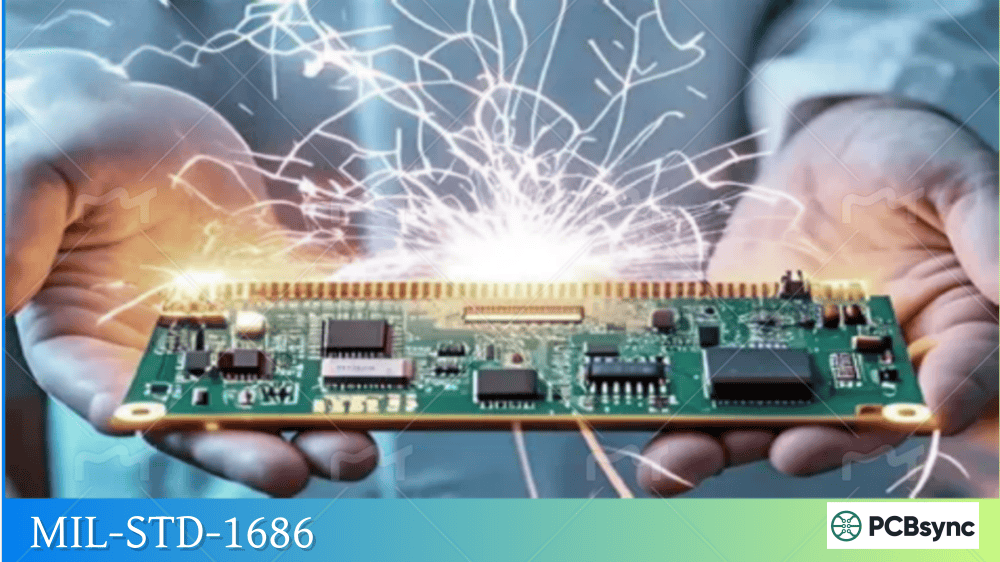
Electrostatic discharge might be invisible, but its effects on military electronics are devastatingly real. I’ve seen entire lots of expensive components rejected because someone picked up a board without proper grounding, or walked across a carpet before handling sensitive devices. MIL-STD-1686 exists to prevent exactly these scenarios—it establishes the requirements for ESD control programs in military electronics manufacturing and handling.
Whether you’re setting up a production line, managing a repair depot, or just trying to understand why your quality team insists on wrist straps, this guide covers what you need to know about MIL-STD-1686 and how to implement effective ESD control for military programs.
MIL-STD-1686 is the U.S. Department of Defense standard that establishes requirements for ESD (electrostatic discharge) control programs to protect electrical and electronic components, assemblies, and equipment susceptible to ESD damage. The standard defines sensitivity classifications, handling procedures, protective measures, training requirements, and program documentation necessary to prevent ESD-related failures in military electronics.
The current version, MIL-STD-1686C, was released in 1995 and remains the governing document for DoD programs, though many of its technical requirements align with commercial standards like ANSI/ESD S20.20.
Why ESD Control Matters for Military Electronics
ESD damage is particularly problematic for military electronics for several reasons:
Component sensitivity: Modern military electronics use advanced semiconductor technologies with feature sizes that make them increasingly vulnerable to ESD damage.
Latent damage: ESD can weaken components without causing immediate failure, leading to field failures months or years later—catastrophic for systems that must operate reliably.
Cost implications: Military components cost significantly more than commercial equivalents, making ESD damage financially painful.
Mission criticality: A field failure caused by ESD damage during manufacturing could compromise mission success.
Liability and accountability: Military contracts require documented ESD programs, and failures can trigger costly investigations and corrective actions.
Understanding ESD Damage Mechanisms
Damage Type
Description
Consequence
Catastrophic
Complete device failure
Detected during testing
Latent
Partial degradation without immediate failure
Field failure, intermittent operation
Upset
Temporary malfunction
Data errors, system resets
Latent damage is the most insidious because devices pass electrical testing but fail later under operational stress. Studies suggest that latent damage may account for significant portions of field failures in electronic systems.
MIL-STD-1686 ESD Sensitivity Classifications
The standard defines sensitivity classifications based on the ESD voltage level that can damage components. These classifications drive handling requirements and protective measures.
ESDS Classification Levels
Class
Human Body Model (HBM)
Machine Model (MM)
Charged Device Model (CDM)
Class 0
<250V
<50V
<125V
Class 1
250V – <500V
50V – <100V
125V – <250V
Class 2
500V – <1000V
100V – <200V
250V – <500V
Class 3
1000V – <2000V
200V – <400V
500V – <1000V
Class 4
2000V – <4000V
400V – <800V
1000V – <1500V
Class 5
4000V – <8000V
—
1500V – <2000V
Class 6
≥8000V
—
≥2000V
Understanding ESD Models
Model
What It Simulates
Typical Source
Human Body Model (HBM)
Discharge from a person touching a device
Direct human contact
Machine Model (MM)
Discharge from equipment or tools
Automated handling equipment
Charged Device Model (CDM)
Discharge from a charged device to ground
Device sliding, rapid grounding
Modern semiconductor devices are increasingly sensitive to CDM events. While HBM protection has improved, CDM sensitivity has actually decreased as die sizes shrink and I/O speeds increase.
Common Component Sensitivities
Component Type
Typical HBM Sensitivity
Handling Considerations
MOSFET transistors
100V – 2000V
Class 0-3 handling
CMOS ICs
250V – 3000V
Class 1-3 handling
Operational amplifiers
500V – 3000V
Class 1-3 handling
GaAs devices
100V – 500V
Class 0-1 handling (very sensitive)
Precision resistors (thin film)
500V – 2000V
Class 1-3 handling
Bipolar transistors
500V – 4000V
Class 1-4 handling
Film resistors
1000V – 10000V
Generally less sensitive
Ceramic capacitors
1000V – 5000V
Generally less sensitive
MIL-STD-1686 Program Requirements
The standard requires organizations to establish and document an ESD control program addressing all aspects of handling sensitive items.
Required Program Elements
Element
Description
Documentation
ESD Control Plan
Written program defining all ESD requirements
Required
Training program
Initial and recurring training for personnel
Training records
Facility requirements
EPA design and grounding specifications
Facility documentation
Handling procedures
Step-by-step handling instructions
Work instructions
Packaging requirements
ESD protective packaging specifications
Packaging procedures
Audit program
Compliance verification procedures
Audit records
Corrective action
Process for addressing nonconformances
CA documentation
ESD Control Plan Contents
A compliant MIL-STD-1686 ESD Control Plan must address:
Section
Required Content
Scope
Products and operations covered
Responsibilities
Roles and accountability
Sensitivity identification
Classification system and marking
EPA requirements
Protected area specifications
Grounding
System design and verification
Personnel grounding
Wrist straps, footwear, garments
Handling procedures
Detailed work instructions
Packaging
Materials and methods
Equipment/tools
Requirements for ESD-safe equipment
Training
Program description and requirements
Auditing
Compliance verification process
Records
Documentation requirements
ESD Program Responsibilities
Role
Responsibilities
Program Manager
Overall ESD program implementation
ESD Coordinator
Day-to-day program management, training
Quality Assurance
Audit program, compliance verification
Engineering
EPA design, procedure development
Production
Procedure execution, EPA maintenance
Receiving/Shipping
Packaging verification, storage
All Personnel
Compliance with ESD procedures
MIL-STD-1686 EPA Requirements
An ESD Protected Area (EPA) is the controlled environment where ESDS items are handled. The standard specifies requirements for EPA design and operation.
EPA Design Elements
Element
Requirement
Purpose
Flooring
Static dissipative (<10⁹ ohms to ground)
Personnel grounding, charge control
Workstation surfaces
Static dissipative or conductive
Safe work area
Grounding system
Common point ground, verified
Reference potential
Ionization
Where needed for insulators
Charge neutralization
Humidity control
30-70% RH recommended
Reduce charge generation
Warning signs
EPA identification
Personnel awareness
Workstation Requirements
Component
Specification
Verification Frequency
Work surface
<10⁹ ohms to ground
Per MIL-STD-1686 (typically weekly)
Wrist strap
<35 megohms (including cord)
Each use or continuous monitoring
Floor mat
<10⁹ ohms to ground
Weekly/monthly
Common point ground
<25 ohms to facility ground
Annually
Continuous monitors
Functioning properly
Daily/each use
Ionizers
Balanced, adequate coverage
Per manufacturer spec
Resistance Measurement Requirements
Measurement
Acceptable Range
Test Method
Wrist strap system
750K – 35M ohms
ESD TR53 or equivalent
Work surface to ground
<10⁹ ohms
ESD TR53
Floor to ground
<10⁹ ohms
ESD TR53
Garment (surface to surface)
<10¹¹ ohms
ESD TR53
Footwear to floor
<35M ohms (with flooring)
ESD TR53
MIL-STD-1686 Personal Grounding Requirements
Personnel are the primary source of ESD events. The standard mandates grounding methods to prevent human-generated ESD.
Personnel Grounding Options
Method
Application
Requirements
Wrist strap
Seated work, highest control
<35M ohms to ground
Heel/toe straps
Mobile workers, with ESD flooring
<35M ohms with floor
ESD footwear
Mobile workers, with ESD flooring
<35M ohms with floor
ESD garments
Charged clothing control
Static dissipative fabric
Wrist Strap Requirements
Parameter
Specification
Cord resistance
750K – 1M ohms typical (built-in)
System resistance
<35 megohms including body
Cord length
6-10 feet typical
Band contact
Minimum 2 inches of skin contact
Verification
Each use or continuous monitoring
Replacement
When damaged, stretched, or failed
Continuous Monitoring Systems
Continuous monitors verify personnel grounding without interrupting work:
Monitor Type
What It Monitors
Advantage
Single-wire
Wrist strap integrity
Basic protection
Dual-wire
Ground path and strap integrity
Higher reliability
Workstation
Surface and personnel
Complete workstation status
Floor
Footwear through ESD floor
Mobile worker monitoring
MIL-STD-1686 Handling Procedures
Proper handling procedures minimize ESD exposure throughout manufacturing and maintenance operations.
General Handling Requirements
Requirement
Description
Personnel grounding
Wrist strap or footwear/flooring before handling
Work surface
ESD protective surface required
Grounded containers
Use conductive or dissipative containers
No direct contact
Avoid touching leads/contacts
Minimize handling
Handle only when necessary
Proper transport
ESD protective packaging
Component Handling Guidelines
Component State
Handling Requirement
In ESD packaging
Open only in EPA
Loose components
Use ESD-safe containers, tweezers
On PCB
Ground board before handling
During assembly
Personnel grounded at all times
During test
Equipment grounded, test fixtures ESD-safe
During rework
Ion blower for non-conductors
Prohibited Practices in EPA
Prohibited Item/Action
Reason
Styrofoam containers
Charge-generating insulator
Non-ESD plastic bags
Triboelectric charging
Personal plastic items
Uncontrolled insulators
Untreated paper products
Charge generation potential
Synthetic clothing uncovered
Triboelectric charging
Rapid movements near ESDS
Air ionization, charge induction
MIL-STD-1686 Packaging Requirements
ESD-protective packaging prevents damage during storage and transportation.
Packaging Material Categories
Category
Resistance Range
Application
Conductive
<10⁴ ohms
Shielding, short-term storage
Static dissipative
10⁴ – 10¹¹ ohms
Handling containers, work surfaces
Antistatic
Low charge generation
General packaging support
Shielding
Faraday cage effect
Transportation, storage
Packaging Requirements by Application
Application
Minimum Requirement
Recommended
Internal transport (within EPA)
Dissipative container
Shielding not required
Storage (short-term)
Static dissipative
Climate controlled
Storage (long-term)
Shielding bag with desiccant
Humidity controlled
Shipping (local)
Shielding bag, dissipative outer
Cushioned
Shipping (external)
Multiple barriers, shielding
Moisture barrier
Shielding Bag Types
Type
Construction
Shielding Effectiveness
Metal-in
Aluminum foil laminate
Excellent
Metal-out
Metalized surface
Good
Metallized film
Vacuum-deposited metal
Moderate
Grid/mesh
Conductive pattern
Moderate
Packaging Verification
Check
Requirement
Surface resistance
Per material specification
Shielding effectiveness
<50 nJ energy transfer
Seal integrity
Complete closure
Labels/marking
ESD sensitivity identified
Desiccant (if required)
Active, properly placed
MIL-STD-1686 Training Requirements
Training is fundamental to ESD control effectiveness. The standard requires documented training programs.
Regular verification ensures the ESD program remains effective.
Audit Types
Audit Type
Frequency
Focus
Internal
Semi-annual minimum
All program elements
Process
Ongoing
Work instruction compliance
Equipment
Per schedule
Resistance, functionality
Training
Annual
Certification currency
External
Per contract
Contractor compliance
Equipment Verification Schedule
Item
Verification Frequency
Method
Wrist straps
Each use or continuous
Tester or monitor
Work surfaces
Weekly to monthly
Resistance measurement
Flooring
Monthly to quarterly
Resistance measurement
Ionizers
Per manufacturer spec
Balance and discharge time
Continuous monitors
Daily check
Functional verification
Packaging materials
Incoming inspection
Resistance verification
Common Audit Findings
Finding
Root Cause
Corrective Action
Wrist strap failures
Wear, stretching
Replacement, more frequent checking
Floor resistance drift
Contamination, wear
Cleaning, refinishing
Training lapses
Schedule management
Automated tracking system
Prohibited items in EPA
Awareness gap
Retraining, signage
Documentation gaps
Process issues
Procedure updates
Ionizer imbalance
Maintenance neglect
PM schedule implementation
MIL-STD-1686 vs. ANSI/ESD S20.20
Many organizations maintain compliance with both military and commercial ESD standards.
Standards Comparison
Aspect
MIL-STD-1686
ANSI/ESD S20.20
Authority
U.S. Department of Defense
ESD Association
Application
Military contracts
Commercial/voluntary
Certification
Contract compliance
Third-party certification available
Sensitivity classes
Class 0-6
Class 0-3 (simplified)
Technical requirements
Similar
Generally aligned
Updates
Less frequent
Regular revisions
Test methods
MIL-STD-1686 specific
ESD TR53 referenced
International recognition
U.S. DoD programs
IEC 61340-5-1 equivalent
Using Both Standards
Situation
Approach
Military contract only
MIL-STD-1686 compliance
Commercial only
ANSI/ESD S20.20 compliance
Mixed business
Program meeting both requirements
New facility design
Design to more stringent requirement
For organizations serving both military and commercial markets, implementing a program that meets both standards provides flexibility and demonstrates strong ESD control.
Implementing an MIL-STD-1686 Compliant Program
Building an effective ESD program requires systematic implementation across all program elements.
What ESD sensitivity classification requires the most stringent handling?
Class 0 components with HBM sensitivity below 250V require the most stringent handling procedures. These devices, which include some GaAs components, advanced CMOS, and certain RF devices, can be damaged by ESD events that humans cannot feel (typically below 3000V). Class 0 handling requires continuous personnel grounding monitoring, controlled ionization to neutralize insulators, enhanced packaging with multiple barriers, and restricted handling environments. Some organizations establish “super-sensitive” or “Class 0” specific areas with additional controls beyond standard EPA requirements. When working with Class 0 devices, assume that any uncontrolled ESD event, no matter how minor it seems, can cause damage.
How often should wrist straps be tested per MIL-STD-1686?
MIL-STD-1686 requires wrist strap verification but allows organizations to determine specific frequency based on their ESD Control Plan. Best practice is to verify wrist straps either at each use (using a wrist strap tester when entering the EPA) or through continuous monitoring systems that verify the ground path throughout work operations. Continuous monitors provide the highest assurance because they detect failures immediately rather than waiting for periodic checks. For seated operations handling Class 0 or Class 1 devices, continuous monitoring is strongly recommended. Whatever method you choose, document it in your ESD Control Plan and maintain verification records. Failed wrist straps should be immediately removed from service and replaced.
What is the difference between static dissipative and conductive materials?
The difference is resistance range: conductive materials have surface resistance below 10⁴ ohms (10,000 ohms), while static dissipative materials range from 10⁴ to 10¹¹ ohms. This distinction affects how quickly charges dissipate and whether rapid discharge could damage components. Conductive materials allow very fast charge transfer, which is useful for shielding but could cause CDM damage if a charged device contacts a conductive surface. Static dissipative materials slow the discharge rate, providing a controlled path to ground that protects sensitive devices. Work surfaces are typically static dissipative (not conductive) for this reason—they drain charges safely without the rapid discharge risk. Shielding bags use conductive layers for their Faraday cage effect, but with construction that prevents direct device contact with the conductive layer.
Can commercial ANSI/ESD S20.20 certification satisfy MIL-STD-1686 requirements?
Not automatically, but there’s significant overlap. A facility certified to ANSI/ESD S20.20 has demonstrated most of the technical controls required by MIL-STD-1686. However, military contracts may specify MIL-STD-1686 compliance directly, require specific documentation formats, or impose additional requirements beyond either standard. To satisfy a MIL-STD-1686 contract requirement, you typically need an ESD Control Plan that specifically references MIL-STD-1686, addresses any contract-specific requirements, and is approved by the contracting activity. Many organizations maintain programs compliant with both standards, which provides flexibility for mixed commercial/military business. Work with your contracts and quality teams to understand exactly what your specific contract requires.
What should I do if an ESD event is suspected during production?
Document the event immediately, including time, location, personnel involved, components affected, and circumstances. Quarantine any potentially affected components or assemblies—do not ship them without evaluation. Notify your ESD Coordinator and Quality Assurance. Evaluate the affected items through electrical testing if possible; some ESD damage can be detected through parametric shifts or functional failures. For high-reliability military applications, consider the items suspect even if they pass electrical testing, since latent damage may not be immediately apparent. Investigate the root cause: was personnel grounding verified, were procedures followed, were any prohibited materials present? Implement corrective action to prevent recurrence. Document everything for your quality records and be prepared to report to the customer if contract requirements specify notification of ESD events.
Practical ESD Program Recommendations
After working with ESD programs across multiple military production environments, here are key lessons learned:
Invest in continuous monitoring. Wrist strap testers at the door are better than nothing, but continuous monitors catch failures in real-time. For Class 0 and Class 1 devices, this investment pays for itself in prevented damage.
Training matters more than equipment. The best EPA in the world won’t help if personnel don’t understand why ESD matters and how to follow procedures. Invest in quality initial training and meaningful refreshers.
Audit honestly. Self-audits that always find everything perfect aren’t helping your program. Look for problems, find them before they cause damage, and treat findings as improvement opportunities.
Document everything. When a customer asks about your ESD program, or when a field failure investigation begins, you’ll need records showing what you did and when.
Control your packaging chain. ESD damage during shipping is common because packaging controls often weaken outside the EPA. Verify packaging materials, train shipping personnel, and audit packaged product.
Stay current. ESD technology and standards evolve. Participate in ESD Association activities, attend training updates, and review your program periodically against current best practices.
MIL-STD-1686 establishes the framework for protecting military electronics from ESD damage. Implementing these requirements thoroughly and consistently prevents costly damage, field failures, and program delays. The investment in proper ESD control pays dividends throughout the product lifecycle.
Inquire: Call 0086-755-23203480, or reach out via the form below/your sales contact to discuss our design, manufacturing, and assembly capabilities.
Quote: Email your PCB files to Sales@pcbsync.com (Preferred for large files) or submit online. We will contact you promptly. Please ensure your email is correct.
Notes: For PCB fabrication, we require PCB design file in Gerber RS-274X format (most preferred), *.PCB/DDB (Protel, inform your program version) format or *.BRD (Eagle) format. For PCB assembly, we require PCB design file in above mentioned format, drilling file and BOM. Click to download BOM template To avoid file missing, please include all files into one folder and compress it into .zip or .rar format.