Inquire: Call 0086-755-23203480, or reach out via the form below/your sales contact to discuss our design, manufacturing, and assembly capabilities.
Quote: Email your PCB files to Sales@pcbsync.com (Preferred for large files) or submit online. We will contact you promptly. Please ensure your email is correct.
Notes: For PCB fabrication, we require PCB design file in Gerber RS-274X format (most preferred), *.PCB/DDB (Protel, inform your program version) format or *.BRD (Eagle) format. For PCB assembly, we require PCB design file in above mentioned format, drilling file and BOM. Click to download BOM template To avoid file missing, please include all files into one folder and compress it into .zip or .rar format.
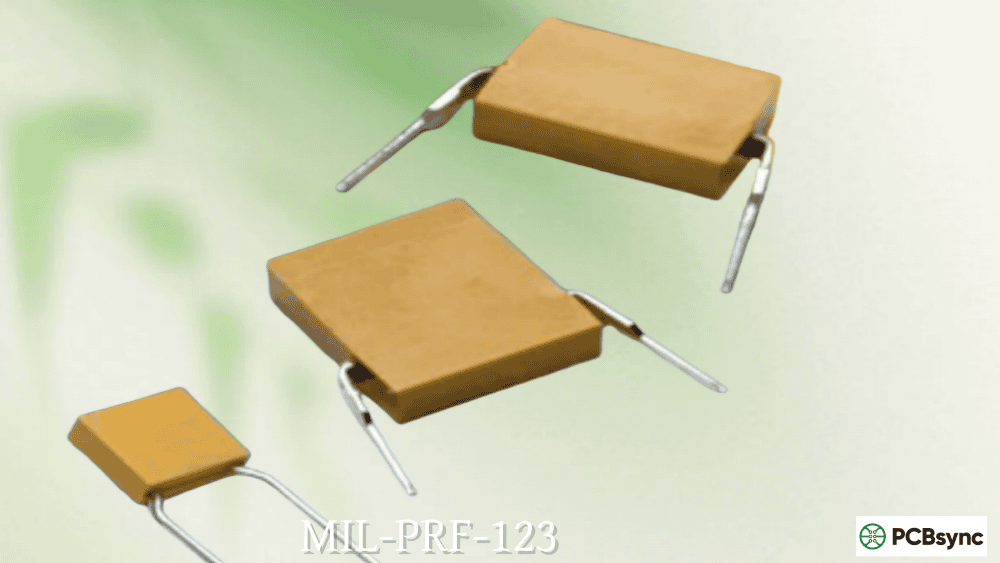
MIL-PRF-123: High-Reliability Ceramic Capacitor Military Standard
When standard military capacitors aren’t reliable enough, MIL-PRF-123 enters the picture. This specification covers ceramic capacitors for the most demanding applications—satellites that can’t be repaired, strategic systems where failure isn’t an option, and missions where every component must work perfectly for decades. If MIL-PRF-55681 is the baseline for military ceramic capacitors, MIL-PRF-123 represents the top tier.
I first encountered MIL-PRF-123 requirements on a spacecraft power system project where component reliability wasn’t just a goal—it was calculated down to individual failure probabilities for each capacitor on the board. The specification’s requirements seemed excessive until I understood that a single capacitor failure could end a billion-dollar mission. This guide explains what engineers need to know about MIL-PRF-123 when designing ultra-high-reliability systems.
MIL-PRF-123 is the U.S. Department of Defense performance specification for high-reliability ceramic dielectric fixed capacitors. While MIL-PRF-55681 covers general military ceramic capacitors, MIL-PRF-123 establishes significantly more stringent requirements for applications demanding the highest reliability levels—primarily space, strategic missiles, and other mission-critical systems.
The specification defines enhanced screening procedures, tighter acceptance criteria, extended life testing, and mandatory destructive physical analysis (DPA) that goes far beyond standard military requirements. Parts qualified to MIL-PRF-123 undergo testing that would be considered overkill for typical military applications but is essential when component failure means mission failure.
MIL-PRF-123 vs. MIL-PRF-55681: Understanding the Difference
Parameter
MIL-PRF-55681
MIL-PRF-123
Primary application
General military
Space, strategic systems
Screening intensity
Standard military
Enhanced/100% screening
Life test duration
2,000 hours
4,000-10,000 hours
DPA requirement
Optional/periodic
Mandatory per lot
Voltage screening
Standard
Enhanced burn-in
Thermal shock cycles
5 cycles
100+ cycles
Failure rate demonstration
M, P, R, S levels
T, S, R, B, D, C levels
Lot traceability
Required
Enhanced with serialization
Cost premium
10-20× commercial
50-200× commercial
Why MIL-PRF-123 Exists
Standard military capacitors, even at S-level reliability, don’t provide adequate assurance for certain applications:
Space missions: Satellites operate for 15+ years with zero maintenance capability. A single capacitor failure can end the mission.
Strategic systems: Nuclear deterrent systems require reliability levels beyond commercial or standard military grades.
Deep space probes: Voyager-class missions demand components that function for decades in radiation environments.
Human-rated spacecraft: NASA missions carrying astronauts require demonstrated reliability margins that standard parts can’t provide.
Implantable medical devices: Some medical applications reference MIL-PRF-123 requirements for life-critical electronics.
MIL-PRF-123 Quality and Reliability Levels
The specification defines multiple quality levels based on demonstrated reliability and screening intensity.
Reliability Level Designations
Level
Designation
Failure Rate (%/1000 hrs)
Primary Applications
T
Ultra-high reliability
0.0001%
Critical space, strategic
S
Space grade
0.001%
Standard space missions
R
Very high reliability
0.01%
High-rel military
B
High reliability
0.1%
Enhanced military
D
Standard
1.0%
General high-rel
C
Commercial plus
—
Screened commercial
Understanding T-Level Requirements
T-level represents the pinnacle of capacitor reliability. These parts undergo:
Requirement
T-Level Specification
Burn-in
100% at elevated voltage and temperature
Life test
10,000 hours minimum
DPA
100% of lots, enhanced criteria
Thermal cycling
100 cycles minimum
Hermeticity (if applicable)
Fine and gross leak 100%
Serialization
Individual part traceability
Lot acceptance
Zero defects allowed
S-Level Space Grade Requirements
S-level parts are the standard choice for space applications:
Requirement
S-Level Specification
Burn-in
100% voltage/temperature screen
Life test
4,000-6,000 hours
DPA
Required per lot
Thermal cycling
50-100 cycles
Group A testing
100% electrical
Voltage conditioning
2× rated voltage screen
MIL-PRF-123 Dielectric Classifications
The specification covers multiple dielectric types, each with specific temperature characteristics and performance requirements.
Class I Dielectrics (Stable)
Designation
EIA Equivalent
TC (ppm/°C)
Capacitance Stability
BZ
C0G (NP0)
0 ±30
Ultra-stable
BP
P100
+100 ±30
Positive TC
BN
N150
-150 ±30
Negative TC
BA
N750
-750 ±120
Temperature compensating
BH
N1500
-1500 ±250
Temperature compensating
Class I dielectrics maintain exceptional stability across temperature, voltage, and time—essential for precision timing, filtering, and RF applications in space systems.
Class II Dielectrics (High Capacitance)
Designation
EIA Equivalent
Temperature Range
Capacitance Change
BX
X7R
-55°C to +125°C
±15%
BR
X5R
-55°C to +85°C
±15%
BW
Y5V
-30°C to +85°C
+22%/-82%
Class II dielectrics provide higher capacitance density but with the ferroelectric behavior that causes DC bias sensitivity and aging effects.
Extended Temperature Dielectrics
Designation
Temperature Range
Application
BQ
-55°C to +150°C
High-temperature operation
BS
-55°C to +200°C
Extreme environments
These extended-range dielectrics address spacecraft thermal extremes, from cold eclipse periods to sun-facing hot conditions.
MIL-PRF-123 Testing and Screening Requirements
The testing regimen for MIL-PRF-123 capacitors exceeds other military specifications significantly. Every test addresses failure modes observed in actual space and strategic system deployments.
Group A Testing (Electrical Verification)
Test
Method
100% or Sample
Capacitance
MIL-STD-202
100%
Dissipation factor
MIL-STD-202
100%
Insulation resistance
MIL-STD-202
100%
DC leakage
Per specification
100%
Dielectric withstanding voltage
MIL-STD-202
100%
Group B Testing (Mechanical/Environmental)
Test
Conditions
Acceptance
Thermal shock
-65°C to +150°C, liquid-to-liquid
No cracking, ΔC within limits
Temperature cycling
-65°C to +150°C, 100 cycles
ΔC ≤±5% (Class I)
Terminal strength
Per MIL-STD-202
No damage
Vibration
Per MIL-STD-202
No failures
Mechanical shock
1500g, 0.5ms
No damage
Constant acceleration
20,000g
No internal damage
Group C Testing (Life and Endurance)
Test
Conditions
Duration
Operating life
2× rated voltage, +125°C
4,000-10,000 hours
Humidity life
85°C/85% RH, rated voltage
1,000 hours
High temperature storage
+150°C
1,000 hours
Resistance to soldering heat
Per MIL-STD-202
No degradation
Destructive Physical Analysis (DPA)
DPA is mandatory for MIL-PRF-123, not optional as in other specifications:
DPA Element
What It Reveals
External visual
Surface defects, marking
X-ray radiography
Internal voids, delamination
Acoustic microscopy
Internal cracks, layer separation
Cross-sectioning
Layer structure, electrode coverage
Terminal evaluation
Solder compatibility, barrier layers
Dielectric analysis
Material composition verification
Lot Acceptance Criteria
MIL-PRF-123 typically requires zero-defect lot acceptance:
Level
Sample Defects Allowed
Consequence
T
0 in sample
Lot rejection
S
0-1 depending on test
Lot rejection or 100% rescreen
R
Per LTPD tables
Disposition per specification
MIL-PRF-123 Part Numbering System
Understanding the part numbering convention enables accurate specification and procurement.
High-reliability applications demand careful attention to derating, thermal management, and stress analysis.
Voltage Derating Requirements
Application Class
Maximum Working Voltage
Space (GEO)
50% of rated
Space (LEO)
60% of rated
Strategic ground
60% of rated
High-temperature
40% of rated
Radiation environment
40-50% of rated
Derating beyond specification minimums is common practice. Many space programs require 40% derating (using only 40% of rated voltage) for all ceramic capacitors regardless of specification minimums.
Thermal Design Considerations
Factor
Design Impact
Orbital thermal cycling
Size thermal stress, CTE matching
Eclipse transitions
Rapid temperature changes
Hot case analysis
Maximum temperature verification
Cold case analysis
Minimum temperature verification
Self-heating
ESR-induced temperature rise
Radiation Considerations
Space applications must address radiation effects:
Radiation Effect
Concern
Mitigation
Total ionizing dose (TID)
Insulation resistance degradation
Select rad-hard dielectrics
Single event effects
Transient upsets
Filtering, redundancy
Displacement damage
Material degradation
Shielding, derating
PCB Assembly Requirements
Requirement
Specification
Solder paste
Type 3 or finer
Reflow profile
Per manufacturer recommendation
Rework
Restricted, documented procedure
Cleaning
Critical, residue-free
Conformal coating
Compatible with capacitor materials
Visual inspection
Per NASA or ESA workmanship
MIL-PRF-123 vs. Other Capacitor Specifications
Comparison with Related Standards
Specification
Focus
Typical Application
MIL-PRF-123
Ultra-high reliability ceramic
Space, strategic
MIL-PRF-55681
General military ceramic
Standard military
MIL-PRF-39014
Military tantalum solid
Military power
MIL-PRF-49470
Military tantalum chip
Military surface mount
NASA EEE-INST-002
NASA instructions
NASA missions
ESCC 3009
ESA ceramic capacitors
European space
NASA and ESA Flow-Down
Many space programs impose additional requirements beyond MIL-PRF-123:
Agency
Additional Requirements
NASA
EEE-INST-002 screening, GIDEP review
ESA
ESCC qualification, European DPA
JAXA
Japanese space agency requirements
Commercial space
Varies by program
Procuring MIL-PRF-123 Capacitors
High-reliability capacitor procurement requires early planning and qualified source selection.
Qualified Manufacturers
Manufacturer
Product Focus
Reliability Levels
KEMET
Full MIL-PRF-123 line
T, S, R, B
Vishay
High-reliability ceramic
S, R, B
AVX (Kyocera)
Space-grade MLCC
S, R
Presidio Components
Ultra-high reliability
T, S
Knowles (DLI)
RF/microwave space
S, R
Exxelia
European space-grade
ESA qualified
Johanson
High-voltage space
S, R
Lead Time Expectations
Product Type
Typical Lead Time
Standard values (stock)
12-16 weeks
Standard values (MTO)
16-26 weeks
T-level (ultra-high rel)
26-40 weeks
Non-standard values
24-36 weeks
Qualification lots
40-52 weeks
Cost Considerations
Level
Approximate Premium (vs. commercial)
B-level
30-50×
R-level
50-75×
S-level
75-150×
T-level
150-300×
A commercial 0.1µF ceramic capacitor costs $0.01. The equivalent MIL-PRF-123 S-level part might cost $2-5, and T-level could reach $10-20 per capacitor.
What is the difference between MIL-PRF-123 and MIL-PRF-55681?
MIL-PRF-123 is the ultra-high-reliability specification for ceramic capacitors used in space and strategic applications, while MIL-PRF-55681 covers general military ceramic capacitors. Key differences include: MIL-PRF-123 requires mandatory DPA on every lot (not optional), life testing extends to 4,000-10,000 hours (versus 2,000 hours), thermal cycling requirements are 100+ cycles (versus 5), and acceptance criteria allow zero or minimal defects. MIL-PRF-123 parts cost 5-10× more than equivalent MIL-PRF-55681 parts and have longer lead times. Use MIL-PRF-123 when mission success depends on absolute capacitor reliability—primarily space missions and strategic systems. For standard military ground, airborne, and shipboard applications, MIL-PRF-55681 provides adequate reliability at lower cost.
Why are MIL-PRF-123 capacitors so expensive?
The cost premium reflects extensive testing and low production volumes. Every MIL-PRF-123 lot undergoes 4,000-10,000 hour life testing (occupying test equipment for months), mandatory destructive physical analysis (sacrificing parts for cross-sectioning), 100% screening at elevated stress levels, enhanced documentation and traceability, and zero-defect acceptance criteria that reject entire lots for single failures. Production volumes are tiny compared to commercial parts—a space program might need 1,000 capacitors while commercial production runs in billions. Fixed costs for qualification, testing, and documentation spread across few units. Additionally, qualified manufacturers maintain dedicated production lines with controlled materials, trained operators, and space-grade processes that aren’t shared with commercial production.
How do I specify MIL-PRF-123 capacitors for a space program?
Start by identifying reliability requirements from your program’s parts control plan or EEE parts list. Most commercial space missions use S-level; government strategic programs may require T-level. Specify the complete part number including dielectric type (BZ for stable, BX for high capacitance), size, capacitance, tolerance, voltage rating, and reliability level. Verify the part number appears on the QPL and the manufacturer is currently qualified. Consider NASA EEE-INST-002 or ESA ESCC requirements if your program flows down agency standards. Plan procurement early—lead times of 20-40 weeks are common. Request DPA data with your order and verify GIDEP for any alerts on the specific part or manufacturer. Document everything for your parts approval process.
Can MIL-PRF-55681 S-level parts substitute for MIL-PRF-123?
Generally no—they’re different specifications with different requirements despite similar reliability level designations. MIL-PRF-123 S-level includes mandatory DPA, longer life testing, more thermal cycles, and tighter acceptance criteria than MIL-PRF-55681 S-level. Some programs may allow MIL-PRF-55681 with additional screening under deviation, but this requires engineering analysis, customer approval, and typically additional testing to demonstrate equivalence. The screening additions often cost more than simply buying MIL-PRF-123 parts. If your program specifies MIL-PRF-123, use MIL-PRF-123. Substitutions create audit findings, require deviation paperwork, and may compromise mission assurance. The cost savings aren’t worth the programmatic risk.
What causes failures in high-reliability ceramic capacitors?
Even with MIL-PRF-123 screening, failures occur. Common mechanisms include: flex cracking from PCB bending or thermal stress (especially in larger case sizes), dielectric breakdown from voltage overstress or defects missed in screening, insulation resistance degradation from humidity ingress or contamination, and solder joint failures from thermal cycling or mechanical stress. The extensive MIL-PRF-123 testing catches most infant mortality and latent defects, but design and assembly practices matter too. Avoid mounting large capacitors near board edges, maintain proper voltage derating, follow manufacturer assembly recommendations, and ensure adequate conformal coating for humidity protection. When failures do occur, DPA-level analysis on failed parts identifies root cause and determines whether lot-wide concerns exist.
Final Guidance on MIL-PRF-123
Working with ultra-high-reliability capacitors requires attention to detail that standard military programs don’t demand:
Plan procurement early. Lead times of 26-52 weeks are normal. Programs have slipped schedule waiting for T-level capacitors.
Derate aggressively. Space programs typically derate to 40-50% of rated voltage regardless of specification minimums.
Trust the screening. MIL-PRF-123 testing catches most latent defects. Don’t duplicate testing unless your program specifically requires it.
Document everything. Parts approval documentation, procurement records, and screening data must be maintained for the program’s life.
Review GIDEP regularly. Problem alerts can affect your parts even after delivery. Stay informed.
Work with qualified suppliers. The QPL exists for a reason. Non-QPL sources cannot provide equivalent reliability assurance.
MIL-PRF-123 represents the highest reliability tier for ceramic capacitors. The extensive testing, documentation, and cost reflect the reality that some missions cannot tolerate component failures. Understanding the specification ensures you select, apply, and procure capacitors that meet the demanding requirements of space and strategic applications.
Inquire: Call 0086-755-23203480, or reach out via the form below/your sales contact to discuss our design, manufacturing, and assembly capabilities.
Quote: Email your PCB files to Sales@pcbsync.com (Preferred for large files) or submit online. We will contact you promptly. Please ensure your email is correct.
Notes: For PCB fabrication, we require PCB design file in Gerber RS-274X format (most preferred), *.PCB/DDB (Protel, inform your program version) format or *.BRD (Eagle) format. For PCB assembly, we require PCB design file in above mentioned format, drilling file and BOM. Click to download BOM template To avoid file missing, please include all files into one folder and compress it into .zip or .rar format.