Inquire: Call 0086-755-23203480, or reach out via the form below/your sales contact to discuss our design, manufacturing, and assembly capabilities.
Quote: Email your PCB files to Sales@pcbsync.com (Preferred for large files) or submit online. We will contact you promptly. Please ensure your email is correct.
Notes: For PCB fabrication, we require PCB design file in Gerber RS-274X format (most preferred), *.PCB/DDB (Protel, inform your program version) format or *.BRD (Eagle) format. For PCB assembly, we require PCB design file in above mentioned format, drilling file and BOM. Click to download BOM template To avoid file missing, please include all files into one folder and compress it into .zip or .rar format.
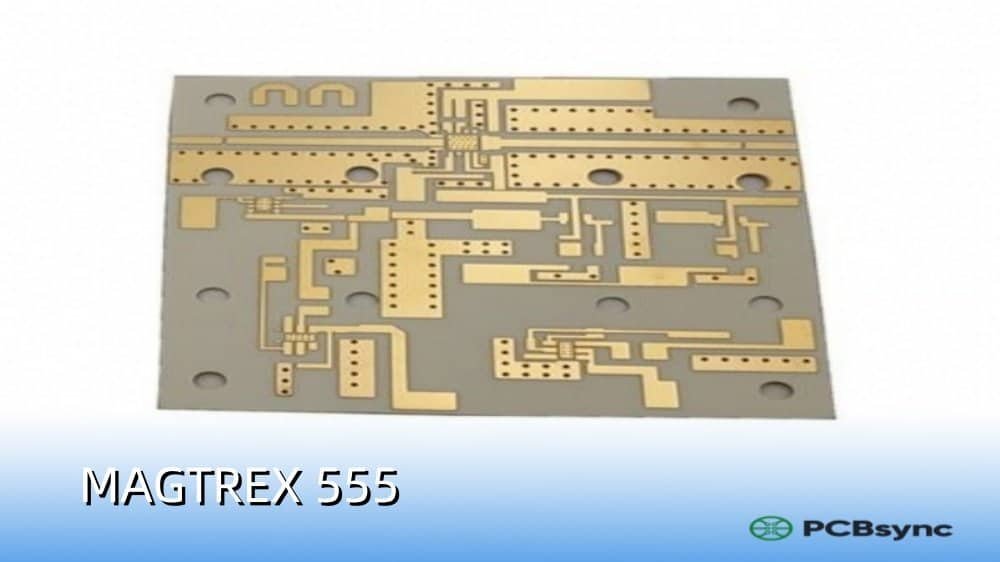
If you’ve ever struggled to squeeze a VHF or UHF antenna into a space-constrained design, you know the frustration. Traditional high-permittivity substrates can shrink your antenna, but they kill your bandwidth. That’s exactly the problem Rogers Corporation tackled when they introduced MAGTREX 555 back in 2018.
I’ve been working with RF laminates for years, and MAGTREX 555 represents something genuinely different in the market. It’s the first commercially available laminate that controls both permeability and permittivity, opening up design possibilities that simply weren’t available before. This isn’t just an incremental improvement over existing materials—it’s a fundamentally different approach to antenna miniaturization.
The demand for compact antennas continues to grow across industries. Military communication systems need conformal antennas that fit on soldier equipment. Maritime applications require VHF antennas small enough for emergency beacons. IoT devices operating in sub-GHz bands face constant pressure to reduce size while maintaining performance. MAGTREX 555 addresses these challenges in ways that conventional materials simply cannot.
In this guide, I’ll walk through everything you need to know about MAGTREX 555—from its core specifications to practical fabrication tips—so you can decide if it’s right for your next antenna project. We’ll cover the physics behind its unique properties, real-world application considerations, and the practical details you need for successful fabrication.
MAGTREX 555 is a high impedance laminate manufactured by Rogers Corporation. Unlike conventional PCB substrates that only manipulate dielectric constant (εr), MAGTREX 555 provides controlled permeability (μr) alongside permittivity. This dual-parameter control is what makes this material unique in the RF laminate space.
The material uses a ceramic-filled PTFE composite system—similar to Rogers’ well-known RT/duroid product line—but with a proprietary high-resistivity ceramic filler that delivers magnetic properties. The high-temperature thermoplastic matrix makes it conformable, through-hole via capable, and mechanically robust.
Why Does Controlled Permeability Matter?
Here’s the key insight: antenna size scales with the square root of εr × μr. With MAGTREX 555 offering εr ≈ 6.5 and μr ≈ 6, you get a miniaturization factor equivalent to a material with εr = 39—but without the bandwidth penalty that comes with high-permittivity-only substrates.
The intrinsic impedance of a substrate is proportional to √(μr/εr). When this ratio is close to 1, as it is with MAGTREX 555, the substrate impedance closely matches free-space impedance (~377Ω). This impedance matching is what preserves bandwidth during miniaturization.
MAGTREX 555 Key Properties and Specifications
Understanding the material properties is essential for proper design. Here’s a breakdown of the critical parameters from the official datasheet:
The physics behind MAGTREX 555’s miniaturization capability is straightforward once you break it down.
The Miniaturization Factor
For a patch antenna, the resonant length is approximately:
L ≈ λ₀ / (2 × √(εr × μr))
Where λ₀ is the free-space wavelength. With εr = 6.5 and μr = 6, you get √(39) ≈ 6.2, meaning you can reduce antenna dimensions by roughly a factor of 6 compared to air-spaced designs.
Bandwidth Preservation
Here’s where MAGTREX 555 shines. Traditional high-εr substrates (say, εr = 30) achieve similar miniaturization, but they severely limit bandwidth. This happens because the substrate impedance drops far below free-space impedance, creating a significant mismatch.
Real-world simulation data illustrates this clearly:
Substrate Type
Patch Size (433 MHz)
Bandwidth (-10dB)
Radiation Efficiency
MAGTREX 555 (εr=6.5, μr=6)
66mm × 80mm
19.1 MHz (4.4%)
~20%
High-εr Ceramic (εr=30, μr=1)
60mm × 80mm
1.4 MHz (0.3%)
~85%
The MAGTREX 555 antenna delivers over 14× the bandwidth at nearly the same size. Yes, radiation efficiency is lower due to substrate losses, but for many applications—especially where bandwidth is critical—this tradeoff is worthwhile.
The Trade-Space Options
Rogers describes MAGTREX 555 as enabling three design optimization paths:
Maximum Miniaturization: Up to 6× size reduction with minimal bandwidth impact
Maximum Bandwidth: Up to 6× bandwidth increase at similar antenna size
Balanced Optimization: A design point between these extremes
This flexibility is valuable when you’re optimizing against multiple constraints—size, bandwidth, efficiency, and cost.
MAGTREX 555 targets a specific frequency range and application set. Understanding where it fits—and where it doesn’t—will save you design time and help you make informed material selections.
Primary Applications
Low-Profile VHF/UHF Antennas
The sweet spot for MAGTREX 555 is antenna designs below 500 MHz. Think military communication systems, land mobile radio, marine VHF, and IoT applications in the 433 MHz ISM band. These frequencies traditionally require large antennas, making miniaturization particularly valuable.
Consider a standard quarter-wave monopole at 150 MHz—you’re looking at nearly half a meter of antenna length. With MAGTREX 555, you can achieve similar performance in a fraction of that space. This opens possibilities for vehicle-mounted systems, handheld devices, and embedded applications where space is at a premium.
Electrically Small Antennas
When platform constraints force antenna dimensions well below λ/4, MAGTREX 555 enables designs that would otherwise require external matching networks or suffer from unusable bandwidth. The Chu-Harrington limit describes the fundamental trade-off between antenna size and bandwidth—MAGTREX 555 doesn’t break this limit, but it allows you to approach it more efficiently than traditional substrates.
For applications like emergency position-indicating radio beacons (EPIRBs) or personal locator beacons operating at 406 MHz, the ability to achieve acceptable bandwidth in a compact form factor can be the difference between a viable product and an engineering compromise.
VHF Magnetic Components
Beyond antennas, the controlled permeability makes MAGTREX 555 suitable for VHF inductors and transformers where magnetic loading is beneficial. The material’s magnetic properties enable higher inductance values in smaller footprints compared to air-core designs.
Cavity-Backed Antenna Loading
MAGTREX 555 is available unclad specifically for use as a loading element in cavity-backed antenna designs, where it can enhance performance without serving as the primary substrate. This configuration allows designers to optimize the trade-off between miniaturization and efficiency by controlling the amount of magnetic material in the antenna structure.
Industry Sectors
Sector
Typical Applications
Military & Defense
Man-portable radios, vehicular communication systems, surveillance equipment
Aerospace
Conformal antennas, satellite communication terminals
Telecommunications
Base station antennas, infrastructure equipment
Maritime
VHF marine antennas, emergency beacons
IoT/M2M
433 MHz ISM band devices, LPWAN gateways
Frequency Limitations
MAGTREX 555 is optimized for frequencies below 500 MHz. Above this threshold, magnetic losses increase rapidly, degrading antenna efficiency. The datasheet shows magnetic loss tangent climbing steeply above 500 MHz—this isn’t a soft boundary you can push.
For higher frequency applications (GHz range), stick with conventional Rogers materials like RO4000 series or RT/duroid.
MAGTREX 555 vs. Traditional High-Permittivity Laminates
Understanding how MAGTREX 555 compares to alternative miniaturization approaches helps clarify when it’s the right choice.
Comparison Table
Parameter
MAGTREX 555
High-εr Ceramic (εr≈30)
Standard RT/duroid
Permittivity (εr)
6.5
30+
2.2-10.2
Permeability (μr)
6.0
1.0
1.0
Miniaturization Factor
√39 ≈ 6.2
√30 ≈ 5.5
√εr
Substrate Impedance
~1 (matched to air)
~0.18
~0.3-1
Bandwidth Performance
Excellent
Poor
Good
Frequency Range
< 500 MHz
GHz capable
GHz capable
Loss at Target Frequency
Moderate
Low
Very Low
Cost
Higher
Moderate
Moderate
When to Choose MAGTREX 555
Choose MAGTREX 555 when:
Operating frequency is below 500 MHz
Bandwidth is a critical design parameter
Size reduction is necessary
You can accept moderate efficiency loss
Avoid MAGTREX 555 when:
Operating above 500 MHz
Maximum efficiency is required
Cost is the primary driver
Standard substrates meet your size constraints
MAGTREX 555 Fabrication Guidelines
Working with MAGTREX 555 requires some adjustments to standard PCB fabrication processes. The PTFE-based matrix behaves differently than FR-4 or even standard Rogers materials.
Storage and Handling
MAGTREX 555 can be stored indefinitely at room temperature (18-30°C) and normal humidity. The dielectric material itself is inert, but copper cladding can oxidize in poor storage conditions. Keep materials in original packaging, stacked no more than five cartons high.
Drilling Recommendations
PTFE materials present a well-known smear challenge. The low-modulus resin can stretch during drilling, creating “flaps” that are difficult to remove with standard plasma desmear processes.
Parameter
Recommendation
Drill Type
Carbide, standard style
Lip Angle
130° included
Stack Height
< 0.240″ (6.1mm) total
Flute Penetration
< 75% of flute length
Entry/Exit Material
Pressed phenolic composite
Tool Life
Conservative—use new or precision-ground drills
Consider undercut style drills (flute diameter reduced 0.025″ from cutting end) to minimize re-deposited smear.
Copper Surface Preparation
Chemical cleaning methods are preferred over mechanical abrasion. Standard preparation sequences work, but avoid aggressive treatments that could damage the dielectric surface.
Routing Guidelines
Parameter
Specification
Tool Type
Double-fluted spiral carbide endmill
Tool Life
20-30 linear feet (6-9m)
Vacuum
Pre-route channels recommended
Edge Quality
Double pass (opposite directions) for clean edges
Flute clogging significantly impacts edge quality. Adequate vacuum extraction extends tool life and improves results.
Multilayer Bonding
Two adhesive system categories work with MAGTREX 555:
Thermoplastic (FEP, CuClad 6700/6250): Use when adhesive layer electrical properties are critical.
Thermoset: Suitable for less demanding electrical requirements.
Standard photoresist, etch, and surface finish procedures apply. All final metal finishes (HASL, Sn, Sn/Pb, Ni/Au, Ag, OSP) are compatible.
Design Considerations and Limitations
Before committing to MAGTREX 555, factor these practical considerations into your design decisions. Getting these details right early in the design process will save significant time and resources.
Frequency Ceiling
The 500 MHz upper limit is real. Magnetic loss increases rapidly above this threshold. If your design has any frequency components above 500 MHz—including harmonics or out-of-band rejection requirements—model carefully or consider alternative approaches.
The datasheet shows magnetic loss tangent values climbing from approximately 0.05 at 500 MHz to significantly higher values at 1 GHz. This isn’t a gradual degradation—it’s a relatively sharp transition that makes the material unsuitable for higher-frequency operation.
Anisotropic Properties
MAGTREX 555 shows slight anisotropy in permittivity between X/Y and Z axes. For accurate simulation, use the axis-specific values from the datasheet rather than assuming isotropic behavior. This becomes particularly important for designs where fields have significant Z-axis components, such as probe-fed patches or antennas with vertical current flow.
Radiation Efficiency Trade-Off
The bandwidth improvement comes at the cost of radiation efficiency. In the 433 MHz patch antenna example mentioned earlier, efficiency dropped to approximately 20%. For applications where every dB matters—like battery-powered remote devices—this efficiency penalty may be unacceptable.
However, it’s worth noting that efficiency isn’t always the primary design driver. In many applications—particularly receive-only systems or applications with sufficient transmit power budget—the bandwidth improvement outweighs the efficiency reduction. Make this trade-off analysis explicitly during your design phase.
Thermal Considerations
While MAGTREX 555’s CTE is closely matched to copper (a significant advantage for reliability), the material’s thermal conductivity is lower than metals. For high-power applications, thermal management becomes a design consideration. The heat generated in the antenna must be dissipated through conduction to the ground plane or other thermal paths.
Availability and Lead Time
MAGTREX 555 is a specialty material with limited distribution. Build adequate lead time into your project schedule, and verify availability with your laminate supplier before finalizing the design. Unlike common materials like FR-4 or even standard Rogers RO4000 series, MAGTREX 555 may not be stocked by all distributors.
For prototype development, consider requesting samples directly from Rogers Corporation. This allows you to validate your design concept before committing to production quantities.
Simulation Accuracy
Standard PCB simulation tools may not handle magnetic substrates correctly. Verify that your EM simulator properly supports both permeability and permittivity tensors before trusting your results. Some older simulation tools assume μr = 1 for all substrate materials, which will give completely incorrect results for MAGTREX 555.
Modern tools like HFSS, CST, and Empire XPU support magnetic substrates, but you may need to manually configure the material properties rather than selecting from a library. Verify your simulation setup against known benchmark cases before relying on results for critical design decisions.
How to Source MAGTREX 555
Direct from Rogers Corporation
Rogers Corporation manufactures MAGTREX 555 at their Chandler, Arizona facility. For large volume requirements or technical consultation, contact Rogers directly:
Address: 100 S. Roosevelt Avenue, Chandler, AZ 85226
Phone: 480-961-1382
Website: rogerscorp.com
Authorized Distributors
Rogers maintains a network of authorized distributors for smaller quantities. Request a sample through the Rogers website to evaluate the material before committing to production quantities.
PCB Manufacturers
Some specialty PCB manufacturers stock MAGTREX 555 or can source it for your project. When selecting a fabricator, verify their experience with PTFE-based magnetic laminates—the fabrication requirements differ from standard materials.
Useful Resources and Downloads
Here are the essential technical documents for working with MAGTREX 555:
MAGTREX 555 is optimized for frequencies below 500 MHz. The material exhibits low magnetic and dielectric loss in this range, making it ideal for VHF and lower UHF antenna applications. Above 500 MHz, magnetic losses increase significantly, reducing antenna efficiency and negating the material’s benefits.
How much can MAGTREX 555 reduce antenna size?
MAGTREX 555 enables up to a 6× reduction in antenna linear dimensions compared to air-spaced designs. This miniaturization factor comes from the combined effect of εr = 6.5 and μr = 6, giving a √(εr × μr) factor of approximately 6.2. Unlike high-permittivity-only substrates, this size reduction doesn’t come with severe bandwidth penalties.
Can MAGTREX 555 be used in multilayer PCB constructions?
Yes, MAGTREX 555 supports multilayer construction using either thermoplastic (FEP, CuClad 6700/6250) or thermoset adhesive systems. The material is through-hole via capable and can be processed using standard multilayer lamination techniques with appropriate temperature profiles for the adhesive system selected.
How does MAGTREX 555 compare to RT/duroid laminates?
Both product lines use PTFE-based composite systems with similar fabrication requirements. The key difference is that MAGTREX 555 provides controlled permeability (μr ≈ 6) in addition to permittivity, while RT/duroid materials have μr = 1. This makes MAGTREX 555 specifically suited for antenna miniaturization below 500 MHz where bandwidth preservation is critical, while RT/duroid excels in higher-frequency, low-loss applications.
What are the main trade-offs when using MAGTREX 555?
The primary trade-offs are radiation efficiency and operating frequency range. The substrate losses that enable bandwidth preservation also reduce radiation efficiency—typically to 15-25% for highly miniaturized designs. Additionally, the 500 MHz upper frequency limit restricts applications to VHF/lower UHF bands. Cost and availability are also considerations, as MAGTREX 555 is a specialty material with limited distribution.
Conclusion
MAGTREX 555 fills a genuine gap in the RF laminate market. For engineers working on VHF and lower UHF antenna designs where size constraints clash with bandwidth requirements, it offers a solution that simply wasn’t available before 2018.
The key takeaway is understanding when MAGTREX 555 makes sense: sub-500 MHz applications where bandwidth matters more than maximum efficiency. If that describes your project, the material delivers on Rogers’ claims—genuine miniaturization with preserved bandwidth.
From a practical standpoint, working with MAGTREX 555 requires attention to fabrication details. The PTFE-based system demands proper drilling techniques, conservative tool life expectations, and appropriate adhesive selection for multilayer builds. None of these challenges are insurmountable, but they’re worth planning for.
For projects outside this sweet spot—higher frequencies, efficiency-critical applications, or cost-constrained designs—conventional Rogers materials like RO4000, RO3000, or RT/duroid remain better choices. There’s no point using a specialty material when standard options meet your requirements.
If you’re evaluating MAGTREX 555 for your next antenna project, here’s a suggested approach:
Validate the application fit: Confirm your operating frequency is below 500 MHz and that bandwidth is a genuine design driver
Run preliminary simulations: Use an EM tool that properly supports magnetic substrates to evaluate the trade-offs
Request samples: Get material from Rogers to verify fabrication compatibility with your manufacturing partner
Plan for lead time: Factor specialty material sourcing into your project schedule
The RF materials landscape continues to evolve, and MAGTREX 555 represents a meaningful advance for a specific—but important—set of applications. Understanding its capabilities and limitations positions you to make the right material choice for your antenna design challenges.
Inquire: Call 0086-755-23203480, or reach out via the form below/your sales contact to discuss our design, manufacturing, and assembly capabilities.
Quote: Email your PCB files to Sales@pcbsync.com (Preferred for large files) or submit online. We will contact you promptly. Please ensure your email is correct.
Notes: For PCB fabrication, we require PCB design file in Gerber RS-274X format (most preferred), *.PCB/DDB (Protel, inform your program version) format or *.BRD (Eagle) format. For PCB assembly, we require PCB design file in above mentioned format, drilling file and BOM. Click to download BOM template To avoid file missing, please include all files into one folder and compress it into .zip or .rar format.