Inquire: Call 0086-755-23203480, or reach out via the form below/your sales contact to discuss our design, manufacturing, and assembly capabilities.
Quote: Email your PCB files to Sales@pcbsync.com (Preferred for large files) or submit online. We will contact you promptly. Please ensure your email is correct.
Notes: For PCB fabrication, we require PCB design file in Gerber RS-274X format (most preferred), *.PCB/DDB (Protel, inform your program version) format or *.BRD (Eagle) format. For PCB assembly, we require PCB design file in above mentioned format, drilling file and BOM. Click to download BOM template To avoid file missing, please include all files into one folder and compress it into .zip or .rar format.
The loop antenna PCB is fundamentally different from other PCB antenna types. While monopoles, dipoles, and patch antennas respond primarily to the electric field component of electromagnetic waves, loop antennas respond to the magnetic field. This makes them ideal for near-field applications like NFC, RFID, and key fob systems where magnetic coupling—not radiation—transfers energy between devices. I’ve designed loop antennas for everything from 125 kHz access cards to 915 MHz ISM band transmitters, and the design approach differs significantly from traditional PCB antennas.
This guide covers the complete loop antenna PCB design process from theory through practical implementation. I’ll provide inductance formulas, dimension tables for common frequencies, Q-factor optimization techniques, and matching network designs. Whether you’re building an NFC reader at 13.56 MHz or a sub-GHz ISM band device, these guidelines will help you achieve reliable performance.
Loop antennas work on a simple principle: a time-varying magnetic field passing through a conductive loop induces a voltage. Conversely, current flowing through a loop creates a magnetic field. This magnetic coupling mechanism is why loop antennas dominate near-field communication applications.
Magnetic vs Electric Antennas
Characteristic
Loop Antenna (Magnetic)
Monopole/Dipole (Electric)
Primary field response
Magnetic (H-field)
Electric (E-field)
Near-field behavior
Strong magnetic coupling
Strong electric coupling
Human body proximity
Less detuning
Significant detuning
Metal proximity
Can use ferrite shielding
Severe performance loss
Typical applications
NFC, RFID, key fobs
WiFi, Bluetooth, cellular
Radiation efficiency
Low (small loops)
Higher
Size relative to λ
<< λ/4 typical
~λ/4 typical
Small Loop vs Large Loop Antennas
The behavior of a loop antenna PCB depends on its circumference relative to wavelength.
Loop Type
Circumference
Behavior
Radiation Resistance
Small loop
< 0.1λ
Purely magnetic
Very low (milliohms)
Medium loop
0.1λ – 0.5λ
Transitional
Low to moderate
Large loop
~1λ
Resonant radiator
Moderate (~100Ω)
For most PCB applications at 13.56 MHz and below, loops are electrically small. At ISM band frequencies (433-915 MHz), loops become medium-sized and exhibit different characteristics.
Loop Shape Comparison
Shape
Inductance (relative)
Area (relative)
Construction
Notes
Circular
Highest
Highest for perimeter
Difficult
~10% more inductance than square
Square
Baseline
Baseline
Easy
Most common for PCB
Rectangular
Lower
Lower
Easy
Useful for space constraints
Triangular
Lowest
Lowest
Moderate
Rarely used
Square and rectangular loops are most practical for PCB implementation due to manufacturing constraints, though they provide slightly less inductance than circular loops of equal perimeter.
Loop Antenna PCB Applications by Frequency
Different applications require different loop designs optimized for their specific frequency and coupling requirements.
Application Overview
Frequency
Application
Typical Loop Size
Turns
Key Standard
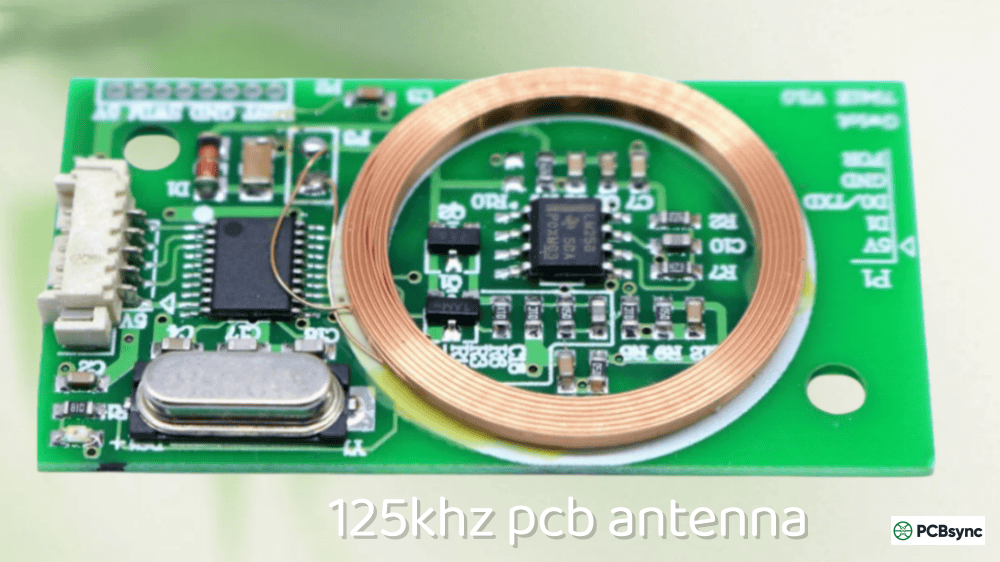
125 kHz
LF RFID, access cards
40-80 mm
10-100+
ISO 11784/85
134.2 kHz
Animal ID
30-60 mm
50-200
ISO 11784
13.56 MHz
NFC, HF RFID
20-80 mm
2-8
ISO 14443, ISO 15693
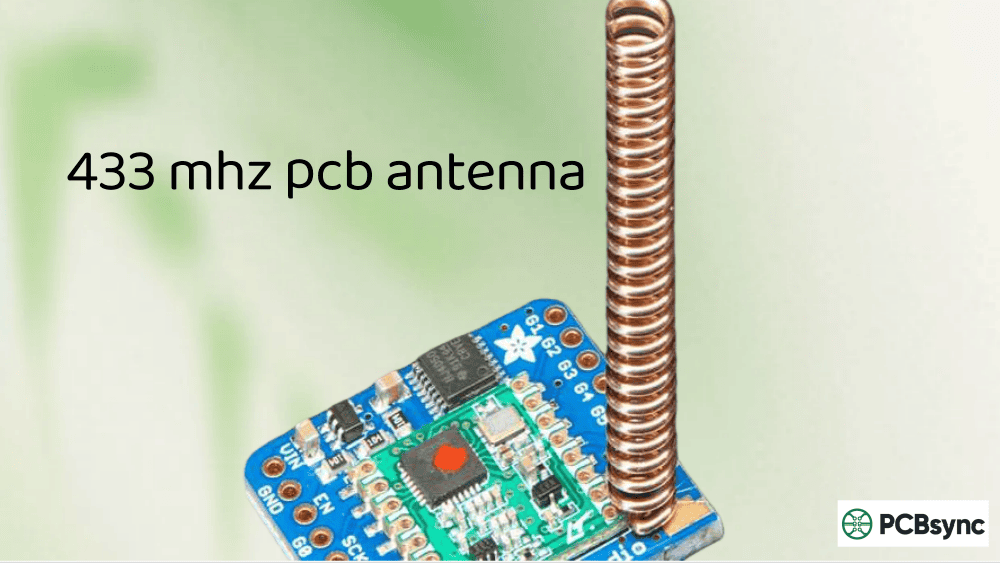
433 MHz
ISM band, key fobs
20-40 mm
1
Regional ISM
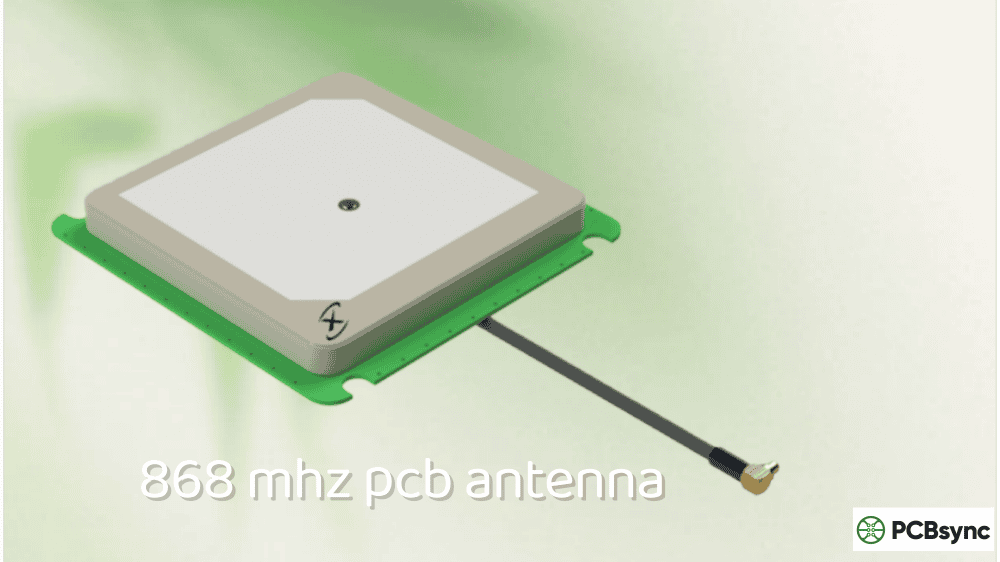
868 MHz
EU ISM, LoRa
15-30 mm
1
ETSI EN 300 220
915 MHz
US ISM, LoRa
15-25 mm
1
FCC Part 15
13.56 MHz NFC/HF RFID Requirements
Parameter
NFC Type A/B/F (ISO 14443)
NFC Type V (ISO 15693)
Carrier frequency
13.56 MHz
13.56 MHz
Data rate
106-848 kbps
26 kbps
Required bandwidth
1.7 MHz
500 kHz
Recommended Q-factor
7-10
15-35
Typical inductance
1-2 µH
2-5 µH
Inductance Calculation for Loop Antenna PCB
Accurate inductance calculation is essential for loop antenna PCB design. The resonant frequency depends directly on loop inductance and tuning capacitance.
Single-Turn Rectangular Loop Inductance
For a single-turn rectangular loop:
Parameter
Symbol
Unit
Outer width
a
mm
Outer height
b
mm
Trace width
w
mm
Inductance
L
nH
Formula: L = 0.4 × [(a + b) × ln(2ab / w) – (a × ln(a + √(a² + b²))) – (b × ln(b + √(a² + b²))) + 2(√(a² + b²) – (a + b)/2 + w/4)]
Simplified Inductance for Square Loops
Loop Size (mm)
Trace Width (mm)
Single Turn (nH)
3 Turns (nH)
5 Turns (nH)
20 × 20
0.5
65
350
750
30 × 30
0.5
105
550
1200
40 × 40
0.8
135
720
1550
50 × 50
1.0
175
920
2000
60 × 60
1.0
215
1120
2450
80 × 80
1.5
280
1480
3200
Multi-Turn Spiral Coil Inductance
For multi-turn planar spiral coils commonly used in NFC:
Proper layout is essential for achieving specified loop antenna PCB performance.
Trace Width and Copper Thickness
Trace Width
Copper Weight
DC Resistance (per meter)
Application
0.3 mm
1 oz
1.9 Ω/m
125 kHz multi-turn
0.5 mm
1 oz
1.1 Ω/m
13.56 MHz tags
1.0 mm
1 oz
0.6 Ω/m
13.56 MHz readers
1.5 mm
1 oz
0.4 Ω/m
ISM band loops
2.0 mm
2 oz
0.15 Ω/m
High-current, low loss
Wider traces reduce ohmic losses and improve Q-factor. For small loops at ISM frequencies where radiation resistance is only milliohms, trace resistance dominates losses—use the widest trace practical.
Ground Plane Requirements
Scenario
Ground Plane Recommendation
NFC tag antenna
No ground plane under loop
NFC reader antenna
Ground plane 10 mm+ from loop
ISM band loop
Ground plane acceptable near feed
Best performance
Keep ground 10-15 mm from loop edge
Metal Proximity Effects
Metal near a loop antenna causes:
Inductance reduction (eddy currents oppose the loop’s field)
Q-factor reduction (energy loss in metal)
Resonant frequency increase
Reduced coupling range
Metal Distance
Inductance Change
Q Reduction
Recommendation
0-2 mm
-30 to -50%
Severe
Not acceptable
2-5 mm
-15 to -30%
Significant
Use ferrite sheet
5-10 mm
-5 to -15%
Moderate
May need retuning
10-20 mm
-2 to -5%
Minor
Usually acceptable
>20 mm
<-2%
Minimal
No concern
Ferrite Sheet Usage for Metal Shielding
When mounting a loop antenna PCB near metal (enclosure, battery, LCD), a ferrite sheet can restore performance.
Ferrite Thickness
Frequency Range
Permeability
Effect
0.1 mm
>1 MHz
100-200
Moderate shielding
0.2 mm
>500 kHz
100-200
Good shielding
0.3 mm
>100 kHz
100-200
Excellent shielding
0.5 mm
>50 kHz
50-100
LF RFID compatible
Place ferrite sheet between the loop antenna and metal surface. The sheet redirects magnetic flux around the metal rather than through it.
Component Placement Near Loop
Component Type
Minimum Distance
Reason
Tuning capacitors
On loop or adjacent
Part of antenna
Matching network
<5 mm from feed
Minimize parasitics
RF IC
<10 mm from matching
Short traces
Power supply
>15 mm
Noise source
High-speed digital
>20 mm
EMI source
Ferrous metal parts
>10 mm or use ferrite
Detuning
Common Loop Antenna PCB Design Mistakes
Mistake 1: Wrong Capacitor Dielectric
Problem: Using X7R or Y5V capacitors for tuning. Effect: Q-factor drops from 40+ to below 10, temperature drift causes detuning. Solution: Always use C0G (NP0) capacitors for resonant circuits.
Mistake 2: Insufficient Trace Width
Problem: Using 0.2-0.3 mm traces for ISM band single-turn loop. Effect: Trace resistance dominates, efficiency drops dramatically. Solution: Use 1.5-2.0 mm traces for sub-GHz single-turn loops.
Mistake 3: Ground Plane Under NFC Antenna
Problem: Solid ground plane directly under NFC loop. Effect: Inductance reduced 30-50%, coupling range severely limited. Solution: Remove ground plane under and around loop (10+ mm clearance).
Mistake 4: Ignoring Metal in Enclosure
Problem: Designing antenna without considering metal housing or battery. Effect: Production units have poor range compared to bench testing. Solution: Test with actual enclosure, use ferrite sheet if needed, retune.
Mistake 5: Q-Factor Too High for Data Rate
Problem: Designing high-Q (>30) loop for ISO 14443 high-speed communication. Effect: Insufficient bandwidth causes data corruption at 424/848 kbps. Solution: Add damping resistor to achieve Q < 10 for high data rates.
Useful Resources for Loop Antenna PCB Design
Application Notes
Document
Source
Content
AN639
Silicon Labs
Differential loop antenna design
SWRA046A
Texas Instruments
ISM band antennas including loop
SLOA241
Texas Instruments
TRF79xxA NFC antenna design
AN2866
STMicroelectronics
ST25 NFC antenna design
AN11564
NXP
PN7120 antenna matching
Inductance Calculators
Tool
Type
URL/Source
Coil32
Software
coil32.net
Missouri S&T Calculator
Web
emclab.mst.edu
Mantaro
Web
mantaro.com
Saturn PCB Toolkit
Software
saturnpcb.com
Simulation Tools
Tool
Purpose
Cost
Sonnet Lite
EM simulation
Free (limited)
HFSS
Full-wave EM
Commercial
CST Studio
Full-wave EM
Commercial
QUCS
Circuit simulation
Free
LTspice
Circuit simulation
Free
Ferrite Sheet Suppliers
Manufacturer
Product Line
Notes
Würth Elektronik
WE-FAS series
Wide range
TDK
IFL series
NFC optimized
Laird
RFID shields
Multiple thicknesses
3M
AB series
Adhesive backed
Frequently Asked Questions
What is the difference between a loop antenna and a coil antenna?
The terms are often used interchangeably, but there’s a subtle distinction. A loop antenna PCB typically refers to a single-turn or few-turn structure used for RF applications (ISM band), where radiation characteristics matter. A “coil antenna” usually refers to multi-turn inductors used in near-field applications (NFC, RFID), where magnetic coupling dominates and radiation is negligible. In NFC at 13.56 MHz, you’re designing a resonant magnetic coupler, not a radiating antenna—the physics is transformer-like coupling between reader and tag coils. At 868/915 MHz, the loop becomes large enough relative to wavelength that radiation becomes significant, and traditional antenna parameters like gain and pattern become relevant.
How do I calculate the tuning capacitor for my loop antenna?
The tuning capacitor resonates with the loop inductance at your operating frequency. Use the formula: C = 1 / (4π²f²L). For a 1.5 µH loop at 13.56 MHz: C = 1 / (4 × π² × (13.56×10⁶)² × 1.5×10⁻⁶) = 92 pF. In practice, you’ll need to account for parasitic capacitance from the PCB, IC input capacitance, and component tolerances. Start with a calculated value about 10-15% lower and add parallel capacitance to tune. Use a network analyzer to measure actual resonant frequency and adjust accordingly. Always use C0G/NP0 dielectric capacitors—other dielectrics have poor Q and temperature stability that will degrade your antenna performance.
Why does my NFC antenna work on the bench but fail in the product enclosure?
This is almost always a metal proximity problem. Metal near your loop antenna causes inductance to drop (shifting resonant frequency higher), reduces Q-factor, and absorbs magnetic field energy. Common culprits include: metal enclosure walls, LCD frame, battery (especially lithium cells with metal cases), shielding cans, and even metalized plastic. Solutions include: repositioning the antenna away from metal (10+ mm), using a ferrite sheet between antenna and metal to redirect flux, and retuning the antenna with all enclosure components in place. Always do final tuning and range testing with the complete product assembly, not just the bare PCB.
Can I use a loop antenna near metal if I add a ferrite sheet?
Yes, ferrite sheets are specifically designed to enable loop antenna PCB operation near metal. The ferrite provides a high-permeability path for magnetic flux, redirecting it around the metal rather than through it. Place the ferrite between your loop and the metal surface. Choose ferrite thickness based on frequency—thicker sheets work better at lower frequencies. At 13.56 MHz, 0.2-0.3 mm sheets typically restore 70-90% of free-space performance. You’ll still need to retune the antenna since the ferrite affects inductance. The ferrite sheet also adds cost and thickness to your design, so avoid metal proximity if possible. If metal is unavoidable (battery-backed NFC tag), budget for ferrite from the start of your design.
What Q-factor should I target for an NFC antenna?
It depends on your communication standard and data rate. For ISO 14443 (NFC Type A/B) at high data rates (424/848 kbps), target Q = 7-10 to ensure sufficient bandwidth (1.7 MHz) for the sidebands. For ISO 15693 (NFC Type V) at 26 kbps, you can use Q = 20-35 for improved sensitivity and range—the narrower bandwidth is acceptable for the lower data rate. Higher Q means better energy transfer and longer read range, but insufficient bandwidth for high-speed data. If your reader must support multiple standards, design for the most demanding case (ISO 14443 high-speed, Q < 10) and accept slightly reduced range for ISO 15693. Add a damping resistor in parallel with the tuning capacitor to reduce Q to your target value.
Conclusion
Loop antenna PCB design differs fundamentally from other antenna types because it relies on magnetic coupling rather than electromagnetic radiation. This makes loops ideal for NFC, RFID, and near-field ISM band applications where coupling range is measured in centimeters to tens of centimeters, not meters.
Success with loop antennas requires attention to several key factors: accurate inductance calculation based on loop geometry, proper Q-factor selection matched to your bandwidth requirements, careful impedance matching using tapped loops or pi-networks, and managing metal proximity through either distance or ferrite shielding. The dimension tables in this guide provide starting points for common frequencies from 125 kHz through 915 MHz.
For NFC applications, remember that you’re designing a transformer, not a radiator—focus on magnetic coupling coefficient and field strength at your required read distance. For ISM band applications, the loop becomes a true antenna with radiation characteristics. In both cases, prototype early, measure with proper equipment (network analyzer for impedance, field probe for magnetic field strength), and always validate with final enclosure materials in place. The difference between bench performance and production performance is often the detail that separates working products from failed designs.
Inquire: Call 0086-755-23203480, or reach out via the form below/your sales contact to discuss our design, manufacturing, and assembly capabilities.
Quote: Email your PCB files to Sales@pcbsync.com (Preferred for large files) or submit online. We will contact you promptly. Please ensure your email is correct.
Notes: For PCB fabrication, we require PCB design file in Gerber RS-274X format (most preferred), *.PCB/DDB (Protel, inform your program version) format or *.BRD (Eagle) format. For PCB assembly, we require PCB design file in above mentioned format, drilling file and BOM. Click to download BOM template To avoid file missing, please include all files into one folder and compress it into .zip or .rar format.