Inquire: Call 0086-755-23203480, or reach out via the form below/your sales contact to discuss our design, manufacturing, and assembly capabilities.
Quote: Email your PCB files to Sales@pcbsync.com (Preferred for large files) or submit online. We will contact you promptly. Please ensure your email is correct.
Notes: For PCB fabrication, we require PCB design file in Gerber RS-274X format (most preferred), *.PCB/DDB (Protel, inform your program version) format or *.BRD (Eagle) format. For PCB assembly, we require PCB design file in above mentioned format, drilling file and BOM. Click to download BOM template To avoid file missing, please include all files into one folder and compress it into .zip or .rar format.
LED PCB Design: SMD, Light Circuits & VU Meter Layout Guide
After spending 15 years designing circuit boards for lighting applications, I’ve learned that LED PCB designisn’t just about placing components on copper—it’s about understanding heat flow, current paths, and the unique demands that make light-emitting diode circuits different from everything else on your bench.
Whether you’re building a simple indicator panel, a commercial lighting fixture, or a fancy 40 LED VU meter circuit with PCB layout, this guide covers the practical knowledge that separates working prototypes from production-ready designs. Let’s dig into what actually matters.
Understanding LED Light Circuit Board Design Fundamentals
The foundation of successful LED light circuit board design starts with recognizing what makes these boards unique. Unlike typical digital circuits where signals matter most, LED boards face two simultaneous challenges: delivering clean, stable current to every diode while managing the heat that threatens to destroy them.
Every LED generates heat at its junction—the tiny semiconductor interface where photons are born. High-brightness LEDs can produce 1-3 watts of thermal energy concentrated in an area smaller than a pencil eraser. Without proper thermal management, junction temperatures climb past 150°C, and your 50,000-hour LED lifespan shrinks to months.
The Three Pillars of LED Circuit Design
Successful LED boards balance three interconnected requirements:
Current regulation ensures each LED receives its rated forward current regardless of voltage fluctuations. A 350mA LED driven at 400mA doesn’t just get brighter—it generates exponentially more heat and degrades rapidly.
Thermal management creates efficient pathways for heat to escape from LED junctions through the PCB substrate to ambient air or heatsinks. The rule of thumb from industry research: every 10°C reduction in junction temperature adds approximately 10,000 hours to LED lifespan.
Electrical distribution provides low-impedance paths that minimize voltage drops and ensure uniform brightness across all LEDs in your array. A 0.5V drop across undersized traces can mean visibly dimmer LEDs at the end of a string.
LED PCB Design Tool
PCBSync Engineering Tools
💡 LED Calculator
🔲 Array Designer
🌡️ Thermal Analysis
💎 LED Chips Guide
📋 PCB Types
⚡ Design Tips
⚡
Basic LED Calculations
📊 Calculation Results
Required Resistor:–
Nearest Standard:–
Power Dissipation:–
Recommended Rating:–
📏
PCB Trace Width Calculator
📊 Trace Requirements
Minimum Width:–
Recommended Width:–
Cross-sectional Area:–
⚠️
Important: Always add a safety margin to your calculations. Use resistors with at least 2x the calculated power rating. Verify all calculations with actual LED datasheets before manufacturing.
🔲
Array Configuration
📊 Array Configuration
LEDs in Series:–
Parallel Strings:–
Total Current Draw:–
Total Power:–
Resistor per String:–
👁️
Visual Array Layout
Configure your array to see the layout
💡
Design Tip: Each parallel string should have its own current limiting resistor to ensure equal current distribution. Never connect LEDs in parallel without individual resistors or a constant current driver.
🌡️
Heat Dissipation Calculator
📊 Thermal Analysis
Total Heat:–
Junction Temperature:–
Temperature Margin:–
Status:–
🎯
PCB Copper Area Calculator
📊 Copper Area Requirements
Required Area:–
Recommended Area:–
Thermal Performance:–
🔥 Thermal Management Tips
Use thermal vias under high-power LEDs (0.3mm diameter, 0.7mm pitch)
Create solid copper pours for heat spreading
Consider MCPCB for power >1W per LED
Maintain 80% or less of maximum junction temperature
Add thermal interface material between LED and PCB
❄️ Cooling Strategies
Natural Convection: Best for <5W total power
Heatsink: Required for 5-20W applications
Active Cooling: Fan required above 20W
Thermal Pads: Use 3-6 W/mK conductivity
Spacing: Minimum 10mm between high-power LEDs
Select LED Type for Detailed Specifications
SMD 3528
3.5×2.8mm
Low Power
SMD 5050
5.0×5.0mm
RGB / White
SMD 2835
2.8×3.5mm
High Efficiency
SMD 5730
5.7×3.0mm
High Power
COB LED
Various sizes
High Density
High Power
1W-100W
Spotlights
🎨 Color Temperature Guide
Warm White (2700-3500K): Residential, hospitality
Neutral White (3500-5000K): Office, retail
Cool White (5000-6500K): Industrial, outdoor
RGB: Entertainment, signage, accent lighting
💪 Power Considerations
Low Power (<0.1W): Indicators, backlighting
Mid Power (0.2-0.5W): General lighting
High Power (1-3W): Spotlights, automotive
Ultra High (>3W): Industrial, street lighting
📊 Key Specifications
Forward Voltage (Vf): Typically 2.8-3.6V
Forward Current (If): 20mA to several amps
Luminous Flux: 5-200 lm/LED
Viewing Angle: 120-140° typical
CRI (Color Rendering Index): >80 preferred
🟢 Standard FR4 PCB
Best For: Low-power LED applications (<0.5W per LED)
Thermal Conductivity: 0.3 W/mK
Advantages:
Low cost and widely available
Standard manufacturing process
Good for indicators and displays
Easy to prototype
Disadvantages:
Poor heat dissipation
Not suitable for high-power LEDs
Limited thermal management
🔵 Aluminum Core PCB (MCPCB)
Best For: High-power LEDs (>1W per LED)
Thermal Conductivity: 1-3 W/mK
Advantages:
Excellent heat dissipation
Extends LED lifespan
Better thermal performance than FR4
Industry standard for LED lighting
Disadvantages:
Higher cost than FR4
Typically single-layer design
Limited routing options
🟡 Ceramic PCB
Best For: Ultra high-power LEDs (>5W per LED)
Thermal Conductivity: 20-170 W/mK
Advantages:
Superior thermal conductivity
Excellent dimensional stability
High reliability in harsh environments
Low thermal expansion coefficient
Disadvantages:
Very high cost
Brittle and fragile
Complex manufacturing
🟣 Copper Core PCB
Best For: Specialized high-power applications
Thermal Conductivity: 380 W/mK
Advantages:
Best thermal performance
Excellent heat spreading
High current capacity
Durable and robust
Disadvantages:
Expensive
Heavy weight
Specialized manufacturing
🟠 Flexible PCB
Best For: LED strips, wearables, curved applications
Thermal Conductivity: 0.2-0.4 W/mK
Advantages:
Bendable and flexible
Lightweight
3D design possibilities
Space-saving
Disadvantages:
Poor heat dissipation
Only for low-power LEDs
Higher cost than rigid FR4
⚪ Heavy Copper PCB
Best For: High-current LED arrays
Copper Weight: 3-10 oz
Advantages:
High current handling (>10A)
Better heat spreading
Improved thermal management
Reduced voltage drop
Disadvantages:
Increased cost
Larger minimum trace spacing
Requires special etching
PCB Type
Thermal Conductivity
Max Power/LED
Cost Ratio
Best Application
Standard FR4
0.3 W/mK
< 0.5W
1x
Indicators, Displays
Aluminum MCPCB
1-3 W/mK
1-5W
2-3x
General LED Lighting
Ceramic
20-170 W/mK
> 5W
10-15x
High-Power Spotlights
Copper Core
380 W/mK
> 10W
8-12x
Industrial Lighting
Flexible
0.2-0.4 W/mK
< 0.2W
3-5x
LED Strips, Wearables
Heavy Copper FR4
0.5-0.8 W/mK
0.5-2W
2-4x
LED Arrays
⚡ Power Supply Design
Use constant current drivers for consistent brightness
Add 20-30% power supply headroom
Include TVS diodes for ESD protection
Implement reverse polarity protection
Add bulk capacitors near LED arrays (100µF+)
Use ceramic bypass caps (0.1µF) at each LED cluster
🎯 PCB Layout Best Practices
Keep LED-to-driver traces short and wide
Use ground plane for heat dissipation
Place thermal vias under LED pads (9-16 vias)
Maintain symmetrical thermal design
Route high-current traces on outer layers
Avoid right-angle corners in traces
🌡️ Thermal Design Rules
Calculate junction temperature accurately
Use thermal simulation software (ANSYS, SolidWorks)
Maintain 10-15mm spacing between high-power LEDs
Apply thermal compound (TIM) properly
Consider airflow direction in enclosure
Test at maximum ambient temperature +10°C
🔌 Component Selection
Choose resistors with 2x power rating minimum
Use metal film resistors for better stability
Select LEDs with matching Vf bins (±0.1V)
Consider LED aging (30% brightness loss over life)
Use automotive-grade components for harsh environments
Verify component temperature ratings
💡 Optical Design Considerations
Choose appropriate viewing angle for application
Use diffusers to eliminate hotspots
Consider light mixing distance (10x LED spacing)
Account for optical losses (lens ~10-15%)
Use reflective solder mask (white) for backlighting
Test color consistency across production
🔬 Testing & Quality
Perform thermal imaging at full power
Test at min, nominal, and max voltage
Conduct life testing (1000+ hours)
Measure actual forward voltage distribution
Verify EMI compliance if required
Document failure modes and rates
🛡️ Protection & Reliability
Add ESD protection on all external connections
Use conformal coating for moisture protection
Implement over-temperature shutdown
Add current limiting for fault protection
Consider redundant LED strings for critical applications
Design for 50,000+ hour lifespan
📐 Mechanical Design
Ensure proper heatsink contact (flatness <0.1mm)
Use spring-loaded mounting for thermal expansion
Consider vibration in automotive/industrial
Provide proper ventilation holes in enclosure
Account for LED mechanical stress during assembly
Design for easy maintenance and LED replacement
💰 Cost Optimization
Use standard LED packages when possible
Minimize PCB layers (2-layer for most designs)
Optimize copper usage to reduce material cost
Consider panel utilization in manufacturing
Use common components to reduce BOM cost
Design for automated assembly
📚
Pro Tip: Always prototype your LED PCB design before mass production. Test under worst-case conditions (maximum ambient temperature, maximum current, minimum airflow). A $500 prototype can save $50,000 in production rework.
📋 Pre-Manufacturing Checklist
Selecting the Right PCB Substrate Material
Material selection drives both performance and cost in LED applications. Here’s what I’ve learned matters in practice:
PCB Material Comparison for LED Applications
Material
Thermal Conductivity
Best Applications
Cost Factor
Notes
FR-4 (Standard)
0.3 W/mK
Low-power indicators, <0.5W LEDs
1× (baseline)
Works for small projects, poor heat handling
Aluminum MCPCB
1-3 W/mK
General LED lighting, mid-power arrays
2-3×
Sweet spot for most commercial lighting
High-performance IMS
3-7 W/mK
High-power LED arrays, street lighting
4-6×
Specialized dielectric layers
Copper Core PCB
200+ W/mK
Extreme heat loads, automotive, surgical
8-15×
Maximum thermal performance
Ceramic (Al₂O₃)
24-30 W/mK
High-reliability, UV curing, medical
10-20×
Excellent electrical isolation
For most LED light circuit board design projects, aluminum-core metal-core PCBs (MCPCBs) offer the best balance of thermal performance and cost. The typical structure places a 35μm copper circuit layer on top of a 75-100μm thermally conductive dielectric, bonded to a 1.0-3.0mm aluminum base. This configuration transfers heat 8-10× faster than standard FR-4.
When Standard FR-4 Actually Works
Don’t automatically reach for expensive metal-core materials. FR-4 handles LED applications just fine when:
Individual LED power dissipation stays below 0.5W
LEDs are widely spaced (>15mm apart)
The application tolerates moderate brightness variations
Cost constraints matter more than longevity
Ambient temperatures remain below 35°C
I’ve shipped hundreds of indicator panel designs on standard 1.6mm FR-4 that work perfectly for years. The key is honest thermal calculations—not assumptions.
SMD LED PCB Board Design: Layout Strategies That Work
Surface-mount LED design dominates modern lighting because SMD packages offer better thermal coupling to the PCB, smaller footprints, and easier automated assembly. Getting SMD LED PCB board design right requires attention to details that through-hole components forgive.
Critical Pad Design Guidelines
SMD LED pads require careful dimensioning. The table below shows recommended pad sizes for common packages:
LED Package
Pad Dimensions (mm)
Pad Spacing
Thermal Pad Size
Solder Paste Opening
0402
0.4 × 0.3
0.2
N/A
80% pad area
0603
0.8 × 0.6
0.3
N/A
85% pad area
2835
2.8 × 3.5
0.5
2.0 × 2.0
90% pad area
5050
5.0 × 5.0
0.8
3.0 × 3.0
90% pad area
3030 High-Power
3.0 × 3.0
0.6
Full underside
90% pad area
The thermal pad underneath high-power SMD LEDs deserves special attention. This pad connects directly to the LED’s heat slug and handles the majority of heat transfer. Connect it to a large copper pour using an array of thermal vias—typically 0.3mm diameter on 1.0mm pitch.
Trace Routing for Current-Carrying Paths
LED traces carry real current, not just signals. Size them accordingly:
For currents up to 1A, use minimum 0.5mm (20 mil) trace widths on 1oz copper. Scale to 1.5-2.0mm for currents between 2-3A. The IPC-2221 standard provides detailed calculations, but these rules of thumb keep you safe in most LED applications.
Avoid 90-degree trace corners in high-current paths. They create current crowding that increases local heating and can cause long-term reliability issues. Use 45-degree miters or smooth curves instead.
Component Placement Best Practices
Effective SMD LED PCB board design follows these placement principles:
Keep current-limiting resistors within 5mm of their associated LEDs. Longer distances introduce inductance that can cause ringing with PWM dimming.
Maintain minimum 5-10mm spacing between adjacent high-power LEDs to prevent thermal interaction. Tighter spacing requires more aggressive thermal management or forced-air cooling.
Orient all LEDs consistently—it simplifies manufacturing inspection and makes polarity errors immediately visible. Modern pick-and-place machines handle rotation easily, but consistent orientation reduces visual QC burden.
Place bypass capacitors at power entry points and every 5-10 LEDs in long strings. Use 0.1μF ceramic capacitors minimum; 1μF provides better high-frequency filtering for PWM-driven applications.
Thermal Management Techniques for High-Power LED PCBs
Heat kills LEDs. Period. Everything else in thermal design flows from this simple truth.
Thermal Via Implementation
Thermal vias provide the critical heat path from surface copper to internal layers or the metal core. Effective via implementation follows these guidelines:
Via diameter: 0.3-0.5mm (12-20 mil) works well. Smaller vias pack more densely; larger vias conduct heat better individually.
Via spacing: Place vias on 1.0-1.5mm pitch directly under LED thermal pads. Closer spacing improves thermal conductivity but increases fabrication cost.
Via filling: For best thermal performance, specify filled and plated vias. Unfilled vias work but conduct approximately 40% less heat.
Via quantity: The thermal pad should contain enough vias that their combined cross-sectional area equals at least 25% of the pad area.
Copper Pour Strategy
Copper pours serve dual purposes in LED designs: electrical distribution and thermal spreading. Maximize copper area on all layers, particularly under and around LED positions.
For single-layer designs, extend copper pours at least 10mm beyond LED footprints in all directions. This “thermal spreading” zone reduces the temperature gradient between LED junction and board edge.
On multi-layer boards, connect thermal pours across layers using via stitching. Don’t rely on single thermal via arrays—distributed connections spread heat more effectively.
Heat Sink Integration
When passive cooling through the PCB isn’t sufficient, external heat sinks become necessary. Design considerations include:
Mounting provisions: Include appropriate screw holes or thermal adhesive mounting areas. M3 mounting holes on 25-50mm centers suit most commercial heat sinks.
Interface materials: Thermal interface materials (TIMs) bridge microscopic air gaps between PCB and heat sink. Budget 0.5-1.5mm thickness in your stack-up calculations.
Contact area: The heat sink contact surface should extend beyond the LED array by at least 20% in each direction to ensure adequate heat spreading.
Audio VU meters represent a classic application that combines LED arrays with analog signal processing. Building a 40 LED VU meter circuit with PCB layout teaches valuable lessons applicable to any multi-LED project.
Understanding VU Meter Topologies
Three main approaches exist for driving LED VU meters:
Discrete transistor ladders use individual transistors as comparators, with each transistor switching its LED when the audio signal exceeds a preset threshold. This approach dominated 1980s audio equipment and remains educational today. The classic 20-40 LED designs use transistors like 2N3904 or BC547 with voltage divider networks setting the switching points.
Dedicated driver ICs like the LM3914, LM3915, and LM3916 simplify design dramatically. Each IC drives 10 LEDs with internal voltage references and comparators. The LM3915 provides logarithmic (3dB/step) response appropriate for audio; the LM3914 offers linear response. Cascading multiple ICs creates 20, 30, or 40 LED displays.
Microcontroller-based designs sample the audio digitally and drive LEDs through shift registers or LED driver ICs. This approach offers flexibility but adds firmware complexity.
IC-Based 40 LED VU Meter Design
For reliable results, I recommend cascading four LM3915 ICs. Here’s the essential circuit architecture:
The audio input connects through a coupling capacitor (1-10μF) to a sensitivity adjustment potentiometer (10K typical). This feeds the signal input (pin 5) of the first LM3915.
Power supply requirements are straightforward: 9-12V DC at approximately 200mA with all LEDs illuminated. Each LED draws roughly 10-20mA depending on brightness requirements.
PCB Layout Considerations for VU Meters
The 40 LED VU meter circuit with PCB layout presents unique challenges:
LED alignment: Arrange LEDs in a straight line or arc with consistent spacing. 2.54mm (0.1″) pitch works well with standard 3mm or 5mm through-hole LEDs. For SMD designs, 2835 or 3528 packages on 5mm pitch provide good visual density.
Power distribution: Route power traces wide enough to handle 400-500mA total current. Use 1.5-2.0mm trace widths for main power rails, branching to individual IC supply pins.
Signal routing: Keep audio input traces short and away from power traces to minimize noise pickup. A ground plane under the input section helps shield sensitive analog signals.
IC placement: Position LM3915 ICs centrally with LEDs arranged around them. This minimizes trace lengths and simplifies routing.
Component Selection Table for 40 LED VU Meter
Component
Value/Type
Quantity
Notes
LM3915N
DIP-18
4
Or LM3914 for linear response
LEDs
3mm or 5mm
40
Green/Yellow/Red color scheme typical
Input capacitor
1-10μF electrolytic
1
Audio coupling
Filter capacitor
2.2μF electrolytic
1
Input filtering
Reference resistor
1.2K 1/4W
4
Sets LED current
Sensitivity pot
10K linear
1
Input level adjustment
Bypass capacitors
100nF ceramic
4
One per IC
Power capacitor
100-470μF electrolytic
1
Supply filtering
LED PCB Design Software and Tools
The right tools accelerate design and reduce errors. Here’s what works well for LED projects:
Professional and Hobbyist Software Options
Software
Cost
Learning Curve
LED Design Strengths
Best For
KiCad
Free
Moderate
Excellent thermal via tools, good library support
Hobbyists to professionals
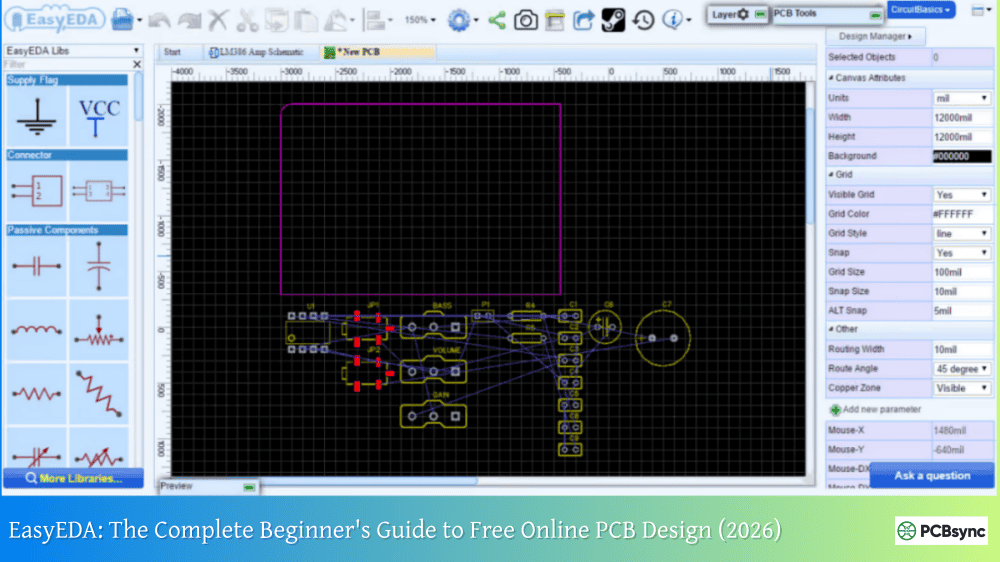
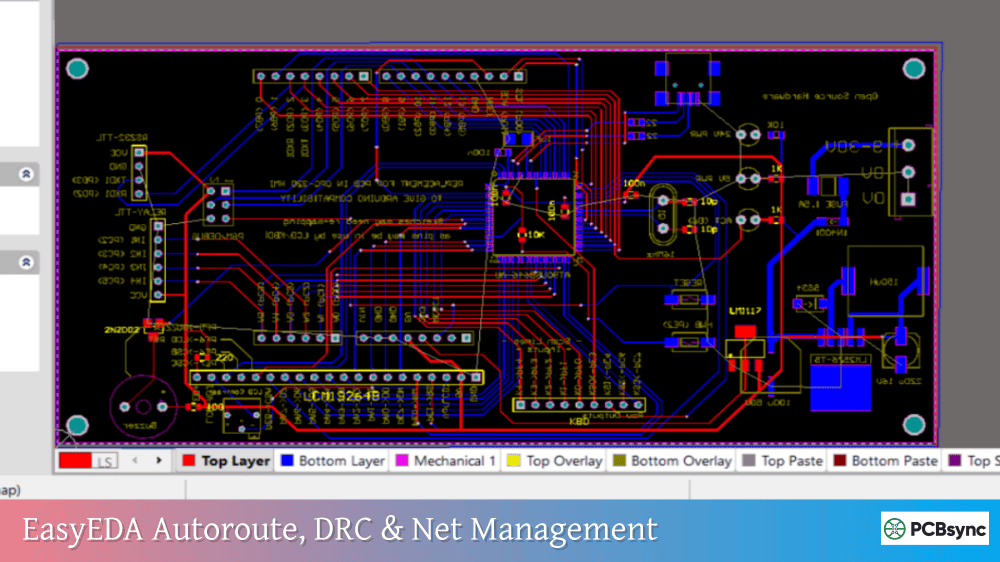
EasyEDA
Free
Easy
Cloud-based, integrated ordering, large component library
Beginners, quick prototypes
Altium Designer
$$$
Steep
Advanced thermal analysis, professional features
Commercial production
EAGLE
Free/Paid
Moderate
Extensive community libraries, SparkFun/Adafruit designs
Makers, small businesses
Cadence Allegro
$$$
Steep
Enterprise-grade, thermal simulation
High-volume manufacturing
For most LED projects, KiCad or EasyEDA provide everything needed without licensing costs. Both support multi-layer designs, thermal via arrays, and export to all common manufacturing formats.
Essential Design Resources
These resources prove invaluable for LED PCB work:
Trace width calculators: Saturn PCB Toolkit or online calculators based on IPC-2221 standards help size current-carrying traces correctly.
Thermal simulation: Free tools like SimScale offer basic thermal analysis. For serious work, ANSYS Icepak or FloTHERM provide detailed predictions.
Component footprint libraries: SnapEDA and Ultra Librarian offer verified footprints for most LED packages, eliminating a common source of manufacturing errors.
Common LED PCB Design Mistakes to Avoid
After reviewing hundreds of LED board designs—both my own and others’—certain mistakes appear repeatedly. Avoiding these saves time and money.
Thermal Mistakes
Insufficient copper under LEDs: Small pads work electrically but create thermal bottlenecks. Always maximize copper area around high-power LEDs.
Missing thermal vias: Surface copper alone doesn’t transfer heat to inner layers or metal cores effectively. Thermal vias are mandatory for any LED dissipating more than 0.5W.
Ignoring ambient temperature: A design that works at 25°C may fail at 45°C ambient. Always analyze thermal performance at maximum expected operating temperature.
Electrical Mistakes
Undersized traces: LED traces carry real current. Using default signal trace widths causes voltage drops and localized heating.
Missing current limiting: LEDs require current limiting—always. Whether through resistors, constant-current drivers, or switching regulators, current must be controlled.
Poor decoupling: PWM-driven LEDs generate high-frequency noise. Without proper decoupling capacitors, this noise can cause EMI issues and erratic behavior.
Manufacturing Mistakes
Incorrect footprints: The most common and frustrating mistake. Always verify footprints against manufacturer datasheets—pad dimensions, spacing, and thermal pad requirements.
Inadequate solder mask clearance: LED pads need proper solder mask expansion. Too tight risks solder mask on pads; too loose invites solder bridging.
Missing polarity markings: LEDs have polarity. Clear silkscreen markings prevent assembly errors that require rework.
Useful Resources for LED PCB Designers
These resources accelerate learning and solve specific problems:
Design Guidelines and Standards
IPC-2221: Generic standard on printed board design
IPC-7351: Generic requirements for surface mount land patterns
JEDEC JESD51: Thermal measurement standards for LED packages
Online Tools and Calculators
Saturn PCB Design Toolkit: Comprehensive calculator suite (free)
JLCPCB Capabilities: Manufacturing constraints for low-cost production
DigiKey Component Search: Extensive parametric search for LED components
PCB Fabrication Services
JLCPCB: Cost-effective prototyping, aluminum PCB options available
PCBWay: Flexible options, good for metal-core boards
OSH Park: Quality finish, popular with hobbyists
Component Datasheets
Always download complete datasheets from manufacturers. Key LED manufacturers include:
Cree (high-power LEDs)
Lumileds (Luxeon series)
Samsung (mid-power SMD LEDs)
Osram (automotive and specialty)
Nichia (high-efficiency LEDs)
Frequently Asked Questions
What is the best PCB material for LED lighting applications?
For most LED lighting applications, aluminum-core MCPCBs (metal-core printed circuit boards) offer the best balance of thermal performance and cost. Aluminum provides thermal conductivity around 200 W/mK compared to 0.3 W/mK for standard FR-4. This 600× improvement in heat transfer keeps LED junctions cooler and extends operating life. For low-power indicators below 0.5W, standard FR-4 works adequately. For extreme high-power applications or when weight isn’t a concern, copper-core PCBs provide even better thermal performance.
How do I calculate the correct trace width for LED circuits?
Trace width depends on current, copper thickness, acceptable temperature rise, and whether the trace is on an external or internal layer. For a quick estimate with 1oz copper and 10°C temperature rise: use 0.5mm minimum for currents up to 1A, 1.0mm for 1-2A, and 1.5-2.0mm for 2-3A. External traces can carry approximately 50% more current than internal traces of the same width due to better air cooling. For precise calculations, use IPC-2221-based calculators like the Saturn PCB Toolkit, inputting your specific parameters.
Can I use SMD LEDs on standard FR-4 PCBs?
Yes, SMD LEDs work fine on FR-4 for lower-power applications. The key considerations are power dissipation and thermal design. LEDs dissipating less than 0.5W each, with adequate spacing (>10mm) and generous copper pours, function reliably on FR-4. Add thermal vias under LED thermal pads and maximize copper area to improve heat spreading. For LEDs above 1W individual power, or densely-packed arrays, switch to aluminum MCPCB or implement external heat sinking.
What causes LEDs to fail prematurely on PCBs?
The primary causes of premature LED failure relate to heat: inadequate thermal design causing excessive junction temperatures, insufficient thermal vias, poor thermal interface to heat sinks, or operating in high-ambient environments without derating. Secondary causes include overcurrent (missing or failed current limiting), electrostatic discharge damage during handling, and solder joint failures from thermal cycling. Proper thermal design addressing all heat paths from junction to ambient prevents most failures.
How many thermal vias do I need under an LED?
The number of thermal vias depends on LED power, via diameter, and target thermal resistance. As a practical guideline: for LEDs up to 1W, use a minimum of 4-6 vias of 0.3mm diameter. For 1-3W LEDs, use 9-16 vias in a grid pattern. For high-power LEDs above 3W, fill the entire thermal pad area with vias on 1.0-1.2mm pitch. The vias’ combined cross-sectional copper area should equal at least 25% of the thermal pad area. Filled and plated vias conduct approximately 40% more heat than hollow vias.
Final Thoughts on LED PCB Design
Successful LED PCB design combines electrical engineering fundamentals with thermal management expertise and practical manufacturing knowledge. The techniques covered here—proper material selection, thermal via implementation, trace sizing, and careful component placement—apply whether you’re building a simple indicator or a commercial lighting product.
Start with thermal design first. Calculate your heat loads, select appropriate materials, and design adequate heat paths before worrying about electrical routing. An electrically perfect design that overheats fails just as surely as one with poor connections.
Test prototypes under realistic conditions. Room-temperature bench testing doesn’t reveal thermal problems that appear at elevated ambient temperatures or after extended operation. Build in margin—design for 20% less junction temperature than maximum rated to ensure long-term reliability.
Document everything. Future you (or your manufacturing partner) will appreciate clear notes on design decisions, component selections, and test results. Good documentation separates professional work from hobby projects.
The LED lighting market continues growing, and well-designed boards command premium prices. Master these fundamentals, and you’ll build products that perform reliably for years—which is ultimately what separates good engineering from lucky prototypes.
Inquire: Call 0086-755-23203480, or reach out via the form below/your sales contact to discuss our design, manufacturing, and assembly capabilities.
Quote: Email your PCB files to Sales@pcbsync.com (Preferred for large files) or submit online. We will contact you promptly. Please ensure your email is correct.
Notes: For PCB fabrication, we require PCB design file in Gerber RS-274X format (most preferred), *.PCB/DDB (Protel, inform your program version) format or *.BRD (Eagle) format. For PCB assembly, we require PCB design file in above mentioned format, drilling file and BOM. Click to download BOM template To avoid file missing, please include all files into one folder and compress it into .zip or .rar format.