Inquire: Call 0086-755-23203480, or reach out via the form below/your sales contact to discuss our design, manufacturing, and assembly capabilities.
Quote: Email your PCB files to Sales@pcbsync.com (Preferred for large files) or submit online. We will contact you promptly. Please ensure your email is correct.
Notes: For PCB fabrication, we require PCB design file in Gerber RS-274X format (most preferred), *.PCB/DDB (Protel, inform your program version) format or *.BRD (Eagle) format. For PCB assembly, we require PCB design file in above mentioned format, drilling file and BOM. Click to download BOM template To avoid file missing, please include all files into one folder and compress it into .zip or .rar format.
If you’ve spent any time selecting components for IoT devices, embedded vision systems, or industrial automation projects, you’ve probably hit the same wall I have: finding processing power that doesn’t drain your power budget or blow up your board dimensions. That’s exactly where Lattice FPGA technology has carved out a sweet spot that frankly, the big players like AMD (Xilinx) and Intel (Altera) haven’t bothered to address.
After working with these devices across multiple product designs over the past few years, I’ve put together this comprehensive guide covering everything from product families to real-world implementation considerations. Whether you’re evaluating your first Lattice FPGA or looking to expand your toolkit, this article breaks down what actually matters when designing with these low-power workhorses.
Why Choose Lattice FPGA for Edge Computing Applications
The edge AI hardware market is projected to reach over $38.9 billion by 2029, and a significant chunk of that growth is coming from exactly the kind of low-power, small form factor applications that Lattice FPGA devices handle exceptionally well. But let’s be honest about what these chips are and aren’t designed for.
Lattice isn’t trying to compete with Xilinx Versal or Intel Stratix in the data center. They’ve strategically positioned themselves as the leaders in the small, power-efficient FPGA segment where milliwatts matter and every square millimeter of PCB real estate is precious. This focused approach has paid off in markets like automotive ADAS, industrial sensors, smart home devices, and medical imaging equipment.
Key Advantages of Lattice FPGA Technology
From a hardware design perspective, there are several compelling reasons to consider Lattice FPGA solutions for your next edge computing project:
Ultra-Low Power Consumption: Some iCE40 family members operate with standby currents as low as a few dozen microamps. The Nexus platform devices deliver up to 3-4x lower power consumption compared to competing FPGAs with similar logic cell counts.
Compact Form Factors: Package sizes as small as 3.5mm x 3.5mm (CrossLinkPlus) and 6mm x 6mm make board layout significantly easier for space-constrained designs.
Instant-On Capability: Boot times as fast as 3ms for I/O configuration make these devices practical for applications where system responsiveness is critical.
FD-SOI Process Technology: The 28nm FD-SOI (Fully Depleted Silicon-on-Insulator) process used in Nexus platform devices provides up to 100x lower soft error rate (SER) compared to bulk CMOS alternatives.
Cost-Effective: For small to mid-range applications, Lattice offers an excellent price-to-performance ratio that makes them viable for high-volume consumer products.
Complete Guide to Lattice FPGA Product Families
Understanding the Lattice FPGA portfolio requires knowing that they organize products into two main platforms (Nexus and Avant) plus several legacy families. Each serves different application requirements, and picking the right one upfront saves considerable design iteration later.
Lattice Nexus Platform: The 28nm FD-SOI Foundation
The Nexus platform, built on Samsung’s 28nm FD-SOI process, was a game-changer for Lattice when it launched. It delivers the power efficiency and reliability improvements that come with FD-SOI technology while maintaining backward compatibility with existing software tools.
The Nexus 2 platform, announced in December 2024, continues this legacy with 16nm FinFET technology, offering up to 3x lower power than competitive devices while adding post-quantum safe security features like AES-GCM and SHA-3 authentication.
CrossLink-NX: Embedded Vision Champion
CrossLink-NX devices are specifically optimized for embedded vision and video bridging applications. They support MIPI D-PHY (CSI-2 and DSI), LVDS, SLVS, sub-LVDS, and multiple other video interfaces that you’ll encounter in camera and display designs.
The family includes devices with 17K and 40K logic cells, 2.9Mb of embedded memory, and DDR3/LPDDR2/LPDDR3 support up to 1066 Mbps. Power consumption runs up to 75% lower than comparable competing FPGAs, which is significant when you’re aggregating multiple camera feeds or processing video streams at the edge.
Certus-NX and CertusPro-NX: General Purpose Workhorses
For general-purpose FPGA applications that don’t specifically require video-centric interfaces, the Certus families provide flexible options. Certus-NX maxes out at 39K logic cells, while CertusPro-NX extends to 100K logic cells with enhanced DSP capabilities.
The recently expanded Certus-NX line now includes devices scaling to 65K logic cells with up to 380 programmable I/O and 128 DSP blocks, all while maintaining sub-watt power profiles. The 3.3V I/O support in newer devices addresses a long-standing request for interfacing with legacy industrial systems.
MachXO5-NX and Mach-NX: Control and Security Applications
The Mach family focuses on control plane applications with integrated flash for configuration storage. This eliminates the external configuration memory typically required for SRAM-based FPGAs, simplifying your BOM and reducing system complexity.
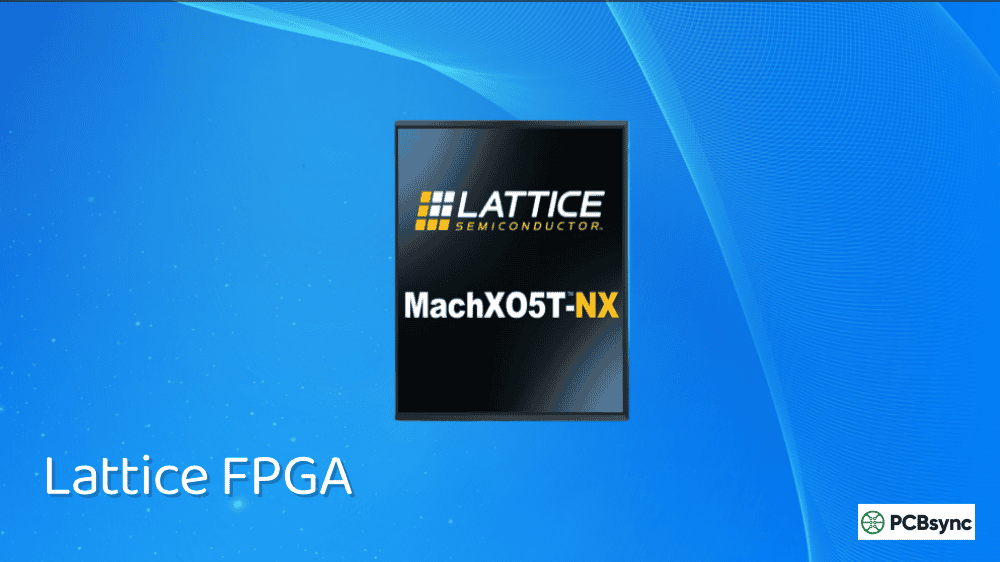
MachXO5-NX offers up to 25K logic cells with hardware root-of-trust security features. These devices are particularly relevant for platform firmware protection, system management, and applications requiring secure boot capabilities.
Lattice Avant Platform: Mid-Range FPGA Performance
The Avant platform, built on TSMC’s 16nm FinFET process, represents Lattice’s push into mid-range FPGA territory. With up to 500K logic elements, these devices offer 5x more capacity than the Nexus platform while maintaining Lattice’s power efficiency focus.
Avant-E, the first family on this platform, delivers up to 5 TOPS (tera operations per second) for AI inferencing at 350 MHz. Compared to Intel Arria V and AMD Kintex-7, Lattice claims 2.5x lower power consumption, 2x faster throughput, and 6x smaller package sizes.
Lattice FPGA Product Family Comparison Table
Product Family
Logic Cells
Process
Platform
Best For
CrossLink-NX
17K – 40K
28nm FD-SOI
Nexus
Video bridging, vision
Certus-NX
Up to 65K
28nm FD-SOI
Nexus
General purpose
CertusPro-NX
Up to 100K
28nm FD-SOI
Nexus
High-density applications
MachXO5-NX
Up to 25K
28nm FD-SOI
Nexus
Control, security
Avant-E
196K – 477K
16nm FinFET
Avant
Mid-range, edge AI
iCE40 UltraPlus
Up to 5K
40nm
Legacy
Ultra-low power, IoT
Lattice FPGA Software Tools and Development Environment
One thing I’ve consistently appreciated about Lattice is their commitment to making FPGA development accessible. Unlike some vendors that seem to assume every user has a team of RTL experts, Lattice provides solution stacks that abstract away much of the complexity for common applications.
Lattice Radiant Design Software
Lattice Radiant is the primary design environment for Nexus platform devices (CrossLink-NX, Certus-NX, CertusPro-NX, MachXO5-NX). It includes synthesis, place-and-route, timing analysis, and bitstream generation in an integrated environment.
Recent updates have improved compile speeds by up to 25%, which makes a noticeable difference when you’re iterating on timing closure for designs with high pin counts. The Reveal Logic Analyzer integration is particularly useful for debugging—it synthesizes a logic analyzer directly inside your FPGA for in-system observation.
Lattice Diamond Design Software
For legacy devices like the ECP5, MachXO2, and MachXO3 families, Lattice Diamond remains the design tool of choice. It’s a mature platform with extensive documentation and a large library of IP cores.
A free license is available that supports non-SERDES-based Diamond-compatible devices, making it accessible for evaluation and many production applications without licensing fees.
Lattice Propel Design Environment for SoC Development
Lattice Propel simplifies the development of FPGA-based processor systems and SoC designs. It includes a complete set of graphical and command-line tools for creating, analyzing, compiling, and debugging both hardware and software aspects of your design.
The IP Catalog provides flexible integration of components including RISC-V processor cores and various peripherals. This is particularly relevant given Lattice’s collaboration with SiFive to enable easy availability of RISC-V Core IP on their devices.
The Lattice sensAI solution stack deserves special attention for anyone working on edge AI applications. It’s an FPGA-based machine learning platform designed specifically for deployment in power-constrained, latency-sensitive environments where cloud-based AI simply isn’t practical.
What sensAI Delivers for Edge Computing
The latest sensAI release (announced December 2024) provides a 10x performance boost with expanded neural network support. It includes:
Neural Network Compiler: Takes output from frameworks like TensorFlow, Caffe, and PyTorch and generates FPGA bitstreams without requiring RTL expertise.
CNN and BNN Accelerator IP: Convolutional Neural Network and Binarized Neural Network accelerators optimized for Lattice devices.
Reference Designs: Pre-built examples for face detection, object tracking, keyword recognition, and other common AI applications.
Python API Integration: Simplified toolchain with YAML-based automation for faster prototyping.
Real-World sensAI Performance Examples
To give you a sense of what’s achievable, here are some documented implementations:
Face Detection (BNN on iCE40 UltraPlus): Operating at less than 5mW—yes, milliwatts. This is for binary “face detected” decisions, not full identification.
Face Tracking (CNN on ECP5): Full tracking capability running at less than 1 watt, suitable for applications that need to follow faces through a video frame.
Human Presence Detection (CrossLink-NX): Counting and presence detection for industrial and commercial applications.
Embedded Vision Development with Lattice mVision
The mVision solutions stack accelerates embedded vision development with modular hardware platforms, IP cores, and reference designs specifically optimized for vision applications.
Key mVision Components
Video Interface Platform (VIP) Development Boards: Modular boards supporting MIPI, LVDS, DisplayPort, HDMI, USB, and other common video interfaces.
Comprehensive IP Library: Ready-to-implement cores for MIPI and LVDS sensor interfaces, image signal processing pipelines, USB, Gigabit Ethernet, and display standards.
Image Sensor Support: Development boards for Sony IMX464, IMX568, and ON Semiconductor AR0344CS sensors for industrial and medical applications.
ISP Reference Design: Image Signal Processing IP core for smart vision applications at the edge.
Lattice FPGA vs. Competitors: How They Compare
Choosing between FPGA vendors typically comes down to understanding where each excels. Here’s an honest comparison based on my experience with devices from all three major vendors.
Factor
Lattice
AMD (Xilinx)
Intel (Altera)
Power Consumption
Best in class (up to 4x lower)
Moderate to high
High for large devices
Form Factor
3.5mm smallest packages
Larger packages typical
Medium to large
Logic Capacity
Up to 500K (Avant)
Up to millions (Versal)
Up to millions (Agilex)
Target Market
Edge, IoT, embedded
Data center, HPC, broad
Data center, networking
Cost
Competitive for low-mid
Premium for high-end
Competitive mid-range
The bottom line: if your primary constraints are power and cost, and you don’t need data center-class performance, Lattice FPGA devices are almost always the better choice. If you need the absolute highest performance for real-time 8K video processing or complex AI training, you’ll need AMD Xilinx Versal or Intel Stratix platforms.
Real-World Lattice FPGA Applications and Use Cases
Understanding where Lattice FPGA devices shine in practice helps determine if they’re right for your specific application. Here are the primary markets and use cases where I’ve seen them deployed successfully.
Automotive and ADAS Applications
Automotive-grade Lattice devices support ADAS sensor fusion, camera aggregation, and in-vehicle networking. The CrossLink family’s MIPI D-PHY support makes camera integration straightforward, while the low power consumption is critical for designs that need to minimize thermal management complexity.
The Lattice Drive solution stack provides reference designs and IP specifically for automotive applications, addressing requirements like functional safety and extended temperature operation.
Industrial Automation and Factory IoT
Industrial applications benefit from Lattice’s reliability and instant-on capability. Motor control, sensor integration, and protocol bridging are common use cases. The Lattice Automate solution stack accelerates factory automation development with reference designs for industrial networking and real-time control.
Mitsubishi Electric has partnered with Lattice to develop scalable edge AI solutions for next-generation automation equipment, combining FPGA-based AI acceleration with industrial expertise.
Consumer Electronics and Smart Home
Smart doorbells, voice-activated assistants, and security cameras all represent target applications. The iCE40 UltraPlus family is particularly attractive for battery-powered devices where every milliwatt counts. Smart home manufacturers appreciate the combination of small footprint, low power, and cost-effectiveness that Lattice FPGA products offer.
Medical and Healthcare Devices
Medical imaging equipment, endoscopic cameras, and patient monitoring devices all benefit from Lattice’s embedded vision capabilities. The mVision stack includes support for medical-grade image sensors, and the high reliability (100x lower SER) provides confidence for mission-critical applications.
Getting Started with Lattice FPGA Development
For engineers new to Lattice FPGA development, here’s a practical roadmap to get productive quickly.
Step-by-Step Development Process
Define Requirements: Identify your logic requirements, I/O needs, power budget, and form factor constraints.
Select Device Family: Use the product comparison table above to identify the appropriate family for your application.
Obtain Development Kit: Lattice offers evaluation boards for all device families. The CrossLink-NX Versa board and Certus-NX Versa board are good starting points.
Install Software Tools: Download Lattice Radiant (for Nexus devices) or Lattice Diamond (for legacy devices) from the Lattice website. Free licenses are available for most development activities.
Explore Solution Stacks: If your application aligns with sensAI, mVision, or other solution stacks, leverage the reference designs and IP to accelerate development.
Implement and Iterate: Use the design tools to implement your RTL, run simulation, and program the development board.
Useful Resources and Downloads for Lattice FPGA Design
Having the right resources readily available makes a significant difference in development efficiency. Here are the key links you’ll need:
Training Videos (Lattice Insights): latticesemi-insights.com/training-series
Development Boards: latticesemi.com/Products/DevelopmentBoardsAndKits
Component Distributors
DigiKey: digikey.com (extensive Lattice inventory with datasheets)
Mouser Electronics: mouser.com (development kits and components)
Octopart: octopart.com (component search across distributors)
Frequently Asked Questions About Lattice FPGA
What is the difference between Lattice FPGA and Xilinx/AMD FPGA?
Lattice FPGA devices focus on low-power, small form factor applications where power efficiency is more important than raw performance. Xilinx (now AMD) targets the high-performance computing and data center market with larger, more powerful devices. For edge computing, IoT, and embedded vision applications with strict power budgets, Lattice typically provides a better fit. For data center acceleration and high-throughput signal processing, AMD Xilinx devices offer more computational resources.
Is Lattice FPGA good for beginners?
Yes, Lattice is an excellent choice for beginners due to several factors. The iCE40 family supports an open-source toolchain (Project IceStorm), which eliminates licensing barriers for learning. Low-cost development boards like TinyFPGA and UPduino make hardware affordable for experimentation. The solution stacks (sensAI, mVision) provide higher-level abstractions that reduce the need for deep RTL expertise. Additionally, free versions of Lattice Radiant and Diamond are available for most development activities.
What programming language is used for Lattice FPGA?
Lattice FPGA devices are programmed using standard hardware description languages (HDLs), primarily Verilog and VHDL. The design tools support both languages equally well. For AI applications, the sensAI Neural Network Compiler can accept models from TensorFlow, Caffe, and PyTorch and generate FPGA-compatible output without requiring RTL expertise. Lattice Propel also supports RISC-V firmware development in C for processor-based designs.
How much power does a Lattice FPGA consume?
Power consumption varies significantly by device and design. iCE40 UltraPlus devices can operate with standby currents as low as 75 microamps, making them suitable for battery-powered applications. Nexus platform devices (CrossLink-NX, Certus-NX) offer up to 75% power reduction compared to competing FPGAs of similar capability. For example, a face detection implementation on iCE40 UltraPlus runs at less than 5mW, while CNN-based face tracking on ECP5 operates under 1W.
Can Lattice FPGA run AI and machine learning models?
Yes, Lattice FPGA devices can run AI and machine learning inference models efficiently. The sensAI solution stack provides complete support for deploying neural networks on Lattice devices. While they’re not designed for training (that requires data center-class hardware), they excel at inference—running trained models to make predictions. Supported model types include Binarized Neural Networks (BNN), Convolutional Neural Networks (CNN), and custom models from popular frameworks. This makes Lattice FPGA ideal for edge AI applications like object detection, face recognition, and voice recognition.
Conclusion: Is Lattice FPGA Right for Your Edge Computing Project?
After working extensively with Lattice FPGA devices across various applications, I can confidently say they occupy a unique position in the market that’s genuinely valuable for the right applications. If your project involves edge computing, embedded vision, IoT, or any application where power efficiency, small form factor, and cost-effectiveness are priorities, Lattice deserves serious consideration.
The combination of FD-SOI process technology, comprehensive solution stacks, and a focused product portfolio means you’re not paying for capabilities you don’t need. For many edge and embedded applications, that’s exactly the right trade-off.
Start by identifying your requirements, selecting the appropriate device family from the options outlined above, and obtaining a development kit to validate your concept. The investment in learning the Lattice ecosystem pays dividends across the entire product line, making it easier to scale designs up or down as requirements evolve.
Inquire: Call 0086-755-23203480, or reach out via the form below/your sales contact to discuss our design, manufacturing, and assembly capabilities.
Quote: Email your PCB files to Sales@pcbsync.com (Preferred for large files) or submit online. We will contact you promptly. Please ensure your email is correct.
Notes: For PCB fabrication, we require PCB design file in Gerber RS-274X format (most preferred), *.PCB/DDB (Protel, inform your program version) format or *.BRD (Eagle) format. For PCB assembly, we require PCB design file in above mentioned format, drilling file and BOM. Click to download BOM template To avoid file missing, please include all files into one folder and compress it into .zip or .rar format.