Inquire: Call 0086-755-23203480, or reach out via the form below/your sales contact to discuss our design, manufacturing, and assembly capabilities.
Quote: Email your PCB files to Sales@pcbsync.com (Preferred for large files) or submit online. We will contact you promptly. Please ensure your email is correct.
Notes: For PCB fabrication, we require PCB design file in Gerber RS-274X format (most preferred), *.PCB/DDB (Protel, inform your program version) format or *.BRD (Eagle) format. For PCB assembly, we require PCB design file in above mentioned format, drilling file and BOM. Click to download BOM template To avoid file missing, please include all files into one folder and compress it into .zip or .rar format.
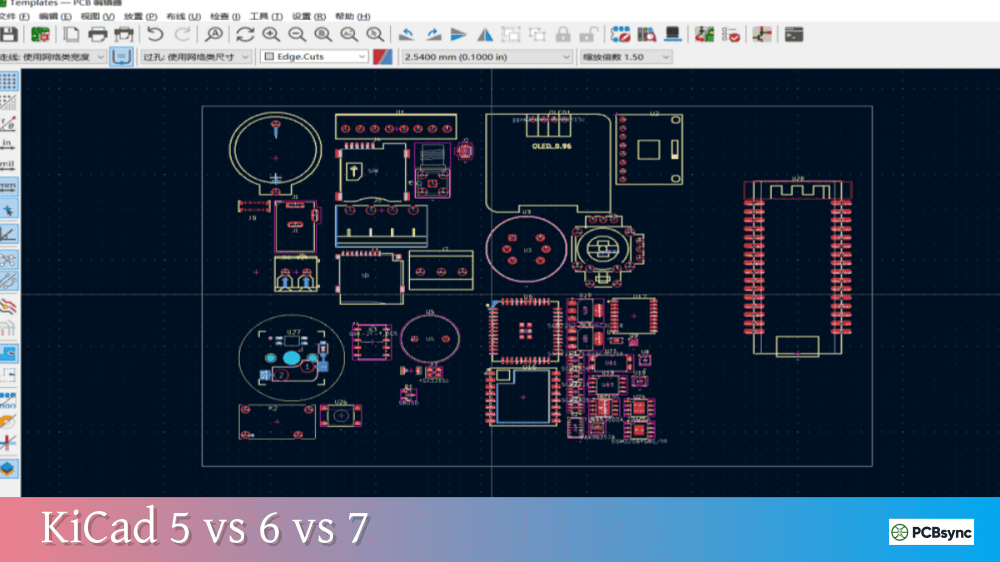
Choosing the right KiCad version can significantly impact your PCB design workflow. I’ve worked through every major KiCad release since version 4, migrating production projects and helping colleagues navigate the upgrade path. The jump from KiCad 5 to KiCad 6 was revolutionary. The transition from KiCad 6 to KiCad 7 was evolutionary. And now with KiCad 8 and 9 available, understanding these foundational changes matters more than ever.
This guide breaks down the real differences between KiCad 5, KiCad 6, and KiCad 7 to help you decide which version fits your projects—or whether you should jump straight to the latest KiCad release.
Quick Version Comparison: KiCad 5 vs KiCad 6 vs KiCad 7
Before diving into details, here’s a snapshot of how these versions stack up:
Feature
KiCad 5.1
KiCad 6.0
KiCad 7.0
Release Date
December 2018
December 2021
February 2023
File Format
Legacy (.sch, .lib)
S-Expression (.kicad_sch, .kicad_sym)
S-Expression (enhanced)
Symbol Embedding
No (cache library required)
Yes
Yes
Plugin Manager
No
Yes
Yes (with auto-update)
Custom Fonts
No
No
Yes
kicad-cli Tool
No
No
Yes
Properties Panel
No
Partial
Yes (PCB Editor)
Custom DRC Rules
Limited
Yes
Enhanced
SPICE Simulation
Basic
Improved
Enhanced
Maintenance Status
Discontinued
Discontinued
Discontinued
The bottom line: KiCad 5 established the foundation, KiCad v6 modernized everything, and KiCad v7 refined the user experience. Today, the latest KiCad version (9.x as of 2026) builds on all these improvements.
Understanding KiCad Version History
KiCad’s development accelerated dramatically starting with version 5. Here’s the timeline that matters:
Version
Release
Development Time
Key Achievement
KiCad 5.0
December 2018
~3 years
Usability overhaul
KiCad 5.1
March 2019
3 months
Stability release
KiCad 6.0
December 2021
3 years
Complete modernization
KiCad 7.0
February 2023
14 months
Workflow refinement
KiCad 8.0
February 2024
12 months
Properties panel expansion
KiCad 9.0
February 2025
12 months
Jobsets, Design Blocks
Notice the shift: after KiCad 6, the development team committed to annual major releases. This faster cadence means you get improvements regularly instead of waiting years between versions.
KiCad 5: The Stable Foundation That Changed Everything
KiCad 5.1 represented a turning point for the project. Before version 5, KiCad was functional but frustrating. Version 5 made it genuinely usable for professional work.
What Made KiCad 5 Important
The KiCad 5 release brought features that convinced many engineers to switch from commercial tools:
Push-and-shove routing arrived in mature form. You could finally route traces that automatically pushed existing tracks aside—a feature Altium users had enjoyed for years.
OpenGL acceleration made the PCB editor responsive even with complex multilayer designs. The canvas no longer stuttered when zooming or panning.
Symbol library tables replaced the chaotic library search paths of KiCad 4. You could finally organize component libraries sensibly.
Differential pair routing worked reliably for high-speed design requirements.
KiCad 5.1 Limitations That Drove Development
Despite improvements, KiCad 5 had significant problems:
The schematic editor behaved strangely. Clicking a component didn’t select it—you had to use specific hotkeys. This confused everyone coming from other EDA tools.
Cache libraries caused constant headaches. Schematics depended on separate cache files containing used symbols. Share a schematic without its cache, and recipients saw question marks instead of components.
Legacy file formats made version control difficult. The .sch and .lib formats weren’t designed for Git or other modern development workflows.
No plugin infrastructure existed. Installing add-ons required manual file copying and configuration.
Should You Still Use KiCad 5?
Almost certainly not for new projects. KiCad 5 hasn’t received updates since 2021. No security patches, no bug fixes, no improvements.
However, you might legitimately stay on KiCad 5 if:
You’re finishing a project already deep in development
Your organization mandates version standardization and hasn’t approved migration
You’re following tutorials specifically written for KiCad 5 (though you should migrate your skills afterward)
For anything else, upgrade. The benefits of newer versions far outweigh the learning adjustment.
KiCad 6: The Revolutionary Modernization
When KiCad 6.0 released in December 2021, it wasn’t just an update—it was a transformation. The development team addressed years of accumulated user complaints and brought KiCad into the modern era.
KiCad 6.0 Major Improvements
Complete file format overhaul: KiCad v6 finished the transition to S-Expression notation for all files. Schematics (.kicad_sch), symbols (.kicad_sym), and project files became human-readable text that works properly with version control systems.
Here’s what the change looked like in practice:
File Type
KiCad 5 Extension
KiCad 6 Extension
Schematic
.sch
.kicad_sch
Symbol Library
.lib
.kicad_sym
Project
.pro
.kicad_pro
PCB
.kicad_pcb
.kicad_pcb
Footprint
.kicad_mod
.kicad_mod
Embedded symbols eliminated cache libraries forever. Schematic files now contain the symbols they use. Share a schematic, and it opens correctly anywhere. No more broken references or chasing library files.
The user interface became intuitive. Icons were redesigned. Menus reorganized logically. Most importantly, clicking something actually selected it—matching every other design application.
Custom design rules enabled complex DRC constraints. You could define area-specific rules, layer-specific clearances, and conditional constraints that weren’t possible in KiCad 5.
The Plugin and Content Manager let you install plugins, libraries, and themes from within KiCad. No more manual file management.
3D viewer improvements added raytracing, lighting controls, and PCB editor integration.
KiCad 6 Download Considerations
The KiCad 6 download introduced a critical migration consideration: files only convert forward. Once you open a KiCad 5 project in KiCad 6 and save it, those files won’t open in KiCad 5 again.
The migration process worked like this:
KiCad 6 offered to convert projects when opening KiCad 5 files
Symbol libraries required separate migration using the Symbol Library Editor
After saving, new file extensions appeared alongside (not replacing) old files
Always keep backups before migrating. I learned this the hard way on a client project.
KiCad 6.0 Growing Pains
The transition wasn’t painless:
Hotkey changes frustrated experienced users. Muscle memory from years of KiCad 5 didn’t transfer perfectly.
Plugin compatibility broke. Plugins written for KiCad 5’s Python API needed updates for KiCad 6. Popular plugins like Interactive HTML BOM required new versions.
Library migration took time. Personal symbol and footprint libraries needed conversion to the new format.
Despite these challenges, KiCad 6 was worth the transition pain. The improvements fundamentally changed what KiCad could accomplish.
KiCad 7: Evolutionary Refinement
KiCad 7.0 released in February 2023—just 14 months after KiCad 6. This faster release demonstrated the development team’s new commitment to annual major versions.
KiCad v7 New Features
KiCad 7 changes were evolutionary rather than revolutionary. The interface remained familiar from KiCad 6, but workflow improvements accumulated throughout:
The kicad-cli command-line tool enabled scripted automation. Generate Gerbers, BOMs, PDFs, and STEP files from scripts without opening the GUI. This transformed KiCad’s usefulness in continuous integration pipelines.
Custom font support finally arrived. Use any system font in schematics, PCB layouts, and worksheets. Technical drawings could match corporate style guides.
Text boxes provided bordered areas for notes, revision tables, and documentation directly in designs.
Orthogonal dragging fixed a long-standing schematic editor annoyance. When you drag a symbol, wires maintain right angles automatically instead of creating diagonal messes.
Properties panel in the PCB editor let you modify object properties directly without opening dialog boxes. Select multiple objects and change their shared properties simultaneously.
Auto-completion while routing saved time. Press ‘F’ while drawing a trace, and KiCad attempts to finish the route automatically.
Plugin manager auto-updates check for new versions automatically and prompt you to update installed packages.
Database library support connected KiCad to external databases for component information, integrating with existing parts management systems.
Do Not Populate (DNP) marking grayed out components in schematics and automatically excluded them from BOM and placement files.
KiCad 7 Download and Migration
The KiCad 7 download maintained better compatibility than the KiCad 5 to 6 transition. Opening KiCad 6 projects in KiCad 7 required no special conversion—just open and save.
However, saving in KiCad 7 still prevented opening files in KiCad 6. This remains true for all KiCad versions: files only migrate forward.
KiCad 7 vs KiCad 6: Was the Upgrade Worth It?
Absolutely. KiCad 7 added capabilities without removing anything. The learning curve was minimal since the interface stayed consistent with KiCad 6. The kicad-cli tool alone justified upgrading for anyone doing repetitive output generation.
The Latest KiCad: Versions 8 and 9
Understanding KiCad 5/6/7 history provides context, but for current work, you should know about recent releases.
KiCad 8 Highlights (February 2024)
KiCad 8 continued the annual release pattern with notable additions:
Properties panel expanded to library editors
3D viewer interface redesigned with appearance panel and saved viewports
Search panel for finding objects across designs
Net coloring in PCB editor
IPC-2581 export format support
API improvements for external tool integration
KiCad 9 Highlights (February 2025)
The latest KiCad version brought significant new capabilities:
Jobsets automate output generation with saved configurations
Zone Manager centralizes copper zone control
Design Blocks enable schematic reuse across projects
Git integration built into the project manager
ODB++ export format for manufacturing
Padstacks allow layer-specific pad properties
Table support in schematic, PCB, and footprint editors
Embedded files including datasheets, 3D models, and fonts
For new projects in 2026, KiCad 9 is the clear choice. It includes everything from previous versions plus powerful new features.
Feature-by-Feature Comparison Table
This detailed breakdown helps identify what you gain or lose at each version:
Feature
KiCad 5.1
KiCad 6.0
KiCad 7.0
Latest (9.x)
S-Expression schematics
No
Yes
Yes
Yes
Embedded schematic symbols
No
Yes
Yes
Yes
Cache libraries required
Yes
No
No
No
Plugin Manager
No
Yes
Yes
Yes
Plugin auto-updates
No
No
Yes
Yes
kicad-cli automation
No
No
Yes
Yes
Custom fonts
No
No
Yes
Yes
Properties panel
No
PCB only
PCB
All editors
Custom DRC rules
Limited
Yes
Enhanced
Enhanced
Database libraries
No
No
Yes
Yes
DNP support
No
No
Yes
Yes
Jobsets
No
No
No
Yes
Design Blocks
No
No
No
Yes
Git integration
No
No
No
Yes
Maintenance
Ended
Ended
Ended
Active
Migration Strategies and Best Practices
Migrating from KiCad 5 to Latest
If you have KiCad 5 projects requiring migration, here’s the recommended approach:
Back up everything before touching any files
Skip intermediate versions—go directly to the latest stable release
Open each file and allow KiCad to perform automatic migration
Migrate custom libraries separately using library editors
Run ERC and DRC on migrated projects to verify integrity
Test thoroughly before committing to the new version
Migrating from KiCad 6 or KiCad 7
Migration from KiCad 6 or 7 to the latest version is straightforward:
Install the new version (it coexists with older versions)
Open your projects normally
Save to update file formats
Verify plugin compatibility and update as needed
Running Multiple Versions
Sometimes you need multiple KiCad versions simultaneously:
Windows and macOS: Each version installs to its own directory without conflict
Linux: Consider Flatpak for multiple version support
Remember: Saving in a newer version prevents opening in older versions
None of them. For new projects in 2026, use the latest stable release (KiCad 9). It includes all features from previous versions plus significant improvements. The only reasons to use older versions are maintaining legacy projects or following version-specific tutorials.
Will my KiCad 5 projects work in the latest version?
Yes, with automatic migration. When you open a KiCad 5 project in current KiCad, it converts files to the new format. After saving, the files won’t open in KiCad 5 again. Always keep backups of original files before migration.
Why can’t I open my KiCad 7 project in KiCad 6?
KiCad files only migrate forward, never backward. Once saved in a newer version, files use that version’s format and can’t be read by older releases. This is a fundamental design decision, not a bug. Keep version-specific backups if you need compatibility.
Is KiCad 6 or 7 still supported with bug fixes?
No. KiCad follows a policy where only the current major version receives active maintenance. KiCad 7 maintenance ended when KiCad 8 released. KiCad 8 maintenance ended when KiCad 9 released. For bug fixes and security updates, use the latest version.
Can I install multiple KiCad versions on the same computer?
Yes. On Windows and macOS, each version installs to its own directory and can run simultaneously. On Linux, Flatpak provides the cleanest multi-version support. Just remember that opening and saving a project in a newer version prevents opening it in older versions.
Real-World Migration Stories
Understanding theory is one thing—seeing how migrations play out in practice is another. Here are scenarios I’ve encountered that might help guide your decision.
Scenario 1: Hobbyist with Legacy Projects
A maker friend had dozens of KiCad 5 projects accumulated over years. He worried migration would break everything. The reality: he installed KiCad 9, opened each project, and saved. Migration took an afternoon. The only hiccup was re-downloading some plugins that had updated for newer versions.
Scenario 2: Small Business Transitioning Tools
A startup I consulted for had standardized on KiCad 6 across their team. When considering KiCad 7, they tested one non-critical project first, verified nothing broke, then rolled out company-wide within a week. The kicad-cli tool immediately improved their automated build process.
Scenario 3: Educational Institution
A university teaching PCB design faced a common dilemma: their curriculum materials targeted KiCad 5.1. Rather than rewrite everything, they installed both KiCad 5 and KiCad 9 on lab computers. Students learned fundamentals on KiCad 5, then graduated to modern KiCad for capstone projects. This bridged the gap without massive documentation rewrites.
Key Migration Lessons
From these experiences, some patterns emerge:
Test before committing: Try one project before migrating your entire library
Keep archives: Store original project folders before any conversion
Update plugins early: Check plugin compatibility before opening important projects
Document custom libraries: Know which personal libraries need migration
Plan for file format changes: Communicate with collaborators about version requirements
Choosing Your KiCad Version: Decision Framework
Still unsure which version fits your situation? Work through these questions:
Are you starting fresh with KiCad? → Install the latest version. No reason to learn outdated interfaces.
Do you have critical projects in KiCad 5? → Either finish them in KiCad 5, or migrate with careful testing and backups.
Does your team share project files? → Everyone needs the same major version. Coordinate upgrades.
Do you need specific plugin functionality? → Verify plugin compatibility with your target version first.
Are you following existing tutorials? → Match the tutorial version for learning, then migrate knowledge to latest for real work.
Final Recommendations
After years of using every KiCad version, here’s my practical advice:
For new projects: Always use the latest stable release. As of early 2026, that’s KiCad 9. You get the most features, active bug fixes, and community support.
For legacy KiCad 5 projects: Migrate when you have time for testing. The longer you wait, the more versions behind you fall—though migration remains straightforward.
For KiCad 6 or 7 projects: Upgrade at your next convenient opportunity. Migration is painless, and you immediately gain useful features.
For learning: If following older tutorials, match the tutorial’s version during learning. Then migrate your skills to the latest release for actual work.
The KiCad development team’s commitment to annual releases means continuous improvement. The transformation from KiCad 5 to 6 was genuinely revolutionary. KiCad 7 refined that foundation. And subsequent versions have added capabilities making KiCad increasingly competitive with commercial tools costing thousands of dollars.
Whatever version you’re currently using, the upgrade path exists and works reliably. Don’t let fear of change keep you on unmaintained software indefinitely. The PCB design community has largely moved forward, and the latest KiCad offers compelling reasons to join them.
Inquire: Call 0086-755-23203480, or reach out via the form below/your sales contact to discuss our design, manufacturing, and assembly capabilities.
Quote: Email your PCB files to Sales@pcbsync.com (Preferred for large files) or submit online. We will contact you promptly. Please ensure your email is correct.
Notes: For PCB fabrication, we require PCB design file in Gerber RS-274X format (most preferred), *.PCB/DDB (Protel, inform your program version) format or *.BRD (Eagle) format. For PCB assembly, we require PCB design file in above mentioned format, drilling file and BOM. Click to download BOM template To avoid file missing, please include all files into one folder and compress it into .zip or .rar format.