Inquire: Call 0086-755-23203480, or reach out via the form below/your sales contact to discuss our design, manufacturing, and assembly capabilities.
Quote: Email your PCB files to Sales@pcbsync.com (Preferred for large files) or submit online. We will contact you promptly. Please ensure your email is correct.
Notes: For PCB fabrication, we require PCB design file in Gerber RS-274X format (most preferred), *.PCB/DDB (Protel, inform your program version) format or *.BRD (Eagle) format. For PCB assembly, we require PCB design file in above mentioned format, drilling file and BOM. Click to download BOM template To avoid file missing, please include all files into one folder and compress it into .zip or .rar format.
IPC/JEDEC-9704 Explained: Complete Guide to PCB Strain Gage Testing for BGA Reliability
If you’ve ever had a batch of boards come back from ICT with intermittent BGA failures that “weren’t there before testing,” you already know why IPC/JEDEC-9704 matters. I’ve spent more hours than I’d like to admit chasing down phantom solder joint cracks that turned out to be caused by overly aggressive test fixtures flexing the board beyond its limits.
The frustrating part? These failures often don’t show up during electrical testing. The board passes, ships to the customer, and fails in the field when normal handling stresses propagate those microscopic cracks into full opens. Strain gage testing per IPC/JEDEC-9704 gives you the quantitative data to catch these problems before they become warranty returns.
IPC/JEDEC-9704, officially titled “Printed Circuit Assembly Strain Gage Test Guideline,” establishes standardized procedures for measuring mechanical strain on PCBs during manufacturing, testing, and handling operations. The original standard was released in June 2005, with the current revision IPC/JEDEC-9704A published in February 2012.
The standard addresses a critical gap in electronics manufacturing: while we’ve always known that excessive board flexure damages solder joints, there was no consistent methodology for measuring and comparing strain levels across the industry. Different companies used different gage types, placement strategies, and analysis methods—making it impossible to compare results or establish meaningful limits.
IPC/JEDEC-9704 standardizes everything from gage selection to placement to reporting format, enabling meaningful data comparison across suppliers, customers, and manufacturing sites.
Why Strain Gage Testing Has Become Essential
Two major industry trends have made IPC/JEDEC-9704 compliance virtually mandatory for any serious electronics manufacturer.
The Lead-Free Solder Problem
When the industry transitioned to lead-free soldering to comply with RoHS regulations, we traded one set of challenges for another. SAC (Sn-Ag-Cu) alloys have comparable tensile and compressive strength to traditional tin-lead solder, but they’re significantly more brittle—nearly twice as brittle by some measures.
This brittleness means lead-free solder joints are far more susceptible to cracking under mechanical stress. A board that survived ICT with tin-lead solder might develop cracks with SAC305 under the same fixture pressures.
The BGA Density Challenge
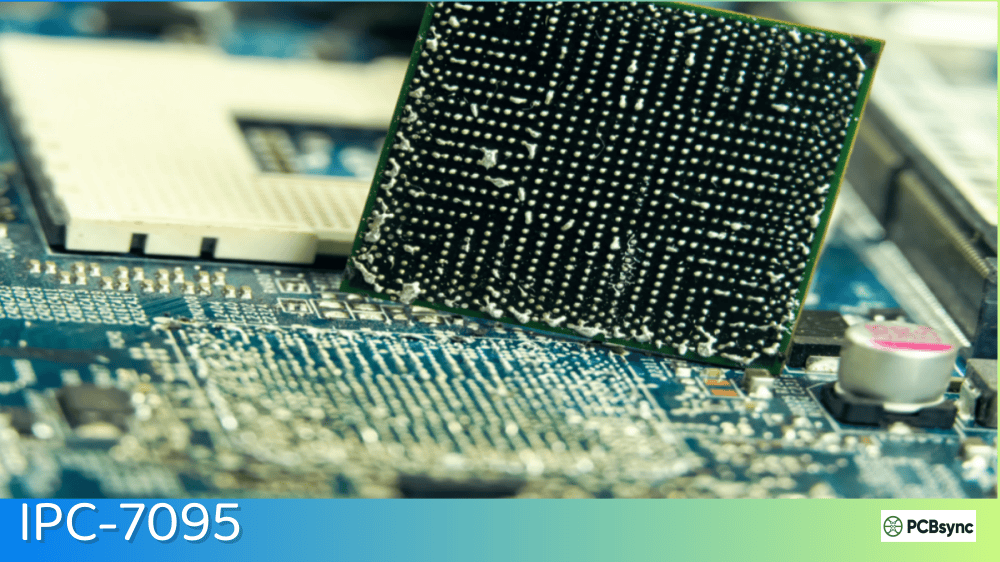
Ball Grid Array packages have become ubiquitous because they offer the highest I/O density for a given footprint. But BGAs have a fundamental weakness: they’re rigid bodies mounted directly to the PCB surface with no compliant leads to absorb strain.
When a board flexes, BGA solder balls—especially those at the package corners—experience concentrated stress. The outer rows see the worst of it because they’re furthest from the package’s neutral point.
Component Type
Strain Sensitivity
Primary Failure Mode
BGA (large >25mm)
Very High
Corner ball cracking
BGA (small <15mm)
High
Corner ball cracking
CSP/WL-CSP
Very High
IMC interface fracture
QFN
Moderate-High
Corner lead lifting
MLCC Capacitors
Moderate
Flex cracking
Through-Hole
Low
Lead stress relief
IPC/JEDEC-9704 Strain Gage Selection Guidelines
The standard specifies three-element stacked rosette strain gages as the preferred sensor type for PCB strain measurement. Unlike single-axis gages that only measure strain in one direction, rosette gages capture the complete strain state on the board surface.
Why Rosette Gages Are Required
A rosette strain gage consists of three independent sensing elements oriented at 0°, 45°, and 90° angles, all stacked in the same location. This configuration allows calculation of:
Principal strains (maximum and minimum)
Principal strain direction
Shear strain
Diagonal strain (critical for BGA assessment)
The diagonal strain—measured at 45° to the component edges—is particularly important because BGA solder joints are most vulnerable to this loading direction.
Recommended Gage Specifications
Parameter
IPC/JEDEC-9704 Recommendation
Gage Type
Three-element stacked rosette
Resistance
120Ω or 350Ω
Gage Length
0.062″ (1.57mm) typical
Grid Configuration
0°/45°/90°
Temperature Compensation
Self-compensating for FR-4
Smaller gage lengths provide better spatial resolution but are more difficult to install. For most BGA applications, 0.062″ gages offer a good balance between resolution and practicality.
Strain Gage Placement per IPC/JEDEC-9704
Proper gage placement is critical for obtaining meaningful data. The standard provides specific guidelines for positioning gages relative to components.
BGA Gage Placement Requirements
For BGA components, IPC/JEDEC-9704 recommends:
Place one rosette gage at each corner of the BGA (four gages total for comprehensive coverage)
Position gage substrate edge no more than 1.0mm from the component body edge
Align the 0° element parallel to the component edge
For rectangular packages, prioritize the corners along the longer axis
Component Priority for Testing
Not every component on a board needs strain gage monitoring. IPC/JEDEC-9704 recommends prioritizing:
Priority
Component Criteria
Reasoning
1 (Highest)
BGAs ≥25mm (1 inch) body
Largest DNP, highest risk
2
BGAs 15-25mm body
Moderate risk
3
Large CSPs, LGAs
Area array interconnects
4
QFN/QFP >10mm
Corner stress concentration
5
Large MLCCs (>1206)
Flex crack susceptibility
If board real estate limits gage installation, focus on the largest BGAs first—they’re statistically most likely to fail from excessive strain.
Avoiding Interference Issues
Gage placement must account for potential interference from test fixtures and handling equipment:
ICT Probe Interference: Ensure gages won’t be contacted by test probes. Check probe locations in your fixture design before finalizing gage positions.
Pushdown Block Interference: Support rods and pushdown blocks can damage or contact gages. Maintain clearance and consider gage wire routing.
Component Keep-Out: Some board areas near large components may have restricted access. Plan wire routing before gage installation.
Data Acquisition System Requirements for IPC/JEDEC-9704
The standard specifies minimum requirements for measurement instrumentation to ensure data quality and comparability.
Hardware Specifications
Parameter
Minimum Requirement
Recommended
Sampling Rate
1 kHz
2 kHz or higher
Channel Count
3 (one rosette)
12+ (four rosettes)
Sampling Mode
Simultaneous
Simultaneous
Input Resolution
12-bit
16-bit
Anti-Aliasing Filter
Required
Low-pass, fc < fs/2
Bridge Excitation
2-5V
Per gage manufacturer
Why Simultaneous Sampling Matters
Many lower-cost DAQ systems use multiplexed sampling, where channels are read sequentially rather than simultaneously. For strain gage testing, this creates timing errors between rosette elements that corrupt principal strain calculations.
IPC/JEDEC-9704 specifically requires simultaneous sampling of all channels to maintain phase relationships between the three rosette elements.
Software Requirements
Your data acquisition software should provide:
Real-time strain display during testing
Principal strain calculation using Mohr’s circle equations
Strain rate calculation (critical for limit assessment)
Report generation per IPC/JEDEC-9704 format
Data export for archiving and analysis
Understanding Strain Limits and Strain Rate
This is where IPC/JEDEC-9704 testing delivers its real value—determining whether measured strains exceed allowable limits.
The Strain Rate Factor
Here’s something that surprises many engineers: the allowable strain limit isn’t a fixed number. It depends heavily on how fast the strain is applied.
Solder joints exhibit viscoelastic behavior—they can tolerate higher strain levels when loaded slowly than when loaded rapidly. A joint that survives 1500 microstrain applied over several seconds might crack at 800 microstrain if that load is applied in milliseconds.
IPC/JEDEC-9704A and the companion document IPC-WP-011 define strain limits as a function of strain rate:
Strain Rate (µε/s)
Typical Strain Limit (µε)
Application
<100
1500-2000
Slow handling
100-500
1000-1500
Manual assembly
500-2000
700-1000
Automated processes
2000-5000
500-700
Fast fixture actuation
>5000
<500
Impact events
Manufacturer-Specific Limits
While IPC-WP-011 provides general guidance, many component manufacturers publish their own strain limits. Intel, for example, specifies strain limits for their processors that may differ from generic IPC guidance.
Always check with your component suppliers for specific requirements. When customer limits, supplier limits, and IPC guidance conflict, use the most conservative (lowest) value.
ICT Fixture Strain Testing Procedures
In-circuit test fixtures are notorious for causing excessive board strain. The combination of vacuum hold-down, probe pressure, and support rod placement can create localized stress concentrations that crack BGA joints.
Pre-Test Setup
Before running strain gage tests on an ICT fixture:
Verify fixture vacuum system operates at production levels (typically 28-29 inHg)
Confirm all probes are properly aligned and at correct pressure
Check that support rods and pushdown blocks are correctly positioned
Document fixture configuration for the test report
Test Sequence per IPC/JEDEC-9704
A typical ICT strain test follows this sequence:
Step
Action
Duration
1
Zero/tare all channels
2-3 seconds
2
Record baseline (no vacuum)
2-3 seconds
3
Apply vacuum (fixture engagement)
Capture transient
4
Hold at full vacuum
2-3 seconds
5
Release vacuum
Capture transient
6
Return to baseline
2-3 seconds
Total test duration is typically 10-15 seconds. The critical data comes from steps 3 and 5—the vacuum application and release transients where strain rates are highest.
Peak Diagonal Strain: The maximum diagonal (45°) strain during vacuum application. This is typically the critical parameter for BGA assessment.
Strain Rate: Calculate the maximum rate of strain change during the vacuum transient. Compare against rate-dependent limits.
Residual Strain: Any strain remaining after vacuum release indicates fixture issues (stuck probes, warped supports).
IPC/JEDEC-9704 Reporting Requirements
The standard includes a detailed reporting template in Appendix A. Complete documentation enables meaningful comparison across tests and facilities.
Required Report Elements
Section
Contents
Test Setup
Fixture ID, DAQ system, gage specifications
Board Information
Part number, revision, serial numbers
Gage Locations
Coordinates, component references
Process Conditions
Vacuum level, cycle time, temperature
Strain Data
Peak strain, strain rate, principal directions
Pass/Fail Assessment
Comparison against applicable limits
Example Strain Report Format
For each monitored process step, report should include:
Component
Location
Max Principal (µε)
Min Principal (µε)
Strain Rate (µε/s)
Limit (µε)
Status
U1 (BGA)
Corner 1
487
-203
1850
700
PASS
U1 (BGA)
Corner 2
892
-445
4200
550
FAIL
U1 (BGA)
Corner 3
523
-287
2100
650
PASS
U1 (BGA)
Corner 4
634
-312
2850
600
FAIL
Common Manufacturing Processes Requiring Strain Monitoring
IPC/JEDEC-9704 identifies several manufacturing operations that commonly induce excessive strain:
High-Risk Processes
Process
Typical Strain Source
Mitigation
In-Circuit Test (ICT)
Probe pressure, vacuum
Fixture redesign, support optimization
Depanelization
Routing/V-score breakout
Tooling adjustment, support fixtures
Manual Handling
Operator technique
Training, handling fixtures
Connector Insertion
Insertion force
Guided tooling, board support
Heat Sink Mounting
Fastener torque
Torque specification, sequence
Final Assembly
Screw insertion
Torque limits, support
When to Perform Strain Gage Testing
Implement IPC/JEDEC-9704 testing:
During new product introduction (NPI)
After fixture modifications or probe changes
When changing board fabrication suppliers
After design changes affecting board thickness or layer count
Following any field failures traced to solder joint cracking
As part of periodic fixture maintenance
IPC/JEDEC-9704 vs Related Standards
Understanding how IPC/JEDEC-9704 relates to other reliability standards helps you build a complete test program.
Standard
Purpose
Key Output
IPC/JEDEC-9704
Strain measurement methodology
µε at process steps
IPC/JEDEC-9702
Monotonic bend characterization
Strain at failure
IPC/JEDEC-9703
Mechanical shock testing
Drops to failure
IPC-WP-011
Strain limit guidance
Allowable µε vs strain rate
JESD22-B111
Board level drop test
Qualification test method
IPC/JEDEC-9704 is a process monitoring standard—it tells you what strain your boards experience during manufacturing. IPC/JEDEC-9702 is a characterization standard—it tells you how much strain your solder joints can survive. Use both together to ensure adequate margin.
Useful Resources for IPC/JEDEC-9704 Implementation
“Identify and Characterize Damaging PCB Assembly and Test Processes Using Strain Gage Testing”
ASTM E1561
Standard Practice for Analysis of Strain Gage Rosette Data
SMTA Proceedings
Technical papers on strain gage applications
Frequently Asked Questions About IPC/JEDEC-9704
What strain limit should I use if my customer doesn’t specify one?
Start with the guidance in IPC-WP-011, which provides strain limits as a function of strain rate and board thickness. For BGAs on standard 1.6mm FR-4, a conservative limit is 500 microstrain at strain rates above 2000 µε/s. For slower processes, you can typically allow 700-1000 microstrain. When in doubt, use 500 microstrain as a universal limit—it’s conservative but widely accepted.
How many strain gages do I need per board?
IPC/JEDEC-9704 recommends monitoring the largest BGA components first. For comprehensive assessment, install rosette gages at all four corners of each critical BGA (four gages per component, twelve channels per component). If resources are limited, prioritize: (1) the largest BGA on the board, (2) BGAs near board edges or fixture support points, and (3) any components with field failure history.
Can I reuse strain gages between boards?
No. Strain gages are bonded to the PCB surface and cannot be removed intact. Each instrumented board requires new gages. This is why strain gage testing is typically performed on a limited sample (3-5 boards) rather than 100% production testing. The goal is process characterization, not individual board screening.
Why do my strain readings differ between test runs?
Variation between runs typically indicates inconsistent fixture engagement, probe alignment issues, or vacuum system fluctuations. Before assuming gage or instrumentation problems, verify fixture repeatability by running multiple cycles on the same board without removing it. If variation persists, check probe tip condition, support rod positioning, and vacuum system stability.
How does IPC/JEDEC-9704 relate to IPC/JEDEC-9702?
IPC/JEDEC-9704 tells you what strain your manufacturing processes apply to the board. IPC/JEDEC-9702 tells you what strain level causes solder joint failure. Use 9702 testing to establish your component’s strain capability, then use 9704 testing to verify your processes stay within that capability. The margin between measured process strain (9704) and failure strain (9702) is your safety factor.
Final Thoughts
IPC/JEDEC-9704 transforms solder joint reliability from guesswork into engineering. Instead of waiting for field failures to reveal process problems, you can proactively measure strain levels and verify they’re within safe limits.
The investment in strain gage testing equipment and training pays for itself quickly when you consider the cost of a single product recall or major customer quality escape. More importantly, it gives you the data to have meaningful conversations with fixture suppliers, component vendors, and customers about realistic strain limits and process capabilities.
Start with your highest-risk processes—usually ICT fixtures on boards with large BGAs. Build a baseline dataset, establish your strain limits, and implement ongoing monitoring as part of your quality system. Your solder joints will thank you.
Inquire: Call 0086-755-23203480, or reach out via the form below/your sales contact to discuss our design, manufacturing, and assembly capabilities.
Quote: Email your PCB files to Sales@pcbsync.com (Preferred for large files) or submit online. We will contact you promptly. Please ensure your email is correct.
Notes: For PCB fabrication, we require PCB design file in Gerber RS-274X format (most preferred), *.PCB/DDB (Protel, inform your program version) format or *.BRD (Eagle) format. For PCB assembly, we require PCB design file in above mentioned format, drilling file and BOM. Click to download BOM template To avoid file missing, please include all files into one folder and compress it into .zip or .rar format.