Inquire: Call 0086-755-23203480, or reach out via the form below/your sales contact to discuss our design, manufacturing, and assembly capabilities.
Quote: Email your PCB files to Sales@pcbsync.com (Preferred for large files) or submit online. We will contact you promptly. Please ensure your email is correct.
Notes: For PCB fabrication, we require PCB design file in Gerber RS-274X format (most preferred), *.PCB/DDB (Protel, inform your program version) format or *.BRD (Eagle) format. For PCB assembly, we require PCB design file in above mentioned format, drilling file and BOM. Click to download BOM template To avoid file missing, please include all files into one folder and compress it into .zip or .rar format.
IPC-7525 Explained: Stencil Aperture Design Rules for Solder Paste Printing
Anyone who’s spent time troubleshooting SMT assembly defects knows the frustration of chasing solder problems that trace back to the printing step. Industry data consistently shows that 60-70% of assembly defects originate during solder paste printing. The stencil is at the heart of this process, and getting the aperture design right can make or break your yield.
That’s where IPC-7525 comes in. This standard consolidates decades of stencil design experience into practical guidelines that actually work on the production floor. Whether you’re designing stencils for fine-pitch BGAs, QFN thermal pads, or mixed-technology boards, IPC-7525 provides the foundational rules you need.
I’ve used these guidelines across hundreds of stencil designs, and while they won’t solve every printing challenge you’ll face, they’ll give you a solid starting point that avoids the most common mistakes.
IPC-7525, officially titled Stencil Design Guidelines, is an industry standard developed by the IPC Assembly and Joining Processes Committee. The current revision is IPC-7525C, released in November 2021.
The standard provides guidance for designing and fabricating stencils used in solder paste and surface-mount adhesive printing. It covers everything from basic aperture sizing rules to specialized topics like step stencils and mixed-technology applications.
Current revision with BTC/QFN updates, fine-pitch improvements
The standard is intentionally written as a guideline rather than a rigid specification. This flexibility acknowledges that optimal stencil design depends on many variables—paste type, component mix, equipment capability, and process parameters all interact in ways that make one-size-fits-all rules impractical.
Why Stencil Design Matters for SMT Assembly
Before diving into the technical details, it’s worth understanding why stencil design deserves so much attention.
Solder paste printing is a volume transfer process. The stencil apertures fill with paste during the print stroke, and when the board separates from the stencil, that paste must release cleanly onto the PCB pads. Several things can go wrong:
Insufficient paste: Not enough solder volume leads to weak joints or opens
Excessive paste: Too much solder causes bridging between adjacent pads
Incomplete release: Paste stays in the aperture instead of transferring to the board
Misalignment: Paste deposits offset from the pad centers cause defects during reflow
IPC-7525 addresses these challenges through design rules that optimize paste release while delivering appropriate solder volumes for different component types.
Key Stencil Design Parameters in IPC-7525
The standard establishes two critical ratios that determine whether an aperture will release paste consistently:
Aspect Ratio
The aspect ratio relates aperture width to stencil thickness:
Aspect Ratio = Aperture Width (W) ÷ Stencil Thickness (T)
IPC-7525 recommends a minimum aspect ratio of 1.5 for reliable paste release.
This makes intuitive sense—if the aperture is too narrow relative to the stencil thickness, the paste has more wall surface to stick to than opening area to escape through. The result is incomplete transfer.
Area Ratio
The area ratio compares the aperture opening area to the total wall surface area:
Area Ratio = (L × W) ÷ [2 × (L + W) × T]
Where L = aperture length, W = aperture width, T = stencil thickness.
IPC-7525 recommends a minimum area ratio of 0.66 for consistent paste release.
For circular apertures (like BGA pads), the formula simplifies to:
Area Ratio = Diameter ÷ (4 × Thickness)
How These Ratios Work Together
Scenario
Aspect Ratio
Area Ratio
Expected Result
Good design
≥1.5
≥0.66
Consistent paste release
Marginal
1.2-1.5
0.5-0.66
May work with process optimization
Poor
<1.2
<0.5
High probability of release failures
When designing apertures, always check both ratios. A long, narrow aperture might meet the aspect ratio requirement but fail on area ratio.
Stencil Thickness Selection by Component Type
Stencil thickness is your primary tool for controlling paste volume. Thicker stencils deposit more paste; thinner stencils deposit less. The challenge is selecting a thickness that works for all components on your board.
IPC-7525 Thickness Guidelines
Component Pitch
Recommended Thickness
Notes
>0.65mm pitch
0.150-0.200mm (6-8 mil)
Standard SMT components
0.5-0.65mm pitch
0.125-0.150mm (5-6 mil)
Fine-pitch QFPs
0.4-0.5mm pitch
0.100-0.125mm (4-5 mil)
Fine-pitch BGAs, 0402 chips
<0.4mm pitch
0.075-0.100mm (3-4 mil)
Ultra-fine pitch, 0201 chips
Ceramic BGA
0.175-0.200mm (7-8 mil)
Requires additional paste volume
The general rule: let your finest-pitch component determine the stencil thickness, then adjust aperture sizes for larger components as needed.
When Thickness Becomes a Compromise
Real boards often combine fine-pitch ICs with large connectors or power components that need more paste. When a single thickness can’t satisfy all components, you have several options:
Aperture modifications: Oversize apertures for large components to increase volume
Step stencils: Vary thickness across the stencil (more on this below)
Double printing: Two print passes with different stencils
Selective paste application: Dispense additional paste on specific pads
Aperture Design Rules by Component Type
IPC-7525 provides specific guidance for different component packages. Here’s how to apply it:
QFP and Gull-Wing Components
For leaded SMDs with 1.3mm to 0.4mm pitch, IPC-7525 recommends:
Width reduction: 0.025mm (1 mil) per side from pad width
Length: Typically 1:1 with pad length, or slight extension for toe fillets
Corners: Radius corners to prevent paste sticking
For 0.5mm pitch and finer QFPs, consider home-plate or bow-tie aperture shapes to reduce solder ball formation.
BGA Components
BGA aperture design depends on pitch:
BGA Pitch
Aperture Recommendation
>1.0mm
1:1 with pad, round apertures
0.8mm
1:1 or slight reduction, round apertures
0.5-0.65mm
Round to square with radius corners
<0.5mm
Square with radius corners, may need size increase
For micro-BGAs and CSPs below 0.5mm pitch, IPC-7525 suggests changing from round to square apertures with radiused corners. This counterintuitive approach increases the aperture area and improves the area ratio without changing the pad-to-pad clearance.
QFN and Bottom Termination Components
QFN packages present unique challenges because of their thermal pads and small perimeter leads. IPC-7525 addresses both:
Perimeter Pads: Use apertures close to 1:1 with pad size. Since these pads are typically small, watch your area ratio carefully—you may need a thinner stencil.
Thermal Pad: Never print the thermal pad 1:1. The component will float during reflow if there’s too much paste under it. IPC-7525 recommends:
50% area reduction compared to pad area
Windowpane (grid) aperture design
Avoid placing apertures directly over vias in the pad
Chip Components (0201, 0402, 0603, etc.)
Small chip components are prone to tombstoning and solder balls. IPC-7525 suggests several aperture modifications:
Component
Aperture Design
Purpose
0201
1:1 or slight reduction
Prevent bridging
0402
Home-plate or bow-tie
Reduce solder balls
0603+
Standard with inner reduction
Prevent mid-chip balls
Home-plate apertures (shaped like the baseball base) reduce solder volume at the component center where balls tend to form. Bow-tie designs serve a similar purpose.
Beyond basic rectangular and circular apertures, IPC-7525 describes specialized shapes for specific challenges:
Home-Plate Apertures
Used for chip components to reduce solder ball formation. The aperture is narrower at the inner end (toward the component body) and wider at the outer end (toward the fillet).
Bow-Tie Apertures
Similar purpose to home-plate, but with both ends wider than the middle. Effective for preventing mid-chip solder balls in no-clean processes.
Windowpane (Grid) Apertures
For large pads like QFN thermal areas or ground planes. Instead of one large aperture, multiple smaller apertures arranged in a grid pattern:
Improves paste release (smaller apertures have better area ratios)
Prevents component floating during reflow
Allows volatiles to escape during heating
Provides channels for flux outgassing
Design the grid so web sections align over any vias in the pad—this prevents paste from wicking down the vias.
Step Stencil Design Guidelines
When a single stencil thickness can’t serve all components, step stencils offer a solution. IPC-7525 covers both step-up and step-down designs.
Step-Down Stencils
Used to reduce paste volume in specific areas (typically for fine-pitch components on boards with larger parts). Material is removed from the squeegee side of the foil in selected regions.
Step-Up Stencils
Used to increase paste volume in specific areas (typically for large components or pin-in-paste through-hole). Material is added to the board-contact side of the foil.
Keep-Out Distance Requirements
This is where many step stencil designs fail. IPC-7525 specifies minimum distances between apertures and step edges:
Parameter
Minimum Distance
K1 (aperture in thin area to step wall)
0.9mm per 0.025mm of step height
K2 (aperture in thick area to step wall)
0.65mm minimum
For example, a 0.05mm (2 mil) step-down requires at least 1.8mm keep-out distance for apertures in the stepped-down region.
Violating these keep-outs causes inconsistent paste transfer near the step transition. If your component placement doesn’t allow adequate keep-out, step stencils may not be the right solution.
Lead-Free Solder Paste Considerations
IPC-7525 addresses differences between tin-lead and lead-free solder paste printing:
Key Differences for Lead-Free
Parameter
SnPb Paste
Lead-Free Paste
Typical aperture sizing
May allow slight oversize
Generally 1:1 or reduced
Paste spread after printing
More spread during reflow
Less spread, stays put
Pad coverage requirement
Can rely on spread
Must achieve full coverage at print
Typical transfer efficiency
80-90%
70-85%
Lead-free pastes generally wet less aggressively than SnPb, so the solder tends to stay where you print it. This means aperture placement accuracy becomes more critical—you can’t rely on the solder flowing to cover misaligned deposits.
Stencil Fabrication Methods
IPC-7525 discusses three primary fabrication technologies, each with different characteristics:
Laser-Cut Stencils
The most common method for production stencils. Apertures are cut sequentially using a YAG or fiber laser.
Advantages: Good wall smoothness, handles complex shapes, no tooling required Considerations: Inherently trapezoidal apertures (larger on contact side), cost increases with aperture count
Chemical-Etched Stencils
Apertures are formed by selective chemical removal of material through a photoresist mask.
Advantages: Lower cost for high aperture counts, good for larger apertures Considerations: Barrel-shaped apertures, limited resolution for fine-pitch, slower turnaround
Electroformed Stencils
Nickel foil is built up around photoresist pillars on a mandrel, then separated.
Advantages: Smoothest aperture walls, best paste release, ideal for ultra-fine pitch Considerations: Higher cost, longer lead time, limited to nickel material
Hybrid Approaches
For mixed boards, laser-chem combination stencils use chemical etching for standard apertures and laser cutting for fine-pitch areas. This balances cost and performance.
Troubleshooting Common Stencil-Related Defects
When printing problems occur, IPC-7525 principles can guide your troubleshooting:
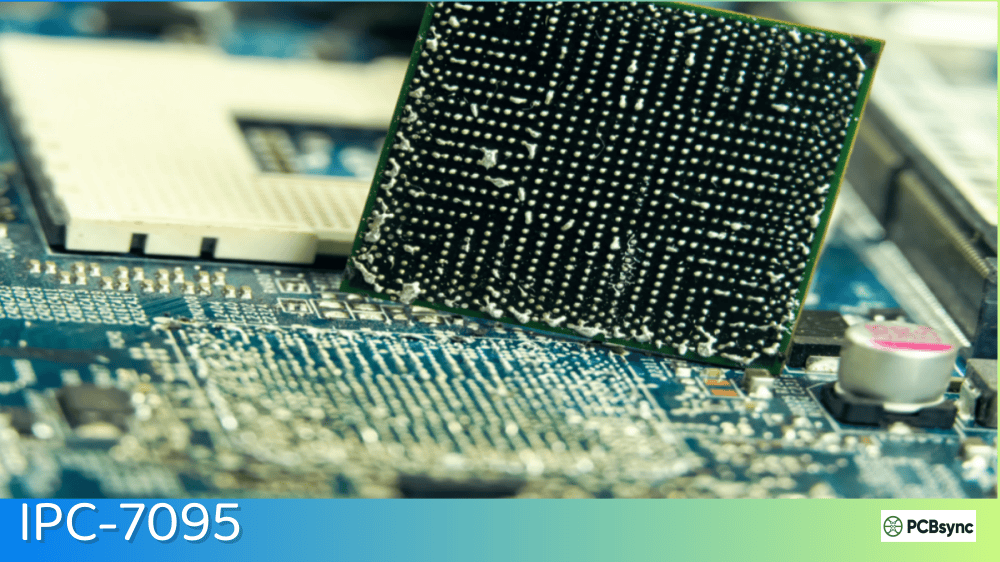
IPC-7095: BGA Design and Assembly Process Implementation
IPC-7093: QFN/BTC Design and Assembly Process
IPC-7351: Land Pattern Standard
Industry Tools and Calculators
Many stencil suppliers offer online aperture calculators that apply IPC-7525 rules. Check with your stencil vendor for design support tools.
Frequently Asked Questions About IPC-7525
What is the minimum aspect ratio for stencil apertures according to IPC-7525?
IPC-7525 recommends a minimum aspect ratio of 1.5 (aperture width divided by stencil thickness). This ensures the aperture is wide enough relative to stencil thickness for reliable paste release. For challenging applications, targeting 1.7 or higher provides additional process margin.
How do I calculate area ratio for rectangular apertures?
The area ratio formula is: (L × W) ÷ [2 × (L + W) × T] where L is length, W is width, and T is stencil thickness. IPC-7525 recommends maintaining an area ratio of 0.66 or higher. Lower ratios indicate the aperture walls have too much surface area relative to the opening, which causes paste to stick in the aperture.
Should I use the same aperture size as my PCB pad?
It depends on the component and solder paste type. For lead-free paste, IPC-7525 generally recommends apertures close to 1:1 with pad size to ensure adequate coverage since lead-free solder spreads less during reflow. Exceptions include QFN thermal pads (reduce by 50%) and fine-pitch QFPs (slight width reduction to prevent bridging).
When should I consider a step stencil instead of a uniform thickness?
Consider step stencils when your board has components requiring significantly different paste volumes—for example, ceramic BGAs (need thick stencil) combined with 0.4mm pitch QFPs (need thin stencil). However, step stencils add cost and complexity. First try aperture modifications on a uniform stencil. Step stencils should be a last resort when aperture adjustments can’t bridge the volume gap.
What stencil thickness should I use for 0201 components?
IPC-7525 suggests 0.075-0.100mm (3-4 mil) thickness for ultra-fine pitch applications including 0201 chips. At these thicknesses, aperture area ratios become critical—verify your apertures meet the 0.66 minimum. Also consider Type 4 or Type 5 solder paste, as the smaller particles improve printing through narrow apertures.
Putting IPC-7525 Into Practice
IPC-7525 provides a solid foundation for stencil design, but it’s important to remember that these are guidelines, not absolute rules. Every manufacturing environment has unique characteristics—your equipment, paste materials, and process parameters all influence what works best.
Use IPC-7525 as your starting point. Calculate your aspect and area ratios. Select appropriate aperture modifications for your component mix. Then validate with first-article inspection and adjust based on your actual results.
The engineers who get the best printing results are those who understand the principles behind the rules. When you know why IPC-7525 recommends a 0.66 area ratio, you can make intelligent decisions about when to push that limit and when to stay conservative.
For new designs, following IPC-7525 closely will get you to a working process faster. For established products with printing challenges, the standard provides a diagnostic framework for identifying and correcting root causes.
Good stencil design isn’t glamorous work, but it’s foundational to SMT success. Master these principles, and you’ll spend less time chasing defects and more time building product.
This article provides an overview of IPC-7525 principles. For official requirements and complete technical details, purchase the standard directly from IPC at www.ipc.org.
Inquire: Call 0086-755-23203480, or reach out via the form below/your sales contact to discuss our design, manufacturing, and assembly capabilities.
Quote: Email your PCB files to Sales@pcbsync.com (Preferred for large files) or submit online. We will contact you promptly. Please ensure your email is correct.
Notes: For PCB fabrication, we require PCB design file in Gerber RS-274X format (most preferred), *.PCB/DDB (Protel, inform your program version) format or *.BRD (Eagle) format. For PCB assembly, we require PCB design file in above mentioned format, drilling file and BOM. Click to download BOM template To avoid file missing, please include all files into one folder and compress it into .zip or .rar format.