Inquire: Call 0086-755-23203480, or reach out via the form below/your sales contact to discuss our design, manufacturing, and assembly capabilities.
Quote: Email your PCB files to Sales@pcbsync.com (Preferred for large files) or submit online. We will contact you promptly. Please ensure your email is correct.
Notes: For PCB fabrication, we require PCB design file in Gerber RS-274X format (most preferred), *.PCB/DDB (Protel, inform your program version) format or *.BRD (Eagle) format. For PCB assembly, we require PCB design file in above mentioned format, drilling file and BOM. Click to download BOM template To avoid file missing, please include all files into one folder and compress it into .zip or .rar format.
IPC-7094 Explained: Complete Guide to Flip Chip & WLBGA Design and Assembly
Anyone who has worked with flip chip technology knows the challenges aren’t immediately obvious until you’re in the thick of production. Underfill voids, die cracking during thermal cycling, warpage on thin substrates—these problems can derail a project that looked perfect on paper. The complexity multiplies when you’re dealing with wafer-level packages where there’s no protective molding compound to hide behind.
That’s precisely why IPC-7094 exists. This standard provides the practical guidance that engineers need to successfully implement flip chip and die-size package technologies. After spending years troubleshooting flip chip assembly issues, I can tell you this document addresses the real-world problems that generic SMT guidelines completely miss.
IPC-7094, officially titled “Design and Assembly Process Implementation for Flip Chip and Die-Size Components,” is an IPC standard that addresses the unique challenges of direct chip attach (DCA) assembly. Originally published in February 2009 with Revision A released in January 2018, IPC-7094 provides comprehensive guidance for implementing flip chip technology across the entire product development cycle.
The standard covers flip chip devices where the active side of the semiconductor die faces down toward the substrate, with electrical connections made through bumps or balls rather than wire bonds. This includes wafer-level ball grid array (WLBGA), die-size ball grid array (DSBGA), and bare die assemblies. IPC-7094 focuses on design methodology, assembly processes, inspection requirements, repair considerations, and reliability issues specific to these advanced packaging technologies.
IPC-7094 targets managers, design engineers, process engineers, operators, and technicians involved in electronic assembly, inspection, and repair. The standard provides practical information for companies currently using flip chip technology or those considering implementation, with particular emphasis on the transition challenges that organizations face when adopting these miniaturization technologies.
Why Flip Chip Technology Matters Today
The flip chip market has grown substantially as electronics demand higher performance in smaller packages. Industry data shows the global flip chip market was valued at approximately $33-38 billion in 2024, with projections reaching $65-75 billion by 2032-2034 at CAGRs ranging from 6% to 11%. This growth is driven by AI accelerators, high-bandwidth memory (HBM), 5G infrastructure, and the relentless push for miniaturization across consumer electronics.
Flip Chip Advantages Over Wire Bonding
Flip chip technology offers compelling benefits that explain its widespread adoption:
Characteristic
Flip Chip
Wire Bond
I/O Density
Area array (entire die surface)
Perimeter only
Electrical Path
50-100 µm (bump height)
1-3 mm (wire loop)
Inductance
Very low (<0.1 nH)
Higher (1-3 nH)
Thermal Path
Direct through bumps + backside
Through die and lead frame
Package Height
Minimal (chip thickness + bump)
Wire loop adds height
Assembly Speed
Single placement
Multiple wire bonds
For RF applications, high-speed digital circuits, and power devices, these electrical and thermal advantages are often decisive. The reduced inductance alone makes flip chip essential for applications above a few GHz.
The Assembly Challenge
However, flip chip’s advantages come with significant assembly complexity that IPC-7094 addresses directly. Unlike wire-bonded packages with robust plastic encapsulation, flip chip assemblies expose bare silicon to the assembly environment. The coefficient of thermal expansion (CTE) mismatch between silicon (2.6 ppm/°C) and organic substrates (14-17 ppm/°C) creates stress that can crack solder joints during thermal cycling. Underfill is typically required to redistribute this stress, but underfill brings its own process challenges. These issues are precisely what IPC-7094 helps engineers navigate.
Flip Chip Package Types Covered in IPC-7094
IPC-7094 addresses multiple flip chip and die-size package configurations:
Package Type
Description
Typical Application
Bare Die (DCA)
Unpackaged die mounted directly to substrate
High-performance computing, RF
WLBGA
Wafer-level ball grid array with redistributed I/O
Mobile, IoT, consumer
DSBGA
Die-size BGA on thin interposer
Memory, sensors
WLCSP
Wafer-level chip scale package (fan-in)
Low pin-count ICs
eWLB/FOWLP
Fan-out wafer-level package
High I/O wireless, baseband
WLBGA and DSBGA Design Considerations
Wafer-level packages present unique design requirements that IPC-7094 addresses in detail. Unlike traditional packages where the die is protected by molding compound, WLBGA and DSBGA expose the silicon die directly. The standard references JEDEC Design Guide 4.18 for WLBGA and Design Guide 4.7 for DSBGA mechanical outlines.
Key WLBGA design factors include:
Design Parameter
Consideration
Impact
Ball Pitch
0.4-0.5 mm typical
Determines routing complexity
Ball Count
Limited by die size (fan-in)
Constrains I/O density
Redistribution Layer
Routes bond pads to ball array
Adds cost, enables flexibility
Ball Alloy
SAC305 or SnPb eutectic
Affects reflow temperature
Standoff Height
200-300 µm typical
Affects underfill flow
For WLBGA packages, dimensional control is critical. Variations in die outline dimensions, ball placement, and coplanarity directly affect assembly yield. IPC-7094 emphasizes that suppliers must provide Known Good Die (KGD) with verified defect levels for successful high-volume production.
Bump Technologies and Materials
IPC-7094 covers the various bump technologies used for flip chip interconnection:
Solder Bump Types
Bump Type
Composition
Pitch Capability
Key Characteristics
C4 (High-Lead)
97Pb3Sn or 95Pb5Sn
200+ µm
Traditional, requires hierarchy
Eutectic SnPb
63Sn37Pb
150+ µm
Self-alignment during reflow
Lead-Free SAC
Sn3.0Ag0.5Cu
150+ µm
RoHS compliant, higher reflow temp
Copper Pillar
Cu + SnAg cap
<100 µm possible
Fine pitch, controlled standoff
Gold Stud
Au
<80 µm
Thermosonic bonding, no flux
Copper pillar technology has become increasingly important as bump pitches shrink below 150 µm. The copper pillar provides precise standoff height control and better electromigration resistance than pure solder bumps, making it preferred for fine-pitch applications in mobile processors and high-performance computing.
Under Bump Metallization (UBM)
IPC-7094 addresses the critical role of under bump metallization in flip chip reliability. The UBM stack provides adhesion to the die passivation, a diffusion barrier to prevent intermetallic growth, and a wettable surface for solder attachment. Common UBM stacks include:
UBM System
Layers
Application
Ti/Cu/Cu
Adhesion/barrier/wettable
General purpose
Ti/Ni(V)/Cu
With diffusion barrier
High reliability
Al/Ni(V)/Cu
Aluminum die pad compatible
Legacy processes
Cr/Cr-Cu/Cu/Au
With gold cap
Gold wire compatible
The choice of UBM system affects both assembly process parameters and long-term reliability, particularly intermetallic compound formation during aging.
Underfill: The Critical Process Step
Underfill encapsulation is perhaps the most critical—and most challenging—aspect of flip chip assembly that IPC-7094 addresses. The underfill adhesive fills the gap between the die and substrate, creating a composite structure that redistributes thermomechanical stress away from the solder joints.
Why Underfill Is Necessary
Without underfill, the CTE mismatch between silicon and organic substrates causes solder joint fatigue during thermal cycling. Industry data shows that underfilled flip chip assemblies typically achieve 3,000+ thermal cycles (-55°C to +125°C), while non-underfilled assemblies may fail within 200-500 cycles. For most applications on organic substrates, underfill is not optional.
Underfill Process Types
IPC-7094 covers the primary underfill methodologies:
Underfill Type
Process
Advantages
Challenges
Capillary Flow
Dispensed after reflow, flows by capillary action
Separate process optimization, rework possible
Additional cure step, slower
No-Flow
Dispensed before placement, cures during reflow
Single reflow, higher throughput
No rework, filler limitations
Molded (MUF)
Applied during package molding
Lowest cost at volume
Voiding risk, limited to packages
Wafer-Applied
Coated at wafer level before dicing
Simplified board assembly
Material compatibility challenges
The capillary underfill process remains most common for board-level assembly. IPC-7094 notes that underfill material must be carefully matched to the solder flux residue—incompatibility between flux residue and underfill chemistry can cause voiding that compromises reliability.
Underfill Selection Criteria
Selecting the right underfill requires balancing multiple properties:
Property
Typical Range
Impact
Filler Content
60-70% by weight
Higher = lower CTE, slower flow
CTE
25-35 ppm/°C
Match to substrate for minimum stress
Tg (Glass Transition)
120-150°C
Above max operating temperature
Flow Time
30-120 seconds
Affects throughput
Cure Time
5-30 minutes at 150°C
Affects throughput
Modulus
6-10 GPa
Stress distribution
IPC-7094 emphasizes that underfill qualification must be performed with the specific die, substrate, and flux combination—published specifications alone are insufficient to predict performance in a given application.
Proper land pattern design is essential for reliable flip chip assembly. IPC-7094 provides guidance on pad sizing, solder mask definition, and surface finish selection.
SMD vs NSMD Pad Definition
Approach
Description
Application
NSMD
Copper pad smaller than solder mask opening
WLBGA, fine pitch, better fatigue life
SMD
Solder mask overlaps copper pad
Larger pitch, controlled solder volume
NSMD (Non-Solder Mask Defined) pads are preferred for most flip chip applications because solder can wet the pad sidewalls, creating a stronger joint. IPC-7094 recommends NSMD for pitches below 0.5 mm.
The substrate surface finish must be compatible with both the solder alloy and any subsequent underfill process. ENIG remains the most common choice for flip chip assembly due to its excellent shelf life and solderability.
Assembly Process Guidelines
IPC-7094 provides detailed guidance on the flip chip assembly process flow.
Flux Application
For solder bump flip chip, flux application is critical for oxide removal and wetting. Common methods include dip fluxing (die bumps dipped into flux film), dispensed flux on substrate, and printed flux through stencil. The flux must provide adequate activity without leaving residues that compromise underfill adhesion.
Placement Accuracy
Flip chip placement requires higher accuracy than standard SMT:
Package Type
Placement Accuracy Required
WLBGA (0.5mm pitch)
±50 µm
WLBGA (0.4mm pitch)
±35 µm
Fine-pitch flip chip
±25 µm
Copper pillar (<100µm)
±15 µm
Machine vision must locate fiducials or bump patterns on both die and substrate to achieve required accuracy. IPC-7094 notes that some underfill types (particularly no-flow) inhibit self-alignment during reflow, requiring even tighter placement accuracy.
Large die with high bump count require extended soak times to ensure uniform temperature across the die before reaching liquidus. Warpage during reflow can cause non-wet defects if corner bumps contact pads before center bumps.
Inspection and Quality Verification
The inability to visually inspect solder joints is a fundamental flip chip challenge that IPC-7094 addresses.
X-Ray Inspection
X-ray is essential for flip chip quality verification. 2D X-ray can detect bridging, non-wet, and gross voiding, but features within the die (active circuits, RDL) can shadow solder joints. 3D X-ray (computed tomography) provides layer-by-layer imaging that isolates the solder joint plane.
Acoustic Microscopy
C-mode scanning acoustic microscopy (C-SAM) detects underfill voids and delamination non-destructively. IPC-7094 notes that voiding in underfill can significantly degrade thermal cycling reliability.
Acceptance Criteria
IPC-7094 references IPC-A-610 and J-STD-001 for acceptance criteria while acknowledging their limitations for flip chip. Key inspection points include solder joint integrity via X-ray, underfill coverage and voiding via C-SAM, and die attach integrity.
IPC-7094 Compared to Related Standards
Standard
Focus
Relationship to IPC-7094
IPC-7095
BGA design and assembly
Similar approach for BGA packages
J-STD-028
Bump construction
Defines bump types referenced by IPC-7094
IPC-7091
3D packaging
Addresses stacked die using flip chip
IPC-A-610
Acceptance criteria
Visual/X-ray criteria for solder joints
J-STD-001
Soldering requirements
Process requirements for solder joints
JEDEC DG 4.18
WLBGA mechanical design
Package outline specifications
IPC-7094 integrates guidance from these standards while providing flip chip-specific interpretation and practical implementation guidance.
Who Needs IPC-7094?
Design Engineers
PCB and package designers need IPC-7094 for land pattern guidance, substrate material selection, and design-for-manufacturing rules specific to flip chip. Understanding assembly constraints early in design prevents costly iterations.
Process Engineers
SMT process engineers implementing flip chip lines use IPC-7094 for flux selection, placement optimization, reflow profiling, and underfill process development. The standard helps establish process windows for new products.
Reliability Engineers
Engineers validating flip chip reliability reference IPC-7094 for understanding failure mechanisms and qualification approaches. The standard addresses thermal cycling, moisture sensitivity, and mechanical stress considerations.
Suppliers and Procurement
Those sourcing flip chip components or assembly services use IPC-7094 to establish specifications and evaluate supplier capabilities.
How to Access IPC-7094
Source
Format
Price Range
IPC Official Store (shop.ipc.org)
PDF (DRM protected)
$183-215
ANSI Webstore
PDF
$190
Accuris/Techstreet
PDF
$185-200
GlobalSpec
Reference access
Varies
IPC-7094A (January 2018) is the current revision, updating the original 2009 release with expanded coverage based on industry experience with lead-free assembly and advanced packaging technologies.
Frequently Asked Questions About IPC-7094
Is underfill always required for flip chip assembly?
For flip chip on organic substrates (FR-4, BT, etc.), underfill is almost always required for acceptable thermal cycling reliability. The CTE mismatch between silicon and organic materials causes rapid solder joint fatigue without underfill. Exceptions exist for very small die (<3mm), low cycle count applications, or ceramic substrates with CTE closer to silicon. IPC-7094 emphasizes that reliability testing with your specific materials is essential to determine underfill requirements.
What’s the difference between WLBGA and DSBGA?
WLBGA (Wafer Level Ball Grid Array) has the redistribution layer and balls applied directly to the wafer before dicing—the package is essentially the bumped die itself. DSBGA (Die Size Ball Grid Array) uses a thin interposer substrate between the die and balls, allowing redistribution independent of wafer processing. Both are die-size packages, but DSBGA offers more routing flexibility while WLBGA provides minimum cost and package height. IPC-7094 addresses assembly considerations for both types.
How does IPC-7094 relate to IPC-7095 for BGAs?
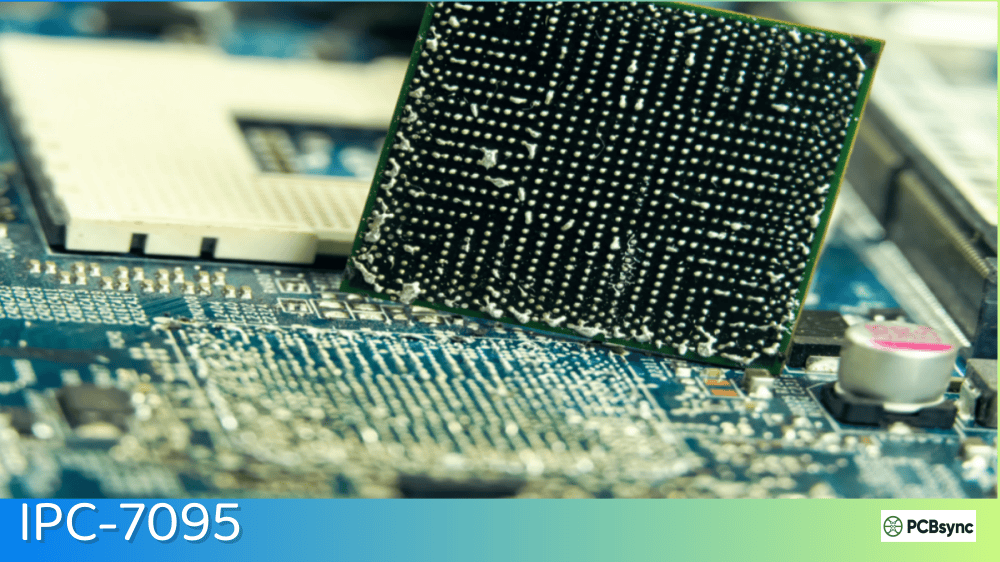
IPC-7095 covers ball grid array packages generally, including PBGA, CBGA, and other BGA types where a packaged component (not bare die) is assembled. IPC-7094 specifically addresses flip chip and die-size components where bare or minimally packaged die are mounted. For WLBGA and DSBGA assembly, IPC-7094 is more directly applicable. Some guidance overlaps, particularly for land pattern design and X-ray inspection.
What causes underfill voiding and how do I prevent it?
Underfill voids typically result from flux residue incompatibility with underfill chemistry, trapped air during underfill dispensing, insufficient underfill volume leaving unfilled regions, or outgassing from substrate or flux during cure. IPC-7094 recommends qualifying flux and underfill combinations together, optimizing dispense patterns to eliminate trapped air, and ensuring adequate underfill volume with controlled fillet formation. Process development should include C-SAM inspection to detect voiding.
Can flip chip assemblies be reworked?
Rework is possible but challenging. For capillary underfill, the assembly must be heated to remove the component while managing thermal damage to the substrate. Underfill must be removed from the site—typically by mechanical scraping or laser ablation—before site preparation and component replacement. IPC-7094 notes that reworkability is a key advantage of capillary underfill over no-flow underfill, where rework is essentially impossible. For high-value assemblies, rework capability may be a deciding factor in underfill selection.
Conclusion: Implementing IPC-7094
Flip chip technology delivers compelling advantages for high-performance, space-constrained applications—but only when the assembly challenges are properly addressed. The gap between successful laboratory demonstrations and reliable high-volume production is exactly what IPC-7094 bridges.
Key implementation takeaways:
Start with materials qualification—flip chip success depends on compatible combinations of bump metallurgy, flux, substrate finish, and underfill
Invest in process development—underfill especially requires optimization for each new product
Plan for inspection—X-ray and acoustic microscopy capability are essential, not optional
Design for manufacturing—engage assembly engineers early to avoid designs that can’t be reliably built
Test to failure—reliability testing must extend to failure to understand margins, not just pass/fail
The flip chip market continues growing as AI accelerators, HBM, and advanced mobile devices push packaging density limits. Engineers who master these technologies—guided by IPC-7094—position themselves to deliver the next generation of electronic products.
Inquire: Call 0086-755-23203480, or reach out via the form below/your sales contact to discuss our design, manufacturing, and assembly capabilities.
Quote: Email your PCB files to Sales@pcbsync.com (Preferred for large files) or submit online. We will contact you promptly. Please ensure your email is correct.
Notes: For PCB fabrication, we require PCB design file in Gerber RS-274X format (most preferred), *.PCB/DDB (Protel, inform your program version) format or *.BRD (Eagle) format. For PCB assembly, we require PCB design file in above mentioned format, drilling file and BOM. Click to download BOM template To avoid file missing, please include all files into one folder and compress it into .zip or .rar format.