Inquire: Call 0086-755-23203480, or reach out via the form below/your sales contact to discuss our design, manufacturing, and assembly capabilities.
Quote: Email your PCB files to Sales@pcbsync.com (Preferred for large files) or submit online. We will contact you promptly. Please ensure your email is correct.
Notes: For PCB fabrication, we require PCB design file in Gerber RS-274X format (most preferred), *.PCB/DDB (Protel, inform your program version) format or *.BRD (Eagle) format. For PCB assembly, we require PCB design file in above mentioned format, drilling file and BOM. Click to download BOM template To avoid file missing, please include all files into one folder and compress it into .zip or .rar format.
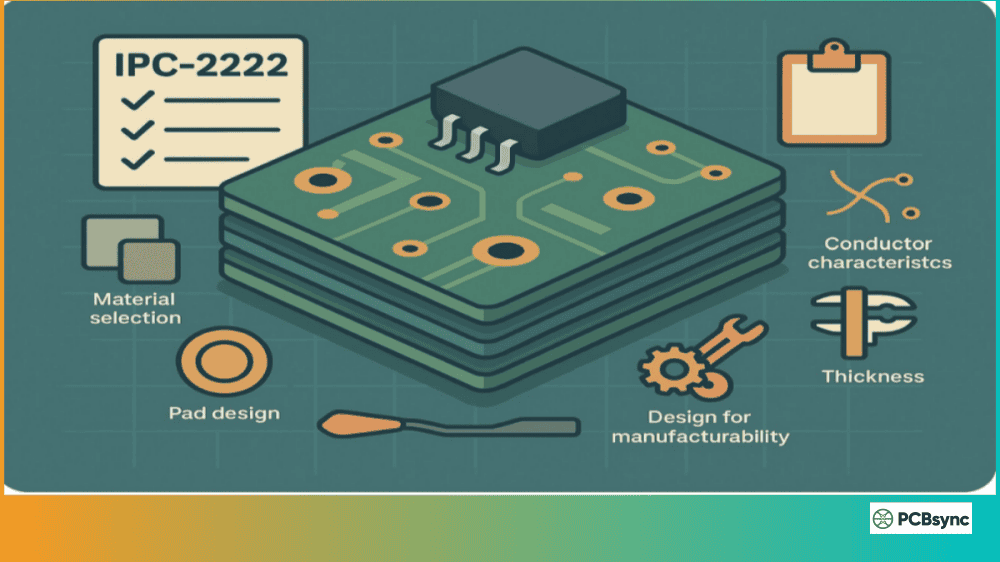
IPC-7092: Complete Guide to Embedded Components in PCB Design
Every PCB designer eventually faces the same challenge: fitting more functionality into less space while maintaining signal integrity. Surface-mount passives consume valuable real estate, add parasitic inductance, and require solder joints that can fail. The solution? Embedding components directly into the PCB substrate. That’s exactly what IPC-7092 addresses, and if you’re working on miniaturized designs, this standard should be on your desk.
In this guide, I’ll walk you through everything IPC-7092 covers—from formed resistors and capacitors to embedded active die—and show you how to apply it in your designs.
IPC-7092, officially titled “Design and Assembly Process Implementation for Embedded Components” (original 2015 release) and “Design and Assembly Process Implementation for Embedded Circuitry” (Revision A, October 2022), is an IPC standard that provides comprehensive guidance for embedding passive and active components within printed circuit board substrates.
The standard addresses both “formed” components—where resistors, capacitors, and inductors are created using specialized materials during PCB fabrication—and “placed” components—where discrete parts or bare die are physically embedded within the board structure. IPC-7092 covers the complete implementation lifecycle including design considerations, material selection, process characteristics, testing requirements, and reliability validation.
At approximately 80+ pages, IPC-7092 provides the technical depth needed to successfully implement embedded component technology. It helps decision-makers understand when embedding makes sense, guides designers through the unique requirements of embedded layouts, and establishes inspection and testing criteria for production.
Why Embedded Components Matter in Modern PCB Design
The embedded die packaging market is experiencing explosive growth, valued at approximately $114.7 million in 2024 with projections reaching $740 million by 2034—a compound annual growth rate exceeding 20%. This growth reflects the fundamental value that embedded component technology delivers.
Space Efficiency and Miniaturization
In a typical smartphone or wearable device, passive components (resistors, capacitors, inductors) can account for over 60% of the bill of materials. Moving even a fraction of these components from the surface into the substrate frees valuable real estate for additional functionality or enables smaller form factors.
Improved Electrical Performance
Surface-mount components introduce parasitic inductance and capacitance through their solder joints and lead structures. Embedded passives eliminate these parasitics by creating components directly within the copper and dielectric layers. For high-frequency applications, this can be the difference between meeting and missing signal integrity requirements.
Enhanced Reliability
Every solder joint is a potential failure point. Embedded components eliminate solder joints entirely, improving reliability in applications subject to thermal cycling, vibration, or shock. This makes embedded technology particularly attractive for automotive, aerospace, and medical applications.
Manufacturing Efficiency
While embedded components add complexity to PCB fabrication, they can simplify board assembly by reducing the number of discrete placements. For high-volume products, this trade-off often favors embedding.
Key Topics Covered in IPC-7092
IPC-7092 is organized to address the complete embedded component implementation process:
In-process testing, final testing, reliability validation
Post-Assembly Considerations
Inspection, rework limitations, failure analysis
Supplier Selection
Qualification criteria, capability assessment
Embedded Component Structure Types
One of IPC-7092’s most practical contributions is defining six standard embedded component structure configurations. Understanding these helps you communicate clearly with your fabricator:
Structure Type
Configuration
Typical Application
Type A
Components on one side of mounting base
Simple single-layer embedding
Type B
Components on both sides of mounting base
Higher density requirements
Type C
Active/passive components on one side + formed passives in base
Hybrid formed/placed
Type D
Active/passive components on both sides + formed passives in base
Maximum integration
Type E
Cavity-embedded components
Thick component accommodation
Type F
Multi-level embedded structures
Complex 3D integration
Embedded Passive Technologies
The majority of embedded component applications involve passive elements. IPC-7092 provides detailed guidance on each technology.
Formed Resistors
Formed resistors are created during PCB fabrication using resistive materials laminated to or deposited on copper foil. Two primary technologies dominate:
Thin-Film Resistors use sputtered nickel-chromium (NiCr) or nickel-chromium-aluminum-silicon (NiCrAlSi) alloys on copper foil. The resistive layer is typically less than 1 micron thick. Thin-film technology offers tight tolerance control (down to ±1% with laser trimming), excellent stability, and low temperature coefficient of resistance (TCR). Sheet resistivity options typically include 25, 50, 100, and 250 ohms per square.
Thick-Film Resistors use screen-printed resistive pastes—either polymer thick film (PTF) or ceramic thick film (CTF). PTF materials offer resistance values from 1 ohm to 1 megohm per square, while CTF materials typically range from 10 ohms to 10K ohms per square. Thick-film processes are generally more economical but offer less precise tolerance control than thin-film.
Technology
Sheet Resistivity Range
Tolerance (As-Formed)
TCR
Best For
Thin-Film NiCr
25-250 Ω/sq
±5% (±1% trimmed)
±50 ppm/°C
Precision applications
Polymer Thick Film
1Ω-1MΩ/sq
±10-20%
±200-500 ppm/°C
Cost-sensitive designs
Ceramic Thick Film
10Ω-10KΩ/sq
±10%
±100-200 ppm/°C
Power applications
IPC-7092 provides guidance on resistor geometry design, including bar, serpentine, and meander patterns. The standard emphasizes that resistor value is determined by the aspect ratio (length/width) multiplied by sheet resistivity—a fundamental relationship designers must understand.
Formed Capacitors
Embedded capacitors come in two primary configurations:
Planar Capacitors are created by laminating thin dielectric material between power and ground planes. The entire plane pair becomes a distributed capacitor, providing excellent high-frequency decoupling directly beneath ICs. Planar capacitors use specialized high-dielectric-constant materials to achieve useful capacitance values within the constraints of plane geometry.
Discrete Formed Capacitors are created by screen-printing or laminating dielectric material between defined copper electrode patterns. This approach creates individual capacitors with specific values at specific locations, similar to placed discrete capacitors but formed during fabrication.
Capacitor Type
Construction
Capacitance Range
Best For
Planar (Distributed)
Dielectric between power/ground planes
0.5-20 nF/sq inch
Power integrity, decoupling
Discrete Formed
Patterned electrodes with dielectric
10 pF-100 nF
Signal coupling, filtering
Formed Inductors
Inductors can be formed by etching spiral or serpentine patterns in copper layers. While value range is limited compared to discrete inductors, formed inductors eliminate the need for special materials—they use standard copper and dielectric. IPC-7092 covers spiral inductor design, including the trade-offs between inductance value, Q factor, and consumed area.
Beyond passive elements, IPC-7092 addresses embedding active semiconductor die within the PCB substrate. This technology, sometimes called “embedded die” or “chip-in-substrate,” offers significant benefits for advanced integration.
Die Embedding Methods
Active components are embedded by creating cavities within the laminate structure and placing bare die or packaged components within those cavities. The die is then connected to the PCB circuitry using either copper-plated vias or conductive adhesive.
The standard covers critical considerations including die thinning requirements (embedded die often must be thinned to less than 100 μm), adhesive selection for die attach, cavity formation processes, and via formation to the die bond pads.
Benefits of Embedded Active Components
Embedding active components delivers compelling advantages. First, it provides a 70% reduction in system-in-package (SiP) footprint compared to surface-mount approaches. Second, shortened interconnect paths improve electrical performance by reducing inductance and resistance. Third, embedding the die within the substrate improves thermal dissipation paths. Finally, eliminating solder joints to the die improves mechanical reliability.
Challenges and Limitations
IPC-7092 acknowledges the challenges of embedded active technology. Once embedded, components cannot be replaced—if a die fails, the entire board is scrapped. This makes known-good-die (KGD) verification critical. The standard provides guidance on incoming inspection, test coverage, and yield considerations for embedded active applications.
Materials for Embedded Components
IPC-7092 provides extensive guidance on material selection, recognizing that material choice fundamentally determines embedded component performance.
Resistive Materials
Material Type
Description
Key Specifications
Ohmega-Ply
NiP thin-film on copper foil
25-250 Ω/sq, ±10% tolerance
TCR Foil
NiCr thin-film on copper
25-100 Ω/sq, ±5% tolerance
Ticer
NiCr thin-film technology
Various resistivities available
PTF Pastes
Carbon-filled polymer inks
10Ω-1MΩ/sq range
The standard references IPC-4811 (Specification for Embedded Passive Device Resistor Materials) for detailed material requirements.
Capacitor Dielectric Materials
Embedded capacitor materials must provide high dielectric constant (Dk) for useful capacitance values while maintaining low loss and good reliability. Common materials include barium titanate-filled epoxies (Dk = 15-25), specialized thin-film dielectrics, and ceramic-filled polymers.
IPC-7092 references IPC-4821 (Specification for Embedded Passive Device Capacitor Materials) for material specifications.
Design Considerations for Embedded Components
IPC-7092 emphasizes that embedded component design requires early planning—you cannot simply substitute embedded parts for discrete parts late in the design cycle.
Design Flow Differences
Traditional design uses catalog parts with known values and standard footprints. Embedded design requires you to specify materials, calculate geometries to achieve target values, account for process tolerances, and design for the specific fabricator’s capabilities.
Tolerance Management
Embedded component tolerances are influenced by material properties, fabrication process control, and environmental factors. IPC-7092 provides guidance on tolerance analysis and design margin allocation. For resistors, laser trimming can improve as-formed tolerance from ±20% to ±1%, but this adds cost and must be planned into the fabrication flow.
Thermal Considerations
Embedded components dissipate heat differently than surface-mount parts. IPC-7092 addresses thermal design for embedded resistors, including maximum power ratings based on geometry, material, and surrounding structure.
CAD Tool Requirements
Most standard PCB CAD tools require customization or workarounds to support embedded component design. The standard acknowledges this gap and provides guidance on design documentation requirements when CAD tools don’t directly support embedded features.
IPC-7092 Compared to Related Standards
IPC-7092 works within a family of related standards:
Standard
Focus
Relationship to IPC-7092
IPC-2316
Design Guide for Embedded Passive Device Printed Boards
Qualification for Boards Containing Embedded Passives
Qualification requirements; complements IPC-7092
IPC-7091
Design and Assembly for 3D Components
3D packaging; IPC-7092 covers substrate embedding
IPC-7092 vs IPC-7091
These standards complement each other but address different integration approaches:
Aspect
IPC-7092
IPC-7091
Focus
Components embedded in PCB substrate
3D package stacking (PoP, stacked die)
Component Types
Formed passives, embedded die
Packaged components, interposers
Integration Level
Substrate level
Package level
Primary Benefit
Eliminate SMT passives, miniaturization
Vertical integration, heterogeneous integration
Testing and Reliability Requirements
IPC-7092 establishes testing requirements appropriate for embedded components.
In-Process Testing
Embedded resistors can be measured before subsequent lamination cycles, enabling laser trimming if required. The standard provides guidance on probe access requirements and measurement methodology for in-process testing.
Final Testing
Since embedded components cannot be probed directly after fabrication is complete, testing relies on functional verification and correlation to in-process measurements. IPC-7092 addresses test strategy development for embedded component boards.
Reliability Validation
The standard references appropriate qualification tests including thermal cycling, humidity exposure, and long-term stability testing. It emphasizes that embedded component reliability depends heavily on material selection and process control.
Who Needs IPC-7092?
PCB Designers
Designers working on miniaturized products, HDI boards, or high-frequency applications will find IPC-7092 essential. The standard provides the design rules, material options, and tolerance guidance needed to successfully implement embedded components.
Process Engineers
Engineers developing embedded component fabrication processes use IPC-7092 for process specifications, inspection criteria, and reliability requirements.
Product Development Teams
Teams evaluating embedded technology for new products use IPC-7092 to understand the trade-offs, costs, and capabilities of embedded approaches versus traditional SMT assembly.
Quality Engineers
Quality professionals reference IPC-7092 for acceptance criteria, inspection requirements, and qualification test protocols for embedded component boards.
How to Access IPC-7092
Purchase Options
Source
Format
Price (Non-Member)
IPC Official Store (shop.ipc.org)
PDF (DRM protected)
$190-215
ANSI Webstore
PDF
$190-200
Accuris/Techstreet
PDF
$190-200
GlobalSpec
Reference access
Varies
Version Information
IPC-7092A (October 2022) is the current revision, updating the original February 2015 release. The revision expanded coverage of embedded circuitry and updated content for current technologies.
Frequently Asked Questions About IPC-7092
What is the difference between IPC-7092 and IPC-2316?
IPC-2316 is a design guide focused specifically on embedded passive devices—it provides design rules and guidelines for implementing formed resistors and capacitors. IPC-7092 is broader in scope, covering both passive and active embedded components, plus the complete implementation process including materials, fabrication, testing, and reliability. Think of IPC-2316 as design-focused guidance and IPC-7092 as comprehensive implementation guidance. Many organizations use both: IPC-2316 for detailed design rules and IPC-7092 for the overall implementation framework.
Can embedded components be repaired or replaced if they fail?
No—this is one of the most significant limitations of embedded component technology. Once a component is embedded within the substrate, it cannot be replaced without scrapping the entire board. This is why IPC-7092 emphasizes in-process testing, known-good-die verification for embedded actives, and conservative design margins. For production applications, the yield and reliability implications must be carefully evaluated before committing to embedded components.
What tolerance can I achieve with embedded resistors?
As-formed tolerance depends on the technology and process. Thin-film resistors typically achieve ±5% as-formed tolerance, while thick-film may be ±10-20%. With laser trimming, tolerances down to ±1% or better are achievable for thin-film resistors. However, laser trimming adds cost and process complexity, so it’s typically reserved for applications requiring tight tolerance. IPC-7092 provides guidance on matching resistor technology to tolerance requirements.
Is IPC-7092 applicable to flex circuits?
Yes, embedded component technology applies to both rigid and flexible circuits, though implementation differs. Flexible circuits present unique challenges for embedded components due to bending stresses and material compatibility requirements. IPC-7092 notes that embedded resistors should generally be placed in rigid portions of flex-rigid designs. For embedded die in flexible substrates—a fast-growing market segment—special considerations apply for die thinning and stress management.
What industries are using embedded component technology?
Consumer electronics leads adoption, accounting for over 40% of the embedded die packaging market. Smartphones, wearables, and IoT devices drive demand for miniaturization. Medical devices benefit from both size reduction and improved reliability. Automotive applications use embedded passives for power management and RF modules. Telecommunications infrastructure, particularly 5G equipment, uses embedded technology for high-frequency performance. Aerospace and defense applications value the reliability improvements from eliminating solder joints.
Conclusion: Implementing IPC-7092 in Your Organization
Embedded component technology offers compelling benefits for the right applications: space savings, improved electrical performance, and enhanced reliability. However, successful implementation requires careful planning, appropriate material selection, and robust process control.
IPC-7092 provides the comprehensive framework needed to navigate embedded component implementation. My recommendations for getting started:
Evaluate application fit before committing to embedded technology. Consider volume requirements, tolerance needs, reliability expectations, and cost targets.
Engage fabricators early in the design process. Not all PCB fabricators support embedded components, and those that do have varying capabilities.
Plan for testing from the beginning. Embedded components require different test strategies than conventional SMT assemblies.
Use related standards together—IPC-7092 for overall implementation, IPC-2316 for design guidance, and IPC-4811/4821 for material specifications.
Start with passives if you’re new to embedded technology. Formed resistors and capacitors have mature processes and lower risk than embedded active die.
As electronic products continue to shrink and performance demands increase, embedded component technology will become increasingly mainstream. IPC-7092 gives you the knowledge foundation to implement this technology successfully.
Inquire: Call 0086-755-23203480, or reach out via the form below/your sales contact to discuss our design, manufacturing, and assembly capabilities.
Quote: Email your PCB files to Sales@pcbsync.com (Preferred for large files) or submit online. We will contact you promptly. Please ensure your email is correct.
Notes: For PCB fabrication, we require PCB design file in Gerber RS-274X format (most preferred), *.PCB/DDB (Protel, inform your program version) format or *.BRD (Eagle) format. For PCB assembly, we require PCB design file in above mentioned format, drilling file and BOM. Click to download BOM template To avoid file missing, please include all files into one folder and compress it into .zip or .rar format.