Inquire: Call 0086-755-23203480, or reach out via the form below/your sales contact to discuss our design, manufacturing, and assembly capabilities.
Quote: Email your PCB files to Sales@pcbsync.com (Preferred for large files) or submit online. We will contact you promptly. Please ensure your email is correct.
Notes: For PCB fabrication, we require PCB design file in Gerber RS-274X format (most preferred), *.PCB/DDB (Protel, inform your program version) format or *.BRD (Eagle) format. For PCB assembly, we require PCB design file in above mentioned format, drilling file and BOM. Click to download BOM template To avoid file missing, please include all files into one folder and compress it into .zip or .rar format.
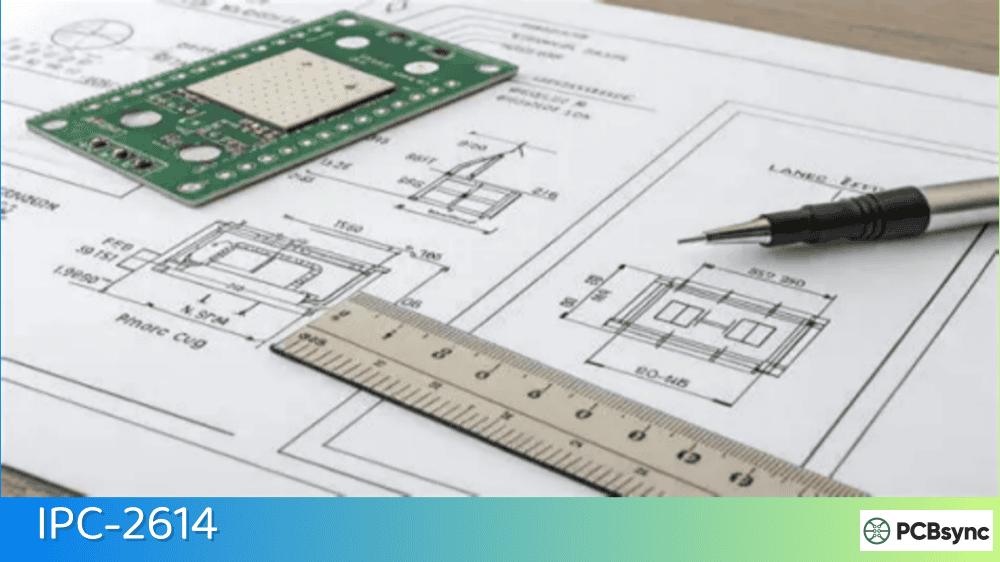
IPC-2614 Guide: Complete PCB Fab Drawing Requirements
Every PCB designer has experienced it: you send your design to fabrication, and the questions start rolling in. “What’s the finished board thickness?” “Is this hole plated or non-plated?” “What IPC class?” “What surface finish?” The back-and-forth delays your project and introduces opportunities for error.
IPC-2614 eliminates this problem by establishing exactly what information must be included in PCB fabrication documentation. Officially titled “Sectional Requirements for Board Fabrication Documentation,” this 59-page standard defines the methodology for transferring design information to board fabricators—including physical characteristics, accept/reject criteria, and quality requirements for the delivered product.
IPC-2614 is a sectional standard within the IPC-2610 documentation series that establishes requirements for PCB fabrication documentation. The standard applies to rigid boards, flexible circuits, rigid-flex, inorganic substrates, and any combination thereof. It covers single-sided, double-sided, multilayer, and HDI constructions, including boards with embedded components.
The purpose of IPC-2614 is creating consistent communication between design and manufacturing. Some documentation elements are mandatory to avoid ambiguity; others are recommended to establish consistent practices across the industry.
IPC-2614 Standard Overview
Attribute
Details
Full Title
Sectional Requirements for Board Fabrication Documentation
IPC-2614 is part of a comprehensive documentation framework that replaced the older IPC-D-325 standard. Understanding where IPC-2614 fits helps you use the complete documentation system effectively.
IPC-2610 Series Standards
Standard
Focus
IPC-2611
Generic requirements for all electronic documentation
IPC-2612
Schematic and logic diagram documentation
IPC-2612-1
Symbol generation methodology
IPC-2614
Board fabrication documentation
IPC-2615
Printed board dimensions and tolerances
IPC-D-325 to IPC-2614 Evolution
Aspect
IPC-D-325 (Old)
IPC-2614 (Current)
Scope
Combined documentation requirements
Fabrication-specific only
Structure
Monolithic document
Sectional within series
Classification
Basic grading
Grade + completeness mode
HDI coverage
Limited
Comprehensive
Electronic data
Secondary focus
Equal to hard copy
Embedded components
Not addressed
Included
The IPC-2610 series split documentation requirements into logical sections, making it easier to find relevant requirements and update individual standards without revising the entire document set.
IPC-2614 Classification System
IPC-2614 uses a two-part classification system that defines both the format and completeness of your documentation package.
Documentation Grade Definitions
Grade
Format
Description
Grade A
Hard copy only
Traditional paper drawings and prints
Grade B
Electronic data only
CAD files, Gerber, ODB++, IPC-2581
Grade C
Hard copy + electronic
Both formats provided
Completeness Mode Requirements
Mode
Completeness Level
Typical Use
Mode 1
Minimum documentation
Simple boards, trusted fabricators
Mode 2
Standard documentation
Most production boards
Mode 3
Complete documentation
Complex boards, new fabricators
The classification is expressed as a letter-number combination. For example, “Grade B, Mode 2” indicates electronic data with standard completeness—the most common classification for modern PCB fabrication.
Board Outline and Dimension Requirements per IPC-2614
The fabrication drawing must clearly define the physical boundaries and critical dimensions of the PCB.
Required Dimension Information
Element
Requirement
Board outline
Complete perimeter with all features
Overall dimensions
Length × width with tolerances
Origin point
(0,0) reference matching drill data
Cutouts
All internal routing with dimensions
Edge features
Chamfers, radii, notches dimensioned
Critical dimensions
Features requiring tight tolerances
Dimension Best Practices per IPC-2614
Practice
Rationale
Match origin to NC drill
Prevents misalignment between artwork and holes
Include only critical dimensions
Too many dimensions create confusion
Specify tolerances
Default tolerances may not meet requirements
Show scaling reference
Allows verification of print scaling
Use consistent units
Metric or imperial throughout
The origin point deserves special attention. IPC-2614 requires that the origin on your fabrication drawing matches the origin in your NC drill data. Mismatched origins cause holes to be drilled in wrong locations—a costly mistake.
Layer Stackup Documentation per IPC-2614
For multilayer boards, the stackup documentation is often the most critical element of your fabrication package.
Required Stackup Information
Element
Requirement
Layer count
Total number of conductive layers
Layer sequence
Order from primary side (Layer 1) through
Layer names
Must match Gerber/ODB++ file names
Copper weights
Starting and finished copper per layer
Dielectric materials
Material type or IPC-4101 slash sheet
Dielectric thickness
Target thickness with tolerances
Overall thickness
Finished board thickness with tolerance
Layer Naming Convention per IPC-2614
Layer Position
IPC-2614 Convention
Primary side (top)
Layer 1
First internal
Layer 2
Subsequent internal
Layer 3, 4, 5…
Secondary side (bottom)
Layer N (highest number)
IPC-2614 requires that conductor layer identification start with the primary side as Layer 1, with subsequent layers numbered sequentially. This seems obvious, but inconsistent naming between the stackup drawing and Gerber files causes fabrication errors.
The drill table documents all holes in the PCB, providing critical information for fabrication planning and verification.
Required Drill Table Information
Column
Content
Symbol
Unique identifier matching drill drawing
Finished hole size
Diameter after plating
Quantity
Number of holes at this size
Plating status
Plated (PTH) or non-plated (NPTH)
Tolerance
Allowable variation (+/-)
Additional Drill Table Information
Element
When to Include
Tool size
When specifying drill (not finished) size
Via type
Blind, buried, or through
Hole type
Via, component, mounting, tooling
Aspect ratio
For high aspect ratio holes
Press-fit callout
When press-fit tolerances required
Slot dimensions
For non-circular holes
Drill Table Best Practices
Practice
Benefit
Specify finished sizes
Fabricator calculates drill compensation
Separate PTH from NPTH
Clear plating requirements
Call out special holes
Press-fit, via-in-pad, laser drills
Include tolerance for critical holes
Prevents assumption of standard tolerance
Match symbols to drill drawing
Easy cross-reference
Fabrication Notes per IPC-2614
Fabrication notes communicate requirements that aren’t captured in the graphical elements of the drawing. IPC-2614 identifies both mandatory and recommended notes.
Mandatory Fabrication Note Topics
Topic
Purpose
IPC class
Defines accept/reject criteria (Class 1, 2, or 3)
Material specification
Base material requirements
Surface finish
HASL, ENIG, OSP, etc.
Solder mask
Type, color, coverage requirements
Silkscreen
Color, legend requirements
Copper plating
Minimum hole wall thickness
Common Fabrication Notes per IPC-2614
Note Category
Example Content
General
“Fabricate per IPC-6012 Class 2”
Material
“Material per IPC-4101/21 or equivalent”
Plating
“Minimum 1 mil copper in plated holes”
Surface finish
“ENIG per IPC-4552, 3-6 μin Au”
Solder mask
“LPI solder mask, green, both sides”
Silkscreen
“White epoxy legend, component side”
Impedance
“Controlled impedance per stackup, ±10%”
Testing
“100% electrical test required”
IPC Class Selection
Class
Application
Accept/Reject Criteria
Class 1
General electronics
Least stringent
Class 2
Dedicated service
Standard production
Class 3
High reliability
Most stringent
The IPC class note is critical—it tells the fabricator which IPC-6012 (or IPC-6013 for flex) acceptance criteria apply. Without this note, the fabricator must guess or ask, delaying your project.
Special Construction Documentation
IPC-2614 addresses documentation requirements for advanced PCB constructions that need additional information beyond standard boards.
HDI Documentation Requirements
Element
Requirement
Microvia specifications
Size, aspect ratio, capture pad
Via stacking
Stacked or staggered configuration
Build-up layers
Sequential lamination requirements
Laser drill callouts
Which holes are laser vs mechanical
Controlled Impedance Documentation
Element
Requirement
Target impedance
Ohms with tolerance (e.g., 50Ω ±10%)
Trace identification
Which nets require control
Reference layers
Ground/power plane references
Test coupon
Whether test coupon required
Measurement method
TDR or other specification
Embedded Component Documentation
Element
Requirement
Component locations
X-Y coordinates in stackup
Component specifications
Part numbers, values
Cavity requirements
If applicable
Connection method
How components connect to circuitry
Electronic Data Requirements per IPC-2614
Modern fabrication relies heavily on electronic data. IPC-2614 addresses requirements for these formats alongside traditional drawings.
Accepted Electronic Formats
Format
Description
Notes
Gerber (RS-274X)
Industry standard artwork
Most common
ODB++
Intelligent format with metadata
Growing adoption
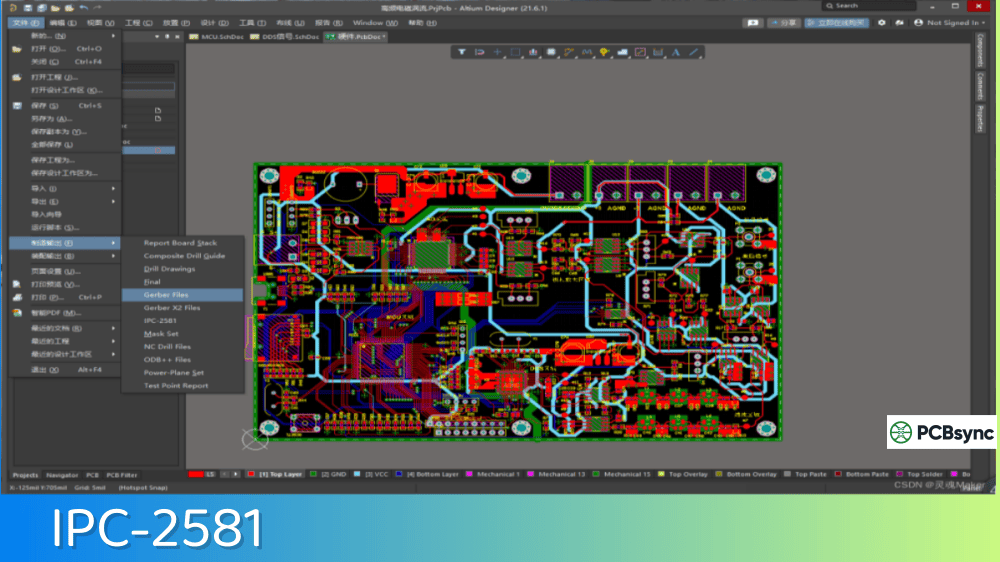
IPC-2581
Open standard with full data
Recommended by IPC
Excellon
NC drill data
Standard for drilling
IPC-D-356
Netlist for electrical test
Required for testing
Electronic Data Best Practices
Practice
Benefit
Include README file
Documents file contents and settings
Match layer names
Drawing and data file names consistent
Verify aperture lists
Ensures correct feature sizes
Include netlist
Enables electrical test verification
Package in single archive
Prevents missing files
Tools and Resources for IPC-2614
Official IPC Documentation
Resource
Source
Notes
IPC-2614 Standard
shop.ipc.org
~$107, primary document
IPC-2611
shop.ipc.org
Generic documentation requirements
IPC-2615
shop.ipc.org
Dimensions and tolerances
IPC-6012
shop.ipc.org
Rigid board qualification
IPC-6013
shop.ipc.org
Flex board qualification
Related Standards
Standard
Relationship to IPC-2614
IPC-6012
Defines Class 1/2/3 acceptance criteria
IPC-4101
Laminate material specifications
IPC-4552
ENIG surface finish specification
IPC-2581
Intelligent data transfer format
IPC-D-356
Netlist format for bare board test
EDA Tool Documentation Features
Tool
Fab Drawing Capability
Altium Designer
Draftsman documentation tool
KiCad
Fabrication output generation
OrCAD
Documentation features
PADS
Fab drawing generation
Eagle
CAM processor outputs
Frequently Asked Questions About IPC-2614
What is the difference between IPC-2614 and IPC-D-325?
IPC-2614 is part of the newer IPC-2610 documentation series that replaced IPC-D-325. While IPC-D-325 was a monolithic document covering all documentation requirements, IPC-2614 focuses specifically on board fabrication documentation. The IPC-2610 series split requirements into logical sections (schematics, fabrication, assembly, etc.) making it easier to find relevant requirements and update individual standards. IPC-2614 also adds coverage for HDI, embedded components, and gives equal weight to electronic data formats alongside traditional drawings.
Do I need a fabrication drawing if I’m using online PCB ordering?
Yes and no. Online PCB services capture most IPC-2614 requirements through their web forms—material, thickness, surface finish, copper weight, and so on. However, having a fabrication drawing creates a permanent record of your specifications and catches any discrepancies between what you ordered and what’s in your design files. For production boards or anything beyond simple prototypes, maintaining IPC-2614 compliant documentation is strongly recommended.
What IPC class should I specify on my fabrication drawing?
Most commercial and industrial electronics use Class 2, which provides good reliability without the cost premium of Class 3. Class 1 is appropriate for general consumer products where cost is the primary driver. Class 3 is required for high-reliability applications like medical devices, aerospace, and military systems. The class designation affects acceptance criteria throughout fabrication—plating thickness, annular ring requirements, surface defects, and more—so choose appropriately for your application’s reliability requirements.
How detailed should my stackup drawing be per IPC-2614?
Your stackup should include enough detail that the fabricator can build exactly what you designed without guessing. At minimum: layer count, layer sequence with names matching your Gerber files, copper weights, dielectric materials (or equivalent specifications), dielectric thicknesses with tolerances, and overall board thickness. For controlled impedance boards, add trace widths and target impedances. For HDI, include microvia specifications and build-up sequence. The fabricator should never need to ask “what did you intend here?”
Can I use IPC-2581 data instead of traditional fab drawings?
IPC-2581 is an intelligent data format that can contain all the information traditionally found in fabrication drawings plus the design data itself. IPC-2614 recognizes electronic data formats including IPC-2581 as valid documentation methods (Grade B). However, not all fabricators fully support IPC-2581 yet, so verify with your fabricator before relying solely on this format. Many designers use IPC-2581 alongside a traditional PDF fabrication drawing to ensure all fabricators can process their documentation.
Creating Complete Fab Documentation with IPC-2614
IPC-2614 transforms fabrication documentation from an afterthought into a systematic process. When your documentation package includes everything the standard requires—board dimensions with matched origins, complete stackup with layer names that match your data files, comprehensive drill tables, and fabrication notes that specify class, materials, and finishes—the questions stop and fabrication proceeds smoothly.
Start by selecting the appropriate classification for your project. Include all mandatory elements: board outline with origin, stackup with materials and thicknesses, drill table with plating status, and notes covering IPC class, material, and finish requirements. For complex boards, add the special construction documentation IPC-2614 requires for HDI, controlled impedance, or embedded components.
The combination of IPC-2614 compliant documentation and modern intelligent data formats like IPC-2581 ensures your fabricator receives exactly the information needed to build your board correctly the first time. That means faster turnaround, fewer engineering queries, and boards that match your design intent.
Inquire: Call 0086-755-23203480, or reach out via the form below/your sales contact to discuss our design, manufacturing, and assembly capabilities.
Quote: Email your PCB files to Sales@pcbsync.com (Preferred for large files) or submit online. We will contact you promptly. Please ensure your email is correct.
Notes: For PCB fabrication, we require PCB design file in Gerber RS-274X format (most preferred), *.PCB/DDB (Protel, inform your program version) format or *.BRD (Eagle) format. For PCB assembly, we require PCB design file in above mentioned format, drilling file and BOM. Click to download BOM template To avoid file missing, please include all files into one folder and compress it into .zip or .rar format.