Inquire: Call 0086-755-23203480, or reach out via the form below/your sales contact to discuss our design, manufacturing, and assembly capabilities.
Quote: Email your PCB files to Sales@pcbsync.com (Preferred for large files) or submit online. We will contact you promptly. Please ensure your email is correct.
Notes: For PCB fabrication, we require PCB design file in Gerber RS-274X format (most preferred), *.PCB/DDB (Protel, inform your program version) format or *.BRD (Eagle) format. For PCB assembly, we require PCB design file in above mentioned format, drilling file and BOM. Click to download BOM template To avoid file missing, please include all files into one folder and compress it into .zip or .rar format.
IPC-2584 Guide: How to Structure Copper, Drilling & Stackup Data for PCB Fabrication
Every PCB fabricator has a story about the Gerber package that arrived incomplete. Missing drill files. Ambiguous layer names. A stackup note that contradicted the actual layer count. These situations happen daily across the industry, and each one costs time, money, and sometimes scrapped boards. The traditional approach of assembling separate files for copper layers, drill data, solder mask, and fabrication notes creates countless opportunities for error.
IPC-2584 was designed to solve this problem. As the fabrication sectional standard within the IPC-2581 family, it defines exactly how copper artwork, drilling specifications, layer stackup, and all other fabrication data should be structured in a single intelligent file. At 40 pages, it’s the most comprehensive sectional in the IPC-2580 series—and for good reason. Fabrication data is where the rubber meets the road in PCB manufacturing.
IPC-2584 is officially titled “Sectional Requirements for Implementation of Printed Board Fabrication Data Description.” First released in June 2007 and updated in February 2021, this standard specifies the XML schema for all data needed to fabricate a printed circuit board.
The standard works as a companion to IPC-2581, the parent standard that defines the complete intelligent data format. While IPC-2581 provides the overall framework, IPC-2584 drills down (pun intended) into the specific requirements for fabrication data—the information that tells a manufacturer exactly how to build the bare board before any components are placed.
IPC-2584 Standard Overview
Attribute
Details
Full Title
Sectional Requirements for Implementation of Printed Board Fabrication Data Description
Standard Number
IPC-2584
Original Release
June 2007
Latest Update
February 2021
Page Count
40 pages
Parent Standard
IPC-2581 (mandatory companion)
Format
XML Schema
Cost
Purchase required from IPC
Predecessor
IPC-2514 (GenCAM fabrication data)
The 40-page length reflects the complexity of fabrication data. Compare this to IPC-2582 (administrative data) and IPC-2583 (design characteristics), which are each only 13 pages. Fabrication touches every physical aspect of the board, and IPC-2584 must address all of it.
Where IPC-2584 Fits in the IPC-2580 Series
The IPC-2581 standard family divides manufacturing data into logical categories, each covered by a sectional standard. IPC-2584 handles the physical fabrication layer—everything needed to produce the bare PCB.
Complete IPC-2581 Sectional Standards
Standard
Focus Area
Relationship to IPC-2584
IPC-2582
Administrative Methods
Order context for fab data
IPC-2583
Design Characteristics
Design intent behind fab features
IPC-2584
Board Fabrication
Core fabrication data
IPC-2585
Board Assembly
Uses fab data as foundation
IPC-2586
Bare Board Testing
Tests fab output quality
IPC-2587
Assembly Testing
Post-assembly verification
IPC-2588
Parts List
Component data for assembly
IPC-2584 sits at the center of the manufacturing process. The design characteristics from IPC-2583 inform what gets fabricated. The fabrication output becomes the substrate for assembly operations defined in IPC-2585. And the bare board testing in IPC-2586 verifies that fabrication met specifications.
What Fabrication Data Does IPC-2584 Cover?
The standard addresses ten major data categories, each corresponding to a critical aspect of PCB fabrication. Understanding these categories helps you ensure your manufacturing data packages are complete.
IPC-2584 Data Categories
Section
Category
Traditional Equivalent
4.4
Board Fabrication Materials
Fab notes, material callouts
4.5
Board Material Suppliers
Approved vendor lists
4.6
Documentation Layers
Fab drawings, dimensions
4.7
DfX Analysis
DFM reports, rule checks
4.8
Miscellaneous Image Layers
Additional artwork
4.9
Packages and Land Patterns
Pad definitions
4.10
Solder Mask and Legend
Mask Gerbers, silkscreen
4.11
Drilling and Routing
Drill files, board outline
4.12
Conductor Layers
Copper Gerbers
4.13
Stack Groups
Stackup drawings, notes
Each category replaces what traditionally required separate files, drawings, or verbal communication. With IPC-2584, all this information lives in a structured, validated format within a single file.
Conductor Layer Data in IPC-2584
Copper artwork is the foundation of any PCB. IPC-2584 defines how conductor layers—signal traces, power planes, and ground planes—should be represented in the manufacturing data.
Conductor Layer Types
Layer Type
Description
IPC-2584 Handling
Signal
Routed traces carrying signals
Full feature attribution
Plane
Solid or split power/ground
Negative or positive polarity
Mixed
Combined signal and plane
Both feature types supported
Power
Dedicated power distribution
Plane with voltage attributes
Ground
Reference plane
Plane with ground designation
Unlike Gerber files, which are essentially images, IPC-2584 conductor data retains intelligence. Each trace knows which net it belongs to. Each pad knows which component pin it connects to. This attribution enables automated DFM analysis and netlist verification that simply isn’t possible with traditional formats.
Copper Feature Representation
IPC-2584 uses standardized primitives to represent copper features:
Feature
Representation
Attributes
Traces
Polyline with width
Net, layer, impedance class
Pads
Polygon or standard shape
Net, component, pin number
Planes
Polygon with voids
Net, voltage, thermal relief
Pours
Polygon fill
Net, clearance, thermal settings
Vias
Padstack definition
Net, drill span, plating
The attribute system is what makes IPC-2584 data intelligent. A manufacturer’s CAM system can automatically verify that copper features match the intended netlist, catch potential shorts, and flag DFM violations—all without manual interpretation.
Drilling and Routing Data in IPC-2584
Drill data is where traditional workflows frequently fail. Separate Excellon files for through-holes, blind vias, buried vias, and micro-vias must all be correctly associated with their layer spans. IPC-2584 eliminates this complexity by embedding complete drill information with explicit layer associations.
Drill Hole Types in IPC-2584
Hole Type
Layer Span
IPC-2584 Handling
Through-hole
All layers
Single drill definition
Blind via
Surface to inner
Explicit start/end layers
Buried via
Inner to inner
Explicit start/end layers
Micro-via
Adjacent layers
Laser drill specification
Back drill
Partial depth
Depth and diameter defined
Drill Data Elements
Element
Purpose
Information Included
HoleType
Classification
PTH, NPTH, via, mounting
DrillSize
Tool diameter
Finished hole size
TolerancePlus
Upper tolerance
Allowable oversize
ToleranceMinus
Lower tolerance
Allowable undersize
PlatingStatus
Plating requirement
Plated, non-plated
LayerSpan
Layer association
Start and end layers
Back drilling support is particularly valuable for high-speed designs. IPC-2584 allows precise specification of back drill requirements including depth, diameter, and location—information that traditionally required separate documentation and was prone to misinterpretation.
Routing (Board Outline) Data
Board outline and internal cutouts are defined in the routing section of IPC-2584:
Stackup definition is critical for impedance control, signal integrity, and manufacturability. Traditional workflows communicate stackup through drawings, spreadsheets, or text notes—all subject to misinterpretation. IPC-2584 provides structured stackup data that CAM systems can read directly.
Stackup Elements
Element
Purpose
Parameters
StackGroup
Stackup container
Name, description
StackupLayer
Individual layer
Type, thickness, material
Material
Material specification
Dk, Df, Tg, CTI
CopperWeight
Copper thickness
Base weight, finished weight
Impedance
Controlled impedance
Target, tolerance, reference
Material Properties in IPC-2584
Property
Description
Typical Values
Dk (Dielectric Constant)
Electrical permittivity
3.5-4.5 for FR-4
Df (Loss Tangent)
Signal loss factor
0.02-0.025 for FR-4
Tg (Glass Transition)
Thermal threshold
130°C-180°C
CTI (Tracking Index)
Arc resistance
PLC 0-5 rating
CTE (Thermal Expansion)
Expansion coefficient
X/Y and Z axis values
By embedding material properties directly in the fabrication data, IPC-2584 enables automated impedance calculation and material selection verification. Manufacturers can confirm that specified materials will achieve target impedances before committing to production.
Solder Mask and Legend Data
While often considered secondary to copper and drill data, solder mask and legend (silkscreen) specifications are essential for assembly success. IPC-2584 addresses both comprehensively.
Solder Mask Data Elements
Element
Purpose
Specifications
MaskType
Mask classification
LPI, dry film, liquid
Color
Visual appearance
Green, black, white, etc.
Thickness
Coating depth
Over copper, over laminate
Opening
Pad exposure
Size, shape, expansion
Dam
Mask between pads
Width, required/optional
Plug
Via filling
Full, partial, tented
Legend (Silkscreen) Data Elements
Element
Purpose
Specifications
LegendType
Ink classification
Epoxy, UV cure
Color
Visual appearance
White, yellow, black
Side
Application surface
Top, bottom, both
Content
Marking elements
RefDes, polarity, logos
MinFeature
Smallest element
Line width, text height
IPC-2584 ensures that solder mask and legend data aligns with the copper artwork it references. Pad openings are defined relative to the pads themselves, eliminating the registration issues that can occur when mask Gerbers are generated separately from copper Gerbers.
DfX Analysis Data in IPC-2584
One of IPC-2584’s unique features is its support for Design for eXcellence (DfX) data. This includes DFM (Design for Manufacturability) measurements that can be embedded directly in the fabrication file.
DfX Measurement Types
Measurement
Purpose
Example Values
MinTraceWidth
Smallest trace
3 mil, 4 mil
MinSpace
Smallest gap
3 mil, 4 mil
MinAnnularRing
Smallest ring
3 mil, 4 mil
MinDrill
Smallest hole
8 mil, 10 mil
AspectRatio
Hole depth/diameter
8:1, 10:1
CopperBalance
Layer symmetry
Percentage per layer
Embedding DfX data allows manufacturers to instantly assess whether a design falls within their capabilities. Instead of manually reviewing each design parameter, CAM systems can automatically flag potential manufacturability issues based on the embedded measurements.
IPC-2584 vs Traditional Gerber Workflow
Understanding what IPC-2584 replaces helps clarify its value. Here’s how traditional fabrication files map to IPC-2584 sections:
File Replacement Mapping
Traditional File
Format
IPC-2584 Section
Copper layers
Gerber RS-274X
Section 4.12 Conductor Layers
Solder mask
Gerber RS-274X
Section 4.10 Solder Mask
Silkscreen
Gerber RS-274X
Section 4.10 Legend
Drill files
Excellon
Section 4.11 Drilling
Board outline
Gerber or DXF
Section 4.11 Routing
Stackup drawing
PDF or Excel
Section 4.13 Stack Groups
Fab notes
PDF or text
Section 4.6 Documentation
Material spec
Text or drawing
Section 4.4 Materials
Approved vendors
Spreadsheet
Section 4.5 AVL
A typical 8-layer board might require 15-20 separate files in a traditional workflow. With IPC-2584, all that information consolidates into structured sections of a single IPC-2581 file.
CAD Tool Support for IPC-2584 Fabrication Export
Major EDA tools support IPC-2581 export, which includes IPC-2584 fabrication data. However, export completeness varies by tool and version.
EDA Tool IPC-2584 Support
CAD Tool
Fab Data Export
Stackup Support
Notes
Cadence Allegro
Comprehensive
Full
Industry-leading implementation
Cadence OrCAD
Comprehensive
Full
Shares Allegro engine
Mentor Xpedition
Comprehensive
Full
Strong HDI support
Mentor PADS
Good
Good
Most fab features
Altium Designer
Good
Good
Continuous improvement
Zuken CR-8000
Comprehensive
Full
Enterprise implementation
When exporting, verify that your CAD tool populates all critical IPC-2584 sections. Pay particular attention to stackup data, drill layer spans, and material properties—these are areas where incomplete exports often cause manufacturing questions.
Tools and Resources for IPC-2584
Official Documentation
Resource
Source
Access
IPC-2584 Standard
shop.ipc.org
Purchase required
IPC-2581 Standard
shop.ipc.org
Purchase required
IPC-2581 XML Schema
IPC-2581 Consortium
Free download
Implementation Guide
ipc2581.com
Free access
Software Tools
Tool
Provider
IPC-2584 Capability
IPC-2581 Viewer
Cadence
View all fab sections
Valor NPI
Siemens
Full import/DFM analysis
CAM350
DownStream
Fab data verification
VisualCAM
ICT
Stackup and drill review
Related Standards
Standard
Relationship to IPC-2584
IPC-2581
Parent standard (mandatory)
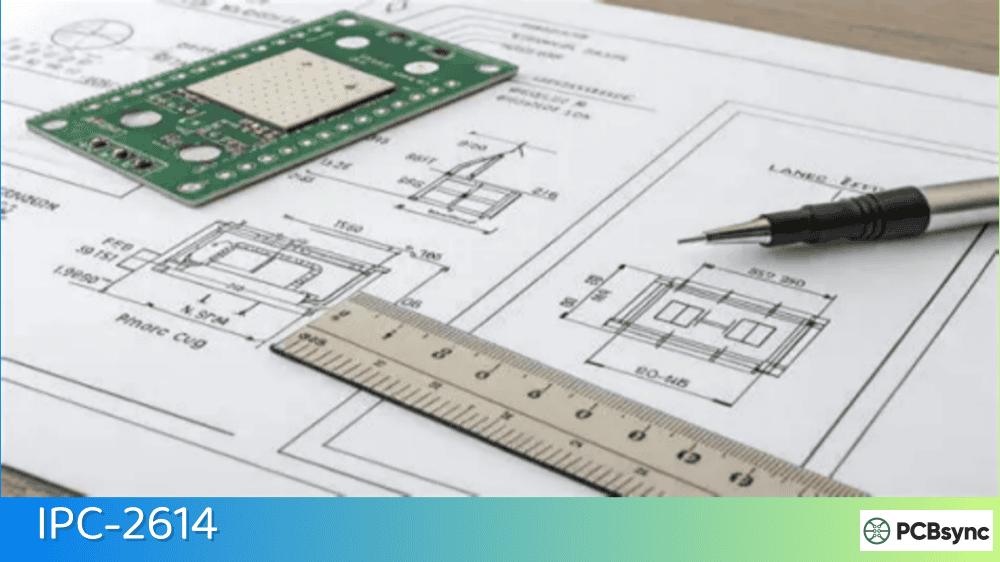
IPC-2614
Fabrication documentation requirements
IPC-2615
Board dimensions and tolerances
IPC-6012
Rigid board qualification
Frequently Asked Questions About IPC-2584
What is the difference between IPC-2584 and IPC-2583?
IPC-2583 covers design characteristics—the logical and electrical aspects of your design including layer definitions, netlists, and component placement. IPC-2584 covers fabrication data—the physical manufacturing instructions including copper artwork, drill specifications, and stackup details. Think of IPC-2583 as “what the design is” and IPC-2584 as “how to make it.” Both are necessary sections of a complete IPC-2581 file, and they reference each other extensively.
Does IPC-2584 replace Gerber files completely?
Yes, IPC-2584 contains all the information traditionally conveyed through Gerber RS-274X files plus additional data that Gerber cannot represent. Copper artwork, solder mask, silkscreen, drill data, board outline, and stackup information all have defined places within the IPC-2584 structure. The key advantage is that all this data is integrated and validated rather than existing as separate, potentially inconsistent files.
Why is IPC-2584 the largest sectional standard at 40 pages?
Fabrication data is inherently complex. A PCB fabricator needs complete information about copper features, drill holes of multiple types, layer stackup with material properties, solder mask specifications, legend requirements, and board outline—all precisely correlated. The 40-page length reflects the thoroughness required to define all these data types unambiguously. By comparison, administrative data (IPC-2582) and design characteristics (IPC-2583) are each only 13 pages.
Can I export only IPC-2584 fabrication data without the full IPC-2581 file?
No, IPC-2584 is a sectional standard that exists within the IPC-2581 framework. You cannot generate a standalone IPC-2584 file. Instead, when you export an IPC-2581 file, the fabrication data sections are structured according to IPC-2584 requirements. Some CAD tools allow you to export a “fabrication only” mode that includes IPC-2584 sections while omitting assembly-specific data, but the output is still an IPC-2581 file.
How do I verify that my exported file has correct IPC-2584 fabrication data?
Use an independent IPC-2581 viewer to inspect your exported file. Check that copper layers show correct polarity and net attribution, drill definitions include proper layer spans for blind and buried vias, stackup data includes material properties and thicknesses, and solder mask openings align with copper pads. Many viewers provide DFM analysis features that flag common fabrication data issues.
Making Fabrication Data Work for Manufacturing
IPC-2584 represents a fundamental improvement in how we communicate fabrication requirements to manufacturers. Instead of assembling disconnected files and hoping they’re interpreted correctly, we can now provide structured, validated data that CAM systems can process automatically.
The transition requires investment—in understanding the standard, configuring CAD tools correctly, and working with manufacturers who support intelligent data formats. But organizations that make this investment report significant reductions in NPI time, engineering queries, and fabrication errors.
Start by examining your current fabrication data packages. How many separate files do you send? How often do manufacturers ask clarifying questions about stackup, drill spans, or material requirements? Each question represents a gap that IPC-2584 was designed to fill.
Your designs contain precise fabrication intent. IPC-2584 ensures that intent reaches the factory floor intact, unambiguous, and ready for automated processing. That’s the promise of intelligent fabrication data—and it’s available today for organizations ready to embrace it.
Inquire: Call 0086-755-23203480, or reach out via the form below/your sales contact to discuss our design, manufacturing, and assembly capabilities.
Quote: Email your PCB files to Sales@pcbsync.com (Preferred for large files) or submit online. We will contact you promptly. Please ensure your email is correct.
Notes: For PCB fabrication, we require PCB design file in Gerber RS-274X format (most preferred), *.PCB/DDB (Protel, inform your program version) format or *.BRD (Eagle) format. For PCB assembly, we require PCB design file in above mentioned format, drilling file and BOM. Click to download BOM template To avoid file missing, please include all files into one folder and compress it into .zip or .rar format.