Inquire: Call 0086-755-23203480, or reach out via the form below/your sales contact to discuss our design, manufacturing, and assembly capabilities.
Quote: Email your PCB files to Sales@pcbsync.com (Preferred for large files) or submit online. We will contact you promptly. Please ensure your email is correct.
Notes: For PCB fabrication, we require PCB design file in Gerber RS-274X format (most preferred), *.PCB/DDB (Protel, inform your program version) format or *.BRD (Eagle) format. For PCB assembly, we require PCB design file in above mentioned format, drilling file and BOM. Click to download BOM template To avoid file missing, please include all files into one folder and compress it into .zip or .rar format.
IPC-2225: Complete Guide to MCM-L & Bare Die Assembly
When you move from packaged components to bare die assembly, everything changes. Standard SMT processes no longer apply. Your substrate becomes the package. Wire bonding pads need specific metallization, die attach requires thermal analysis, and encapsulation becomes critical for reliability. Without proper guidance, bare die projects turn into expensive learning experiences.
IPC-2225 provides that guidance. Officially titled “Sectional Design Standard for Organic Multichip Modules (MCM-L) and MCM-L Assemblies,” this standard establishes the design requirements for mounting bare semiconductor dice directly onto organic laminate substrates. Whether you’re designing single chip modules, multichip assemblies, or chip-on-board applications, IPC-2225 covers the thermal, electrical, electromechanical, and mechanical considerations that determine success or failure.
IPC-2225 is a sectional design standard within the IPC-2220 family that addresses the unique requirements of organic multichip modules. Unlike traditional PCB design where packaged components handle their own interconnection challenges, MCM-L designs place bare semiconductor dice directly on laminate substrates—requiring the designer to manage everything the package normally handles.
The standard covers Single Chip Modules (SCM-L), Multichip Modules (MCM), and MCM-L assemblies where the “L” designates laminate (organic) substrate technology.
IPC-2225 Standard Overview
Attribute
Details
Full Title
Sectional Design Standard for Organic Multichip Modules (MCM-L) and MCM-L Assemblies
Published
May 1998
Page Count
44 pages
ANSI Approved
Yes
Used With
IPC-2221 (required companion)
Current Status
No Longer Maintained
Replacement
Concepts absorbed into advanced packaging standards
Key Concepts in IPC-2225
Topic
Coverage
Die attach methods
Adhesive, eutectic, and solder attachment
Wire bonding design
Pad sizes, spacing, metallization
Flip-chip considerations
Bump pitch, underfill, thermal management
Substrate materials
Organic laminates, dielectric properties
Thermal management
Heat dissipation, via strategies
Microvia properties
Material characteristics for HDI substrates
DFM/DFE relationships
Design for manufacturing and environment
Understanding MCM Technology Types
Before diving into IPC-2225 specifics, understanding where MCM-L fits in the broader multichip module landscape helps contextualize the standard’s requirements.
MCM Technology Comparison
Type
Substrate
Line/Space
Cost
Thermal
Applications
MCM-L
Organic laminate
50-75 μm
Low
Moderate
Consumer, telecom
MCM-C
Ceramic (LTCC/HTCC)
75-100 μm
Medium
Good
Military, RF
MCM-D
Deposited thin film
10-25 μm
High
Variable
High-density, aerospace
MCM-S
Silicon substrate
5-10 μm
Highest
Excellent
Interposers, HBM
MCM-L offers the lowest cost entry point for bare die assembly because it leverages existing PCB manufacturing infrastructure. The organic substrate uses familiar materials—FR-4, polyimide, BT resin—processed with standard lamination and photolithography equipment.
MCM-L vs Chip-on-Board (COB)
IPC-2225 addresses both MCM-L and what’s commonly called Chip-on-Board (COB) technology. The distinction is subtle but important.
Characteristic
MCM-L
COB
Definition
Subsystem module (ASEM)
Application-specific assembly (ASEA)
Chip density
≥50% active area coverage
No minimum density
Usage
Mounted to larger assembly
Complete functional unit
Typical application
CPU modules, memory stacks
LED assemblies, sensors
IPC-2225 uses the term Application Specific Electronic Module (ASEM) for MCM-L devices, distinguishing them from complete application assemblies.
How IPC-2225 Works with IPC-2221
Like other sectional standards in the IPC-2220 family, IPC-2225 doesn’t stand alone. It works in conjunction with IPC-2221, the generic design standard that establishes baseline requirements for all printed board designs.
IPC-2220 Family Hierarchy
Standard
Focus Area
Relationship to IPC-2225
IPC-2221
Generic design requirements
Required companion—provides baseline rules
IPC-2222
Rigid organic boards
Substrate fabrication reference
IPC-2223
Flex and rigid-flex
Flex MCM-L substrate guidance
IPC-2224
PC card form factors
—
IPC-2225
MCM-L and bare die
Bare die-specific requirements
IPC-2226
HDI boards
Microvia and fine-line guidance
When designing an MCM-L assembly, start with IPC-2221 for generic requirements (conductor spacing, material selection, performance classes), then apply IPC-2225 for bare die-specific guidance (wire bond pads, die attach, encapsulation).
Die Attach Methods per IPC-2225
How you attach bare dice to the substrate fundamentally affects thermal performance, reliability, and rework capability. IPC-2225 addresses multiple attachment methods.
Die Attach Technology Comparison
Method
Thermal Conductivity
Process Temperature
Reworkable
Cost
Epoxy adhesive
1-3 W/mK
125-175°C
Difficult
Low
Silver-filled epoxy
3-25 W/mK
125-175°C
Difficult
Medium
Solder (eutectic)
50+ W/mK
280-320°C
Yes
Medium
Gold-silicon eutectic
27 W/mK
380°C+
No
High
Sintered silver
150+ W/mK
250-300°C
No
High
Die Attach Material Selection Factors
Factor
Consideration
Die size
Larger dice need better thermal conductivity
Power dissipation
High-power devices require eutectic or sintered attach
Substrate Tg
Must survive attachment temperature
CTE mismatch
Adhesive must accommodate expansion differences
Electrical requirements
Some applications need conductive attach
Rework needs
Prototype vs production determines method
For most MCM-L applications, silver-filled epoxy provides the best balance of thermal performance, process compatibility, and cost. The organic substrate’s glass transition temperature (Tg) typically limits attachment to adhesive or low-temperature solder processes.
Die Mounting Pad Requirements
Parameter
Requirement
Pad size
Die size + 0.25-0.5 mm per side minimum
Surface finish
Bare copper, OSP, or ENIG
Via exclusion
No vias under die (or filled/capped if required)
Electrical potential
Match die backside requirement (Vss, Vdd, or floating)
Wire Bonding Design Requirements
Wire bonding remains the dominant interconnection method for MCM-L assemblies. IPC-2225 establishes design rules for successful wire bond attachment.
Wire Bond Pad Specifications
Parameter
Ball Bonding
Wedge Bonding
Minimum pad size
100 × 100 μm
75 × 150 μm
Pad pitch
≥100 μm
≥75 μm
Surface finish
Gold (0.5-1.25 μm)
Gold or aluminum
Gold hardness
≤80 Knoop
≤80 Knoop
Nickel barrier
3-5 μm under gold
3-5 μm under gold
Wire Bond Layout Guidelines
Guideline
Specification
Die edge to pad
≥2× die thickness or 0.25 mm minimum
Maximum wire length
≤3 mm for 25 μm gold wire
Wire angle
30-45° from horizontal preferred
Crossing wires
Avoid—use routing alternatives
Bond pad orientation
Consistent direction aids automation
Wire Types for MCM-L
Wire Type
Diameter
Application
Gold (Au)
18-50 μm
Standard thermosonic bonding
Copper (Cu)
18-50 μm
Cost reduction, higher conductivity
Aluminum (Al)
25-500 μm
Ultrasonic wedge bonding
Gold ribbon
50-75 μm × 12-18 μm
High-current applications
Gold wire on gold-plated pads remains the industry standard for MCM-L wire bonding. The gold-to-gold interface forms reliable intermetallic compounds during thermosonic bonding at 150-200°C.
Flip-Chip Design Considerations
For higher I/O density and better electrical performance, flip-chip attachment eliminates wire bonds entirely. IPC-2225 addresses flip-chip design considerations for organic substrates.
Flip-Chip vs Wire Bond Comparison
Parameter
Wire Bond
Flip-Chip
I/O density
Peripheral only
Area array
Inductance
Higher (wire loop)
Lower (direct bump)
Thermal path
Through die backside
Through bumps + underfill
Substrate requirements
Lower
Higher (finer features)
Rework
Possible
Difficult
Cost
Lower
Higher
Flip-Chip Bump Requirements
Parameter
Specification
Bump pitch
≥150 μm for organic substrate
Bump diameter
75-100 μm typical
Bump height
50-100 μm
Pad size
Bump diameter + 25 μm minimum
Via-in-pad
Allowed with filled/capped vias
Underfill
Required for reliability
Underfill Requirements
Parameter
Typical Values
CTE
25-30 ppm/°C (matched to solder)
Tg
>125°C
Filler content
65-70% silica
Flow time
<60 seconds capillary fill
Cure
150°C / 30 minutes typical
Underfill is non-negotiable for flip-chip on organic substrates. The CTE mismatch between silicon die (~3 ppm/°C) and organic laminate (~15-18 ppm/°C) would destroy solder joints without underfill’s stress redistribution.
Substrate Design for MCM-L
The organic substrate in MCM-L serves as both interconnect platform and package. IPC-2225 addresses substrate-specific design requirements.
MCM-L Substrate Material Options
Material
Tg (°C)
Dk @ 1 GHz
CTE (ppm/°C)
Application
FR-4
130-180
4.2-4.5
14-17
General purpose
High-Tg FR-4
170-180
4.2-4.5
12-14
Lead-free compatible
BT resin
185-210
3.8-4.2
12-15
High reliability
Polyimide
250+
3.2-3.5
12-16
High temperature
Low-Dk laminates
140-200
3.0-3.5
14-18
High-speed signal
Surface Finish Selection for Bare Die Assembly
Finish
Wire Bond
Flip-Chip
Die Attach
Shelf Life
ENIG
Excellent
Good
Good
>12 months
ENEPIG
Excellent
Excellent
Good
>12 months
Soft gold (electrolytic)
Excellent
Fair
Good
6 months
OSP
Not suitable
Not suitable
Fair
6 months
Immersion tin
Not suitable
Fair
Fair
6 months
For MCM-L assemblies requiring wire bonding, ENIG (Electroless Nickel Immersion Gold) or electrolytic soft gold are the only practical choices. The gold thickness must meet wire bonding requirements (≥0.5 μm) while remaining soft enough for reliable ball bond formation.
Without the thermal mass of traditional packages, MCM-L assemblies require careful thermal design. Bare dice dissipate heat directly into the substrate.
Thermal Via Design
Parameter
Guideline
Via diameter
0.3-0.5 mm for thermal vias
Via pitch
1.0-1.5 mm grid under die
Via fill
Copper-filled for best performance
Thermal pad
Connect to internal ground/power plane
Keep-out
No thermal vias under wire bond shelf
Thermal Resistance Comparison
Configuration
Typical θJA (°C/W)
Die on FR-4, no thermal vias
80-120
Die on FR-4, thermal via array
40-60
Die on metal-core substrate
15-25
Die in cavity (direct to heatsink)
5-15
For power devices, cavity-down mounting (die facing a metal heatsink through a cutout in the substrate) provides the best thermal performance, as referenced in IPC-2225 design guidance.
Encapsulation and Protection
Bare dice require protection from mechanical damage, moisture, and contamination. IPC-2225 addresses encapsulation requirements for MCM-L reliability.
Encapsulation Methods
Method
Coverage
Application
Glob top
Individual die
Standard protection
Dam and fill
Die groups
Multiple dice, wire bonds
Molded package
Entire module
Production modules
Lid/cap
Module level
Hermetic or near-hermetic
Glob Top Material Properties
Property
Typical Range
CTE
20-30 ppm/°C
Tg
>125°C
Moisture absorption
<0.5%
Ionic purity
<20 ppm chloride
Adhesion
>5 MPa to gold
IPC-2225 Current Status and Modern Context
Here’s something important: IPC-2225 is no longer actively maintained by IPC. The standard was published in 1998 and hasn’t been revised since. This doesn’t mean it’s irrelevant—the fundamental principles still apply—but the semiconductor industry has evolved significantly.
Why IPC-2225 Matters Today
Evolution
Impact
Chiplet architectures
MCM concepts now mainstream in advanced packaging
2.5D/3D integration
Silicon interposers supplement organic substrates
Fan-out packaging
Combines MCM-L concepts with wafer-level processing
Advanced HDI
IPC-2226 now covers fine-feature organic substrates
Heterogeneous integration
Multiple die types on single substrate
Modern advanced packaging—chiplets, system-in-package (SiP), fan-out wafer-level packaging—builds directly on MCM-L concepts. AMD’s Ryzen processors, Apple’s M-series chips, and high-bandwidth memory (HBM) stacks all use multichip module principles that trace back to IPC-2225 foundations.
Related Modern Standards
Standard
Relationship
IPC-2226
HDI design—covers fine features for advanced MCM-L
IPC-7094
Design guidelines for flip-chip
IPC-7095
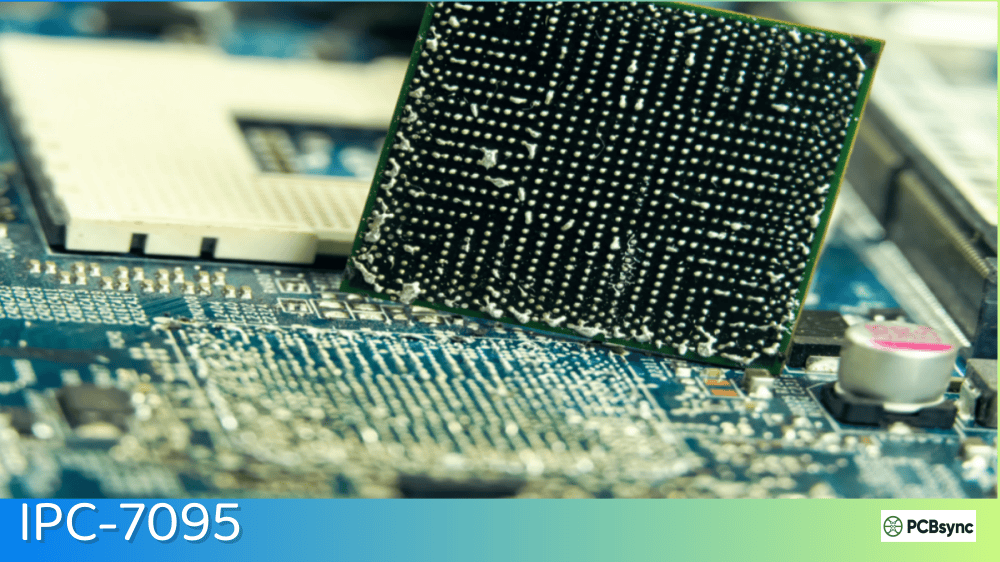
BGA design (relevant for module interfaces)
IPC-7351
Land pattern guidelines
JEDEC JEP95
Die and wire bond standards
Tools and Resources for IPC-2225
Official Documentation
Resource
Source
Notes
IPC-2225 Standard
shop.ipc.org
~$120, 44 pages
IPC-2221C
shop.ipc.org
Required companion standard
IPC-MC-790
shop.ipc.org
MCM Technology Utilization Guidelines
IPC-6015
shop.ipc.org
MCM-L Qualification Specification
Related IPC Standards
Standard
Content
IPC-2221
Generic PCB design (required with IPC-2225)
IPC-2226
HDI design for fine-pitch substrates
IPC-6012
Rigid board qualification
IPC-A-610
Assembly acceptability
J-STD-020
Moisture sensitivity classification
Industry Resources
Resource
Type
URL
JEDEC
Die and packaging standards
jedec.org
SEMI
Semiconductor equipment standards
semi.org
IMAPS
Microelectronics packaging society
imaps.org
Frequently Asked Questions About IPC-2225
Is IPC-2225 still valid if it’s no longer maintained?
Yes, the technical content remains valid for MCM-L design fundamentals. However, for cutting-edge applications, supplement IPC-2225 with IPC-2226 (HDI design), IPC-7094 (flip-chip), and current JEDEC standards. The core principles—die attach, wire bonding, thermal management—haven’t changed, but feature sizes and material options have expanded significantly since 1998.
What’s the difference between MCM-L and standard PCB assembly?
In standard PCB assembly, components come in packages that handle interconnection (leads, balls, pads) and protection (molding, encapsulation). In MCM-L, bare semiconductor dice mount directly to the substrate—the substrate becomes the package. This requires wire bonding or flip-chip for interconnection, careful thermal design, and encapsulation that standard PCB assembly doesn’t need.
Do I need IPC-2225 for chip-on-board (COB) LED assemblies?
IPC-2225 concepts apply, though LED-specific guidance exists elsewhere. COB LEDs use bare die on organic substrates—exactly what IPC-2225 addresses. The die attach, wire bonding, and encapsulation guidance translates directly. However, LED thermal and optical requirements may need additional references beyond IPC-2225.
What surface finish should I specify for wire bonding on MCM-L?
ENIG (Electroless Nickel Immersion Gold) or electrolytic soft gold are the standard choices. Gold thickness should be 0.5-1.25 μm for reliable thermosonic ball bonding. The underlying nickel barrier (3-5 μm) prevents copper diffusion into the gold. ENEPIG adds a palladium layer that improves both wire bonding and solder joint reliability if the substrate has mixed assembly requirements.
How does IPC-2225 relate to modern chiplet and advanced packaging?
Modern chiplet architectures—AMD’s Zen processors, Intel’s Foveros, Apple’s M-series—are essentially advanced MCM designs. They use the same fundamental principles IPC-2225 established: bare dice on interconnect substrates with wire bonding or flip-chip attachment. The difference is scale (finer features), complexity (heterogeneous integration), and substrate technology (silicon interposers alongside organic substrates). IPC-2225 provides the foundational understanding; modern designs layer additional complexity on top.
Designing Successful MCM-L Assemblies
IPC-2225 documents the accumulated knowledge of bare die assembly on organic substrates—knowledge that remains relevant even as the standard itself ages. The principles of die attach thermal management, wire bond pad design, flip-chip requirements, and encapsulation selection don’t change just because feature sizes shrink.
For engineers entering bare die assembly, IPC-2225 combined with IPC-2221 provides the foundation. Start with proper die attach selection based on thermal requirements. Design wire bond pads with correct metallization and spacing. Plan thermal via arrays under power devices. Specify appropriate encapsulation for your reliability environment.
The MCM-L concepts in IPC-2225 have become mainstream in ways the 1998 authors might not have anticipated. Every advanced processor, every system-in-package, every heterogeneous integration project builds on multichip module principles. Understanding IPC-2225 isn’t just about legacy technology—it’s about understanding the foundation of modern advanced packaging.
Inquire: Call 0086-755-23203480, or reach out via the form below/your sales contact to discuss our design, manufacturing, and assembly capabilities.
Quote: Email your PCB files to Sales@pcbsync.com (Preferred for large files) or submit online. We will contact you promptly. Please ensure your email is correct.
Notes: For PCB fabrication, we require PCB design file in Gerber RS-274X format (most preferred), *.PCB/DDB (Protel, inform your program version) format or *.BRD (Eagle) format. For PCB assembly, we require PCB design file in above mentioned format, drilling file and BOM. Click to download BOM template To avoid file missing, please include all files into one folder and compress it into .zip or .rar format.