Inquire: Call 0086-755-23203480, or reach out via the form below/your sales contact to discuss our design, manufacturing, and assembly capabilities.
Quote: Email your PCB files to Sales@pcbsync.com (Preferred for large files) or submit online. We will contact you promptly. Please ensure your email is correct.
Notes: For PCB fabrication, we require PCB design file in Gerber RS-274X format (most preferred), *.PCB/DDB (Protel, inform your program version) format or *.BRD (Eagle) format. For PCB assembly, we require PCB design file in above mentioned format, drilling file and BOM. Click to download BOM template To avoid file missing, please include all files into one folder and compress it into .zip or .rar format.
IPC-2221 Explained: Complete Guide to PCB Design Standards
Every PCB designer eventually runs into the same question: “What’s the minimum spacing I need between these traces?” Or maybe it’s “How thick should my copper be for this current?” Or “What materials can I specify for this operating environment?” The answer to virtually all these questions starts with the same document.
IPC-2221 is the foundation standard for printed circuit board design. Officially titled “Generic Standard on Printed Board Design,” this comprehensive document establishes the baseline requirements for materials, conductor spacing, clearance, creepage, via design, thermal management, and manufacturability. Whether you’re designing a simple two-layer board or a complex HDI stackup, IPC-2221 provides the fundamental rules that keep your design safe, manufacturable, and reliable.
IPC-2221 is the generic design standard developed by IPC (Association Connecting Electronics Industries) that serves as the foundation for the entire IPC-2220 series of PCB design documents. It establishes requirements applicable to all types of organic printed boards—single-sided, double-sided, and multilayer—regardless of the specific technology used.
The standard covers everything from raw material selection to finished board requirements, providing guidelines that ensure boards meet performance expectations across three defined product classes.
IPC-2221 Version History
Version
Release Date
Key Updates
IPC-2221
1998
Original release, replaced IPC-D-275
IPC-2221A
2003
Added imperial units, clarified requirements
IPC-2221B
2012
Updated conductor spacing tables, metric focus
IPC-2221C
2023
New clearance guidance, press-fit, back-drilling
The current version, IPC-2221C, was released in 2023 and includes significant updates to conductor spacing guidance, particularly regarding altitude effects, surface coatings, and new sections on compliant pins and back-drilling. Most online calculators still reference IPC-2221B tables, so be aware of which version your tools implement.
IPC-2221 Standard Scope
Attribute
Details
Full Title
Generic Standard on Printed Board Design
Page Count
~140 pages
Developed By
IPC Rigid Printed Board Committee (D-30)
Document Set
IPC-2220 (base number for design series)
Applicability
All organic printed boards
Performance Classes
Class 1, 2, and 3
The IPC-2220 Design Standards Family
IPC-2221 doesn’t work in isolation—it’s the parent document for a family of sectional standards that address specific board technologies. You need IPC-2221 plus the relevant sectional standard for your board type.
IPC-2220 Series Hierarchy
Standard
Focus
When to Use
IPC-2221
Generic requirements (foundation)
Always—applies to all boards
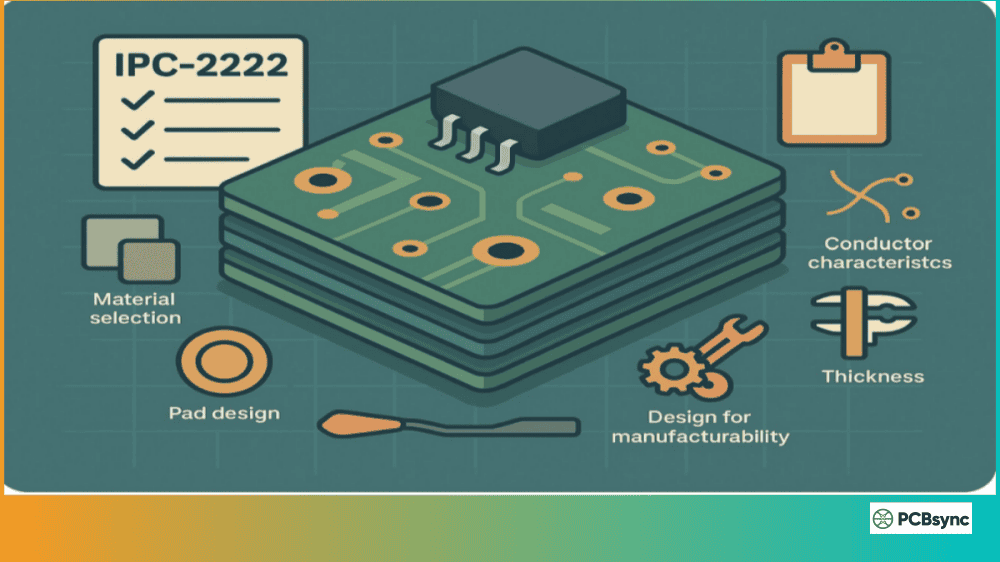
IPC-2222
Rigid printed boards
Standard FR-4 multilayer designs
IPC-2223
Flexible printed boards
Flex and rigid-flex circuits
IPC-2225
MCM-L (organic chip carriers)
Chip-scale packaging substrates
IPC-2226
HDI printed boards
High-density interconnect designs
IPC-2228
RF/Microwave printed boards
High-frequency applications
When designing a rigid-flex board, for example, you’d reference IPC-2221 for generic requirements, IPC-2222 for the rigid sections, and IPC-2223 for the flexible sections. The sectional standards add specific requirements but don’t override IPC-2221—they supplement it.
IPC-2221 Performance Classes
IPC-2221 defines three product classes that establish different levels of requirements based on the end-use application. Your class selection affects tolerances, inspection criteria, and acceptable defect levels throughout the design and manufacturing process.
Product Class Definitions
Class
Name
Description
Typical Applications
Class 1
General Electronic Products
Consumer products where cosmetic imperfections are acceptable and function is the primary requirement
Products requiring extended life and uninterrupted service, where some cosmetic imperfections are acceptable
Industrial equipment, communications, computers
Class 3
High-Performance Electronic Products
Products where continued performance and reliability are critical, downtime is unacceptable
Medical devices, aerospace, military, life support
Class selection affects minimum annular ring requirements, conductor width tolerances, hole quality standards, and many other design parameters. Specifying Class 3 when Class 2 would suffice increases manufacturing cost unnecessarily—but under-specifying can lead to field failures.
Material Selection per IPC-2221
IPC-2221 provides comprehensive guidance on selecting appropriate materials for your PCB based on electrical, mechanical, and thermal requirements.
Substrate Material Considerations
Material
Dielectric Constant (Dk)
Tg (°C)
Best For
FR-4 Standard
4.2-4.8
130-140
General purpose, cost-sensitive
FR-4 High-Tg
4.2-4.8
170-180
Lead-free assembly, higher temps
Polyimide
3.2-3.5
250+
High reliability, extreme temps
Rogers/Taconic
2.2-3.5
Varies
RF/microwave, controlled impedance
Metal Core (MCPCB)
Varies
N/A
High-power LED, thermal management
IPC-2221 references IPC-4101 for detailed laminate specifications. When selecting materials, consider not just electrical properties but also thermal expansion (CTE), moisture absorption, and compatibility with your assembly process.
Copper Foil Requirements
Copper Weight
Thickness (oz/ft²)
Thickness (μm)
Typical Use
0.5 oz
17.5 μm
0.7 mil
Fine-pitch, HDI
1 oz
35 μm
1.4 mil
Standard signal layers
2 oz
70 μm
2.8 mil
Power distribution
3 oz
105 μm
4.2 mil
High current
4 oz+
140+ μm
5.6+ mil
Extreme current
Heavier copper requires wider spacing and affects etching capabilities. IPC-2221 notes that etch compensation should be at least twice the copper thickness to account for undercut during etching.
IPC-2221 Conductor Spacing Requirements
Section 6 of IPC-2221 contains the famous Table 6-1—the conductor spacing requirements that every PCB designer eventually needs to reference. These values specify minimum distances between conductors based on voltage, conductor location, and operating conditions.
B2: External conductors, uncoated, sea level to 3050m altitude
B4: External conductors with polymer solder mask coating
Conductor Spacing Above 500V
For voltages exceeding 500V, IPC-2221 provides formulas rather than fixed values:
Conductor Type
Formula (mm)
Internal conductors
0.25 + 0.0025 × (V – 500)
External uncoated
2.5 + 0.005 × (V – 500)
Polymer coated
0.8 + 0.00305 × (V – 500)
For example, a 1000V design with uncoated external conductors requires: 2.5 + 0.005 × (1000 – 500) = 5.0 mm minimum spacing.
Clearance vs Creepage in IPC-2221
Two terms that often confuse designers are clearance and creepage. IPC-2221 addresses both, though they serve different purposes in ensuring electrical safety.
Clearance and Creepage Definitions
Term
Definition
Measurement Path
Clearance
Shortest distance between conductors through air
Straight line through air
Creepage
Shortest distance between conductors along a surface
Following the insulator surface
Clearance prevents arc-over through air. Creepage prevents tracking—the gradual formation of conductive paths along contaminated surfaces. In humid or contaminated environments, creepage requirements often exceed clearance requirements.
When Creepage Matters More Than Clearance
Scenario
Primary Concern
Design Response
High humidity environment
Creepage
Increase surface distance, use conformal coating
Clean room application
Clearance
Standard spacing acceptable
Outdoor/industrial
Both
Meet both requirements, consider pollution degree
High altitude (>3050m)
Clearance
Increase clearance per IPC-2221C guidance
IPC-2221C includes updated guidance on altitude effects. Air at higher altitudes has lower density, reducing its dielectric strength and requiring increased clearances.
Designing PCBs for high-voltage applications requires careful attention to IPC-2221 spacing requirements combined with understanding of insulation coordination.
Altitude Correction for Clearance
Altitude Range
Clearance Multiplier
Sea level to 3050m
1.0× (baseline)
3050m to 5000m
~1.3×
5000m to 9000m
~1.5×
Above 9000m
~1.7×
For products intended for use in aircraft or at high altitudes, clearance values from Table 6-1 must be increased. Some international standards (particularly Chinese GB 4943.1) require design for 5000m unless the product is marked for lower altitude use only.
Surface Coating Effects
Coating Type
Effect on Required Spacing
Bare board (uncoated)
Maximum spacing required
Solder mask (polymer)
Significant reduction allowed
Conformal coating
Further reduction possible
Potting/encapsulation
Maximum reduction
Conformal coating per IPC-2221 allows reduced clearances because the coating prevents contamination and increases surface insulation resistance. However, coating quality and coverage must be verified—voids or thin spots can create failure points.
Via Design Requirements in IPC-2221
IPC-2221 establishes requirements for via design including aspect ratios, annular rings, and hole quality parameters.
Via Aspect Ratio Limits
Via Type
Maximum Aspect Ratio
Notes
Through-hole
10:1 typical
Board thickness : hole diameter
Blind via
1:1 recommended
Depth : diameter
Buried via
8:1 typical
Depends on fabricator capability
Microvia (laser)
0.75:1 to 1:1
HDI applications
Aspect ratio affects plating quality in the hole barrel. Higher aspect ratios make it difficult to achieve uniform plating thickness, potentially creating reliability issues.
Minimum Annular Ring Requirements
Class
External Layers
Internal Layers
Class 1
0.05 mm (2 mil)
0.0 mm (breakout allowed)
Class 2
0.05 mm (2 mil)
0.025 mm (1 mil)
Class 3
0.05 mm (2 mil)
0.05 mm (2 mil)
Annular ring is the copper remaining around a drilled hole after drilling and registration tolerances are considered. Insufficient annular ring can cause lifted pads or unreliable connections.
Thermal Management Guidance
IPC-2221 provides guidance on thermal design, though detailed current-carrying calculations have been superseded by IPC-2152.
Thermal Via Design
Parameter
Typical Value
Purpose
Via diameter
0.3-0.5 mm
Heat conduction path
Via pitch
1.0-1.5 mm
Maximize thermal conductivity
Via fill
Copper, conductive epoxy
Improve thermal transfer
Placement
Under thermal pads
Direct heat path to planes/heatsinks
Thermal vias connect heat-generating components to internal planes or heatsinks. Filled and capped vias provide better thermal performance than open vias.
IPC-2221 vs IPC-2152 for Trace Current
Topic
IPC-2221
IPC-2152
Purpose
General design guidance
Current capacity focus
Data basis
Theoretical/legacy
Empirical testing
Internal traces
Conservative estimates
Accurate test data
Recommendation
Reference only
Use for current calculations
The trace width charts in IPC-2221 are legacy data from the 1950s. For accurate current-carrying capacity calculations, use IPC-2152 instead. IPC-2221 acknowledges this by referencing IPC-2152 for conductor sizing.
IPC-2221B vs IPC-2221C Changes
The 2023 release of IPC-2221C includes several important updates that designers should understand.
Key Changes in IPC-2221C
Area
Change
Impact
Conductor spacing
Updated altitude guidance
Clearer requirements for high-altitude products
Surface coatings
Refined definitions
Better classification of coating types
Press-fit (compliant pins)
New section added
Guidance for press-fit connector design
Back-drilling
New requirements
Stub removal for high-speed designs
Test coupons
Updated Appendix A
Revised coupon designs for qualification
If your design tools or calculators reference IPC-2221B, the conductor spacing values remain largely unchanged for sea-level applications. The primary differences appear in high-altitude requirements and new technology sections.
Tools and Resources for IPC-2221
Official Documentation
Resource
Source
Notes
IPC-2221C Standard
shop.ipc.org
Current version (~$200)
IPC-2221B Standard
shop.ipc.org
Previous version, still widely used
IPC-2152
shop.ipc.org
Current capacity (use with IPC-2221)
IPC-2222
shop.ipc.org
Rigid board sectional
Online Calculators
Calculator
Provider
Features
Conductor Spacing Calculator
Sierra Circuits
IPC-2221B Table 6-1
PCB Clearance Calculator
Altium Resources
Voltage-based spacing
Trace Spacing Tool
SMPS Power Supply
Includes IPC-9592 comparison
Saturn PCB Toolkit
Saturn PCB Design
Comprehensive, free download
Related Safety Standards
Standard
Scope
Relationship to IPC-2221
IEC 62368-1
IT/AV equipment safety
Mandatory creepage/clearance for some products
UL 796
Printed wiring boards
Safety certification requirements
IPC-9592
Power conversion devices
Additional spacing for power supplies
Frequently Asked Questions About IPC-2221
What is the minimum trace spacing per IPC-2221?
The minimum trace spacing depends on voltage between the conductors and their location. For low-voltage signals (0-30V) on internal layers, IPC-2221 specifies 0.05mm (2 mil) minimum. For external uncoated conductors at the same voltage, the minimum is 0.1mm (4 mil). These values increase significantly with voltage—at 300V, external uncoated conductors require 1.25mm spacing. Always reference Table 6-1 for your specific voltage and conductor configuration.
Should I use IPC-2221 or IPC-2152 for trace width calculations?
Use IPC-2152 for trace width and current-carrying capacity calculations. The trace sizing charts in IPC-2221 are based on 1950s data and have been superseded by IPC-2152’s empirical testing. IPC-2221 is still your primary reference for conductor spacing (clearance/creepage), material selection, via design, and general PCB design requirements—but route current calculations through IPC-2152.
What’s the difference between clearance and creepage?
Clearance is the shortest distance between two conductors measured through air—a straight line. Creepage is the shortest distance along the surface of an insulator between conductors. Clearance prevents electrical arcing through air, while creepage prevents tracking—the formation of conductive paths along contaminated surfaces. In contaminated or humid environments, creepage requirements typically exceed clearance requirements.
How do I choose between Class 1, 2, and 3?
Choose based on your product’s end-use requirements and consequences of failure. Class 1 suits consumer products where occasional failure is acceptable. Class 2 covers most industrial and commercial electronics requiring reliable service. Class 3 is for critical applications—medical, aerospace, military—where failure could endanger lives or cause significant consequences. Higher classes mean tighter tolerances and higher manufacturing costs, so don’t over-specify.
Does IPC-2221 apply to flexible circuits?
IPC-2221 provides generic requirements that apply to all organic printed boards including flex circuits. However, you must also reference IPC-2223 (Sectional Design Standard for Flexible Printed Boards) for flex-specific requirements like bend radius, dynamic flex cycles, and flexible material considerations. The two standards work together—IPC-2221 for baseline requirements, IPC-2223 for flex-specific additions.
Building Your Design Foundation
IPC-2221 isn’t just another document to reference when auditors ask questions—it’s the accumulated knowledge of decades of PCB design experience distilled into actionable requirements. Understanding its contents helps you make informed decisions rather than guessing at spacing values or material selections.
Start every design by identifying your performance class, operating voltage ranges, and environmental conditions. Reference IPC-2221 for conductor spacing requirements, material guidance, and via design rules. Use IPC-2152 for current-carrying calculations. Add the appropriate sectional standard for your board technology. This layered approach ensures you’re meeting industry-accepted requirements while keeping your designs manufacturable and reliable.
The standard evolves with technology—IPC-2221C added sections on back-drilling and press-fit pins that didn’t exist when IPC-2221B was published. Staying current with these updates keeps your designs aligned with modern manufacturing capabilities and industry best practices.
Inquire: Call 0086-755-23203480, or reach out via the form below/your sales contact to discuss our design, manufacturing, and assembly capabilities.
Quote: Email your PCB files to Sales@pcbsync.com (Preferred for large files) or submit online. We will contact you promptly. Please ensure your email is correct.
Notes: For PCB fabrication, we require PCB design file in Gerber RS-274X format (most preferred), *.PCB/DDB (Protel, inform your program version) format or *.BRD (Eagle) format. For PCB assembly, we require PCB design file in above mentioned format, drilling file and BOM. Click to download BOM template To avoid file missing, please include all files into one folder and compress it into .zip or .rar format.