Inquire: Call 0086-755-23203480, or reach out via the form below/your sales contact to discuss our design, manufacturing, and assembly capabilities.
Quote: Email your PCB files to Sales@pcbsync.com (Preferred for large files) or submit online. We will contact you promptly. Please ensure your email is correct.
Notes: For PCB fabrication, we require PCB design file in Gerber RS-274X format (most preferred), *.PCB/DDB (Protel, inform your program version) format or *.BRD (Eagle) format. For PCB assembly, we require PCB design file in above mentioned format, drilling file and BOM. Click to download BOM template To avoid file missing, please include all files into one folder and compress it into .zip or .rar format.
A practical guide from the workbench for engineers and makers building wireless IoT devices
When I started designing my first wireless IoT board back in 2018, I made every rookie mistake possible. The Bluetooth module would drop connections randomly. The NRF24L01 range was a fraction of what the datasheet promised. My NodeMCU layout worked fine on the breadboard but turned into a noisy mess once I transferred it to a custom PCB.
If any of this sounds familiar, you’re in the right place. This guide covers everything I’ve learned about IoT PCB design through years of trial, error, and late-night debugging sessions. We’ll dig into Bluetooth PCB design, tackle the nuances of NRF24L01 PCB design, and walk through proper NodeMCU PCB layout techniques that actually work in production.
Before we touch any schematic software, let’s establish the baseline physics that govern all wireless PCB designs. Every wireless module we’ll discuss operates in the 2.4 GHz ISM band, which means we’re dealing with wavelengths around 125mm. At these frequencies, your PCB traces aren’t just conductors anymore—they’re transmission lines, and every routing decision matters.
The golden rule? Impedance matching. When your transmission line impedance doesn’t match your antenna impedance (typically 50Ω), you get reflections. Those reflections mean wasted power and reduced range. I’ve seen boards where poor impedance control cut effective range by 60% compared to an identical design with proper RF layout.
Key RF Parameters Every IoT Designer Must Know
Parameter
Typical Value
Why It Matters
Target Impedance
50Ω
Industry standard for RF; mismatches cause reflections
Return Loss
≥10 dB
Ensures 90% power reaches the antenna
Operating Frequency
2.4-2.4835 GHz
ISM band for Bluetooth, WiFi, NRF24L01
Quarter Wavelength
~31mm
Critical for antenna trace lengths
Keep-out Zone
λ/4 (~31mm at 2.4GHz)
Minimum clearance around antenna elements
Bluetooth PCB Design: From BLE to Classic
Bluetooth remains the workhorse of short-range IoT connectivity. Whether you’re building a fitness tracker, smart home sensor, or industrial monitor, getting your Bluetooth PCB design right determines whether your product works reliably or frustrates users with dropped connections.
Bluetooth Low Energy vs Classic: Design Implications
The distinction matters for PCB design more than you might think. Bluetooth Low Energy (BLE) devices can operate at incredibly low power levels—some modules consume just 1 µA in sleep mode. This means your power supply design becomes critical. Any noise on VCC will show up in your RF performance.
For BLE applications, I recommend these specific practices:
Power Supply Stability: Use a dedicated LDO regulator for your Bluetooth module, separate from noisy digital circuits. Place 1.0 µF and 0.1 µF bypass capacitors as close as physically possible to the module’s VCC pins. The datasheet says 10mm maximum—I aim for 3mm or less.
Crystal Placement: The 32 MHz crystal oscillator needs special attention. Keep traces short (under 10mm), add a ground ring around the crystal footprint, and avoid routing any digital signals nearby. I’ve debugged boards where a poorly placed crystal caused intermittent connectivity issues that only showed up at certain temperatures.
Antenna Options for Bluetooth PCB Design
Your antenna choice fundamentally shapes your board layout. Here’s what I’ve learned works best for different applications:
Antenna Type
PCB Space Required
Typical Range
Best For
Chip Antenna
3x5mm
10-30m
Space-constrained wearables
PCB Trace (IFA)
15x25mm
30-50m
Cost-sensitive products
PCB Trace (Meander)
10x30mm
20-40m
Balanced size/performance
External Whip
Connector only
50-100m
Maximum range priority
Chip antennas look attractive because they’re tiny, but they’re the least forgiving option. The manufacturer’s reference layout isn’t a suggestion—it’s mandatory. That ground plane cutout they specify? Follow it to the millimeter. The keep-out zone? Don’t even think about putting a trace there.
PCB trace antennas give you more control but require careful impedance management. The inverted-F antenna (IFA) has become my go-to choice for most Bluetooth PCB design projects. It offers a good balance of performance and size, plus the tuning process is relatively straightforward with a matching network.
Ground Plane Design for Bluetooth
The ground plane acts as the other half of your antenna system—what RF engineers call the “counterpoise.” For a properly functioning Bluetooth antenna, your ground plane needs to extend at least λ/4 (about 31mm) in all directions from the antenna feed point.
Here’s where many designers stumble: they cut slots or route traces through the ground plane under the RF section. Every slot in your ground plane forces return currents to detour, changing the impedance and creating EMI opportunities. Use solid copper pours and stitch them with vias every 3-5mm in critical RF areas.
NRF24L01 PCB Design: Getting That 100-Meter Range
The NRF24L01+ from Nordic Semiconductor has become legendary in the maker community for good reasons: it’s cheap, draws minimal power, and when designed correctly, achieves impressive range. But “when designed correctly” is doing a lot of heavy lifting in that sentence. The forums are full of frustrated engineers getting 10 meters from a module rated for 100.
Understanding NRF24L01 Module Types
Before diving into layout guidelines, let’s clarify what we’re working with:
Module Version
Antenna Type
Output Power
Realistic Indoor Range
NRF24L01+ Basic
PCB Trace
0 dBm
20-40m
NRF24L01+ PA+LNA
External SMA
+20 dBm
800-1000m (line of sight)
Custom Design
Your choice
Configurable
Depends on implementation
Most problems I see with NRF24L01 PCB design come from treating the module as a simple drop-in component. It’s not. Even when using pre-built modules, how you integrate them into your carrier board matters enormously.
Critical Layout Guidelines for NRF24L01
Antenna Positioning: The antenna must extend beyond your PCB edge. This isn’t optional. I’ve reviewed dozens of failed designs where someone thought they could save space by placing the module in the center of the board with copper surrounding the antenna. The result? Degraded range and unreliable communication.
Ground Plane Configuration: Nordic’s reference design shows a specific ground plane pullback around the matching network components. This reduces parasitic capacitance that would detune your antenna. Copy this exactly—they spent considerable engineering effort optimizing it.
Symmetric RF Traces: The differential antenna outputs (ANT1 and ANT2) must have perfectly symmetric trace lengths. Even 0.5mm difference at 2.4 GHz creates phase errors that hurt your radiation pattern. Use your EDA tool’s differential pair routing feature and verify lengths in the design rule check.
Decoupling Strategy: Place capacitors in the sequence specified by Nordic: 10 µF (bulk), 1 µF, and multiple 100 nF capacitors. Position them in a star configuration around the power pins. The power supply rejection at 2.4 GHz is surprisingly poor without proper decoupling.
Matching Network Considerations
If you’re designing with the bare NRF24L01+ chip rather than a module, you’ll need a matching network to interface between the chip and your antenna. This typically consists of a few inductors and capacitors that transform the chip’s output impedance to 50Ω.
The component values in the datasheet are starting points. Real-world PCB parasitics will shift these values. Budget for at least one board spin to tune the matching network, or use a vector network analyzer (VNA) to characterize your first prototype and adjust accordingly.
The ESP8266-based NodeMCU has democratized WiFi for IoT projects. At under $3 for a complete WiFi-enabled microcontroller, it’s hard to argue against. But taking your NodeMCU prototype to a custom NodeMCU PCB layout introduces challenges that breadboard testing never reveals.
ESP8266 Hardware Design Essentials
Espressif publishes comprehensive hardware design guidelines—read them. Seriously. I’ll summarize the most critical points, but the full document belongs in your reference library.
Antenna Keep-Out Zone: The ESP8266’s on-board ceramic antenna requires a 15mm minimum keep-out zone. No copper, no components, no traces. If you can’t provide this clearance, plan to use an external antenna with a U.FL connector.
Power Supply Requirements: The ESP8266 draws up to 300mA peak during WiFi transmission. Your 3.3V regulator needs to handle these spikes without drooping. Use a regulator rated for at least 500mA, add 10 µF and 0.1 µF capacitors at both the regulator output and the module’s VCC pins.
PCB Layer Stack-Up for NodeMCU Designs
For any serious NodeMCU PCB layout, I recommend a minimum of four layers:
Layer
Purpose
Notes
Top
Components, RF traces
Keep RF section isolated
Inner 1
Ground Plane
Continuous under RF area
Inner 2
Power Plane
Isolated from RF section
Bottom
Signal routing
No high-speed traces under antenna
Two-layer boards can work for simple applications, but you’ll fight noise issues. The dedicated ground plane on layer 2 provides the stable reference your WiFi signals need.
Dealing with ESP8266 Boot Modes
The NodeMCU uses specific GPIO states during boot to determine operating mode. Your PCB design must account for these:
GPIO Pin
Boot Function
Required State for Normal Boot
GPIO0
Flash mode select
HIGH (pulled up)
GPIO2
Must be HIGH
HIGH (pulled up)
GPIO15
Boot source
LOW (pulled down)
Add 10kΩ pull-up/pull-down resistors to these pins. Don’t rely on internal pull-ups for reliable booting—external resistors make your design temperature-stable and robust.
Reducing WiFi Interference on Your Board
The ESP8266 generates significant EMI during WiFi transmission. Without proper design practices, this noise couples into your analog sensors and digital communication lines.
Physical Separation: Place the ESP8266 module on the opposite side of your PCB from sensitive analog circuits. If that’s not possible, use a ground-connected shielding can over the WiFi section.
Filter Power Lines: Add ferrite beads in series with the power lines feeding your ESP8266. This prevents high-frequency noise from propagating to other circuits through the power distribution network.
Signal Routing: Never route SPI, I2C, or UART traces under the antenna area. The electromagnetic coupling will introduce bit errors that manifest as random glitches impossible to debug without proper RF analysis equipment.
Practical Component Placement Strategies
Having worked on probably fifty-plus wireless IoT boards at this point, I’ve developed a component placement workflow that consistently produces good results:
The Three-Zone Approach
Zone 1 – RF Section: Contains your wireless module, antenna, matching network, and crystal. This zone gets priority placement—usually along one edge of the board with the antenna at the corner. Nothing else goes here.
Zone 2 – Power Management: Regulators, inductors, and filter capacitors. Position this zone to minimize trace lengths to Zone 1 while providing adequate thermal relief. Connect zones with wide, short traces.
Zone 3 – Digital/Analog: Your microcontroller, sensors, connectors, and everything else. This zone adapts around Zones 1 and 2. Keep high-speed digital signals away from the RF section edge.
Component Placement Checklist
Component
Placement Priority
Distance from Antenna
Matching Network
Critical
Adjacent, follow reference
Crystal Oscillator
Critical
<10mm from chip
Bypass Capacitors
High
<5mm from power pins
Voltage Regulator
High
>30mm recommended
DC-DC Converter
Medium
>50mm, shielded if closer
Connectors
Low
Board edge, away from RF
EMI and Signal Integrity Considerations
Every wireless IoT board is simultaneously a radio transmitter and a potential victim of electromagnetic interference. Ignoring EMI during design leads to products that work in your lab but fail FCC/CE certification—or worse, pass certification but fail in the customer’s environment.
Common EMI Sources in IoT Designs
DC-DC converters top the list. Their switching frequencies and harmonics can land directly in the 2.4 GHz band. I’ve measured boards where a poorly chosen switching frequency created spurs just 3 dB below the wanted signal. Use converters with spread-spectrum modulation when possible, and always verify your design with a spectrum analyzer.
Clock oscillators generate harmonics that extend well into the GHz range. A 24 MHz crystal’s 100th harmonic lands at 2.4 GHz—right where your Bluetooth operates. Add series damping resistors (22-47Ω) to clock lines and keep traces short.
Shielding Strategies
For products requiring regulatory certification, plan for RF shielding from the start:
PCB-Mounted Shields: Add the footprint and fence even if you don’t populate the shield during development. Testing will reveal whether you need it. Retrofitting a shield onto a layout not designed for one rarely works well.
Ground Stitching: Place grounding vias every λ/20 (approximately 6mm at 2.4 GHz) along shield perimeters. This prevents the PCB edge from acting as a slot antenna.
PCB Design Software and Tools for IoT
The right tools make wireless PCB design manageable. Here’s what I recommend based on project complexity:
Software Comparison for IoT PCB Design
Software
Cost
RF Capabilities
Best For
KiCad
Free
Good, improving
Budget-conscious projects
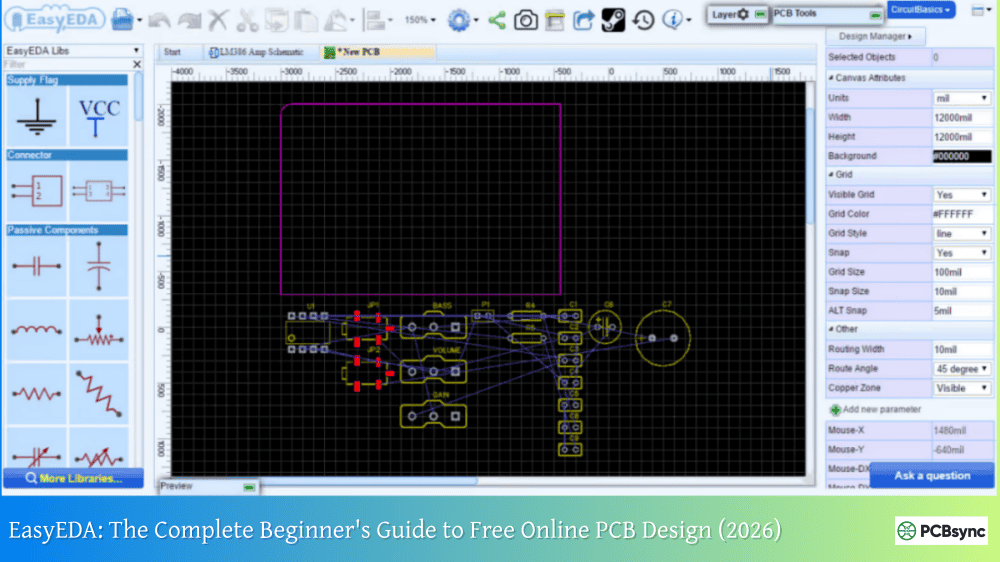
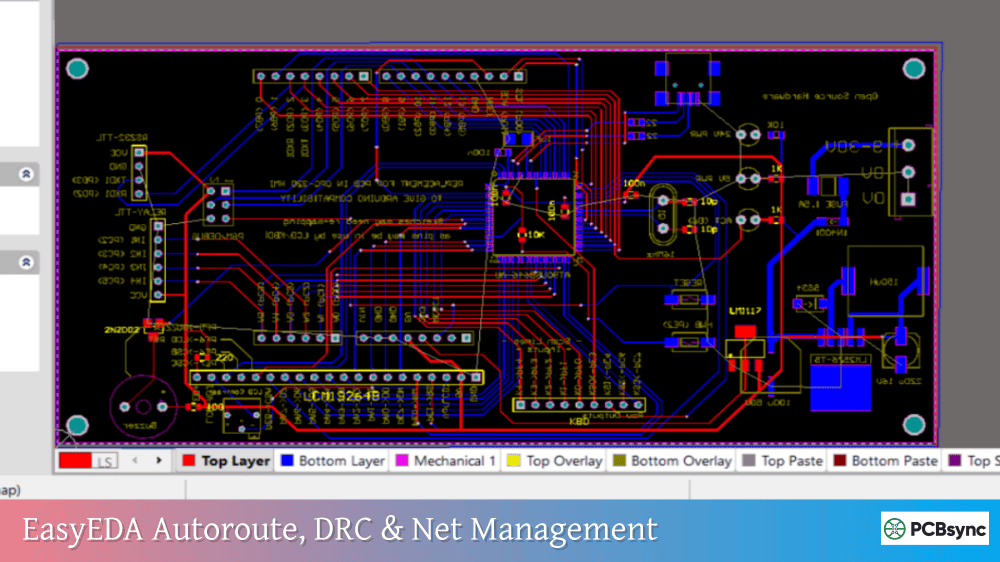
EasyEDA
Free
Basic
Quick prototypes
Autodesk EAGLE
$$$
Good
Professional products
Altium Designer
$$$$
Excellent
Complex multilayer boards
KiCad has matured significantly and now handles controlled impedance routing well. The length tuning tools work fine for differential pairs. For hobbyists and startups, it’s hard to justify paid software when KiCad does 90% of what you need.
Essential Online Calculators
Bookmark these—you’ll use them constantly:
Impedance Calculators: Saturn PCB Toolkit (free download) handles microstrip, stripline, and coplanar waveguide calculations. The Mantaro web calculator is also excellent for quick checks.
Wavelength Calculators: Useful for determining antenna lengths and keep-out zones at your operating frequency.
Via Inductance Calculators: Critical for understanding ground via performance at GHz frequencies.
Testing and Validation Techniques
A design isn’t complete until it’s tested. For wireless IoT boards, this means RF measurements beyond just “does it connect?”
Essential Test Equipment
Equipment
Purpose
Budget Option
Spectrum Analyzer
EMI analysis, spurious emissions
RTL-SDR + software (~$30)
Vector Network Analyzer
Impedance, return loss
NanoVNA (~$50)
Power Meter
TX output verification
Calibrated module readings
Field Strength Meter
Range testing
Free phone apps
The NanoVNA deserves special mention. For under $50, you get S-parameter measurements that would have cost $10,000+ a decade ago. It’s not lab-grade, but it’s more than adequate for tuning matching networks and verifying antenna performance.
Testing Workflow
Pre-Power Checks: Use a multimeter to verify no shorts between power rails and ground. Check continuity of critical traces, especially the 50Ω RF line.
Initial Power-Up: Monitor current consumption. Excessive current often indicates shorts or failed components. Expected values vary by module but are documented in datasheets.
RF Performance: Measure return loss with a VNA. Anything worse than -10 dB at your center frequency needs investigation. Adjust matching network values if necessary.
Range Testing: Test actual range in conditions representative of final deployment. Indoor and outdoor performance differ significantly.
What trace width should I use for 50Ω impedance on FR4?
The answer depends on your board stackup. For standard 1.6mm four-layer FR4 with signal on the top layer referenced to a ground plane on layer 2 (typical 0.2mm prepreg), a microstrip trace width of approximately 0.3mm (12 mil) achieves 50Ω. However, always verify with an impedance calculator using your specific fabricator’s stackup data. Manufacturing tolerances mean your actual impedance may vary by ±10%, which is generally acceptable for IoT applications.
Can I use a two-layer PCB for Bluetooth or WiFi designs?
Yes, but with compromises. A two-layer board lacks the continuous ground plane that provides optimal RF performance. You can make it work by dedicating most of your bottom layer to ground, using via stitching around RF traces, and keeping digital routing minimal near the antenna. For cost-sensitive products in high volume, the savings justify the extra design effort. For prototypes, four layers save debugging time.
Why does my NRF24L01 range drop when I add other components to the board?
Most likely, nearby components or traces are coupling with the antenna, detuning it or absorbing radiated energy. Check that you’ve maintained the required keep-out zone (at least 10mm of no copper around the antenna). Also verify your ground plane configuration matches the reference design—insufficient ground pullback near the matching network causes this exact symptom.
How do I debug intermittent wireless connectivity issues?
Start by ruling out software. Use known-good firmware and libraries to isolate hardware problems. Then check power supply stability with an oscilloscope during transmission—voltage dips below the module’s minimum cause connection drops. Next, examine your RF environment with a spectrum analyzer or SDR. Interference from other 2.4 GHz devices (WiFi routers, microwaves, Zigbee) can saturate particular channels. Finally, verify your antenna’s return loss hasn’t shifted due to environmental factors like nearby metal or the human body.
What’s the minimum PCB thickness for IoT wireless designs?
Standard 1.6mm works fine for most applications. Thinner boards (0.8mm or less) are popular for wearables but complicate impedance control—trace widths for 50Ω become very narrow, challenging to manufacture reliably. If using a thinner board, budget extra time for impedance verification and potentially a tuning board spin. Some chip antenna manufacturers specify different footprints for different board thicknesses, so verify their guidelines.
Manufacturing Considerations for Wireless PCBs
Once your design is complete, the journey isn’t over. How your board gets manufactured significantly impacts RF performance. Here are the key conversations to have with your PCB fabricator.
Specifying Controlled Impedance
When ordering boards with RF traces, explicitly request controlled impedance fabrication. This costs slightly more (typically 5-15% premium) but ensures your 50Ω traces actually measure 50Ω. Specify your target impedance, tolerance (±10% is standard), and which traces require control.
Your fabricator will adjust their processes—layer thicknesses, trace etching—to hit your target. Without this specification, they optimize for cost, not RF performance, and your impedance might drift anywhere from 40Ω to 65Ω depending on manufacturing variation.
Material Selection
Standard FR4 works adequately for 2.4 GHz designs with proper layout techniques. However, if you’re pushing for maximum performance or designing at higher frequencies, consider Rogers or Isola laminates. These high-frequency materials have tighter dielectric constant tolerance and lower loss tangent, translating to more predictable impedance and better antenna efficiency.
The trade-off is cost—Rogers 4350B costs roughly 3-5x more than FR4. For most consumer IoT products, FR4 with careful design meets requirements. Save premium materials for designs where the cost premium justifies the performance gain.
For RF sections, ENIG or Immersion Silver outperform HASL. The flatter surface and consistent plating thickness improve high-frequency signal integrity. Many designers use ENIG as the default choice—it balances cost, shelf life, and RF performance well.
Common Mistakes to Avoid
After reviewing hundreds of wireless PCB designs over the years, patterns emerge. Here are the mistakes I see most often:
Ignoring Reference Designs: Chip vendors employ RF engineers who spent months optimizing reference layouts. Treating their recommendations as optional suggestions rather than requirements leads to poor performance. The time to get creative with RF layout is after you’ve successfully implemented the reference design, not before.
Inadequate Power Filtering: Wireless modules are sensitive to power supply noise. A single 10 µF capacitor isn’t sufficient filtering. Use the full recommended decoupling scheme with multiple capacitor values to cover different frequency ranges.
Ground Plane Cuts: Routing traces through the ground plane under RF sections seems convenient but destroys performance. Those return current paths matter at 2.4 GHz. Route around, not through.
Ignoring Temperature Effects: Your board might work perfectly at room temperature but fail in hot or cold environments. Components drift with temperature. Test across the expected operating range, especially if designing for outdoor or automotive applications.
Last-Minute Antenna Changes: The antenna isn’t a commodity component you can substitute freely. Each antenna type has specific ground plane requirements, keep-out zones, and matching network needs. Changing antennas late in development often means starting the RF design over.
Future-Proofing Your IoT PCB Design
The wireless landscape evolves constantly. While designing for today’s requirements, consider how your platform might adapt to tomorrow’s standards.
Modular RF Sections: Design your board so the wireless module connects through a well-defined interface. This allows swapping modules for different protocols (Bluetooth to Zigbee, for example) or upgraded versions without redesigning the entire board.
Antenna Flexibility: Include footprints for both PCB trace antennas and U.FL connectors for external antennas. This gives you options during testing and allows product variants from a single PCB design.
Regulatory Margin: Design conservatively relative to regulatory limits. A board that just barely passes FCC certification today might fail after component tolerances drift over time. Build in margin for production variation and long-term reliability.
Conclusion
Successful IoT PCB design requires treating RF sections with the respect they deserve. Whether you’re implementing Bluetooth PCB design for a wearable device, optimizing NRF24L01 PCB design for a sensor network, or creating a custom NodeMCU PCB layout for a smart home product, the fundamentals remain consistent: maintain proper impedance, respect antenna keep-out zones, ensure power supply stability, and validate with real measurements.
The techniques covered here reflect hard-won lessons from production designs. Your first wireless board probably won’t be perfect—mine certainly wasn’t. But by following these guidelines and leveraging the resources provided, you’ll avoid the most common pitfalls and create IoT devices that work reliably in the real world.
Start with the reference designs. Measure everything. Iterate based on data rather than assumptions. That’s how professional wireless products get made.
The IoT market continues growing, and the demand for engineers who can design reliable wireless hardware grows with it. Master these fundamentals, and you’ll be well-positioned to build the connected devices shaping our future.
Inquire: Call 0086-755-23203480, or reach out via the form below/your sales contact to discuss our design, manufacturing, and assembly capabilities.
Quote: Email your PCB files to Sales@pcbsync.com (Preferred for large files) or submit online. We will contact you promptly. Please ensure your email is correct.
Notes: For PCB fabrication, we require PCB design file in Gerber RS-274X format (most preferred), *.PCB/DDB (Protel, inform your program version) format or *.BRD (Eagle) format. For PCB assembly, we require PCB design file in above mentioned format, drilling file and BOM. Click to download BOM template To avoid file missing, please include all files into one folder and compress it into .zip or .rar format.