Inquire: Call 0086-755-23203480, or reach out via the form below/your sales contact to discuss our design, manufacturing, and assembly capabilities.
Quote: Email your PCB files to Sales@pcbsync.com (Preferred for large files) or submit online. We will contact you promptly. Please ensure your email is correct.
Notes: For PCB fabrication, we require PCB design file in Gerber RS-274X format (most preferred), *.PCB/DDB (Protel, inform your program version) format or *.BRD (Eagle) format. For PCB assembly, we require PCB design file in above mentioned format, drilling file and BOM. Click to download BOM template To avoid file missing, please include all files into one folder and compress it into .zip or .rar format.
How to Import Eagle Files into EasyEDA: Complete Migration Guide for PCB Designers
With Autodesk planning to discontinue Eagle as a standalone product, many PCB designers are looking for alternatives to preserve their existing designs. EasyEDA has emerged as a popular destination for Eagle users, offering a free, browser-based platform with tight integration to JLCPCB’s manufacturing services. If you’re sitting on years of Eagle schematics, board layouts, and component libraries, the good news is that importing Eagle files into EasyEDA is straightforward—once you know the quirks.
This guide walks through everything you need to successfully migrate your Eagle projects to EasyEDA, from preparing your files to troubleshooting the inevitable hiccups that come with any EDA tool migration.
Why PCB Engineers Are Moving from Eagle to EasyEDA
Before jumping into the technical process, it’s worth understanding why this migration path has become so common.
Cost considerations drive many transitions. While Eagle’s free tier has limitations on board size and layers, EasyEDA offers unrestricted access to most features at no cost. For hobbyists and small teams, this makes a real difference.
Manufacturing integration appeals to production-focused engineers. EasyEDA connects directly to JLCPCB and LCSC, allowing one-click ordering with pre-checked design rules. The parts library links to in-stock components with real-time pricing and availability data.
Eagle’s uncertain future concerns long-time users. Since Autodesk acquired Eagle and began merging functionality into Fusion 360, the standalone product’s trajectory has worried engineers who prefer dedicated PCB tools over all-in-one platforms.
Accessibility advantages matter for distributed teams. EasyEDA runs entirely in a browser, requiring no installation and enabling collaboration from any machine with internet access.
Understanding Eagle File Types Before Import
Eagle uses several file formats, and EasyEDA handles each differently. Knowing what you’re working with prevents confusion during the import process.
Critical version requirement: EasyEDA only supports Eagle files from version 6.0 and later. Eagle 6.0 introduced an XML-based file format, replacing the earlier encrypted binary format. Files from Eagle 5.x and earlier cannot be directly imported—you’ll need access to a newer Eagle installation to resave them first.
Preparing Your Eagle Files for Import into EasyEDA
Proper preparation prevents most import failures. Spend a few minutes on these steps before attempting any import.
Check Your Eagle Version
Open your Eagle file and look at the file header. If it’s from a version earlier than 6.0, you’ll need to convert it:
Open the file in Eagle 6.0 or later
Go to File → Save a Copy As
Select 7.x and above format
Save the converted file
If you don’t have access to Eagle, the Format Converter tool in EasyEDA Pro can sometimes handle older files, though results vary.
Gather All Required Files
A complete Eagle project typically includes multiple files. For successful import, collect:
All .SCH schematic files
The .BRD board layout file
All .LBR library files used in the design
Any custom library files your project references
Missing library files cause the most common import problems. When EasyEDA can’t find component definitions, it imports schematics without proper footprint associations.
Clean Up Garbled Characters
Some Eagle files contain character encoding issues that break the import process. If you encounter errors, open the Eagle file in a text editor (these are XML files in version 6.0+) and search for:
Non-ASCII characters in unexpected places
Strange symbols in component names or values
Corrupted text strings
Remove or replace problematic characters before attempting import again.
Step-by-Step Process to Import Eagle Files into EasyEDA
EasyEDA offers two editions: Standard (Std) and Professional (Pro). Both support Eagle imports, but the process differs slightly. Pro tends to handle more complex files better, so consider using it for problematic imports.
Importing Eagle Files in EasyEDA Standard Edition
Method 1: Direct File Import
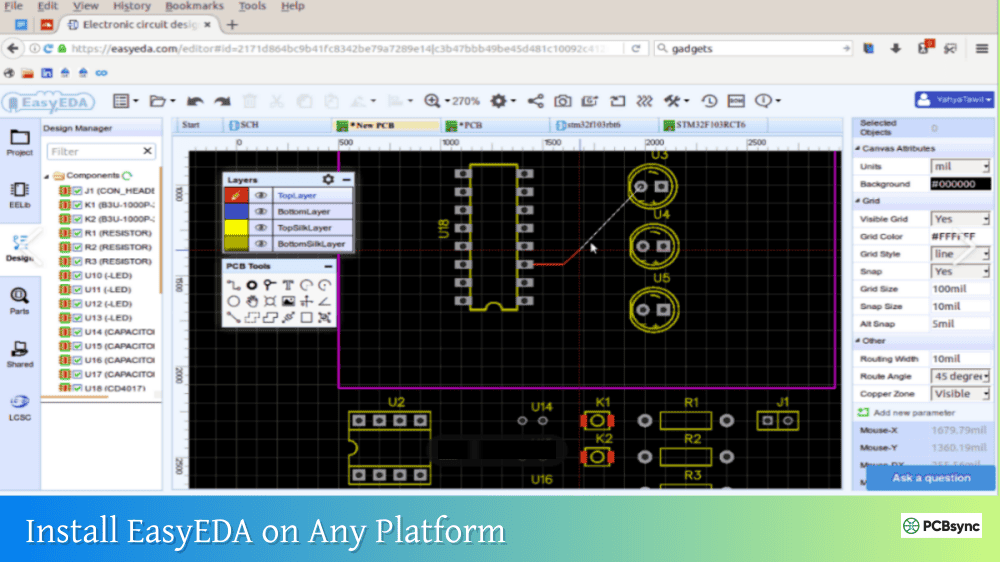
Open EasyEDA in your browser at easyeda.com
Click File → Open → Eagle
Select your .SCH, .BRD, or .LBR file
Choose your import option:
Import File: Imports the design only
Import File and Extract Libs: Imports design plus extracts all component libraries (recommended)
Wait for processing to complete
Review the imported design in the editor
Method 2: Using the Import Menu
Navigate to File → Import → Eagle
Select the file type you’re importing
Browse to your Eagle file
Click Import and wait for conversion
Importing Eagle Files in EasyEDA Pro Edition
EasyEDA Pro provides a more robust import process:
Open EasyEDA Pro (pro.easyeda.com)
From the Start Page, go to Quick Start → Import Other → Import EAGLE
Alternatively, use Top Menu → File → Import → EAGLE
Select your Eagle files (you can import multiple files at once)
For best results, compress your schematic and PCB files into a ZIP archive before importing
Monitor the progress indicator and wait for completion
Importing Eagle Library Files Separately
Often you’ll want to import Eagle libraries independently to build your component database:
Go to File → Import → Eagle → Library Component
Select the .LBR file from your computer
EasyEDA displays available symbols and footprints
Check the boxes next to components you want to import
Click Add to My Library
For large libraries, the import dialog lacks a search filter, so finding specific components requires scrolling through the entire list.
EasyEDA Pro vs Standard Edition for Eagle Imports
Understanding the differences helps you choose the right tool for your migration.
Feature
EasyEDA Standard
EasyEDA Pro
Eagle Version Support
6.0+
6.0+
Import Method
Browser-based
Browser + Format Converter
Complex File Handling
Basic
Better for problematic files
Batch Import
Limited
Supported via ZIP files
Library Extraction
Manual per-component
More automated
Error Recovery
Basic
More options
Recommended For
Simple projects
Complex or problematic imports
If the Standard edition fails to import your files, try the Pro edition before attempting other workarounds. Many users report that Pro handles edge cases better.
Common Eagle to EasyEDA Import Problems and Solutions
Even well-prepared files can encounter issues. Here are the problems I’ve seen most often and how to resolve them.
“Unexpected Error While Converting” Message
This generic error appears when EasyEDA can’t parse the file content.
Solutions:
Resave the file in a newer Eagle version (7.x or later preferred)
Open the file in a text editor and remove garbled characters
Try importing with EasyEDA Pro instead of Standard
Check for special characters in component names or net names
Missing Footprints After Import
Schematics import successfully, but components show “NONE PACKAGE” when converting to PCB.
Cause: The schematic symbols imported, but their associated footprints didn’t.
Solutions:
Use Import File and Extract Libs instead of plain Import
Import the .LBR library files separately before importing schematics
Manually assign footprints from EasyEDA’s library to orphaned components
Copper Area Conflicts
Error messages about overlapping copper areas with different net names indicate polygon pour issues.
Solutions:
Review copper pours in the imported layout
Delete and recreate problem polygon areas
Check that ground and power planes don’t overlap incorrectly
Missing Connections After Import
Schematic imports but shows missing or broken connections between components.
Cause: Net naming inconsistencies or unsupported schematic structures.
Solutions:
Verify the original Eagle file has no ERC errors before export
Check that all net labels match exactly across schematic sheets
Manually reconnect wires where the import broke connectivity
Layer Mapping Issues
Eagle layers don’t all translate directly to EasyEDA equivalents.
Eagle Layer
Typical EasyEDA Mapping
Top (1)
Top Layer
Bottom (16)
Bottom Layer
tPlace (21)
Top Silk Screen
bPlace (22)
Bottom Silk Screen
tNames (25)
Top Silk Screen
Dimension (20)
Board Outline
Milling (46)
May require manual recreation
Restrict (41,42,43)
Not automatically imported
Restriction layers and milling layers often need manual recreation in EasyEDA. Check your board outline carefully after import—the Dimension layer should create the board edge, but complex shapes may not translate perfectly.
Read more How to convert PCB Files in different Design software:
KiCad: Can import Eagle files and export to other formats
Altium Designer: EasyEDA can export to Altium format as an intermediate step
FAQs About Importing Eagle Files into EasyEDA
Can I import Eagle files older than version 6.0 into EasyEDA?
Not directly. Eagle files prior to version 6.0 use an encrypted binary format that EasyEDA cannot read. You’ll need to open these files in Eagle 6.0 or later and resave them in the newer XML format before importing. If you don’t have access to Eagle, try the EasyEDA Pro Format Converter, though results with very old files are inconsistent. Some users have had success asking in the EasyEDA forums for someone to convert their files.
Will my Eagle design look exactly the same after importing into EasyEDA?
Expect minor differences. While EasyEDA does an excellent job translating most Eagle features, some elements translate imperfectly. Text alignment may shift, certain graphic primitives like filled polygons on schematic symbols may not import correctly, and restriction layers typically need manual recreation. Copper pours rebuild automatically but may need parameter adjustments. Always verify critical dimensions and spacing after import rather than assuming perfect translation.
Can I go back to Eagle after importing my design into EasyEDA?
No, EasyEDA does not support exporting to Eagle format. The import is effectively one-way. You can export from EasyEDA to Altium format, and from there potentially convert to other tools, but direct Eagle export isn’t available. Keep your original Eagle files as backups—once you commit to EasyEDA, you’re committed unless you want to manually recreate the design or find a conversion path through another tool.
Should I use EasyEDA Standard or Pro for importing Eagle files?
Start with Standard edition for simple projects. It handles most straightforward imports well and requires no additional setup. Switch to Pro if Standard fails with errors, especially the “unexpected error while converting” message. Pro has more robust import handling and can process some files that Standard rejects. For complex multi-sheet schematics or boards with unusual features, going directly to Pro often saves time.
Why do my imported schematics show missing packages when I try to create a PCB?
This happens when schematic symbols import successfully but their associated footprints don’t. The fix depends on the cause: if you imported the schematic without extracting libraries, reimport using the “Import File and Extract Libs” option. If libraries aren’t available, import the Eagle .LBR files separately first, then import the schematic. For components that still show missing packages, you’ll need to manually assign footprints from EasyEDA’s library or create the missing footprints yourself.
Final Thoughts on Migrating from Eagle to EasyEDA
Moving your Eagle designs to EasyEDA represents a significant workflow change, but the migration process itself is more manageable than it might seem. The key is approaching it systematically: prepare your files carefully, import libraries before designs, verify results thoroughly, and don’t hesitate to try the Pro edition when Standard struggles.
For engineers with extensive Eagle libraries, the migration also presents an opportunity to clean house. Not every legacy footprint needs to come along—EasyEDA’s integrated LCSC library offers verified, manufacturing-ready components that may well replace custom parts you’ve maintained for years.
The transition does require patience. Some projects will import cleanly in minutes; others will need troubleshooting. But once your designs are in EasyEDA, you gain access to a capable, free platform with direct manufacturing integration and an active development team. For many engineers, that tradeoff proves worthwhile.
Start with a smaller project to learn the import process before tackling your most complex designs. The experience you gain on a simple board will make migrating larger projects much smoother.
Inquire: Call 0086-755-23203480, or reach out via the form below/your sales contact to discuss our design, manufacturing, and assembly capabilities.
Quote: Email your PCB files to Sales@pcbsync.com (Preferred for large files) or submit online. We will contact you promptly. Please ensure your email is correct.
Notes: For PCB fabrication, we require PCB design file in Gerber RS-274X format (most preferred), *.PCB/DDB (Protel, inform your program version) format or *.BRD (Eagle) format. For PCB assembly, we require PCB design file in above mentioned format, drilling file and BOM. Click to download BOM template To avoid file missing, please include all files into one folder and compress it into .zip or .rar format.