Inquire: Call 0086-755-23203480, or reach out via the form below/your sales contact to discuss our design, manufacturing, and assembly capabilities.
Quote: Email your PCB files to Sales@pcbsync.com (Preferred for large files) or submit online. We will contact you promptly. Please ensure your email is correct.
Notes: For PCB fabrication, we require PCB design file in Gerber RS-274X format (most preferred), *.PCB/DDB (Protel, inform your program version) format or *.BRD (Eagle) format. For PCB assembly, we require PCB design file in above mentioned format, drilling file and BOM. Click to download BOM template To avoid file missing, please include all files into one folder and compress it into .zip or .rar format.
How to Generate Gerber Files from Zuken CR-8000: A Complete Manufacturing Output Guide
Zuken CR-8000 represents the pinnacle of enterprise PCB design technology. When you’re working on automotive electronics, aerospace systems, or complex multi-board designs, CR-8000’s capabilities are unmatched. But all that design power needs to translate into manufacturable outputs, and that’s where Gerber generation comes in.
I’ve spent years working with CR-8000 on automotive radar modules and ADAS systems. The tool handles incredible complexity, routing high-speed differential pairs while managing thermal constraints and EMC requirements simultaneously. But I’ve also learned that CR-8000’s sophisticated manufacturing output system requires careful configuration to get right. The flexibility that makes it powerful also means there’s more to set up correctly.
This guide provides a complete walkthrough of generating Gerber files from Zuken CR-8000, covering everything from initial preparation through final verification. Whether you’re transitioning to CR-8000 from another platform or refining your existing output workflow, this practical guide will help you produce manufacturing files that fabricators can use without issues.
Before jumping into procedures, understanding how CR-8000 approaches manufacturing output helps you make better configuration decisions throughout the process.
The CR-8000 Design Suite Architecture
CR-8000 isn’t a single tool but an integrated design environment. The suite includes Design Gateway for schematic capture and system design, Design Force for PCB layout and routing, and Board Designer as an alternative layout environment. Manufacturing outputs are typically generated from Design Force or Board Designer, depending on which layout tool you’re using.
This integrated architecture means your manufacturing outputs can leverage data from across the design flow, including component information, net properties, and design rules. It also means output configuration needs to account for this data structure.
Output Generation Approach
CR-8000 uses a job-based output system. Rather than exporting individual files through menu commands, you configure output jobs that define what to generate and how. These jobs can be saved, reused, and automated, making them particularly valuable for organizations with standardized manufacturing requirements.
The system supports multiple output formats including Gerber RS-274X (the industry standard extended Gerber format), Gerber X2 (enhanced format with embedded metadata), ODB++ (Zuken’s native manufacturing format), and IPC-2581 (the emerging open standard for design transfer).
While CR-8000 excels at ODB++ output, Gerber remains essential for working with fabricators who haven’t adopted newer formats. Most PCB manufacturers worldwide still prefer or require Gerber files.
Preparing Your CR-8000 Design for Gerber Output
Proper preparation prevents the frustrating cycle of generating outputs, discovering problems, fixing them, and regenerating. These verification steps take minutes but save hours.
Running Comprehensive Design Checks
CR-8000 provides extensive design rule checking capabilities. Before generating any manufacturing files, run a complete DRC and resolve all errors.
Access Design Rule Check through the Verify menu in Design Force. Critical checks to review include clearance violations between all copper features, minimum trace width and spacing violations, drill-to-copper clearance issues, annular ring violations, silk screen over solder mask pad openings, and net connectivity and antenna detection.
Address all errors before proceeding. For warnings, evaluate each one against your fabricator’s actual capabilities. What CR-8000 flags as a warning might be perfectly acceptable or might be a hard failure depending on your manufacturer.
Layer Stackup Verification
Your layer stackup definition directly influences Gerber output. Incorrect stackup configuration leads to wrong layer assignments, incorrect drill span definitions, and fabrication problems.
In Design Force, access stackup configuration through Setup and then Layer Stack. Verify that all layers are present and correctly typed (signal, plane, mixed), layer ordering matches your intended fabrication stackup, dielectric materials and thicknesses are specified correctly, copper weights are accurate, and drill span definitions are correct for through-hole and any blind or buried vias.
Pad Stack and Via Verification
CR-8000’s pad stack system provides detailed control over pad geometry across layers. Before output generation, verify that minimum drill sizes meet fabricator requirements (typically 0.2mm minimum), annular rings satisfy manufacturing tolerances on all layers, thermal relief connections are properly defined, and solder mask and paste mask expansions are correctly configured.
Access pad stack definitions through the Library Manager or directly within Design Force. Review any custom pad stacks carefully since these are common sources of manufacturing issues.
Step-by-Step Guide to Generate Gerber Files from CR-8000
Now let’s walk through the complete Gerber generation process in Zuken CR-8000 Design Force.
Step 1: Accessing the CAM Output Environment
Open your design in Design Force. Navigate to Output and then Manufacturing Output, or access CAM Output directly depending on your CR-8000 version. This opens the Manufacturing Output Manager, which serves as the control center for all fabrication file generation.
The Manufacturing Output Manager displays available output configurations and allows you to create new output definitions or modify existing ones.
Step 2: Creating a New Output Job
If you’re setting up outputs for the first time, create a new output job. Click New Job or Add Configuration depending on your interface version.
Give the job a meaningful name that identifies the design and revision. Select Gerber as the primary output format. Choose the output directory where files will be generated.
Step 3: Defining Gerber Output Layers
Each physical manufacturing layer requires a corresponding output definition. For a typical 6-layer board, configure outputs for Top Copper (Layer 1), Inner Layer 2, Inner Layer 3, Inner Layer 4, Inner Layer 5, Bottom Copper (Layer 6), Top Solder Mask, Bottom Solder Mask, Top Silkscreen, Bottom Silkscreen, Top Paste Mask, Bottom Paste Mask, and Board Outline/Profile.
In the output configuration, add each layer and specify which design layers contribute to that output. CR-8000 allows multiple design layers to combine into a single output, providing flexibility for complex layer configurations.
Step 4: Configuring Gerber Format Parameters
For each output layer, configure the Gerber format settings. These parameters must be consistent across all outputs and compatible with your fabricator’s equipment.
For format selection, choose Gerber RS-274X for maximum compatibility. For units, select inches or millimeters to match your design units. For coordinate format, use 2:5 for imperial (2 integer digits, 5 decimal places, giving 0.00001 inch resolution) or 3:4 for metric (0.0001mm resolution). For zero suppression, select Leading zero suppression, which is standard for most fabricators. For coordinate mode, choose Absolute coordinates unless specifically requested otherwise. For polarity, set Positive for most layers (copper layers show copper, mask layers show openings). Plane layers may require Negative polarity depending on fabricator preference.
Step 5: Configuring Layer Content
CR-8000 provides granular control over what appears on each output layer. For each Gerber output, specify the included content.
For copper layers, include traces and routing on the corresponding layer, pads (through-hole and SMD), vias visible on this layer, copper pours and fills, and any test points or fiducials.
For solder mask layers, CR-8000 typically generates mask openings automatically from pad definitions. Verify mask expansion settings, which are typically 2-4 mils larger than pads. Check for any manual mask modifications in your design.
For silkscreen layers, include reference designators and component outlines, any drawing elements on the silk layer, and polarity markings and assembly notes. Verify that silk doesn’t overlap solder mask openings.
For board outline, include the board boundary definition, any internal cutouts or slots, dimension annotations if required by your fabricator, and tooling holes if defined in your design.
Step 6: Aperture Configuration
CR-8000 offers both automatic and manual aperture configuration. For most applications, automatic aperture generation produces optimal results. The tool analyzes your design features and creates appropriate apertures.
If your fabricator requires a specific aperture table, you can load their aperture definitions. Select Fixed or Predefined aperture mode and import their aperture file. CR-8000 will map design features to the defined apertures.
Drill file generation uses the same Manufacturing Output Manager but with drill-specific configuration.
Add a new output definition and select NC Drill or Excellon format. Configure drill parameters including units matching your Gerber outputs, coordinate format consistent with Gerber settings, tool table format (typically embedded in file header), and zero suppression matching Gerber configuration.
CR-8000 allows separation of drill files by type. For most fabrication processes, generate separate files for plated through-holes (PTH), non-plated through-holes (NPTH), and blind and buried vias if your design includes them.
Step 9: Executing the Output Job
With all outputs configured, execute the job to generate files. Select all output definitions you want to generate or use Select All. Click Generate or Run to create the output files.
CR-8000 processes each definition and writes files to your specified output directory. Monitor the log window for any warnings or errors during generation.
Review the generation log after completion. CR-8000 provides detailed information about what was generated, any apertures created, and any issues encountered.
Advanced CR-8000 Gerber Output Techniques
Once you’ve mastered basic output generation, these advanced techniques improve efficiency and handle complex scenarios.
Output Job Templates
CR-8000’s job-based system excels at repeatability. Create template jobs for your common board configurations.
Configure a complete output job for a standard layer count (4-layer, 6-layer, etc.). Save it as a template with a descriptive name. For new designs, load the template and modify only design-specific parameters. Share templates across your organization for consistency.
This approach ensures consistent output quality and reduces configuration time for new projects.
Multi-Board System Outputs
CR-8000’s strength in multi-board design extends to manufacturing output. For systems with multiple PCBs, you can generate outputs for all boards in a coordinated manner.
Configure separate output jobs for each board in the system. Use consistent naming conventions across boards. Generate all outputs together to ensure revision synchronization. Consider creating a master documentation package covering the complete system.
Panel Output Generation
For production panelization, CR-8000 offers several approaches. Design-level panelization means creating the panel within CR-8000 and outputting as a single unit. Post-processing panelization means generating single-board Gerbers and panelizing in CAM software. Fabricator panelization means providing single-board files and letting the manufacturer handle array layout.
For prototype and low-volume work, fabricator panelization is typically most efficient. For high-volume production with specific panel requirements, handling panelization in CR-8000 gives you complete control.
Read more How to convert PCB Files in different Design software:
Verifying Gerber Files Before Fabrication Submission
Never submit manufacturing files without independent verification. This critical step catches errors invisible within the source tool.
CR-8000 Built-in Verification
CR-8000 includes capabilities for reviewing generated outputs. After generation, use the viewer function to inspect Gerber files. Check each layer for completeness. Overlay layers to verify registration. Compare drill output with copper layers.
External Gerber Viewer Verification
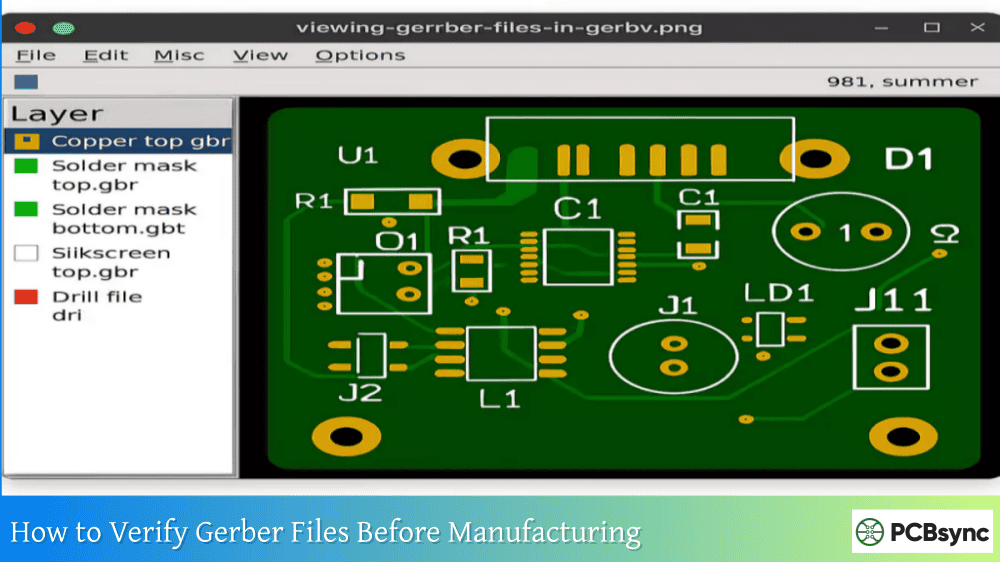
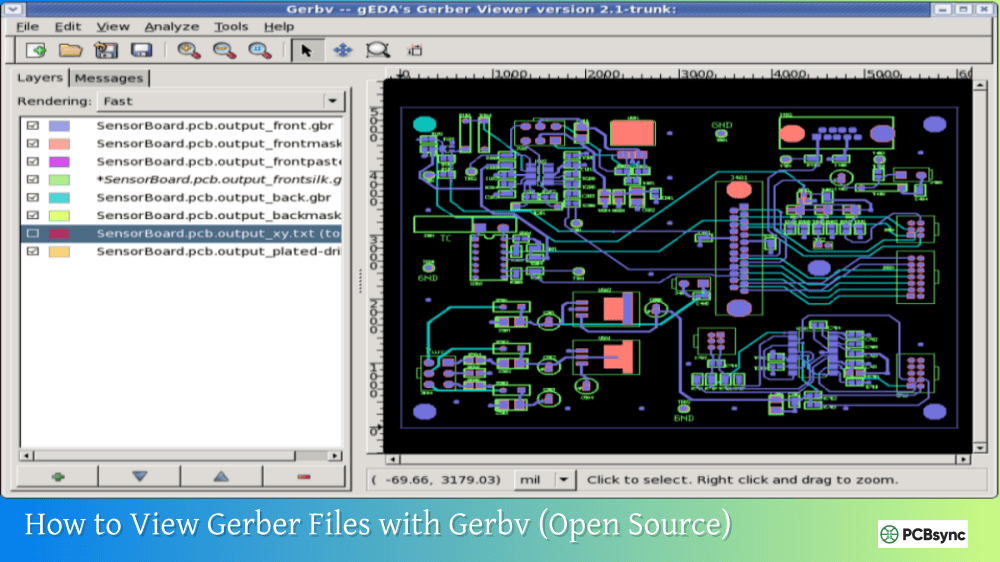
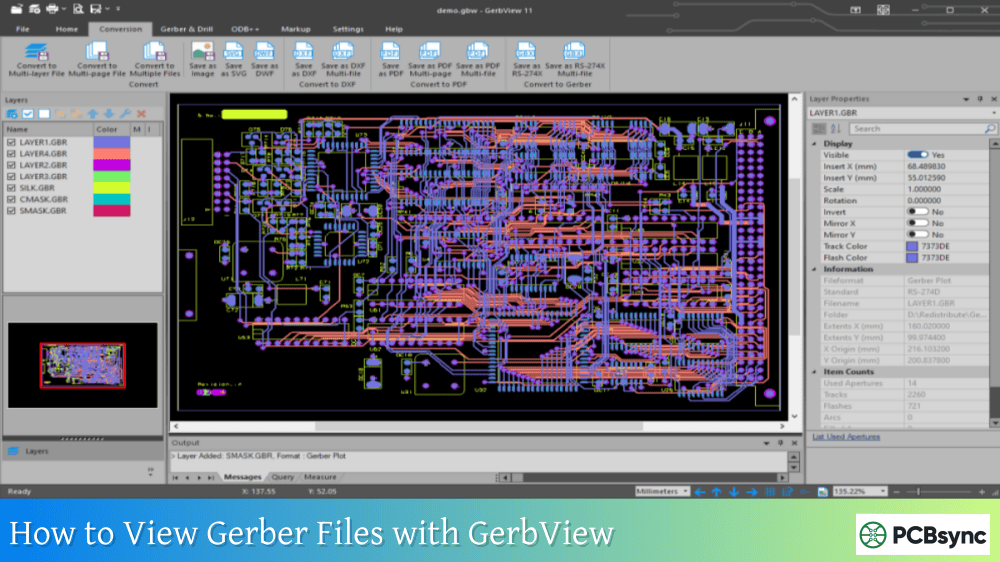
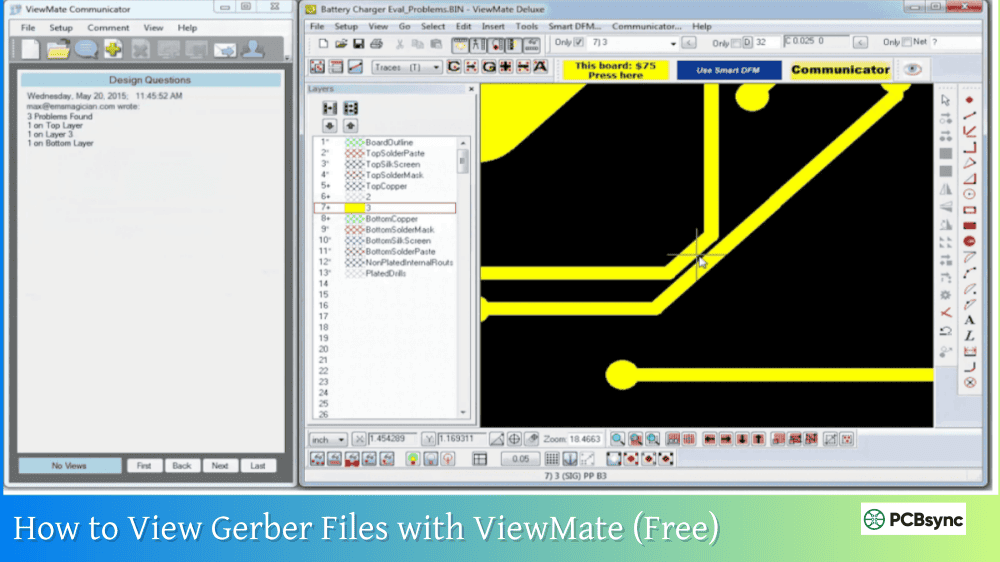
While CR-8000’s viewer is useful, verification in an external tool provides true independence. Load your complete Gerber package in a third-party viewer to catch any CR-8000-specific output issues, verify the files work correctly outside the Zuken environment, and simulate what your fabricator’s CAM operator will see.
Recommended verification tools include GerbView from KiCad (free, cross-platform, handles Gerber and drill), ViewMate from Pentalogix (free, Windows-based with measurement capabilities), Ucamco Reference Gerber Viewer (free online tool from the format maintainers), and ZofzPCB (free, provides 3D visualization of assembled Gerber sets).
Verification Checklist
During review, systematically verify registration by overlaying copper layers to confirm consistent alignment. Check drill-to-pad alignment to ensure every drill hit centers correctly on its pad. Verify mask clearances to confirm adequate solder mask opening around all pads. Check the board outline to make sure it’s complete and includes any internal cutouts. Verify silkscreen clipping to confirm no silk overlaps pad areas. Inspect plane layers to confirm clearances and thermal reliefs appear correctly. Compare the drill tool table against your design to catch any unexpected drill sizes.
Complete Manufacturing File Package
Before submission, verify your package includes all necessary files.
Category
Files Required
Notes
Copper Gerbers
One per copper layer
Signal and plane layers
Solder Mask
Top and bottom
Verify polarity with fab
Silkscreen
Top (bottom optional)
Check pad clearance
Paste Mask
Top and bottom
For SMT assembly
NC Drill
PTH and NPTH minimum
Separate by hole type
Board Outline
One
Include internal cutouts
Readme/Specification
One
Stackup, finish, requirements
Netlist (optional)
IPC-D-356
For electrical test
Pick and Place
For assembly orders
Component centroids
Bill of Materials
For assembly orders
Complete BOM
Troubleshooting Common CR-8000 Output Issues
Even experienced engineers encounter output problems. Here are solutions to frequently occurring issues.
Missing Features in Gerber Output
When expected features don’t appear, check layer mapping in the output definition to ensure all relevant design layers are included. Verify feature class inclusion since CR-8000’s class system may filter certain features. Check for conditional output rules that might exclude elements. Verify the feature exists on the expected layer in your design database.
Aperture Generation Problems
If pads appear incorrectly (outlined instead of filled, wrong shapes), verify automatic aperture generation is enabled. Check for complex pad shapes exceeding maximum aperture size. Review any custom aperture table mappings. Consider simplifying very complex pad geometry.
Drill Coordinate Misalignment
When drill holes don’t align with Gerber copper, ensure identical origin points for Gerber and drill outputs. Verify units match between all outputs. Check coordinate format consistency. Look for any offset values applied to either output type.
Plane Layer Display Issues
If internal planes appear incorrect, verify layer type assignment (plane vs. signal). Check polarity settings (planes often use negative polarity). Ensure thermal relief and anti-pad definitions are correct. Verify your viewer correctly interprets the polarity.
File Size Anomalies
For unexpectedly large or small files, check polygon complexity settings since excessive vertices increase file size. Verify coordinate precision isn’t higher than necessary. Look for data integrity issues in the design database. Compare against file sizes from similar previous designs.
Useful Resources for CR-8000 Users
These resources provide additional support for CR-8000 manufacturing output.
For official documentation, Zuken provides comprehensive documentation through their support portal at zuken.com/support. The CR-8000 Design Force User Manual covers manufacturing output in detail. The Zuken Knowledge Base contains technical articles addressing specific output issues.
For Gerber format specifications, the official Gerber format specification is maintained by Ucamco at ucamco.com/gerber, including RS-274X and X2 documentation.
For verification tools, ViewMate is available at pentalogix.com, GerbView is part of the KiCad suite at kicad.org, and Ucamco’s Reference Gerber Viewer is available at gerber-viewer.ucamco.com.
For community and peer support, Zuken user groups exist in various regions and can be found through Zuken’s website. EDAboard.com includes Zuken tool discussions. LinkedIn has CR-8000 user groups for networking and knowledge sharing.
For training resources, Zuken offers official CR-8000 training courses globally. Regional Zuken offices provide localized training options. Zuken webinars cover specific feature topics including manufacturing output.
Frequently Asked Questions
What Gerber format should I select in CR-8000 for best compatibility?
Select Gerber RS-274X (Extended Gerber) for maximum compatibility with fabricators worldwide. This format embeds aperture definitions directly in each file and is universally supported by manufacturing equipment. While CR-8000 supports newer formats like Gerber X2 and ODB++, RS-274X remains the safest choice unless your fabricator specifically requests otherwise. Always confirm format preferences with your manufacturer before generating final outputs.
How do I generate separate drill files for plated and non-plated holes?
In CR-8000’s Manufacturing Output Manager, create separate NC Drill output definitions for each hole type. Configure the first definition to include only plated through-holes (PTH) using the hole type filter. Configure a second definition for non-plated holes only. Name the files clearly (such as “ProjectName_PTH.drl” and “ProjectName_NPTH.drl”) so fabricators can easily identify each type. This separation is important because plated and non-plated holes require different manufacturing processes.
Can I save my output configuration for reuse on future projects?
Yes, CR-8000’s job-based output system is designed for this. After configuring your output job with all layer definitions, format settings, and naming conventions, save it as a template. For future projects with similar layer structures, load this template and it applies all your configurations automatically. You may need to verify layer mappings if the new design has different layer names, but format settings persist. This significantly reduces setup time and ensures consistency across projects.
Why don’t my internal plane layers look correct in the Gerber viewer?
Internal plane layers often appear confusing due to polarity settings. Planes are typically output with negative polarity, meaning the Gerber file shows copper removal (clearances and thermal reliefs) rather than copper presence. Some viewers display this inverted, making planes look “wrong.” First verify your CR-8000 polarity setting matches your fabricator’s expectation. Then check if your viewer has a polarity toggle to display the layer correctly. When viewing multiple layers together, clearances should align with pads and vias.
What files beyond Gerber and drill outputs should I include for a complete manufacturing package?
Include a fabrication specification document detailing layer stackup, board thickness, copper weights, surface finish (HASL, ENIG, OSP, etc.), solder mask color, silkscreen color, impedance requirements, and any special manufacturing instructions. Provide a layer stackup drawing showing physical layer arrangement and materials. For impedance-controlled designs, include target impedance values with tolerances. If ordering assembly services, add pick-and-place centroid data and a complete bill of materials with manufacturer part numbers and reference designators. A readme file summarizing package contents helps fabricators navigate your submission efficiently.
Conclusion
Generating Gerber files from Zuken CR-8000 requires more configuration than simpler PCB tools, but the result is precise control over your manufacturing outputs. The sophisticated job-based system handles complex multi-board designs and provides repeatability that enterprise design environments require.
Success starts with thorough design verification before output generation. Configure each output definition carefully, ensuring layer mappings, format parameters, and naming conventions are correct. Generate your complete file package and verify it in an external viewer before submission.
Build templates from successful configurations to streamline future projects. CR-8000’s job system makes this easy, and the time invested in creating good templates pays dividends across every subsequent project.
When problems arise, approach them systematically. Check layer mappings, verify format settings, and compare against known-good outputs from previous designs. Zuken’s support resources and user community can help with unusual issues.
CR-8000 handles some of the most demanding PCB design challenges in the industry. Your manufacturing outputs should reflect that same level of quality. Take the time to configure the output system correctly, and you’ll consistently deliver fabrication packages that translate your sophisticated designs into physical boards exactly as intended.
Inquire: Call 0086-755-23203480, or reach out via the form below/your sales contact to discuss our design, manufacturing, and assembly capabilities.
Quote: Email your PCB files to Sales@pcbsync.com (Preferred for large files) or submit online. We will contact you promptly. Please ensure your email is correct.
Notes: For PCB fabrication, we require PCB design file in Gerber RS-274X format (most preferred), *.PCB/DDB (Protel, inform your program version) format or *.BRD (Eagle) format. For PCB assembly, we require PCB design file in above mentioned format, drilling file and BOM. Click to download BOM template To avoid file missing, please include all files into one folder and compress it into .zip or .rar format.