Inquire: Call 0086-755-23203480, or reach out via the form below/your sales contact to discuss our design, manufacturing, and assembly capabilities.
Quote: Email your PCB files to Sales@pcbsync.com (Preferred for large files) or submit online. We will contact you promptly. Please ensure your email is correct.
Notes: For PCB fabrication, we require PCB design file in Gerber RS-274X format (most preferred), *.PCB/DDB (Protel, inform your program version) format or *.BRD (Eagle) format. For PCB assembly, we require PCB design file in above mentioned format, drilling file and BOM. Click to download BOM template To avoid file missing, please include all files into one folder and compress it into .zip or .rar format.
How to Generate Gerber Files from Target 3001!: Complete PCB Export Guide
Understanding Target 3001! and Its Gerber Capabilities
Target 3001! was developed by Ing.-Büro Friedrich in Germany and has been available since 1992. Unlike many PCB tools that treat Gerber export as an afterthought, Target 3001! offers sophisticated output options including support for the latest Gerber X2 and Gerber X3 formats alongside traditional RS-274X.
The software creates what developers call a “do it all” Gerber format—files that work with both older RS-274D interpreters and modern RS-274X systems. This backward compatibility proves valuable when working with various manufacturers who may have different CAM software capabilities.
Target 3001! Version Comparison for Gerber Features
Edition
Pin Limit
Copper Layers
Gerber Output
Price
Free
250
2
Limited
Free
Light
400
2
Full RS-274X
Paid
Smart
700
4
Full RS-274X/X2
Paid
Medium
1500
4
Full RS-274X/X2/X3
Paid
Professional
4000
8
Full with all options
Paid
Design Station
Unlimited
16
Full enterprise features
Paid
The free version handles basic Gerber generation for small projects, while commercial versions unlock advanced features like Gerber X3 output with component assembly information.
Prerequisites Before Generating Gerber Files in Target 3001!
Before jumping into the export process, complete these essential preparation steps to ensure your manufacturing files come out correctly.
Run Design Rule Check
Target 3001! includes comprehensive DRC functionality accessible through the Actions menu. Run this check to identify spacing violations, unconnected nets, and other issues that could cause manufacturing problems. Fix all errors before generating Gerber files—manufacturers will either reject files with obvious problems or charge extra for manual corrections.
Verify Layer Stack Configuration
Target 3001! uses a specific layer numbering system that differs from other PCB software. Understanding this mapping prevents confusion when configuring Gerber output:
Target 3001! Layer
Function
Gerber Extension
Layer 2
Copper Bottom
.BOT or .GBL
Layer 16
Copper Top
.TOP or .GTL
Layer 3
Area Bottom (Ground Plane)
Included in bottom copper
Layer 15
Area Top (Ground Plane)
Included in top copper
Layer 4
Deletion Bottom
Cutouts from bottom plane
Layer 14
Deletion Top
Cutouts from top plane
Layer 6
Solder Stop Bottom
.GBS
Layer 7
Solder Stop Top
.GTS
Layer 21
Position Print Bottom
.GBO
Layer 22
Position Print Top
.GTO
Layer 24
Drill Holes
.DRL or .DRILL
Layer 23
Board Outline
.OUTLINE or .GKO
The copper layers in Target 3001! always consist of three combined layers: the actual copper layer, an area layer for planes, and a deletion layer for plane cutouts. The software automatically merges these during Gerber export.
Check Board Outline Definition
Your board outline must be properly defined on Layer 23. Without a clear outline, manufacturers cannot determine board dimensions or where to route individual panels. Verify the outline forms a completely closed path with no gaps.
Step-by-Step Guide to Generate Gerber Files from Target 3001!
The actual Gerber generation process in Target 3001! follows a logical workflow once you know where to find the commands.
Step 1: Access the Gerber Output Dialog
Navigate to the Gerber export function using one of these methods:
Menu Path: File → Input/Output Formats → Production → (X-)Gerber and Drill Output PCBout
Keyboard Shortcut: Press F11 directly
Toolbar: Click the Gerber output icon in the top toolbar (when in PCB view)
The main Gerber output dialog appears, showing layer selections and configuration options.
Step 2: Configure Basic Output Settings
The standard dialog presents essential options for most users:
Output Directory: By default, Target 3001! creates Gerber files in your project directory. Consider creating a dedicated subdirectory to keep manufacturing files organized separately from your design files.
Layer Selection: Check the boxes for each layer you want to export. For a standard two-layer board, select:
Copper Top
Copper Bottom
Solder Stop Top (solder mask)
Solder Stop Bottom (solder mask)
Position Print Top (silkscreen)
Position Print Bottom (silkscreen)
Board Outline
Drill Holes
File Naming: Target 3001! offers multiple naming conventions. Click the “Standard” button to use internationally recognized file extensions, or customize names using the “TARGET” button for legacy compatibility.
Step 3: Access Advanced Settings (Special Dialog)
For additional control, click the “Special >>” button below the Start button. This expands the dialog to reveal advanced configuration options:
Smallest Aperture: Enter the minimum aperture size your manufacturer can handle. Typically 0.15mm (6 mil) works for most fabricators. Tracks thinner than this value get automatically widened during export—Target 3001! warns you if this causes spacing violations.
Maximum Chord Error: Controls how circles and curves get approximated with straight line segments. Lower values create smoother curves but larger file sizes. A value of 0.01mm works well for most applications.
Polygon Fill Method: Choose how copper pours get represented in Gerber:
Fill with thin lines only (most compatible, largest files)
Standard polygon fill (recommended for most cases)
Advanced polygon handling (for complex designs)
Via Coverage: Configure whether vias should be covered with solder mask, left open, or have only the drill hole exposed. This setting affects the solder stop layer generation.
Step 4: Configure Gerber Format Options
Target 3001! supports multiple Gerber format variations:
Format Option
Description
When to Use
RS-274X (XGerber)
Extended format with embedded apertures
Default for most manufacturers
RS-274D Compatible
Legacy format with separate aperture files
Older CAM systems only
Gerber X2
Extended with layer function metadata
Modern manufacturers
Gerber X3
Includes assembly and component data
Automated assembly services
For maximum compatibility, keep the default RS-274X format. Enable Gerber X2 attributes if your manufacturer supports them—this reduces the chance of layer misidentification during CAM processing.
Step 5: Generate the Files
Click the “Start” button to initiate Gerber generation. Target 3001! processes each selected layer and creates individual files in your specified output directory.
Upon completion, the software generates an information file (*.info) containing project details, layer mapping, and any warnings encountered during generation. Review this file before sending data to your manufacturer.
Step 6: Generate Drill Files
Drill file generation happens as part of the standard Gerber output process in Target 3001!. The software creates Excellon-format drill files automatically when you include Layer 24 (Drill Holes) in your selection.
The drill file includes:
Tool definitions with diameter specifications
Hole coordinates in the same units as your Gerber files
Plated and non-plated hole designations (if properly defined in your design)
Target 3001! Gerber File Extensions and Naming
Target 3001! generates files with specific extensions. Understanding these helps when organizing data for manufacturers:
File Extension
Content
Notes
*.TOP
Top copper layer
Primary signal layer
*.BOT
Bottom copper layer
Secondary signal layer
*.StopTop
Top solder mask
Defines mask openings
*.StopBot
Bottom solder mask
Defines mask openings
*.PosiTop
Top silkscreen
Component markings
*.PosiBot
Bottom silkscreen
Secondary markings
*.Outline
Board outline
Routing/cutting path
*.Drill
Excellon drill data
Hole positions and sizes
*.Apr
Aperture list
Tool definitions
*.Tool
Drill tool list
Drill bit specifications
*.Whl
Aperture list (Eagle format)
For compatibility
*.info
Project information
Layer mapping and notes
*.X3B
Gerber X3 bottom assembly
Component placement data
*.X3T
Gerber X3 top assembly
Component placement data
When using the “Standard” naming option, Target 3001! generates files with more universally recognized extensions like .GTL, .GBL, .GTS, .GBS, etc.
Verifying Gerber Output from Target 3001!
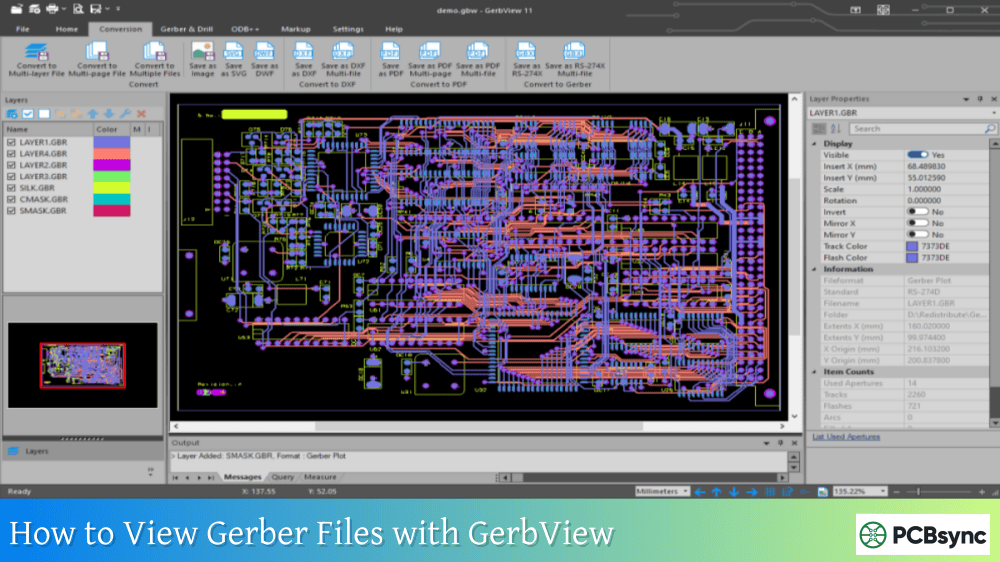
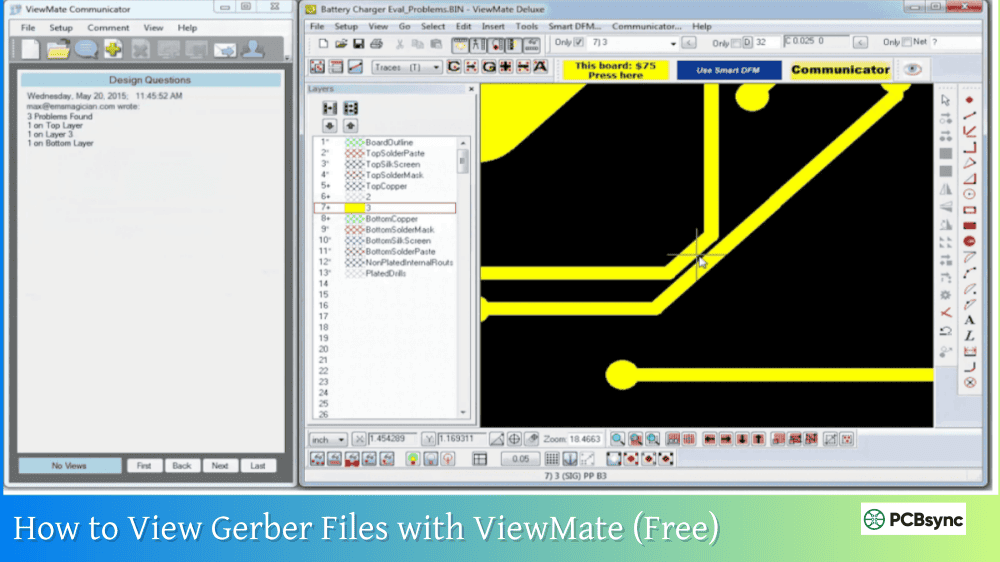
Never send Gerber files to a manufacturer without verification. Target 3001! is not a Gerber viewer, so you need external tools to check your output.
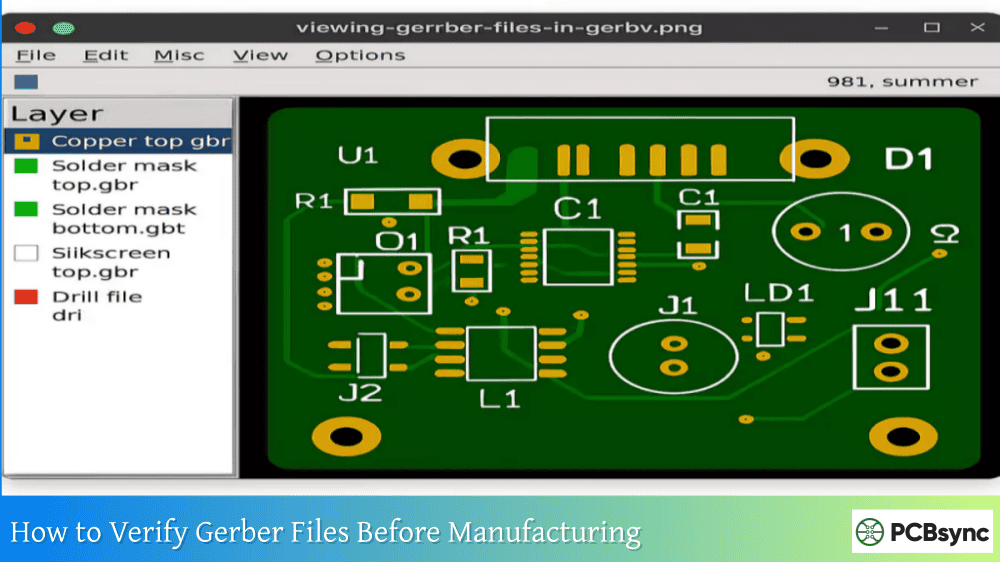
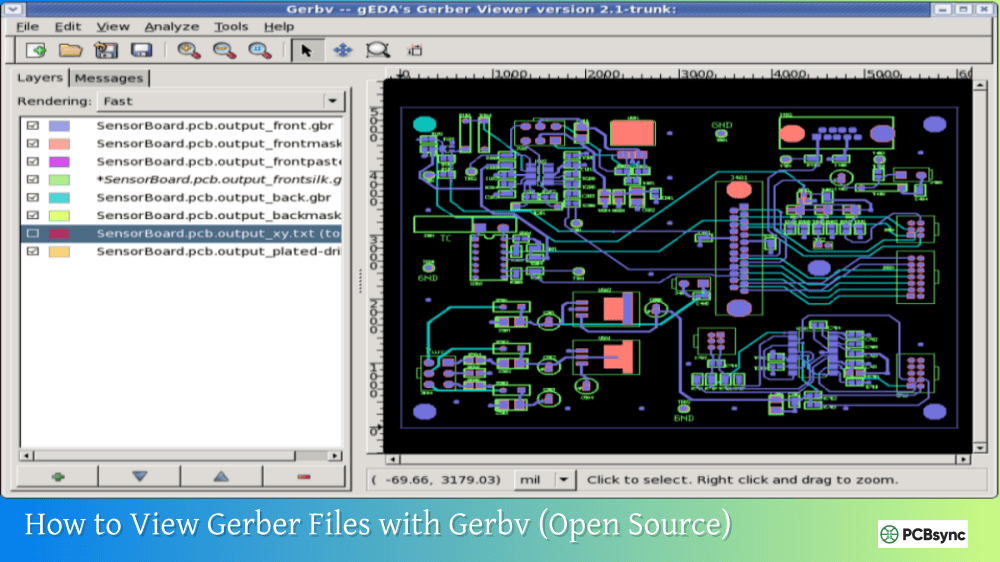
Recommended Gerber Viewers
Viewer
Platform
Cost
Key Features
GC-Prevue
Windows
Free
Industry standard, comprehensive
Gerbv
Windows, Linux, Mac
Free
Open source, lightweight
ViewMate
Windows
Free
Professional grade
GerberLogix
Windows
Free
Advanced measurement tools
Online viewers (JLCPCB, PCBWay)
Web
Free
Quick verification before ordering
Verification Checklist
When inspecting your Gerber files, check these critical items:
Layer Alignment: Stack all layers in the viewer and confirm perfect registration. Pads on different layers must align exactly.
Drill Centering: Verify drill holes center precisely on pads. Misalignment indicates coordinate system problems.
Copper Plane Integrity: Check that ground planes and poured copper areas render correctly without gaps or artifacts.
Silkscreen Placement: Verify text and component outlines don’t overlap solder mask openings.
Board Outline: Confirm the outline forms a continuous closed path at the correct dimensions.
Troubleshooting Common Gerber Export Issues in Target 3001!
Even experienced users encounter problems occasionally. Here are solutions to frequent issues:
Problem: Copper Planes Display Incorrectly
If ground planes or power planes don’t export properly, check your polygon fill settings in the Special dialog. Try switching between fill methods. Also verify that your area layers (3 and 15) and deletion layers (4 and 14) are correctly configured.
Problem: Drill Holes Offset from Pads
This usually indicates a coordinate system mismatch. Ensure your Gerber and drill files use the same units (metric or imperial) and zero reference point. The info file lists the exact settings used—compare these if problems arise.
Problem: File Size Extremely Large
Large Gerber files typically result from complex copper pours being filled with many thin lines instead of using polygon commands. Adjust the polygon fill method in Special settings. Also check the chord error setting—very small values create unnecessary detail.
Problem: Manufacturer Reports Missing Layers
Target 3001!’s default file naming may confuse some manufacturers. Use the “Standard” naming option for international compatibility, or provide a README file explaining your layer mapping.
Problem: Aperture Warnings During Export
If Target 3001! reports aperture issues, some design elements may be smaller than your specified minimum aperture. Review the warnings carefully and either adjust your design or accept the automatic widening.
Read more How to convert PCB Files in different Design software:
After producing countless boards from Target 3001! designs, these practices consistently prevent problems:
Use Standard Layer Assignments
Stick with Target 3001!’s default layer numbering scheme. Creative layer reassignment causes confusion during export and verification. Document any deviations clearly.
Configure Solder Mask Expansion Correctly
In Target 3001!, the solder mask expansion (called “Soldermask +” in settings) controls how much larger mask openings are compared to pads. A value of 0.050mm (50 microns) provides adequate clearance without creating solder bridges on fine-pitch components.
Include All Necessary Files
A complete manufacturing package from Target 3001! should include:
All copper layer Gerbers
Both solder mask layers
Both silkscreen layers (if used)
Board outline
Drill file with tool list
The info file for reference
Create a Subdirectory for Output
Rather than cluttering your project folder, configure Target 3001! to place Gerber files in a dedicated subdirectory. This keeps files organized and makes packaging for manufacturers easier.
Useful Resources for Target 3001! Users
Here are essential links for anyone working with Target 3001! and Gerber files:
Sending Target 3001! Files Directly to Manufacturers
Meta:Master Target 3001! Gerber export with detailed instructions for RS-274X, Gerber X2, and X3 formats. Includes layer mapping, verification steps, and best practices.
Some PCB manufacturers accept native Target 3001! project files (*.T3001) directly, handling the Gerber conversion themselves. This can simplify your workflow:
Manufacturers Accepting Target 3001! Files
Manufacturer
Direct File Support
Notes
PCB-Pool (Beta Layout)
Yes
Integrated ordering from software
Multi-CB
Yes
Free conversion service
Conrad Electronic
Yes
Partnership with Target 3001!
If using direct file submission, ensure your design passes DRC and follows the manufacturer’s design rules. The manufacturer’s CAM engineers will generate optimized Gerber files from your project.
Comparing Target 3001! Gerber Output to Other Software
Understanding how Target 3001! compares helps when collaborating with users of other tools:
Feature
Target 3001!
KiCad
Altium
Eagle
Gerber RS-274X
Yes
Yes
Yes
Yes
Gerber X2
Yes
Yes
Yes
Limited
Gerber X3
Yes
No
Yes
No
Embedded Apertures
Yes
Yes
Yes
Yes
Excellon Drill
Yes
Yes
Yes
Yes
Polygon Fill Options
Multiple
Limited
Multiple
Limited
Built-in Verification
No (external)
No
Yes
No
Target 3001! stands out with its Gerber X3 support and flexible polygon handling options, though it lacks built-in Gerber viewing capabilities.
Frequently Asked Questions
What Gerber format does Target 3001! generate by default?
Target 3001! generates RS-274X (Extended Gerber) format by default, which includes embedded aperture definitions. The software creates files that are backward compatible with older RS-274D systems by including aperture information as comments that legacy interpreters ignore. Modern systems read the embedded apertures directly, while older systems can use the separate aperture file (*.Apr) that Target 3001! also generates.
Can I generate Gerber X2 or X3 files in Target 3001!?
Yes, Target 3001! supports both Gerber X2 and Gerber X3 output. Enable these options in the Gerber output dialog by checking the appropriate boxes. Gerber X2 adds layer function attributes that help manufacturers identify each file’s purpose automatically. Gerber X3 extends this further by including component placement and assembly information, useful for automated pick-and-place programming.
Why do my copper planes look different in the Gerber viewer than in Target 3001!?
Target 3001! displays copper planes differently than Gerber viewers because the software shows design intent while Gerber files show actual manufacturing data. Copper pours get converted to filled polygons or vector fills during export, which can appear different visually. Verify the actual copper coverage is correct—minor visual differences between the design view and Gerber representation are normal and don’t affect manufacturing.
How do I include pick-and-place data with my Gerber files?
Target 3001! can export centroid (pick-and-place) files along with Gerber data. In the Gerber output dialog, ensure the pick-and-place option is enabled. The software generates files containing component positions, rotations, and designators that assembly houses use for automated placement. For Gerber X3 output, this information gets embedded directly in the *.X3T and *.X3B files.
What resolution does Target 3001! use for Gerber output?
Target 3001! generates Gerber files with extremely high resolution: 0.000254mm (0.01 mil), expressed as format %FSLAX35Y35*% in the file header. This resolution far exceeds what any manufacturer can actually produce and ensures no loss of precision during data transfer. The high resolution accommodates future improvements in manufacturing technology without requiring file format changes.
Final Thoughts on Target 3001! Gerber Generation
Target 3001! offers one of the more sophisticated Gerber export systems available in PCB design software, particularly with its support for the latest Gerber X2 and X3 formats. The unified approach to schematic capture, simulation, and layout means your design data remains consistent throughout the process, reducing the chance of errors that plague multi-tool workflows.
The key to success lies in understanding Target 3001!’s unique layer structure and taking time to properly configure export settings. The Special dialog options give you fine control over how your design translates to manufacturing data, but the defaults work well for most standard projects.
Always verify your output using an independent Gerber viewer before submitting to manufacturers. This simple step catches problems that could result in expensive board respins. With proper preparation and verification, Target 3001! produces manufacturing files that any competent PCB fabricator can process successfully.
Whether you’re a hobbyist using the free version or a professional with a full Design Station license, mastering the Gerber export process transforms Target 3001! from a design tool into a complete PCB development solution.
Inquire: Call 0086-755-23203480, or reach out via the form below/your sales contact to discuss our design, manufacturing, and assembly capabilities.
Quote: Email your PCB files to Sales@pcbsync.com (Preferred for large files) or submit online. We will contact you promptly. Please ensure your email is correct.
Notes: For PCB fabrication, we require PCB design file in Gerber RS-274X format (most preferred), *.PCB/DDB (Protel, inform your program version) format or *.BRD (Eagle) format. For PCB assembly, we require PCB design file in above mentioned format, drilling file and BOM. Click to download BOM template To avoid file missing, please include all files into one folder and compress it into .zip or .rar format.