Inquire: Call 0086-755-23203480, or reach out via the form below/your sales contact to discuss our design, manufacturing, and assembly capabilities.
Quote: Email your PCB files to Sales@pcbsync.com (Preferred for large files) or submit online. We will contact you promptly. Please ensure your email is correct.
Notes: For PCB fabrication, we require PCB design file in Gerber RS-274X format (most preferred), *.PCB/DDB (Protel, inform your program version) format or *.BRD (Eagle) format. For PCB assembly, we require PCB design file in above mentioned format, drilling file and BOM. Click to download BOM template To avoid file missing, please include all files into one folder and compress it into .zip or .rar format.
How to Generate Gerber Files from Pulsonix: Complete PCB Engineer’s Guide
Having worked with numerous PCB design tools over the years, I’ve developed a real appreciation for Pulsonix’s approach to manufacturing output generation. The UK-based software strikes a solid balance between professional capabilities and usability that larger enterprise tools often sacrifice. When it comes to generating Gerber files from Pulsonix, the workflow is logical and well-integrated into the design environment.
This guide walks you through the complete process of creating manufacturing-ready Gerber files, NC drill data, and other fabrication outputs from Pulsonix, including the configuration details that make the difference between smooth manufacturing and costly delays.
Gerber files have been the backbone of PCB manufacturing communication for decades. Originally developed by Gerber Scientific Instruments in the 1960s for vector photoplotters, the format has evolved into the RS-274X (Extended Gerber) standard that virtually every fabrication house accepts today.
Each Gerber file represents a single layer of your PCB as a 2D vector image. When a manufacturer receives your files, they load them into CAM software to prepare tooling for each fabrication step — copper etching, solder mask application, silkscreen printing, and board profiling.
The RS-274X Standard
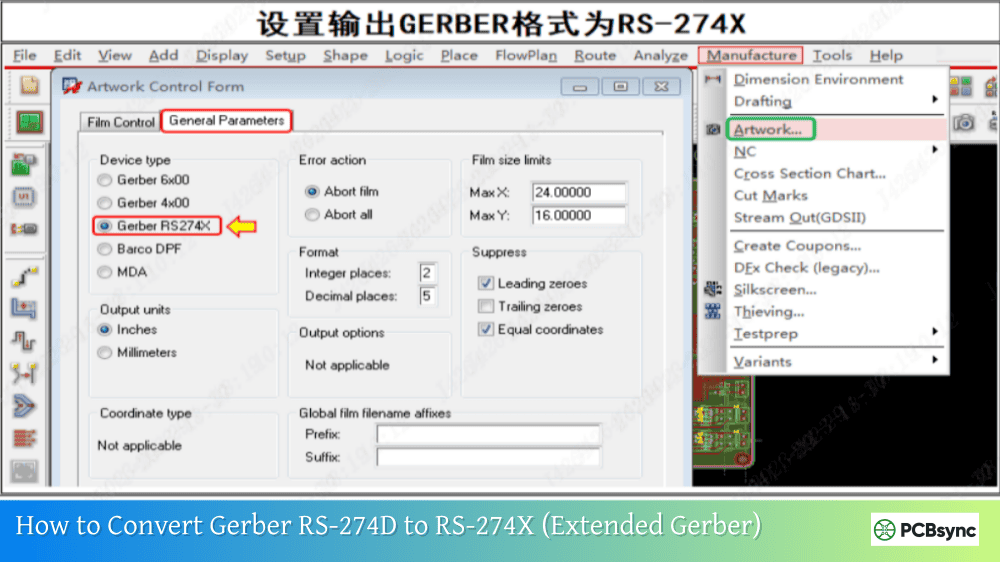
Pulsonix outputs Gerber files in the RS-274X format, which embeds aperture definitions directly within each file. This self-contained approach eliminates the compatibility issues that plagued the older RS-274D format, which required separate aperture wheel files.
Key characteristics of RS-274X files include:
Embedded aperture definitions (no external aperture files needed)
Human-readable ASCII format for troubleshooting
Support for complex polygons and thermal reliefs
Universal compatibility with CAM systems worldwide
Pulsonix Overview: Professional PCB Design Software
Pulsonix is a Windows-based schematic capture and PCB layout application developed by WestDev in the UK. The software has been in continuous development since 1991 and serves over 9,000 users globally, including installations at major electronics companies.
Key Manufacturing Features in Pulsonix
Feature
Description
Manufacturing Benefit
CAM/Plot System
Comprehensive output dialog
Centralized manufacturing control
Plot Groups
Saved output configurations
Repeatable exports across revisions
Plot Wizard
Step-by-step guidance
Reduces configuration errors
ODB++ Export
Alternative to Gerber
Single-file manufacturing data
Technology Files
Pre-defined CAM settings
Consistent outputs across designs
Auto Generate
Automatic plot creation
Time savings for standard boards
Pre-Export Checklist: Preparing Your Design
Before opening the CAM/Plot dialog, take time to verify your design is truly ready for manufacturing output. Catching issues now saves significant time compared to discovering problems after fabrication begins.
Design Rule Check (DRC)
Run a comprehensive DRC to verify your design meets manufacturing constraints:
Navigate to Tools > Design Rule Check
Select all rule categories relevant to your manufacturer’s capabilities
Review and resolve any violations
Pay particular attention to clearance violations and unrouted connections
Verify Layer Stack Configuration
Ensure your layer definitions accurately represent your intended board construction:
Confirm copper layer count matches your design intent
Verify layer naming follows your manufacturer’s conventions
Check that plane layers are correctly defined (positive vs. negative)
Board Outline Verification
Your board outline must be a continuous, closed shape:
Check for gaps at corners or segment intersections
Verify any internal cutouts are properly defined
Confirm the outline appears on the correct documentation layer
Step-by-Step Guide: Generating Gerber Files from Pulsonix
Step 1: Access the CAM/Plot Dialog
Pulsonix centralizes all manufacturing output through the CAM/Plot option. Access it through:
Output Menu > CAM/Plot
The dialog presents a comprehensive interface for configuring all plot outputs, including Gerber files, drill data, and documentation drawings.
Step 2: Configure Plot Settings
The CAM/Plot dialog contains several key configuration areas:
Layer Selection: Select which design layers to include in your output. For a standard two-layer board, you’ll typically need:
Plot Type
Design Layer
Purpose
Top Copper
Elec 1 (Top)
Component-side traces
Bottom Copper
Elec 2 (Bottom)
Solder-side traces
Top Solder Mask
Solder Resist Top
Mask openings
Bottom Solder Mask
Solder Resist Bottom
Mask openings
Top Silkscreen
Silk Top
Component markings
Bottom Silkscreen
Silk Bottom
Solder-side markings
Board Outline
Assembly
Manufacturing boundary
Plot Scale and Rotation: Leave scale at 1:1 for manufacturing outputs. Rotation is typically unnecessary unless your manufacturer specifically requests it.
Machine Driver: Select the appropriate output format driver. For Gerber files, choose the Gerber driver from the available options.
Step 3: Configure Gerber-Specific Settings
Click the Setup button next to the Gerber driver selection to access detailed format options:
Gerber Setup Dialog Options:
Setting
Recommended Value
Notes
Format
RS-274X
Extended Gerber with embedded apertures
Units
Imperial or Metric
Match your design units
Integer Digits
2-3
Whole number precision
Decimal Digits
4-5
Fractional precision
Coordinate Type
Absolute
Industry standard
Zero Suppression
Leading
Most common format
Step 4: Access Change Format Dialog
For precise coordinate formatting control, use the Change Format option within the Gerber Setup:
Format Settings:
Units: Choose Imperial (inches) or Metric (millimeters) based on your manufacturer’s preference
Integer and Decimal: Together these define coordinate precision. Common configurations include 2.4 (imperial) or 3.3 (metric)
Type: Absolute coordinates are standard; Incremental is rarely used
These settings are stored in the Windows Registry and apply to all subsequent plots until changed.
Step 5: Configure Aperture Settings
Pulsonix automatically generates apertures based on your design features, but you can access the aperture table through the Gerber Apertures option:
Aperture considerations:
Review the aperture list to ensure all pad shapes and trace widths are represented
Verify no custom apertures exceed your manufacturer’s capabilities
Check that thermal relief patterns use appropriate aperture definitions
Step 6: Generate Individual Layer Plots
With settings configured, generate each required layer:
Select the layer combination from the layer list
Specify the output filename (use descriptive names like “TopCopper.gbr”)
Click Plot or Generate to create the file
Repeat for each required manufacturing layer
Step 7: Use Plot Groups for Efficiency
Pulsonix’s Plot Groups feature saves your output configurations for reuse:
Configure all required plots for your design
Save the configuration as a Plot Group
Load the Plot Group for future revisions of the same design
Modify only changed settings as needed
This feature significantly reduces setup time for repeat orders or design revisions.
Generating NC Drill Files in Pulsonix
Gerber files define copper features, but drill files specify hole locations and sizes. Manufacturing requires both file types.
Excellon Drill Format
Pulsonix supports the Excellon format for NC drill data, which is the industry standard accepted by virtually all fabricators.
Accessing Drill Output:
Navigate to Output > CAM/Plot and select the Excellon driver option. Configure the drill output settings:
Setting
Description
Recommendation
Units
Inch or Metric
Match Gerber settings
Format
Coordinate precision
Match Gerber format
Zero Suppression
Leading/Trailing
Match Gerber settings
Tool Table
Drill size list
Auto-generated from design
Drill File Considerations
Plated vs. Non-Plated Holes: Separate drill files for plated through-holes (PTH) and non-plated through-holes (NPTH) are best practice. Some manufacturers require this separation.
Drill Size Table: Pulsonix generates a drill size table showing all unique hole diameters in your design. Review this table to ensure sizes match your manufacturer’s standard drill inventory.
Slot and Routed Features: For slots or complex routed features, additional mill/rout files may be required. Pulsonix can generate these through the CAM/Plot system.
Using the Plot Wizard for Guided Output
For engineers new to Pulsonix or those who want step-by-step guidance, the Plot Wizard provides a structured approach to generating manufacturing outputs.
Accessing the Plot Wizard
From the CAM/Plot dialog, select the Plot Wizard option to launch the guided interface.
Wizard Steps
The Plot Wizard walks through:
Technology Selection: Choose or create appropriate technology file
Layer Configuration: Define which layers to output
Format Settings: Configure Gerber and drill parameters
Output Options: Specify file locations and naming
Generation: Create all configured outputs
The wizard is particularly useful for ensuring no required layers are accidentally omitted.
Auto Generate Feature for Standard Boards
Pulsonix includes an Auto Generate feature that automatically creates standard manufacturing outputs based on your layer stack and technology file settings.
When to Use Auto Generate
Auto Generate works well for:
Standard two-layer or four-layer boards
Designs using technology files with pre-configured CAM settings
Quick prototype outputs where manual optimization isn’t critical
Auto Generate Limitations
Consider manual configuration when:
Your design uses non-standard layer configurations
Manufacturer-specific requirements differ from defaults
Complex flexi-rigid or embedded component designs
Alternative Output: ODB++ Format
Beyond Gerber files, Pulsonix supports ODB++ export for manufacturers who accept this more comprehensive format.
ODB++ vs. Gerber Comparison
Aspect
Gerber Files
ODB++
File Count
Multiple (one per layer)
Single archive
Embedded Data
Images only
Images + netlist + components
Stack-up Info
External documentation
Included
Industry Support
Universal
Growing
File Size
Smaller per layer
Larger overall
Exporting ODB++ from Pulsonix
Access ODB++ export through the Output menu. The format includes layer images, drill data, component information, and netlist data in a single package.
Verifying Your Gerber Files
Never send Gerber files to manufacturing without verification. Visual inspection catches issues that design software might miss.
Using Pulsonix’s Built-in Viewer
Pulsonix includes a Gerber viewer for checking exported files. This allows you to verify outputs without leaving the design environment.
External Gerber Viewers
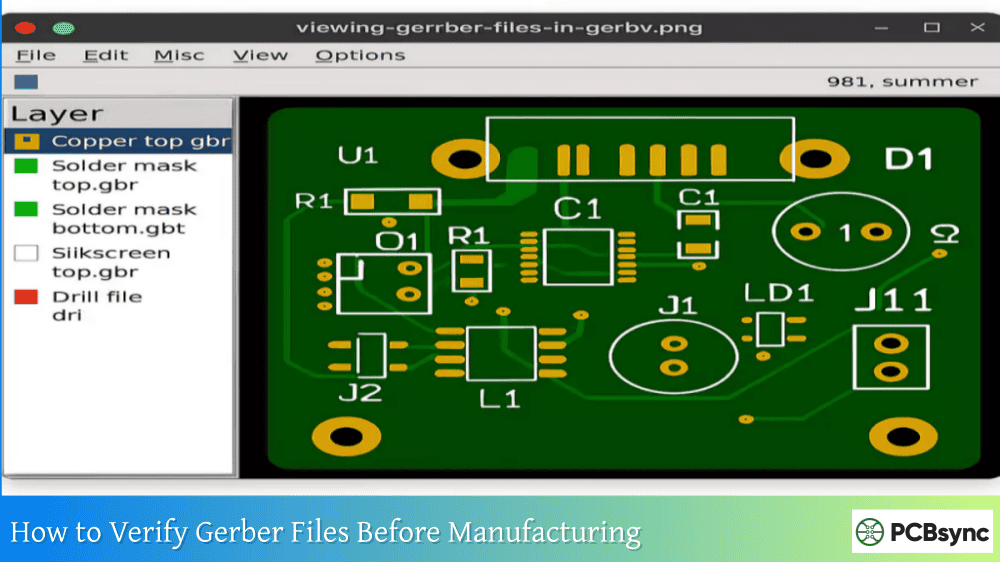
For independent verification, consider these free viewers:
Viewer
Platform
Notes
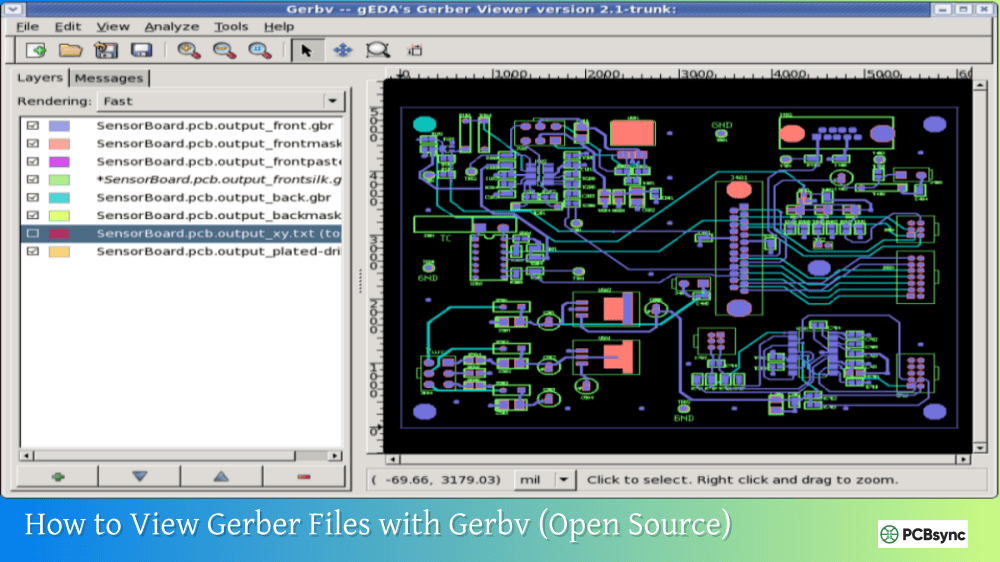
Gerbv
Windows/Linux
Open source, widely used
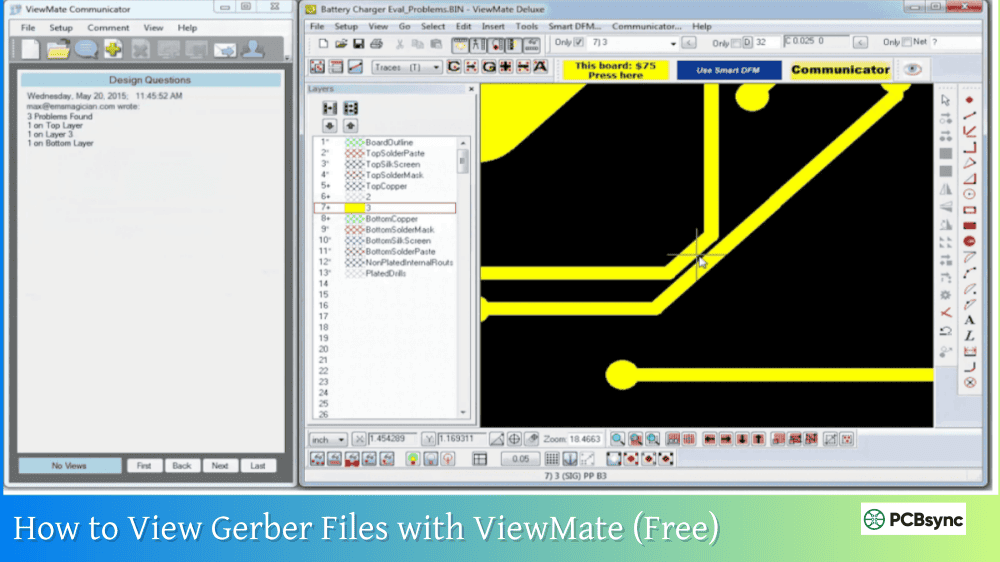
ViewMate
Windows
Professional quality
GC-Prevue
Windows
Free version available
Ucamco Reference Viewer
Web
Official Gerber format viewer
Verification Checklist
When reviewing Gerber files:
Toggle each layer individually to verify completeness
Check layer registration (alignment) by overlaying copper and mask layers
Verify drill holes align with pad centers
Confirm board outline is continuous and closed
Check silkscreen for legibility and pad clearance
Verify no features extend beyond the board outline
Common Pulsonix Gerber Export Issues
Issue 1: Coordinate Format Mismatch
Symptom: Drill holes appear offset from pads in viewer
Solution: Ensure Gerber and Excellon drill files use identical coordinate format settings (units, integer/decimal digits, zero suppression)
Issue 2: Missing Aperture Definitions
Symptom: Features appear as thin lines or incorrect shapes
Solution: Verify RS-274X format is selected (not RS-274D). Re-export with embedded apertures enabled.
Issue 3: Incomplete Board Outline
Symptom: Manufacturer reports missing or open board boundary
Solution: Check board outline layer for continuous, closed path. Verify outline exports on correct layer.
Issue 4: Text Font Issues
Symptom: Silkscreen text appears different than expected
Solution: Use Pulsonix’s standard fonts for Gerber output. Custom TrueType fonts may not translate correctly.
Issue 5: Thermal Relief Problems
Symptom: Plane connections appear solid or missing
Solution: Review thermal relief settings in pad styles. Verify power plane plots include correct thermal definitions.
Useful Resources for Pulsonix Users
Official Documentation
Resource
URL
Description
Pulsonix Main Site
pulsonix.com
Software and support
Online Documentation
pulsonix.com/documentation
Comprehensive help system
User Forum
pulsonix.com/forum
Community support
Download Center
pulsonix.com/downloads
Updates and resources
Gerber Verification Tools
Tool
Access
Cost
Gerbv
gerbv.sourceforge.net
Free
ViewMate
pentalogix.com
Free version
GC-Prevue
graphicode.com
Free
Reference Viewer
ucamco.com
Free
Manufacturer Resources
Always consult your specific PCB manufacturer’s documentation for:
Can I generate Gerber files with the Pulsonix evaluation version?
Yes, the evaluation version includes full CAM/Plot functionality including Gerber and drill file generation. This allows you to test the complete workflow before purchasing a license.
Does Pulsonix support Gerber X2 format?
Pulsonix primarily outputs RS-274X format. While it can import files containing X2 commands, the software notes that X2-specific attributes (AperFunction, FileFunction) are detected but not fully processed. For most manufacturers, RS-274X remains sufficient.
How do I create Gerber files for a flexi-rigid design?
Pulsonix’s flexi-rigid support extends to manufacturing outputs. Use layer spans and bend region definitions in your design, then configure the CAM/Plot to output appropriate layers for each rigid and flexible section. Consult your manufacturer for their specific documentation requirements.
What’s the difference between Plot Groups and Technology Files?
Technology Files define design rules, styles, and default settings used during PCB creation. Plot Groups store specific CAM/Plot configurations for manufacturing output. Both work together — Technology Files can include default plot settings that Plot Groups can override for specific projects.
Can Pulsonix generate IPC-2581 format?
Pulsonix supports ODB++ as an alternative to Gerber. Check with your manufacturer whether they accept IPC-2581, and verify current Pulsonix version capabilities for this format.
Pulsonix vs. Other PCB Tools for Gerber Export
Having used multiple PCB design platforms, I can offer perspective on how Pulsonix compares for manufacturing output generation.
Gerber Export Comparison
Feature
Pulsonix
Altium Designer
KiCad
Eagle
Built-in Gerber Viewer
Yes
Yes
Yes
Limited
Plot Groups/Templates
Yes
OutJob files
Presets
CAM Jobs
Auto Generate
Yes
Partial
No
No
ODB++ Export
Yes
Yes
No
No
Technology File Support
Yes
Design Rules
Project files
DRU files
Learning Curve
Moderate
Steep
Moderate
Easy
Pulsonix Strengths for Manufacturing
Pulsonix excels in several areas for manufacturing output:
Integrated CAM/Plot System: Unlike tools that scatter output functions across multiple menus, Pulsonix consolidates everything in one comprehensive dialog. This centralized approach reduces the chance of missing required files.
Technology File Integration: The ability to embed CAM settings within Technology Files means new projects automatically inherit proven output configurations. This consistency is valuable for organizations producing multiple designs.
Plot Wizard Guidance: For engineers transitioning from other tools or new to PCB design, the Plot Wizard provides structured guidance that prevents common omissions.
Considerations for Tool Selection
Pulsonix pricing positions it between free tools like KiCad and premium solutions like Altium Designer. For organizations that need professional manufacturing output capabilities without enterprise-level costs, this represents good value.
The Windows-only platform may be a limitation for teams using Linux or macOS workstations, though Wine compatibility has been reported for some functions.
Advanced Topics: Multilayer and Specialty Board Outputs
Complex designs require additional attention during Gerber generation to ensure manufacturers receive complete, accurate data.
Multilayer Board Considerations
For boards with four or more layers, ensure your output includes:
Inner Layer Copper: Each inner signal or plane layer requires its own Gerber file. Pulsonix can output plane layers as positive (showing copper) or negative (showing clearances).
Blind and Buried Via Drill Files: Complex via structures may require separate drill files for different layer spans. Configure the Excellon output to properly differentiate these.
Layer Stack Documentation: Include a clear stack-up drawing or text file specifying layer order, copper weights, and dielectric materials.
Flexi-Rigid Design Outputs
Pulsonix provides true flexi-rigid support with manufacturing implications:
Layer spans define which layers exist in rigid vs. flexible regions
Bend regions require special documentation for the fabricator
Stiffener locations should be clearly indicated on mechanical layers
Embedded Component Boards
For designs using embedded components within the PCB substrate, additional documentation beyond standard Gerber files is essential. Work closely with your manufacturer to determine their specific requirements.
Troubleshooting Advanced Gerber Issues
Issue: Copper Pour Rendering Problems
Symptom: Filled areas appear fragmented or incomplete in viewer
Solution: Pulsonix handles copper pours correctly according to industry reviews, but verify pour settings include proper thermal relief definitions. Regenerate pours before export if modifications were made late in the design cycle.
Issue: Panel Array Output
Symptom: Need to output panelized version for production quantities
Solution: Use Pulsonix’s panel editor to create the manufacturing panel, then generate Gerber files from the panel design rather than the individual board. This ensures step-and-repeat patterns and panel features are correctly captured.
Issue: Variant-Specific Outputs
Symptom: Design has multiple assembly variants requiring different manufacturing files
Solution: Pulsonix supports assembly variants. When generating outputs, ensure you’ve selected the correct variant or use Plot Groups to save variant-specific configurations.
Manufacturing File Submission Best Practices
Communicating with Your Fabricator
Before submitting files, establish clear communication:
Request Design Guidelines: Get your manufacturer’s capability document specifying minimum trace widths, spacing, hole sizes, and other constraints
Confirm File Format Preferences: While RS-274X is universal, some manufacturers prefer specific naming conventions or file organization
Discuss Special Requirements: HDI, controlled impedance, or specialty materials require additional documentation beyond standard Gerber files
Quality Assurance Before Submission
Implement a systematic review process:
Compare Gerber output against original design in Pulsonix
Verify all layers are present and correctly named
Confirm drill file alignment with copper layers
Check that board outline matches design intent
Review silkscreen for manufacturing readability
Conclusion: Streamlining Your Pulsonix Manufacturing Workflow
Generating Gerber files from Pulsonix is a straightforward process once you understand the relationship between the CAM/Plot dialog, format settings, and output options. The software’s Plot Groups feature and Auto Generate capability can significantly reduce setup time for routine projects.
Key takeaways for reliable manufacturing output:
Use Technology Files to establish consistent CAM settings across projects
Run DRC before generating any manufacturing files
Match coordinate formats between Gerber and drill files exactly
Save Plot Groups for repeatable configurations
Verify all outputs in an independent Gerber viewer before submission
Pulsonix’s integrated approach to manufacturing output — combining Gerber, drill, ODB++, and documentation in a single dialog — provides efficiency that engineers appreciate. Whether you’re producing quick prototypes or preparing for production volumes, the CAM/Plot system delivers the flexibility needed for professional PCB manufacturing.
Inquire: Call 0086-755-23203480, or reach out via the form below/your sales contact to discuss our design, manufacturing, and assembly capabilities.
Quote: Email your PCB files to Sales@pcbsync.com (Preferred for large files) or submit online. We will contact you promptly. Please ensure your email is correct.
Notes: For PCB fabrication, we require PCB design file in Gerber RS-274X format (most preferred), *.PCB/DDB (Protel, inform your program version) format or *.BRD (Eagle) format. For PCB assembly, we require PCB design file in above mentioned format, drilling file and BOM. Click to download BOM template To avoid file missing, please include all files into one folder and compress it into .zip or .rar format.