Inquire: Call 0086-755-23203480, or reach out via the form below/your sales contact to discuss our design, manufacturing, and assembly capabilities.
Quote: Email your PCB files to Sales@pcbsync.com (Preferred for large files) or submit online. We will contact you promptly. Please ensure your email is correct.
Notes: For PCB fabrication, we require PCB design file in Gerber RS-274X format (most preferred), *.PCB/DDB (Protel, inform your program version) format or *.BRD (Eagle) format. For PCB assembly, we require PCB design file in above mentioned format, drilling file and BOM. Click to download BOM template To avoid file missing, please include all files into one folder and compress it into .zip or .rar format.
How to Export VRML Files from PCB Design Software: Complete Guide
When I first needed to share a 3D model of my PCB with a colleague working on product renders, I quickly learned that STEP files aren’t always the answer. VRML files offer something different—rich color information, material properties, and rendering-ready visuals that mechanical formats simply can’t match. After years of exporting VRML files from various PCB design tools for visualization, marketing materials, and web presentations, I’ve compiled everything engineers need to know about this workflow into one comprehensive guide.
VRML (Virtual Reality Modeling Language) is a text-based 3D file format originally designed for interactive virtual environments. For PCB designers, VRML files (with .wrl extension) serve a specific purpose that differs significantly from mechanical CAD formats.
What Makes VRML Different from STEP for PCB Models
Characteristic
VRML (.wrl)
STEP (.step/.stp)
Primary purpose
Visualization and rendering
Mechanical CAD exchange
Color/material support
Full RGB, textures, transparency
Limited color at assembly level
Geometry type
Tessellated surface mesh
Parametric B-Rep solid
File size
Generally smaller
Can be much larger
Editability in MCAD
Not editable
Fully editable
Rendering quality
Excellent for visuals
Basic
Best use case
Marketing, presentations, web
Enclosure design, manufacturing
The fundamental difference is that VRML uses tessellated surface meshes optimized for visual rendering, while STEP contains parametric geometric data for engineering work. Understanding this distinction helps you choose the right export format for your specific needs.
Why Export VRML Files from PCB Designs
Common scenarios where VRML export makes more sense than STEP include creating photorealistic product renders in Blender or similar tools, embedding 3D PCB models on websites or in presentations, generating marketing materials and product visualizations, sharing visual models with non-engineering stakeholders, and creating virtual assembly views where mechanical precision isn’t required.
PCB Design Software That Supports VRML Export
Most modern PCB design tools support VRML export to some degree. Here’s how the major platforms compare.
VRML Export Capability Comparison
Software
VRML Export
Components Included
Color Support
Notes
KiCad
Yes
Yes (with .wrl models)
Full
Native export from PCB editor
Altium Designer
Yes
Yes
Full
Via File → Export → VRML
DipTrace
Yes (VRML 2.0)
Yes
Full
Real-time 3D preview module
EAGLE
Limited
Via Fusion 360
Limited
Requires conversion workflow
OrCAD
Yes
Yes
Full
Part of Cadence suite
PCB Creator
Yes (VRML 2.0)
Yes
Full
DipTrace-based platform
The quality of VRML export varies significantly between tools. Some export only the bare board, while others include full component models with accurate colors.
How to Export VRML Files from KiCad
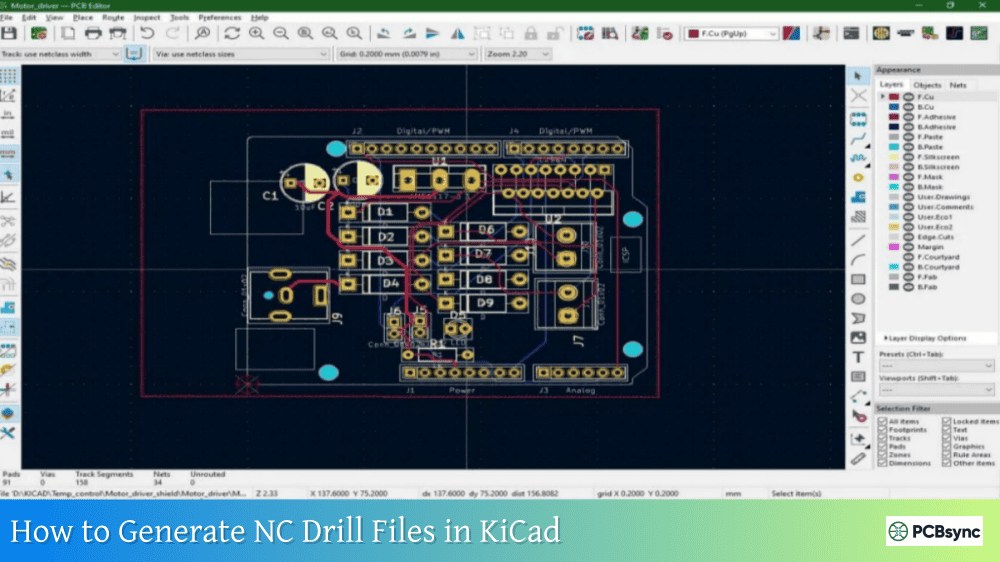
KiCad is one of the most popular open-source PCB design tools, and its VRML export is well-developed. Here’s the complete process.
Step-by-Step KiCad VRML Export
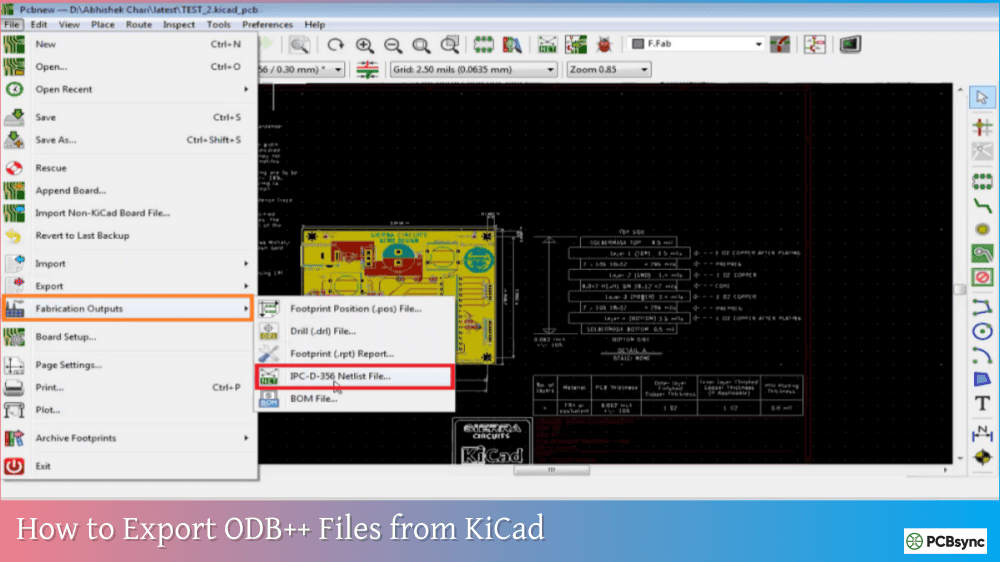
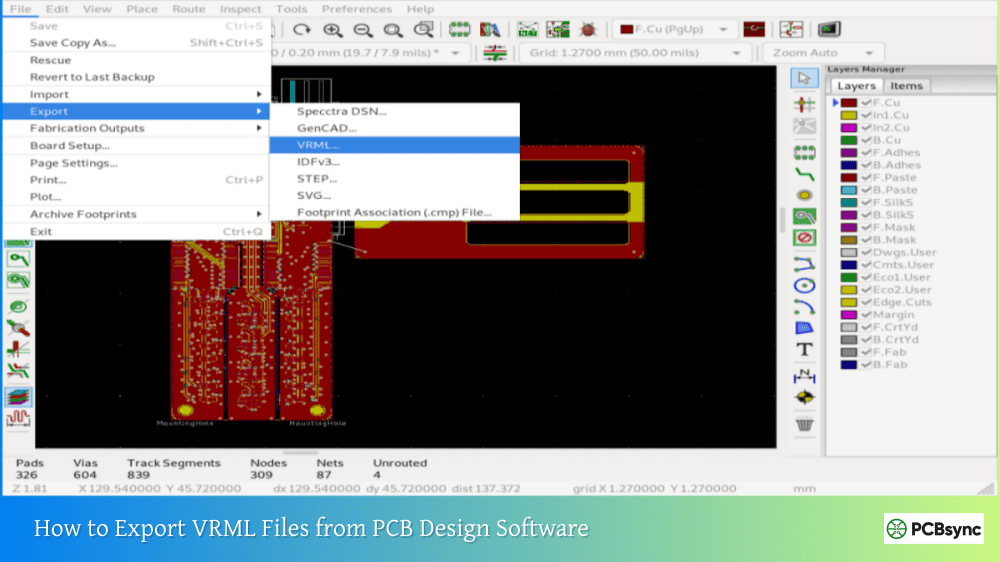
Open your PCB layout in KiCad’s PCB Editor (Pcbnew)
Navigate to File → Export → VRML
Configure export settings in the dialog:
Output file: Choose destination and filename
Units: Select mm or inches
Export 3D models: Check to include component models
Use relative paths: Recommended for portability
Click Export to generate the .wrl file
KiCad VRML Export Settings Explained
Setting
Recommended Value
Purpose
Output units
mm to VRML units
Conversion factor for dimensions
3D model subdir
./shapes3d
Folder for component VRML files
Export 3D models
Checked
Include component models in export
Use relative paths
Checked
Makes file portable between systems
X/Y reference point
0, 0 or board center
Sets origin for 3D model
Important KiCad VRML Considerations
KiCad’s 3D viewer and VRML export rely on .wrl files for component models. If your footprints use STEP models instead of VRML, the VRML export may not include those components. The workaround is to ensure footprints have both .wrl and .step models assigned, or use the “Substitute similarly named models” option if available.
For complete VRML export with all components, verify that each footprint has a VRML model assigned in the footprint’s 3D Settings tab. KiCad’s standard libraries include VRML models for most common components.
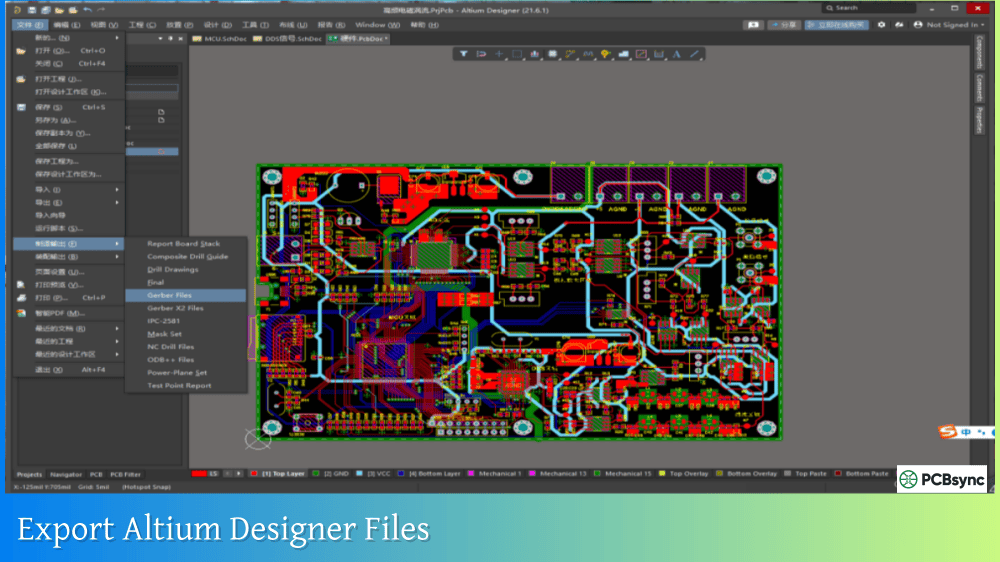
How to Export VRML Files from Altium Designer
Altium Designer offers VRML export as part of its comprehensive 3D export capabilities.
Altium VRML Export Process
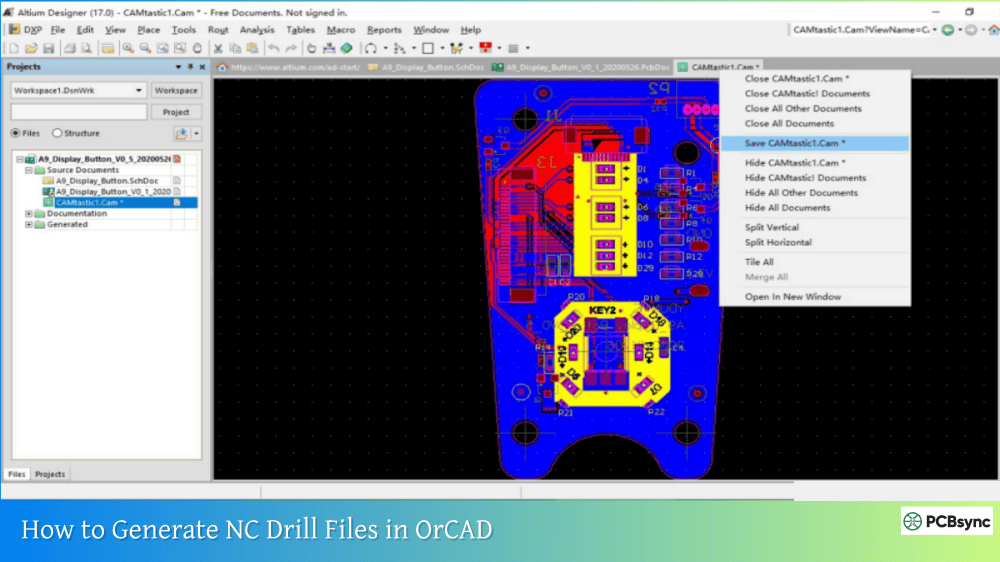
Open your PCB document in Altium Designer
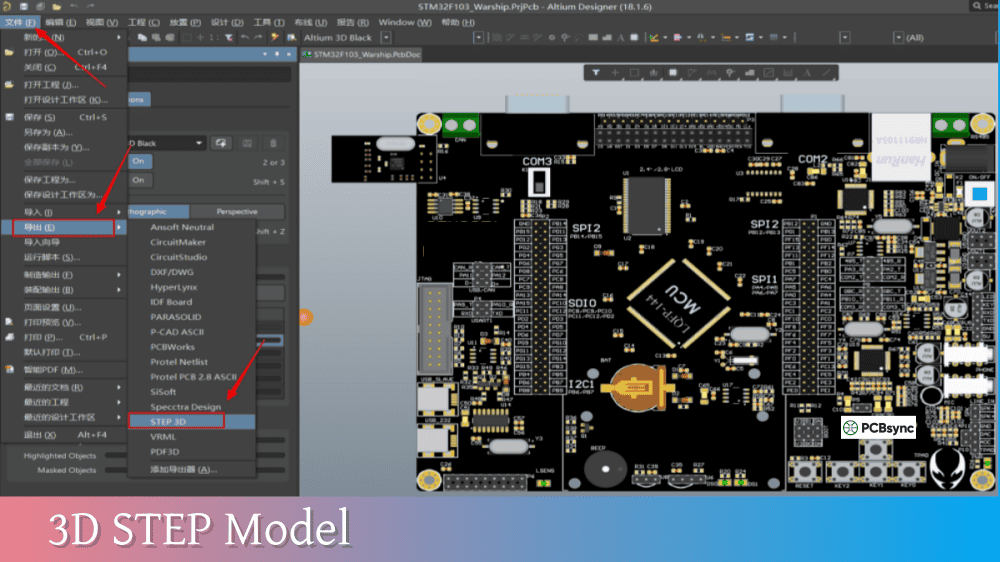
Navigate to File → Export → VRML
In the Export File dialog, choose your destination
Click Save to generate the VRML file
Configure options in the Export Options dialog if prompted
Altium Export Options
Option
Description
Export All
Exports all components (larger file, slower)
Export Selected
Exports only selected components
Prefer simple bodies
Uses extruded 3D bodies instead of detailed models
Prefer generic 3D models
Uses STEP/Parasolid models where available
Export both
Includes both simple and detailed representations
Using Output Job Files for Repeatable VRML Export
For consistent exports across projects, Altium supports Output Job files:
Open or create an .OutJob file in your project
Click [Add New Export Output] under Export Outputs
Select Export VRML from the menu
Configure the export settings
Save the Output Job for reuse
This approach ensures every team member exports VRML files with identical settings, reducing inconsistencies.
How to Export VRML Files from DipTrace
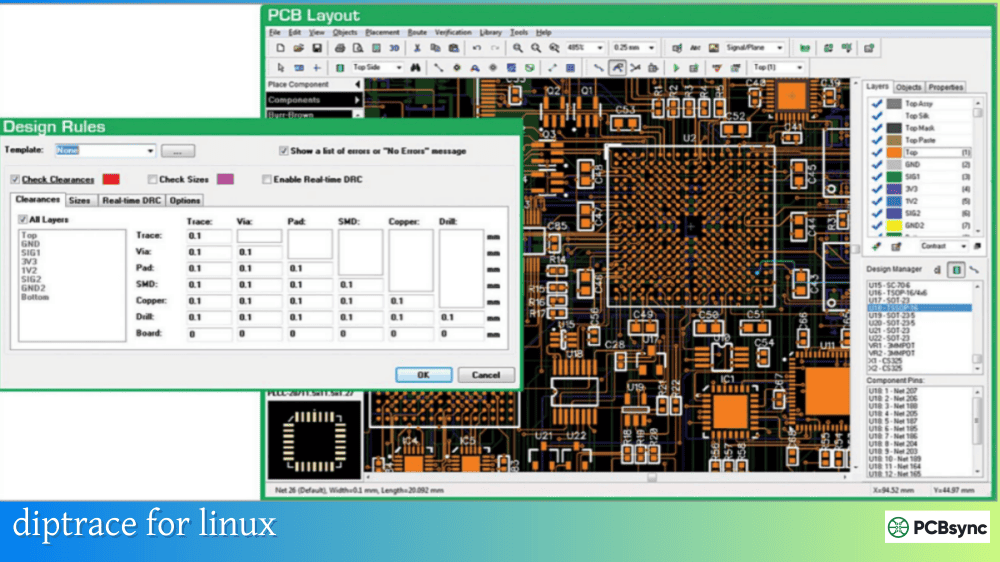
DipTrace provides straightforward VRML export through its 3D preview module.
DipTrace VRML Export Steps
Open your PCB layout in DipTrace PCB Layout
Access 3D → 3D Preview or press Ctrl+Shift+3 to open the 3D viewer
In the 3D preview window, click File → Export VRML 2.0
Choose destination and filename
Click Save to export
DipTrace VRML Export Settings
Setting
Options
Recommendation
Include components
Yes/No
Yes for complete model
Include pad/via holes
Yes/No
No for faster MCAD import
Board colors
Customizable
Match your actual board spec
Export format
VRML 2.0
Standard compatible format
DipTrace supports VRML 2.0 format, which is widely compatible with 3D modeling software. The software includes over 11,000 3D models, with both STEP and VRML versions available for most packages.
Importing External VRML Models into DipTrace
If you need to add custom VRML models to DipTrace:
Download or create .wrl files for your components
Place files in the DipTrace models3d folder (typically C:\Program Files\DipTrace\models3d)
In Pattern Editor, open the footprint properties
Navigate to the 3D Model tab
Browse to and select your .wrl file
Adjust scale, rotation, and offset as needed
Converting VRML Files for Different Applications
Exported VRML files often need conversion for specific applications. Here are the most common workflows.
VRML to OBJ/STL Conversion Using Blender
Blender is the most accessible tool for converting VRML files to other formats.
Step
Action
Notes
1
Open Blender and delete default objects
Camera, Cube, Light
2
File → Import → X3D Extensible 3D (.x3d/.wrl)
Select your .wrl file
3
Set Transform: -Z Forward, Y Up
Correct orientation
4
Import the file
Model appears in viewport
5
File → Export → Wavefront (.obj)
Or choose STL, FBX, etc.
6
Configure export settings
Maintain scale and orientation
VRML Scaling Issues and Solutions
A common problem when working with VRML files is scale mismatch. Different tools use different base units.
Software Origin
Scale Factor to mm
Notes
KiCad (native)
Varies by model
Check 3D Settings scale value
Wings3D
0.3937 (1/2.54)
Wings units are 0.1 inch
FreeCAD
1.0
Usually mm-based
SketchUp
Varies
Depends on model creation
If your imported VRML appears too large or small, apply the appropriate scale factor in your target application.
VRML to STEP Conversion
While direct VRML to STEP conversion loses some visual information, it’s sometimes necessary for MCAD workflows.
Using FreeCAD:
Open FreeCAD
File → Import → Select .wrl file
File → Export → Select STEP format
Note: Colors and textures may not transfer
Using Online Converters:
CAD Exchanger Cloud
Autoconverter (automapki.com)
3D-Tool (limited free version)
Be aware that VRML’s mesh geometry converts to faceted STEP bodies, not smooth parametric surfaces.
Creating Photorealistic PCB Renders from VRML Exports
One of the most powerful uses for VRML exports is creating marketing-quality renders.
Blender Workflow for PCB Renders
After importing your VRML file into Blender:
Adjust materials: VRML materials transfer, but you can enhance them with Blender’s node editor
Set up lighting: Add HDRI environment or three-point lighting setup
Configure camera: Frame the board attractively
Apply post-processing: Use Blender’s compositor for final touches
Render: Use Cycles for photorealistic output
Tips for Better PCB Renders
Aspect
Recommendation
Solder mask finish
Add slight roughness to avoid plastic look
Copper traces
Apply metallic shader with appropriate color
Component leads
Use brushed metal material
IC packages
Add subtle text/markings if missing
Board substrate
Visible fiberglass weave adds realism
Through-hole plating
Match finish to actual manufacturing
Read more How to convert PCB Files in different Design software:
Symptoms: Export shows only bare board, no components
Causes and Solutions:
Cause
Solution
No 3D models assigned to footprints
Add .wrl models in footprint 3D settings
STEP models used instead of VRML
Convert STEP to VRML or use dual-format assignment
Export option unchecked
Enable “Export 3D models” in export dialog
Component marked as excluded
Check component properties
Problem: VRML File Won’t Open in Target Software
Common causes:
VRML version incompatibility (VRML 1.0 vs 2.0)
Corrupt or truncated file
Unsupported node types
Solutions:
Try opening in Blender first (best VRML compatibility)
Check file isn’t truncated (open in text editor, verify closing braces)
Use online converter as intermediary step
Problem: Colors or Textures Missing
Symptoms: Model imports but appears gray or monochrome
Solutions:
Check if target software supports VRML material nodes
Verify original export included materials
Re-apply colors manually in target application
Use Blender as conversion intermediary (preserves colors better)
Problem: Scale Completely Wrong
Symptoms: Model is microscopic or enormous in target application
Solutions:
If Model Is…
Apply Scale Factor
Too small by ~2.54x
Model was in inches, target expects mm
Too large by ~2.54x
Model was in mm, target expects inches
Too small by ~1000x
Model was in meters, target expects mm
Wrong by random factor
Check original export unit settings
Best Practices for VRML Export from PCB Software
Before Exporting
Action
Benefit
Verify all footprints have 3D models
Complete export with all components
Check 3D viewer first
Catches problems before export
Document board thickness setting
Ensures correct Z dimensions
Note component models source
Helps troubleshoot missing parts
During Export
Practice
Reason
Use consistent unit settings
Prevents scale confusion
Export to project folder
Keeps files organized
Use descriptive filenames
version_boardname_date.wrl
Keep relative paths enabled
File portability
After Export
Verification Step
How to Check
Open in 3D viewer
Verify export completed
Check file size
Very small = missing data
Import to target application
Confirm compatibility
Verify scale
Measure known dimension
Useful Resources for VRML and PCB 3D Models
Software Tools
Tool
Purpose
Link
Blender
VRML import/export, conversion, rendering
blender.org
FreeCAD
CAD with VRML support, KiCad integration
freecad.org
Wings3D
3D modeling with VRML export
wings3d.com
MeshLab
Mesh processing and conversion
meshlab.net
CAD Exchanger
Professional format conversion
cadexchanger.com
3D Component Model Libraries
Source
Description
3D ContentCentral
Free CAD models including VRML (3dcontentcentral.com)
GrabCAD
Community models, many in VRML format (grabcad.com)
SnapEDA
Component models with VRML options (snapeda.com)
KiCad Libraries
Official models for KiCad footprints (gitlab.com/kicad)
DipTrace Libraries
11,000+ models including VRML (diptrace.com/download)
Documentation and Tutorials
Resource
Description
KiCad Documentation
Official export guides (docs.kicad.org)
Altium Documentation
VRML export reference (altium.com/documentation)
DipTrace Help
3D preview and export guide (diptrace.com/books/help)
Blender Manual
X3D/VRML import documentation (docs.blender.org)
Frequently Asked Questions
What is the difference between VRML and WRL files?
They are the same format. VRML (Virtual Reality Modeling Language) files use the .wrl extension by convention. Some systems also recognize .vrml extension, but .wrl is far more common. Both extensions contain identical VRML code—text-based 3D geometry definitions, material properties, and scene graph information. When downloading or exporting, you may see either extension, but they’re interchangeable.
Can I convert VRML to STEP for mechanical CAD work?
Yes, but with significant limitations. VRML stores tessellated mesh data while STEP contains parametric solid geometry. When you convert VRML to STEP, you get faceted bodies that cannot be edited as true solids. The resulting STEP file works for visualization and basic collision checking, but not for detailed mechanical engineering. For proper MCAD integration, export STEP directly from your PCB software rather than converting from VRML.
Why do my VRML component models appear in KiCad but not in the exported file?
This typically happens when footprints reference VRML files using absolute paths that don’t exist on other systems, or when the “Export 3D models” option is disabled during export. Check that your footprint 3D model paths use relative references (starting with ${KICAD6_3DMODEL_DIR} or similar variables) rather than absolute paths. Also verify the export dialog has component export enabled. If models still don’t appear, check that the actual .wrl files exist in the referenced locations.
Which PCB design software produces the best VRML exports?
DipTrace and Altium Designer produce the most complete VRML exports with full color and component support out of the box. KiCad’s VRML export is excellent when footprints have proper .wrl models assigned, but the default library uses a mix of VRML and STEP models which can cause incomplete exports. For rendering purposes, any tool that exports complete VRML works well—the differences show more in the included component library quality than the export function itself.
How do I add custom VRML models to my PCB design software?
The process varies by software but follows similar patterns. In KiCad, edit the footprint in Footprint Editor, go to the 3D Settings tab, and add your .wrl file path. In DipTrace, open the pattern in Pattern Editor, access the 3D Model properties, and browse to your file. In Altium, edit the component footprint and add the model in the 3D Body settings. Most tools require you to specify scale factors, rotation, and offset values to properly align the 3D model with the footprint pads. Always preview in the 3D viewer before finalizing.
Conclusion
Exporting VRML files from PCB design software opens up visualization possibilities that STEP files simply can’t match. Whether you’re creating product renders for marketing, embedding interactive 3D models on websites, or sharing visual designs with non-technical stakeholders, VRML provides the color, material, and rendering information needed for compelling visuals.
The key points to remember are that VRML is optimized for visualization rather than mechanical engineering, most major PCB tools support VRML export with varying levels of completeness, component models must be in VRML format for full export from most tools, and Blender serves as an excellent bridge for converting VRML to other formats.
When choosing between VRML and STEP export, consider your end use. If the model will be used for rendering, presentations, or web display, VRML is the better choice. If mechanical engineers need to design enclosures or verify fitment, STEP remains the standard. Many workflows benefit from exporting both formats—STEP for engineering and VRML for visualization—ensuring all downstream users get the format that best serves their needs.
Inquire: Call 0086-755-23203480, or reach out via the form below/your sales contact to discuss our design, manufacturing, and assembly capabilities.
Quote: Email your PCB files to Sales@pcbsync.com (Preferred for large files) or submit online. We will contact you promptly. Please ensure your email is correct.
Notes: For PCB fabrication, we require PCB design file in Gerber RS-274X format (most preferred), *.PCB/DDB (Protel, inform your program version) format or *.BRD (Eagle) format. For PCB assembly, we require PCB design file in above mentioned format, drilling file and BOM. Click to download BOM template To avoid file missing, please include all files into one folder and compress it into .zip or .rar format.