Inquire: Call 0086-755-23203480, or reach out via the form below/your sales contact to discuss our design, manufacturing, and assembly capabilities.
Quote: Email your PCB files to Sales@pcbsync.com (Preferred for large files) or submit online. We will contact you promptly. Please ensure your email is correct.
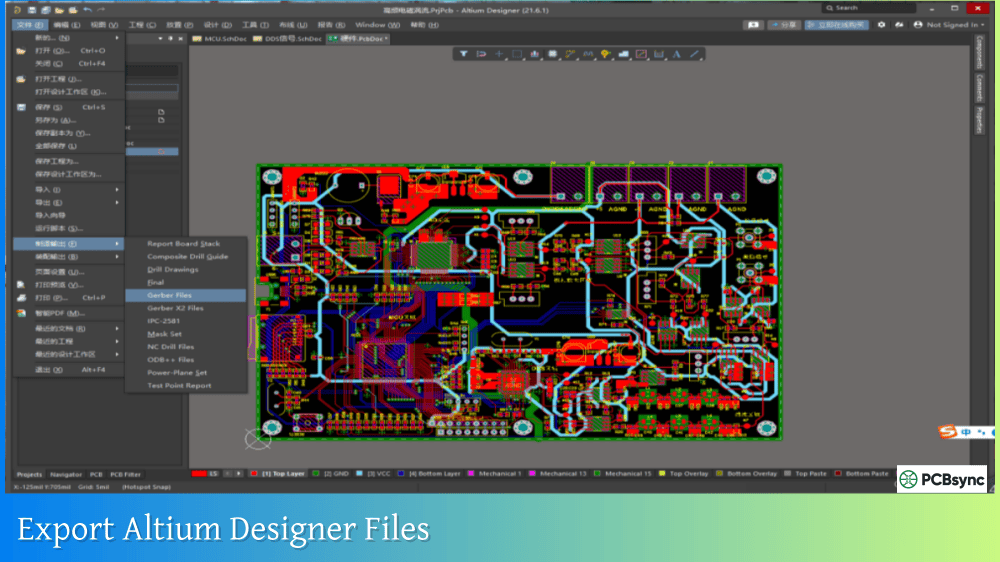
Notes: For PCB fabrication, we require PCB design file in Gerber RS-274X format (most preferred), *.PCB/DDB (Protel, inform your program version) format or *.BRD (Eagle) format. For PCB assembly, we require PCB design file in above mentioned format, drilling file and BOM. Click to download BOM template To avoid file missing, please include all files into one folder and compress it into .zip or .rar format.
How to Export STEP Files from KiCad: Complete Guide for ECAD-MCAD Integration
After spending years designing boards in KiCad and handing them off to mechanical engineers working in SolidWorks and Fusion 360, I’ve learned that the STEP export process isn’t always as straightforward as it should be. KiCad handles 3D models differently than commercial tools, and understanding this difference is the key to getting clean exports that your mechanical team can actually use. This guide covers everything from basic exports to troubleshooting the notorious “Cannot add a VRML model to a STEP file” error.
STEP (Standard for the Exchange of Product model data) is an ISO-standardized CAD format (ISO 10303-21) that enables data exchange between different mechanical design software. When you export a STEP file from KiCad, you create a 3D model of your PCB assembly that mechanical engineers can import into their MCAD tools for enclosure design, clearance checking, and physical integration.
The critical use case is fit verification. When your PCB needs to mount inside an enclosure with specific connector positions, switch access, and display cutouts, your mechanical engineer needs accurate dimensional data. STEP files provide this with the precision required for tooling decisions.
What Gets Exported in a KiCad STEP File
Element
Included
Notes
Board substrate
Yes
Based on board outline and stackup thickness
Board cutouts
Yes
Internal cutouts export correctly
Component 3D models
Conditional
Only STEP models export; VRML requires substitution
Mounting holes
Yes
Part of board geometry
Copper traces
Optional
Available in KiCad 7+ with “Include tracks” option
Silkscreen
No
Not included in STEP format
Solder mask color
No
Not part of STEP geometry
Understanding these limitations upfront prevents the frustrating discovery that your beautiful 3D viewer rendering doesn’t translate directly to STEP output.
Understanding VRML vs STEP Models in KiCad
This is where most KiCad users run into problems. KiCad’s default 3D libraries include two file formats for each component:
Format
Extension
Purpose
STEP Export Compatible
VRML
.wrl
Visual rendering in 3D viewer
No (requires substitution)
STEP
.step, .stp
MCAD integration
Yes
VRML files contain material properties and colors that make the 3D viewer look realistic. However, VRML is a mesh-based visualization format—not a CAD format—and cannot be directly included in STEP exports. This mismatch causes the common error message: “Cannot add a VRML model to a STEP file.”
The official KiCad libraries include both formats for most components, but the footprints often reference only the VRML file by default. This creates the situation where your board looks perfect in the 3D viewer but exports with missing components.
Step-by-Step Guide to Export STEP Files from KiCad
The native STEP export in KiCad has improved significantly in recent versions. Here’s how to use it effectively.
Verify your design in the 3D Viewer (View → 3D Viewer or Alt+3)
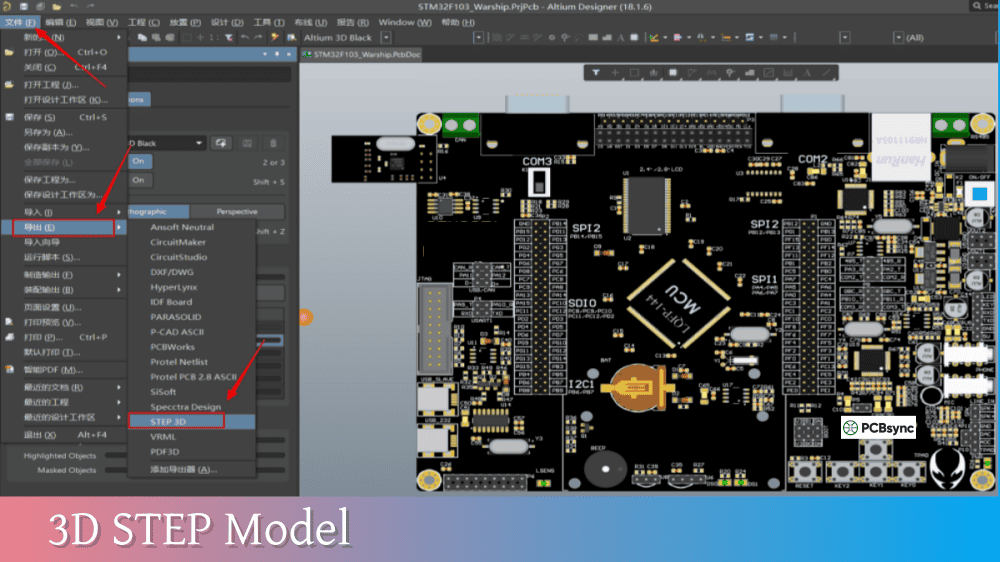
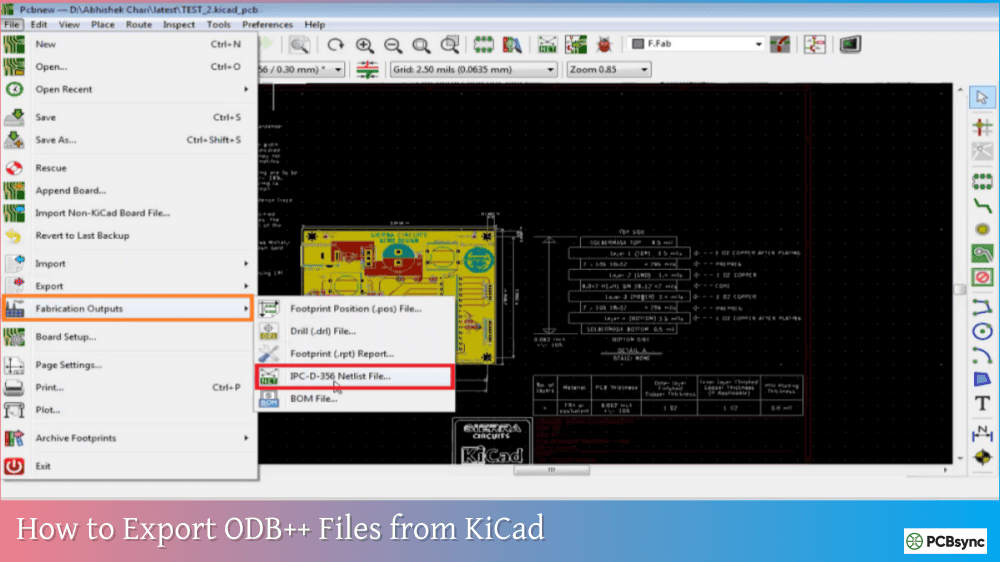
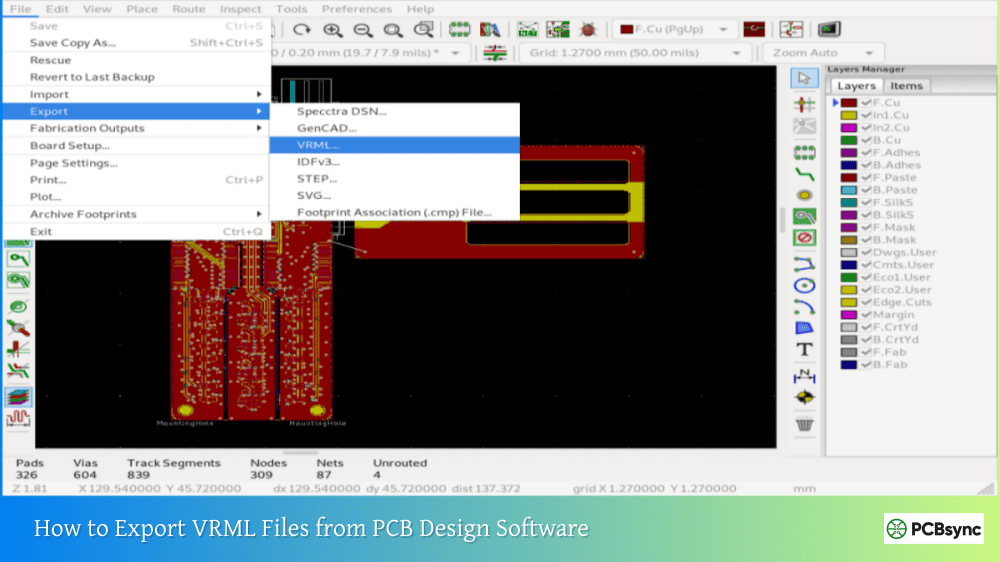
Navigate to File → Export → STEP
Configure export options in the dialog (detailed below)
Choose your save location and filename
Click Export
The export dialog provides several options that significantly affect your output quality.
KiCad STEP Export Options Explained
Option
Description
Recommended Setting
Coordinate origin
Reference point for model positioning
Grid origin (for consistent MCAD alignment)
Output file
Destination path and filename
Use .step extension
Substitute similarly named models
Replaces VRML with STEP models automatically
Enable this
Overwrite existing file
Replace without prompting
Enable for iterative workflows
Export board outline
Include the PCB substrate
Always enable
Export components
Include 3D component models
Enable for full assembly
Export tracks
Include copper traces (KiCad 7+)
Enable if needed for visualization
Export zones
Include copper pours (KiCad 7+)
Usually disable (increases file size)
The Critical Setting: Substitute Similarly Named Models
This checkbox is the solution to most STEP export problems. When enabled, KiCad automatically looks for a STEP file with the same base name as the referenced VRML file. For example:
Without this option enabled, you’ll see the “Cannot add a VRML model to a STEP file” message for every component using VRML models, and your export will contain only the bare board.
Troubleshooting Common KiCad STEP Export Problems
Over years of exporting boards from KiCad, I’ve encountered these issues repeatedly. Here’s how to solve them.
Problem: “Cannot add a VRML model to a STEP file” Errors
Symptom: Export log shows multiple warnings about VRML models, resulting in bare board without components.
Solution: Enable “Substitute similarly named models” in the export dialog. This tells KiCad to look for STEP equivalents of VRML models.
If errors persist after enabling substitution, the component likely lacks a STEP model entirely. You have three options:
STEP isn’t the only 3D export option. Depending on your needs, other formats might work better.
Format
Extension
Best For
Notes
STEP
.step, .stp
MCAD integration
Universal CAD compatibility
VRML
.wrl
Visualization
Includes colors/materials, not CAD-compatible
IDF
.emn, .emp
Legacy MCAD exchange
Older format, limited features
GLB/GLTF
.glb
Web visualization
KiCad 8+ feature
PLY
.ply
3D printing/scanning
Mesh format
STL
.stl
3D printing
No color, mesh only
For most mechanical integration workflows, STEP remains the best choice due to universal support across MCAD platforms.
Setting Up 3D Models for Reliable STEP Export
The key to consistent STEP exports is ensuring your components have proper STEP models assigned.
Verifying 3D Model Assignments
Open your PCB in the PCB Editor
Double-click a component to open Properties
Click the “3D Models” tab
Verify both the path and that the file exists
Adding STEP Models to Footprints
Open the Footprint Editor
Load the footprint to modify
Go to Footprint Properties → 3D Models tab
Click “Add 3D Model”
Navigate to your STEP file
Adjust scale (STEP models should use scale 1:1:1)
Adjust offset and rotation as needed
Save the footprint
3D Model Scale Reference
Model Source
Typical Scale Setting
KiCad official STEP
1:1:1
Manufacturer STEP
1:1:1 (verify units match)
VRML models
0.3937:0.3937:0.3937 (inch to mm)
FreeCAD exports
1:1:1
Useful Resources for KiCad STEP Export
Official KiCad Resources
Resource
Description
Link
KiCad Documentation
Official PCB Editor manual
docs.kicad.org
KiCad 3D Libraries
Official STEP/VRML models
gitlab.com/kicad/libraries/kicad-packages3D
KiCad StepUp
FreeCAD workbench
kicad.org/external-tools/stepup
KiCad CLI Reference
Command-line documentation
docs.kicad.org (CLI section)
3D Model Download Sources
Source
Description
Formats
SnapEDA
Free component libraries
STEP, VRML, KiCad native
Ultra Librarian
Manufacturer-sourced models
STEP, various
3D ContentCentral
Dassault-hosted library
STEP, multiple CAD formats
GrabCAD
Community models
STEP, various
Component Search Engine
SamacSys library
STEP, VRML
Manufacturer websites
Direct from component makers
Usually STEP
STEP File Viewers (Free)
Tool
Platform
Notes
FreeCAD
Windows, Mac, Linux
Full CAD capability, KiCad StepUp support
Fusion 360 (Personal)
Windows, Mac
Free for hobbyists
eDrawings
Windows, Mac
Free viewer from SolidWorks
CAD Exchanger
Windows, Mac, Linux
Viewer with format conversion
Frequently Asked Questions
Why does my STEP export only show the bare board without components?
This happens when components use VRML (.wrl) 3D models instead of STEP models. Enable “Substitute similarly named models” in the export dialog. KiCad will automatically look for STEP files with matching names. If substitution doesn’t work, the component lacks a STEP model entirely—you’ll need to download or create one.
Can I export copper traces and silkscreen in the STEP file?
KiCad 7 and later versions support exporting copper traces via the “Include tracks” and “Include zones” options in the STEP export dialog. Silkscreen is not included in STEP exports because STEP is a geometry format, not a visual rendering format. For visualizations including silkscreen, export as VRML instead.
What’s the difference between exporting from KiCad directly versus using FreeCAD StepUp?
Native KiCad export is faster and simpler for straightforward boards. FreeCAD StepUp provides more control: you can adjust model positions, fix alignment issues, modify the board outline, and access FreeCAD’s full CAD capabilities. Use StepUp when native export produces unsatisfactory results or when you need bi-directional editing.
How do I fix components that are misaligned in the STEP export?
Component alignment issues stem from incorrect offset or rotation values in the footprint’s 3D model settings. Open the footprint in the Footprint Editor, go to the 3D Models tab, and adjust X/Y/Z offset and rotation values. The 3D viewer preview helps you verify alignment before committing changes.
Why is my exported STEP file so large?
Large file sizes typically result from enabling track and zone export, which converts all copper geometry to 3D objects. For mechanical fit checking, disable these options—the board outline and components are usually sufficient. Complex 3D models with high polygon counts also increase file size; consider using simplified models for passive components.
Best Practices for KiCad STEP Export Workflow
Establishing consistent practices prevents the common issues that derail ECAD-MCAD collaboration.
Before Starting Your Design
Verify your component library has STEP models for critical components
Confirm 3D model paths are correctly configured in Preferences
Use official KiCad libraries when possible (they include matched STEP/VRML pairs)
Before Exporting
Check the 3D viewer to verify all components appear correctly
Note any components showing as missing models
Verify board thickness is correctly set in Board Setup → Physical Stackup
After Exporting
Open the STEP file in FreeCAD or another viewer to verify contents
Check that critical components (connectors, switches, tall parts) exported correctly
Document any limitations when sharing with mechanical team
Conclusion
Exporting STEP files from KiCad requires understanding the distinction between VRML visualization models and STEP CAD models. The key to successful exports is enabling the “Substitute similarly named models” option and ensuring critical components have STEP models available.
For most designs, the native KiCad STEP export works well once properly configured. For complex boards or when you need more control, KiCad StepUp with FreeCAD provides advanced capabilities. Either way, investing time in proper 3D model setup pays dividends when your PCB drops into the mechanical assembly and fits correctly the first time.
The few minutes spent verifying 3D models and configuring export settings saves hours of back-and-forth with your mechanical team—and potentially prevents expensive mechanical redesigns late in the project.
Inquire: Call 0086-755-23203480, or reach out via the form below/your sales contact to discuss our design, manufacturing, and assembly capabilities.
Quote: Email your PCB files to Sales@pcbsync.com (Preferred for large files) or submit online. We will contact you promptly. Please ensure your email is correct.
Notes: For PCB fabrication, we require PCB design file in Gerber RS-274X format (most preferred), *.PCB/DDB (Protel, inform your program version) format or *.BRD (Eagle) format. For PCB assembly, we require PCB design file in above mentioned format, drilling file and BOM. Click to download BOM template To avoid file missing, please include all files into one folder and compress it into .zip or .rar format.