Inquire: Call 0086-755-23203480, or reach out via the form below/your sales contact to discuss our design, manufacturing, and assembly capabilities.
Quote: Email your PCB files to Sales@pcbsync.com (Preferred for large files) or submit online. We will contact you promptly. Please ensure your email is correct.
Notes: For PCB fabrication, we require PCB design file in Gerber RS-274X format (most preferred), *.PCB/DDB (Protel, inform your program version) format or *.BRD (Eagle) format. For PCB assembly, we require PCB design file in above mentioned format, drilling file and BOM. Click to download BOM template To avoid file missing, please include all files into one folder and compress it into .zip or .rar format.
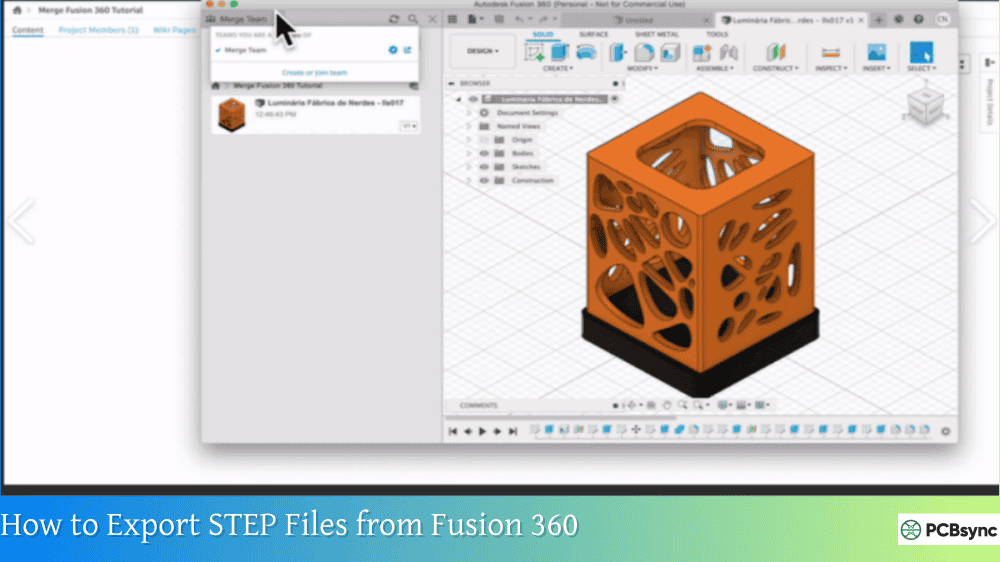
How to Export STEP Files from Fusion 360: Complete Guide for CAD Collaboration
As someone who regularly shuttles designs between Fusion 360 and mechanical teams using SolidWorks, CATIA, and various CNC software, I’ve learned that the STEP export isn’t just about clicking a button. Getting a clean, compatible STEP file that opens correctly in another engineer’s software requires understanding what Fusion exports, what gets lost in translation, and how to handle assemblies properly. This guide covers everything you need to know about exporting STEP files from Fusion 360 for manufacturing, collaboration, and archival purposes.
STEP (Standard for the Exchange of Product model data) is an ISO-standardized neutral CAD format (ISO 10303) that enables reliable data exchange between different CAD systems. When you export a STEP file from Fusion 360, you create a geometry file that SolidWorks, CATIA, Creo, NX, and virtually every professional CAD platform can open without requiring Fusion 360.
The primary reasons to export STEP files from Fusion 360 include sharing designs with clients or manufacturers who use different CAD software, submitting files for CNC machining or 3D printing services, archiving designs in a vendor-neutral format, and collaborating with mechanical engineers on enclosure designs.
What Gets Preserved in a Fusion 360 STEP Export
Element
Preserved
Notes
3D solid geometry
Yes
Full B-Rep (boundary representation) data
Surface geometry
Yes
NURBS surfaces maintained
Assembly structure
Yes
Component hierarchy preserved
Body/part colors
Partial
Basic RGB colors only (AP214/AP242)
Materials/textures
No
Only basic color information transfers
Parametric history
No
Timeline and sketches not included
Sketches
No
Only 3D bodies export
Joints/constraints
No
Assembly constraints lost
Design metadata
Partial
Basic properties may transfer
Understanding these limitations upfront prevents surprises when your recipient opens the file and finds “dumb” geometry without your carefully constructed feature tree.
Step-by-Step Guide to Export STEP Files from Fusion 360
The basic STEP export process in Fusion 360 is straightforward, but the details matter for compatibility and file quality.
Basic STEP Export Process
Open your design in Fusion 360
Click File in the top-left corner
Select Export from the dropdown menu
In the Export dialog, locate the Type dropdown
Select **STEP Files (.stp, .step)
Choose your save location (local drive or cloud)
Enter a filename
Click Export
Fusion 360 will process the export and display a confirmation in the upper-right corner when complete. For complex assemblies, this can take several seconds to a few minutes.
Alternative Export Method: Right-Click Export
For exporting individual components from an assembly, use the browser tree method:
Expand the browser tree on the left side
Right-click the specific component or body you want to export
Select Export from the context menu
Choose STEP format and save location
Click Export
This method is faster when you only need one part from a large assembly.
Understanding Fusion 360 STEP Export Format Versions
Fusion 360 exports STEP files in the AP242 format by default—the most modern STEP standard. However, this can cause compatibility issues with older CAD systems.
STEP Application Protocol Comparison
Protocol
Features
Best For
AP203
Geometry and topology only, no colors
Maximum compatibility with legacy systems
AP214
Adds colors, layers, GD&T, design intent
Automotive industry, colored models
AP242
Full PMI support, metadata, advanced features
Modern CAD systems, model-based definition
Fusion 360 automatically exports as AP242, which includes color information and enhanced metadata. Most modern CAD systems (SolidWorks 2016+, CATIA V5 R20+, NX 8+, Creo 3+) handle AP242 without issues.
Compatibility Warning for Older Systems
If your recipient uses older software and reports warnings like “the file being read in is not a STEP AP203 or AP214,” the AP242 format may be causing issues. While most systems still import the geometry correctly, some features may not transfer properly. In these cases, consider using CAD Exchanger or another conversion tool to downgrade to AP214.
Exporting Specific Bodies and Components
One of the most common requirements is exporting only certain parts of your design, not the entire assembly.
Method 1: Visibility Toggle
Fusion 360 exports only visible bodies. To export specific bodies:
In the browser tree, click the eye icon to hide bodies you don’t want to export
Verify in the viewport that only desired geometry is visible
Go to File → Export
Select STEP format and export
This method works well for simple selections but becomes tedious for complex assemblies.
Method 2: Component-Level Export
For cleaner results, export at the component level:
Right-click the specific component in the browser
Select Export
Choose STEP format
Export the component as a standalone file
This ensures you get only that component’s geometry without accidentally including hidden bodies from other components.
Method 3: Derive and Export
For exporting a subset of components from a complex assembly:
Create a new design file
Go to Insert → Derive
Select the source design
Choose only the components you need
Export the new derived design as STEP
This method creates a clean separation and works well for sending subassemblies to different vendors.
Exporting Assemblies as STEP Files
Full assembly export requires some planning to ensure the recipient gets usable data.
Complete Assembly Export
When exporting an entire assembly:
What Transfers
What’s Lost
All visible bodies
Hidden bodies
Component hierarchy
Parametric relationships
Part positions
Joint definitions
Basic colors
Material appearances
Body names
Sketch geometry
The exported STEP file maintains the assembly structure, allowing recipients to see individual parts organized as they were in your Fusion design.
Exporting Assembly Components as Separate Files
Many manufacturers request individual STEP files for each part. Options include:
Manual Method:
Right-click each component
Select Export
Save as individual STEP files
Repeat for all components
Automated Method (using Add-ins): Several third-party add-ins automate batch export. The most popular is ExportIt (available on GitHub), which can export all components as separate STEP files in one operation.
Preserving Colors and Appearances in STEP Export
Fusion 360’s appearance system is more sophisticated than what STEP supports, leading to common frustration when colors don’t transfer.
What Color Information Transfers
Fusion Feature
STEP Transfer
Paint (solid colors)
Yes (RGB values)
Material appearances
No (geometry only)
Decals
No
Textures
No
Reflectivity/roughness
No
Best Practice for Color Preservation
If color is important:
Use the Paint tool under Modify → Appearance to apply simple colors
Avoid relying on material appearances (Steel, Aluminum, etc.) for color
Test by re-importing your exported STEP file to verify colors
For photorealistic rendering needs, share the native .f3d file or use formats like OBJ with material files.
Troubleshooting Common Fusion 360 STEP Export Problems
After years of exporting from Fusion 360, I’ve encountered these issues repeatedly.
Problem: Export Fails with No Error Message
Causes and Solutions:
Cause
Solution
Special characters in filename
Remove characters like / ? \ : * | ” from component and file names
Design not saved
Save the design before exporting
Network connectivity issues
Ensure stable internet connection (Fusion requires cloud access)
Corrupt geometry
Run Inspect → Validate to check for geometry errors
Problem: STEP Option Not Available in Export Dialog
Symptom: The Type dropdown doesn’t show STEP as an option.
Cause: You’re trying to export a Configured Design.
Solution:
In the export dialog, change from “Configured Design” to “Active Configuration”
Or right-click the specific body/component in the browser and select Export
Problem: Mesh Bodies Not Exporting
Symptom: Imported STL/OBJ mesh bodies don’t appear in the STEP export.
Solution: STEP format only supports B-Rep (solid) geometry. Convert mesh to solid first:
Select the mesh body
Use Mesh → Modify → Convert Mesh
Or use Mesh → Modify → Generate Face Groups followed by conversion
Problem: Large Assembly Export Hangs or Fails
Solutions:
Export in sections (subassemblies)
Temporarily suppress complex components
Ensure adequate system memory
Check for corrupt geometry with Validate tool
Problem: Recipient Reports Missing Components
Causes:
Bodies were hidden during export
Linked/referenced components weren’t included
Configured design variations not properly resolved
Solution: Before export, verify all intended geometry is visible. Check the browser for any suppressed or hidden items.
Read more How to convert PCB Files in different Design software:
STEP isn’t always the best choice. Consider alternatives based on your use case.
Format
Extension
Best For
STEP
.step, .stp
Universal CAD exchange, manufacturing
IGES
.igs, .iges
Legacy CAD systems
SAT (ACIS)
.sat
SolidWorks, some CAM software
Parasolid
.x_t, .x_b
NX, SolidEdge, high-fidelity exchange
STL
.stl
3D printing, mesh-based workflows
OBJ
.obj
Rendering, visualization
F3D
.f3d
Native Fusion format (full fidelity)
DWG/DXF
.dwg, .dxf
2D drawings and sketches
For maximum compatibility, STEP remains the safest choice. For Autodesk-to-Autodesk workflows, native F3D files preserve all design data.
Frequently Asked Questions
Does Fusion 360 export parametric data in STEP files?
No. STEP files contain only “dumb” geometry—solid and surface bodies without parametric history. Your timeline, sketches, constraints, and feature tree are not included. Recipients can measure and modify the geometry but cannot access your original construction methods. If you need to share editable designs, use the native .f3d format or share via Fusion 360’s link sharing feature.
Why are my colors missing after exporting to STEP?
Fusion 360 exports basic RGB colors applied via the Paint tool, but material appearances (like “Steel – Satin” or “Aluminum”) don’t transfer. STEP AP214/AP242 supports only simple color values, not physical material properties. To preserve colors, apply them using Modify → Appearance → Paint rather than assigning materials. Textures and decals will never transfer to STEP format.
Can I export a STEP file from the Fusion 360 Personal/Hobbyist license?
Yes. STEP export is available on all Fusion 360 license types, including the free Personal Use license. There are no export format restrictions based on license tier. However, some advanced features like certain simulation exports may have restrictions on non-commercial licenses.
How do I export each assembly component as a separate STEP file?
For manual export, right-click each component in the browser tree and select Export. For automated batch export, install a third-party add-in like ExportIt, which can export all components as individual files in one operation. The add-in also supports customizable naming conventions and folder structures.
Why does SolidWorks show a warning when opening my Fusion 360 STEP file?
Fusion 360 exports STEP AP242 format, which is newer than the AP203/AP214 formats that older SolidWorks versions expect. The warning “the file being read in is not a STEP AP203 or AP214” is typically informational—SolidWorks usually imports the geometry correctly despite the warning. If you experience actual import failures, try opening the STEP file in CAD Exchanger and re-exporting as AP214.
Best Practices for Fusion 360 STEP Export
Following consistent practices ensures reliable exports across projects and recipients.
Before Exporting
Verify design is saved and synced to cloud
Check for geometry errors using Inspect → Validate
Confirm all intended bodies are visible
Verify correct units (Document Settings)
Apply colors via Paint if appearance matters
During Export
Use descriptive filenames without special characters
Choose appropriate save location (local for large files)
For assemblies, decide between single file or component-per-file
Document which components are included
After Exporting
Open the exported STEP in a viewer to verify contents
Check file size is reasonable (very small may indicate missing geometry)
Test import in recipient’s software if possible
Include a readme with units and any special notes
Conclusion
Exporting STEP files from Fusion 360 is straightforward for basic use cases but requires attention to detail for professional workflows. The key points to remember are that Fusion 360 exports AP242 format by default (which works with most modern CAD systems), only visible solid geometry exports (no sketches or parametric history), colors transfer only when applied via Paint (not material appearances), and batch export requires third-party add-ins for efficiency.
For most ECAD-to-MCAD collaboration scenarios—like sharing enclosure models with mechanical engineers or submitting parts for CNC machining—the standard File → Export → STEP workflow works reliably. When issues arise, they’re usually related to visibility settings, special characters in names, or expectations about what data transfers with the format.
The few minutes spent verifying your export settings and testing the output file saves hours of back-and-forth with recipients wondering why components are missing or colors look wrong.
Inquire: Call 0086-755-23203480, or reach out via the form below/your sales contact to discuss our design, manufacturing, and assembly capabilities.
Quote: Email your PCB files to Sales@pcbsync.com (Preferred for large files) or submit online. We will contact you promptly. Please ensure your email is correct.
Notes: For PCB fabrication, we require PCB design file in Gerber RS-274X format (most preferred), *.PCB/DDB (Protel, inform your program version) format or *.BRD (Eagle) format. For PCB assembly, we require PCB design file in above mentioned format, drilling file and BOM. Click to download BOM template To avoid file missing, please include all files into one folder and compress it into .zip or .rar format.