Inquire: Call 0086-755-23203480, or reach out via the form below/your sales contact to discuss our design, manufacturing, and assembly capabilities.
Quote: Email your PCB files to Sales@pcbsync.com (Preferred for large files) or submit online. We will contact you promptly. Please ensure your email is correct.
Notes: For PCB fabrication, we require PCB design file in Gerber RS-274X format (most preferred), *.PCB/DDB (Protel, inform your program version) format or *.BRD (Eagle) format. For PCB assembly, we require PCB design file in above mentioned format, drilling file and BOM. Click to download BOM template To avoid file missing, please include all files into one folder and compress it into .zip or .rar format.
How to Convert PDF to Gerber Files: A Practical Guide for PCB Manufacturing
Let me be upfront with you: converting PDF to Gerber is one of the most frustrating tasks in PCB work. Unlike converting DXF or DWG files where there’s a relatively straightforward path, PDF conversion involves reconstructing manufacturing data from a format that was never designed for that purpose.
I’ve handled countless PDF-to-Gerber conversions over the years, and the success rate depends almost entirely on what kind of PDF you’re starting with. A clean vector PDF from Adobe Illustrator? That’s workable. A scanned image of an old board? That’s going to be painful. This guide covers every scenario and gives you the tools and techniques to get the job done.
Understanding Why PDF to Gerber Conversion is Challenging
Before diving into methods, let’s understand why this conversion isn’t straightforward. It’ll save you frustration and help you choose the right approach for your specific situation.
What is a PDF File?
PDF (Portable Document Format) was created by Adobe for sharing documents that look the same regardless of what software or device opens them. PDFs can contain vector graphics, raster images, text, and complex formatting. They’re excellent for documentation and sharing designs, but they weren’t designed for manufacturing.
When a PCB design gets exported to PDF, it becomes a visual representation of the board. The manufacturing intelligence, including layer assignments, aperture definitions, drill data, and net information, gets stripped away or flattened into simple graphics.
What Makes Gerber Files Different
Gerber is the opposite: it’s purely manufacturing data with no concern for visual presentation. Each Gerber file represents exactly one PCB layer and contains explicit instructions for a photoplotter. The format stores X,Y coordinates paired with aperture definitions that tell the machine exactly what shapes to expose and where.
A complete manufacturing package typically includes separate Gerber files for each copper layer, solder mask, silkscreen, and board outline, plus Excellon drill files for hole data. This layered, precise structure is fundamentally different from PDF’s document-centric approach.
Key Differences Between PDF and Gerber Formats
Characteristic
PDF Format
Gerber Format
Primary Purpose
Document viewing and sharing
PCB photoplotter instructions
Layer Handling
Layers often flattened or merged
One file per PCB layer
Data Type
Vector graphics, raster images, text
Aperture-based coordinates only
Drill Information
Not included or shown graphically
Separate Excellon files with tool definitions
Scalability
May contain scaling artifacts
Absolute coordinates, no scaling issues
Manufacturing Ready
No
Yes
Types of PDF Files and Their Conversion Difficulty
Not all PDFs are created equal. The conversion approach depends heavily on what type of PDF you’re working with.
Vector PDFs (Best Case Scenario)
Vector PDFs contain mathematical descriptions of lines, arcs, and shapes. These convert most reliably because the geometric data can be extracted and translated to Gerber commands. If your PDF was created by exporting from design software like Adobe Illustrator, CorelDRAW, or a CAD program, you likely have a vector PDF.
How to identify a vector PDF:
Zoom in significantly; lines remain crisp and smooth
File size is relatively small for the design complexity
Text is selectable rather than appearing as an image
Raster PDFs (Challenging)
Raster PDFs contain bitmap images, essentially photographs of the design. Scanned documents fall into this category, as do PDFs exported as images. Converting raster PDFs requires image-to-vector conversion, which introduces approximations and potential errors.
How to identify a raster PDF:
Zoom in and you see pixelation or jagged edges
File size is large relative to the design complexity
Text cannot be selected; it’s part of the image
Mixed PDFs (Common but Problematic)
Many PDFs contain both vector and raster elements. A schematic exported as PDF might have vector traces but raster component symbols. These mixed files require careful handling to preserve the vector data while converting raster elements.
PDF to Gerber Conversion Methods
There are three main approaches to converting PDF files to Gerber format, each suited to different situations.
Method 1: Direct PDF to Gerber Conversion Software
Several CAM tools can import vector PDF files and export Gerber data directly. This is the fastest approach when it works.
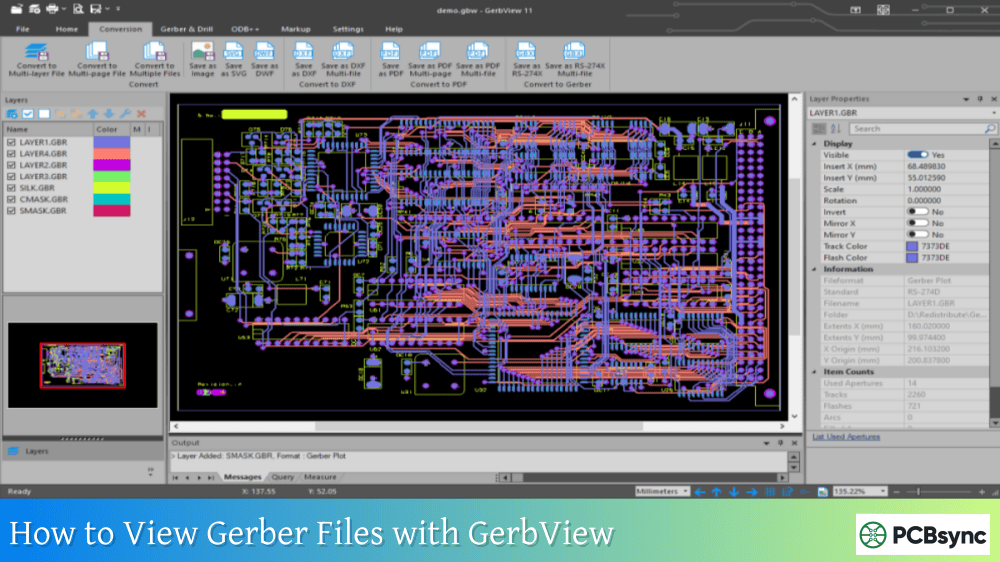
GerbView
GerbView offers PDF-to-CAD conversion that can output Gerber RS-274X files. The software works with vector PDFs and provides layer manipulation tools for organizing the converted data.
Conversion steps with GerbView:
Open GerbView and select File → Open
Choose your PDF file
GerbView imports each PDF page as a separate layer
Use layer tools to verify and adjust the imported data
Export to Gerber format via File → Export → Gerber
Configure output settings and generate files
Important limitation: GerbView does not support PDF files containing only raster images (scanned documents).
FAB 3000
FAB 3000 from Numerical Innovations handles both vector PDF import and raster image conversion. It requires GhostScript installed on your system to process PDF files.
Conversion steps with FAB 3000:
Ensure GhostScript (32-bit version) is installed
Launch FAB 3000 and import your PDF
The software extracts vector objects (lines, arcs, circles, text)
Assign imported elements to appropriate PCB layers
Generate Gerber and NC drill output
Note for raster PDFs: FAB 3000 Professional includes bitmap import capability for handling scanned images, but this requires additional cleanup work to flash pads and generate proper outlines.
Method 2: PDF to Vector to Gerber Workflow
When direct conversion fails or produces poor results, converting through an intermediate vector format often works better.
Step 1: Extract Vector Data from PDF
Open the PDF in vector editing software:
Software
Cost
PDF Handling
Adobe Illustrator
Commercial
Excellent vector extraction
Inkscape
Free
Good for most PDFs
CorelDRAW
Commercial
Strong PDF import
Affinity Designer
Mid-range
Reliable extraction
Step 2: Clean and Export to DXF or SVG
In your vector editor:
Remove non-manufacturing elements (annotations, dimensions, borders)
Organize content onto separate layers if needed
Verify that all geometry is properly closed and continuous
Export to DXF format (preferred for PCB tools) or SVG
Step 3: Import to PCB Software and Generate Gerber
Use PCB design software to complete the conversion:
If you’re creating designs that will eventually need Gerber output, structure your PDFs for successful conversion.
Best Practices for PDF Creation
Use Proper Layering
Create separate layers in your design software for:
Top copper
Bottom copper
Top silkscreen
Bottom silkscreen
Solder mask openings
Board outline
Drill locations
When exporting to PDF, maintain these layers rather than flattening the document.
Represent Drill Holes Correctly
The pdf2gerb script from GitHub uses a clever approach: drill holes are represented as solid black circles (for the pad) with solid white circles on top (for the hole). This allows extraction of both pad and drill data from a single layer.
Use Vector Graphics Only
Avoid embedding raster images for any PCB features. Text should use outline fonts rather than system fonts to ensure accurate conversion.
Maintain Consistent Units
Specify dimensions in either millimeters or inches consistently. Mixed units cause scaling errors that may not be obvious until boards come back wrong.
Step-by-Step PDF to Gerber Conversion Process
Here’s the workflow I recommend for most PDF-to-Gerber conversions:
Step 1: Analyze Your PDF
Before attempting conversion, understand what you’re working with:
Open the PDF at high zoom levels
Determine if content is vector or raster
Identify how many layers are present
Check if drill information is included
Note any reference dimensions for verification
Step 2: Choose Your Conversion Path
Based on your analysis:
PDF Type
Recommended Approach
Clean vector, single layer
Direct conversion with GerbView or FAB 3000
Vector, multiple pages/layers
GerbView with layer-by-layer processing
Vector but needs cleanup
PDF → Vector editor → DXF → PCB software
Raster (scanned)
Image extraction → FAB 3000 Professional or manual redraw
Troubleshooting Common PDF to Gerber Conversion Issues
Problem: Converted Files Have Wrong Scale
Cause: Unit mismatch or PDF created with non-standard page size
Solution:
Check units in both source PDF and conversion software
Use reference dimensions from the original design to verify scale
Apply scaling factor if needed during import
Problem: Layers Are Merged or Missing
Cause: PDF was flattened during export or uses non-standard layer structure
Solution:
Try opening in Illustrator or Inkscape to separate elements manually
Use selection tools to isolate different feature types
Export each layer to a separate file
Problem: Drill Holes Not Detected
Cause: Holes represented as graphics rather than proper circles, or drill data not included in PDF
Solution:
Manually identify drill locations and create Excellon file
If holes are shown as filled circles, measure diameters and define tool table
Contact original designer for drill data if available
Problem: Raster PDF Produces Poor Vector Output
Cause: Low resolution source or complex geometry that doesn’t trace well
Solution:
Obtain higher resolution scan if possible
Increase tracing detail settings
Accept that manual cleanup will be required
Consider redrawing from scratch for complex designs
Problem: Text Converts as Outlines
Cause: Fonts embedded as outlines rather than editable text
Solution:
This is usually acceptable for silkscreen text
For editable text, you’ll need to recreate it in your PCB software
Outline text actually converts more reliably than system fonts
Frequently Asked Questions About PDF to Gerber Conversion
Can I Convert Any PDF File to Gerber Format?
Not reliably. Vector PDFs created from CAD or illustration software convert reasonably well. Raster PDFs (scanned documents) require image-to-vector conversion that introduces errors and requires significant cleanup. PDFs missing critical information like drill data will produce incomplete Gerber packages regardless of conversion quality. The best conversions come from PDFs specifically created with Gerber output in mind.
What is the Best Free PDF to Gerber Converter?
For vector PDFs, the pdf2gerb Perl script offers free conversion if your PDF was created in Adobe Illustrator with proper layer structure. For a more general solution, combining Inkscape (free vector editor) with KiCad (free PCB software) provides a no-cost workflow: extract vectors in Inkscape, export to DXF, import to KiCad, and generate Gerber output. GerbView offers a 30-day trial that’s functionally complete.
Why Do PCB Manufacturers Require Gerber Files Instead of PDF?
Gerber files contain machine-readable instructions that directly drive photoplotter equipment. PDFs require interpretation since they’re designed for viewing, not manufacturing. A PDF shows what a board looks like; a Gerber file tells the machine exactly how to create it. Manufacturers need aperture definitions, precise coordinates, and layer-specific data that PDFs simply don’t provide in a usable format.
How Do I Handle Multi-Layer PCB Designs in PDF Format?
If your PDF contains multiple pages representing different layers, convert each page separately and verify alignment. If all layers are merged onto a single page, you’ll need to manually separate them using a vector editor before conversion. Use registration marks or board outlines to ensure layers align correctly. Generate separate Gerber files for each layer and verify alignment in a Gerber viewer before sending to manufacturing.
Is It Better to Request Original Design Files Instead of Converting PDF?
Absolutely. If the original design files (native CAD format or original Gerber package) are available, always use those instead of converting from PDF. Ask the designer, client, or manufacturer for the source files. Even if they only have an older version, working from proper PCB data will produce more reliable results than reconstructing from PDF documentation.
Conclusion
Converting PDF to Gerber files is genuinely challenging because you’re trying to reconstruct manufacturing data from a format designed for documentation. Success depends heavily on the quality and type of your source PDF.
For vector PDFs, direct conversion tools like GerbView or FAB 3000 can produce usable results with reasonable effort. For raster PDFs, expect significant manual work to clean up the conversion and verify accuracy. In either case, validation is essential: never send converted Gerber files to manufacturing without thorough verification against the original PDF.
When possible, avoid the conversion entirely by requesting original design files. If you’re creating designs that will eventually need Gerber output, structure your PDFs with conversion in mind, using proper layers, vector graphics, and clear drill representations.
The techniques in this guide will get you through most PDF-to-Gerber scenarios, but there’s no substitute for starting with proper manufacturing files. Treat PDF conversion as a last resort rather than a standard workflow, and you’ll save yourself considerable time and frustration.
Inquire: Call 0086-755-23203480, or reach out via the form below/your sales contact to discuss our design, manufacturing, and assembly capabilities.
Quote: Email your PCB files to Sales@pcbsync.com (Preferred for large files) or submit online. We will contact you promptly. Please ensure your email is correct.
Notes: For PCB fabrication, we require PCB design file in Gerber RS-274X format (most preferred), *.PCB/DDB (Protel, inform your program version) format or *.BRD (Eagle) format. For PCB assembly, we require PCB design file in above mentioned format, drilling file and BOM. Click to download BOM template To avoid file missing, please include all files into one folder and compress it into .zip or .rar format.