Inquire: Call 0086-755-23203480, or reach out via the form below/your sales contact to discuss our design, manufacturing, and assembly capabilities.
Quote: Email your PCB files to Sales@pcbsync.com (Preferred for large files) or submit online. We will contact you promptly. Please ensure your email is correct.
Notes: For PCB fabrication, we require PCB design file in Gerber RS-274X format (most preferred), *.PCB/DDB (Protel, inform your program version) format or *.BRD (Eagle) format. For PCB assembly, we require PCB design file in above mentioned format, drilling file and BOM. Click to download BOM template To avoid file missing, please include all files into one folder and compress it into .zip or .rar format.
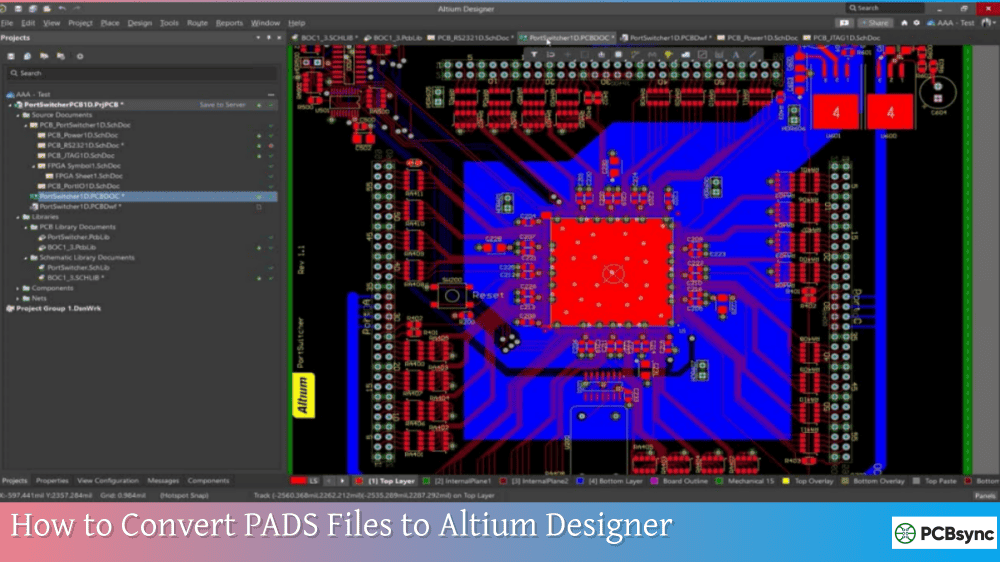
How to Convert PADS Files to Altium Designer: Complete Migration Guide for PCB Engineers
If you’ve spent years building designs in Siemens PADS and now need to move them into Altium Designer, you’re facing a challenge that thousands of engineers encounter every year. Whether your company is standardizing on Altium, you’re joining a new team, or you simply want access to Altium’s unified design environment, getting your PADS designs converted properly is critical.
Having migrated multiple PADS projects to Altium myself, I can tell you the process is manageable when you understand the requirements upfront. The key insight is that Altium’s Import Wizard only accepts ASCII versions of PADS files—not the native binary format. This single requirement trips up more engineers than any other aspect of the migration.
This guide walks you through every step: preparing your PADS files for export, running the Import Wizard, mapping layers correctly, and verifying your converted design. By the end, you’ll have a clear roadmap for moving your PADS data into Altium Designer with minimal rework.
Why Engineers Migrate from PADS to Altium Designer
Before diving into the technical process, it’s worth understanding why this migration makes sense for many design teams. PADS (formerly from Mentor Graphics, now owned by Siemens) has served the industry well, but Altium Designer offers several advantages that drive conversions.
Unified Design Environment: Altium Designer integrates schematic capture, PCB layout, library management, and manufacturing outputs in a single application. PADS traditionally separates these functions across PADS Logic and PADS Layout, requiring more coordination between tools.
Modern User Interface: Engineers switching from PADS often cite Altium’s more intuitive interface as a significant productivity improvement. The learning curve is shorter for new team members.
Supply Chain Integration: Altium’s direct links to component suppliers, real-time pricing, and lifecycle status information streamline the design-for-manufacturing process.
Cloud Collaboration: Altium 365 enables team collaboration, design sharing, and version control that many PADS users find lacking in their current workflow.
Understanding PADS File Types for Conversion
The first step in any successful migration is understanding which files you need and what format they must be in. PADS uses binary file formats natively, but Altium’s Import Wizard requires ASCII exports.
PADS File Type
Binary Extension
ASCII Extension
Altium Output
PCB Layout
.pcb
.asc
.PcbDoc
Schematic
.sch
.txt
.SchDoc
Decal Library (Footprints)
.pd9
.d
.PcbLib
CAE Decal Library (Symbols)
.pt9
.c
.SchLib (partial)
Part Type Library
.pt9
.p
.SchLib (combined with .c)
Understanding this table is crucial because attempting to import binary PADS files directly will fail. The Import Wizard cannot read native .pcb or .sch files—only their ASCII equivalents.
Preparing PADS Files for Export to Altium
Proper file preparation in PADS makes the difference between a smooth import and hours of troubleshooting. Follow these steps carefully before attempting any conversion.
Exporting PCB Layout Files from PADS Layout
The board layout contains your most critical design data. Export it correctly with these steps:
Open your board design in PADS Layout
Navigate to File → Export
Change the filename if desired and select a destination folder
Click Save to open the export options dialog
In the Output Version dropdown, select your PADS version (typically use the version matching your installation)
Set the Units option to Basic (this ensures database units are preserved)
Click OK to generate the .asc file
The exported .asc file should begin with header text similar to:
*PADS-PCB**PART*
If your file starts differently—particularly if it looks like a netlist beginning with signal names—you’ve exported the wrong file type. Re-export using the steps above.
Exporting Schematic Files from PADS Logic
Schematic export follows a similar process:
Open your schematic in PADS Logic
Go to File → Export
Choose your output location and filename
Click Save
In the export dialog, click Select All to include all schematic data
Choose your output version from the dropdown
Click OK to create the .txt file
Each schematic sheet in your PADS Logic design will translate to a separate Altium schematic document (.SchDoc).
Exporting PADS Library Files
Library files require two or three separate exports depending on what you need:
For Footprint Libraries (Decals):
In PADS Layout, select File → Export
Set the Library filter to target the specific library (avoid using “All Libraries”)
Export to create a .d file
For Schematic Symbol Libraries:
In PADS Logic, export the CAE Decal library to create a .c file
Export the Part Type library to create a .p file
Both files are required—Altium combines them during import to create complete .SchLib files
Critical Pre-Export Cleanup Steps
Before exporting, address these common issues that cause import failures:
Break Physical Design Reuse Blocks: PADS Layout’s reuse blocks don’t translate. Right-click on any reuse block and select Break Reuse to convert it to individual components.
Convert Individual Pin Connectors: PADS Logic’s individual pin-type connectors aren’t supported. Convert these to block-style connectors in PADS, or plan to recreate them in Altium after import.
Verify Data Integrity with “ASCII-In”: Before importing to Altium, test your ASCII files by reimporting them into an empty PADS workspace. If PADS reports errors during this process, your source data may be corrupted and will cause problems in Altium too.
Installing the PADS Importer Extension in Altium Designer
The PADS importer isn’t always enabled by default. Verify its installation before starting:
Launch Altium Designer
Click the user profile icon in the top-right corner
Select Extensions and Updates
Navigate to Configure Platform
Scroll to the Importers\Exporters section
Ensure the PADS option is checked
Click Apply and restart Altium Designer when prompted
Without this extension, the “PADS ASCII Design and Library Files” option won’t appear in the Import Wizard.
Step-by-Step: How to Convert PADS Files to Altium Designer
With your ASCII files prepared and the importer enabled, follow these steps for the actual conversion.
Step 1: Launch the Import Wizard
Open Altium Designer and navigate to File → Import Wizard. Click Next on the welcome screen.
Step 2: Select PADS File Type
On the “Select Type of Files to Import” screen, choose PADS ASCII Design and Library Files. Click Next to continue.
Step 3: Add Your PADS Design Files
Click Add to browse for your files. The dialog defaults to .asc files (PCB layouts). To add schematics, change the file filter dropdown to PADS Logic Files (*.txt).
You can add multiple files in this step—both PCB and schematic files can be imported together. Click Next after selecting all design files.
Step 4: Add Library Files (Optional)
If you’re importing libraries, add them on this screen:
Decal libraries: .d files
CAE Decal libraries: .c files
Part Type libraries: .p files
For complete schematic library translation, add both the .c and .p files—Altium combines them automatically. Click Next to proceed.
Step 5: Configure Reporting Options
The reporting screen controls what information appears in the translation log:
Log All Errors: Always enable
Log All Warnings: Recommended for first imports
Log All Events: Optional but useful for troubleshooting
Click Next to continue.
Step 6: Set Default Import Options
This critical screen controls how PADS data translates to Altium:
Design Rules Section:
Import Clearance Rules: Enable to transfer spacing rules
Import Routing Rules: Enable to transfer trace width rules
Import High-Speed Rules: Enable if your design uses matched-length routing
Keep-Out Options:
Leave unchecked to convert PADS keepouts to Altium keepout areas
Be aware that Altium keepouts are global (affect all objects), while PADS keepouts can be object-specific
Click Next to proceed to layer mapping.
Step 7: Configure Layer Mapping
Click Edit Mapping to review how PADS layers translate to Altium layers. The wizard attempts intelligent mapping (silkscreen to silkscreen, etc.), but verify these critical mappings:
PADS Layer
Altium Layer
Top
Top Layer
Bottom
Bottom Layer
Inner Signal Layers
Mid Layer 1, 2, etc.
CAM Plane Layers
Internal Plane 1, 2, etc.
Top Silk
Top Overlay
Bottom Silk
Bottom Overlay
Top Mask
Top Solder
Bottom Mask
Bottom Solder
Assembly 1
Mechanical Layer 1
Important: PADS inner signal layers map to Altium signal layers. PADS CAM plane layers map to Altium plane layers (negative image). Split/mixed plane layers can go either way—verify based on your design intent.
Set any unnecessary layers to Not Imported to exclude them from translation.
Step 8: Set Output Directory
Specify where Altium should save the converted project files. The wizard creates a new project folder with all translated documents. Click Next to begin the import.
Step 9: Review and Complete
The wizard displays a summary of files being translated. Click Next to execute the import. When the progress bar completes, click Finish to close the wizard and review your converted design.
Post-Import Verification Checklist
Never assume a conversion completed perfectly. Verify these elements in your imported design:
Schematic Verification
Component Count: Compare totals between PADS and Altium
Net Names: Check that system-generated names imported correctly (Altium uses different naming conventions)
Sheet Connectivity: For multi-sheet designs, verify hierarchical connections
Symbol Appearance: Spot-check critical symbols for correct pin assignments
PCB Layout Verification
Board Outline: Confirm the outline imported on the correct layer
Component Placement: Verify all components appear in correct positions
Copper Integrity: Check traces, pours, and plane layers
Via Placement: Confirm vias transferred with correct sizes
Design Rule Verification
Run Altium’s DRC immediately after import:
Open the PCB document
Go to Design → Rules to review imported rules
Pay special attention to:
Electrical clearance rules (spacing between objects)
Plane connect rules (thermal relief settings)
Routing width rules (trace width constraints)
Run Tools → Design Rule Check and address violations
Polygon Pour Review
PADS pour shapes may need attention:
Open Tools → Polygon Pours → Polygon Manager
Review pour order (critical when small pours are enclosed by larger ones)
Repour all polygons to ensure proper fills
Check thermal connections to pads
Read more How to convert PCB Files in different Design software:
Common PADS to Altium Conversion Issues and Solutions
Based on community experience and my own migrations, these problems occur most frequently:
Wrong ASCII File Type: The most common failure—importing a netlist file instead of a design export. Open your .asc file in a text editor. It should begin with *PADS-PCB* not with signal names.
Corrupted Source Data: If PADS itself can’t cleanly re-import your ASCII file, Altium won’t either. Always test with the “ASCII-in” procedure in PADS before attempting Altium import.
Keepout Behavior Differences: PADS keepouts can be configured to exclude specific object types. Altium keepouts are global—they apply to all electrical objects. Review and adjust keepout areas after import.
Thermal Relief Settings: PADS thermal settings configured at the padstack level may not translate completely. Check thermal connections on power/ground pads and create manual rules if needed.
2D Line Libraries Not Supported: PADS stores 2D drawing items in library structures. These cannot be directly translated—the content must be placed in a design file first, then imported.
Net Name Mismatches: PADS assigns net names as wire attributes; Altium uses net labels. System-generated names (like $$$12345) may translate differently. Enable the “Do not translate hidden net names” option during import to let Altium assign its own system names.
Design Rules Translation Reference
Understanding how PADS rules map to Altium helps with post-import configuration:
PADS Rule Category
Altium Equivalent
Clearance Rules
Electrical Clearance
Routing Width
Width Rules
Via-to-Via
Via-to-Via (within Clearance)
Matched Net Lengths
Length Constraint (High Speed)
Minimum Annular Ring
Manufacturing Constraints
Power Plane Connect Style
Polygon Connect Style
Power Plane Clearance
Plane Clearance
Not all PADS rules have direct Altium equivalents. Complex high-speed constraints may require manual recreation.
Useful Resources for PADS to Altium Migration
These resources provide additional support for your conversion project:
The official migration guide PDF from Altium is particularly valuable—it includes detailed layer mapping tables and rule translation references.
Best Practices for Ongoing PADS and Altium Workflows
If your organization maintains projects in both platforms, establish these practices:
Document Your Layer Standards: Create a reference document mapping your company’s PADS layer conventions to Altium layers. Save custom layer mappings as .INI files for reuse.
Standardize Export Settings: Document the exact PADS export settings that produce successful imports. Share these settings with your team.
Version Your Translations: Keep both original PADS files and converted Altium projects under version control. This provides a reference point if questions arise later.
Create Library Migration Strategy: Decide whether to convert entire libraries at once or translate component-by-component as projects require. Each approach has tradeoffs.
Frequently Asked Questions
Can I import binary PADS files directly into Altium Designer?
No. Altium Designer’s Import Wizard only accepts ASCII versions of PADS files. You must export your designs from PADS Layout (.asc) and PADS Logic (.txt) in ASCII format before importing. Binary .pcb and .sch files cannot be used directly.
What PADS versions are compatible with Altium’s Import Wizard?
Altium supports PADS ASCII files from version 2005.2 and later. When exporting from PADS, select the output version that matches your PADS installation. Altium regularly updates the importer, so ensure you’re running the latest Altium Designer version for best compatibility.
Will my PADS design rules transfer to Altium Designer?
Most clearance, routing, and high-speed rules transfer during import. However, rules applied at the padstack level (like specific thermal or antipad values) may need manual recreation. Always review imported rules in Altium’s PCB Rules and Constraints Editor and run DRC to verify proper translation.
How long does the PADS to Altium conversion process take?
The Import Wizard itself completes in minutes. The total time depends on post-import cleanup requirements. Simple two-layer boards might need 15-30 minutes of verification. Complex multi-layer designs with extensive design rules can require several hours of review and adjustment.
Can I convert PADS libraries separately from design files?
Yes. The Import Wizard allows you to import library files independently of design files. Add your .d files (footprints), .c files (schematic symbols), and .p files (part types) to create Altium .PcbLib and .SchLib files. This is useful for building an Altium library from existing PADS components before starting new designs.
Wrapping Up
Converting PADS files to Altium Designer is straightforward once you understand the ASCII export requirement and layer mapping process. The Import Wizard handles most of the heavy lifting automatically—your job is proper file preparation beforehand and thorough verification afterward.
The most successful migrations I’ve seen share common characteristics: engineers take time to clean up their PADS data before export, they test ASCII files by reimporting them into PADS first, and they methodically verify every aspect of the converted design in Altium.
Don’t rush the process. A careful conversion that catches issues early is far faster than discovering problems during your next design review or, worse, in manufacturing. Take advantage of Altium’s comprehensive documentation and support resources when questions arise—the migration guides are detailed and constantly updated.
Your PADS design experience transfers directly to Altium. The concepts are identical; only the interface differs. Within a few projects, you’ll likely find yourself more productive in Altium’s unified environment than you were coordinating between PADS Logic and PADS Layout.
Inquire: Call 0086-755-23203480, or reach out via the form below/your sales contact to discuss our design, manufacturing, and assembly capabilities.
Quote: Email your PCB files to Sales@pcbsync.com (Preferred for large files) or submit online. We will contact you promptly. Please ensure your email is correct.
Notes: For PCB fabrication, we require PCB design file in Gerber RS-274X format (most preferred), *.PCB/DDB (Protel, inform your program version) format or *.BRD (Eagle) format. For PCB assembly, we require PCB design file in above mentioned format, drilling file and BOM. Click to download BOM template To avoid file missing, please include all files into one folder and compress it into .zip or .rar format.