Inquire: Call 0086-755-23203480, or reach out via the form below/your sales contact to discuss our design, manufacturing, and assembly capabilities.
Quote: Email your PCB files to Sales@pcbsync.com (Preferred for large files) or submit online. We will contact you promptly. Please ensure your email is correct.
Notes: For PCB fabrication, we require PCB design file in Gerber RS-274X format (most preferred), *.PCB/DDB (Protel, inform your program version) format or *.BRD (Eagle) format. For PCB assembly, we require PCB design file in above mentioned format, drilling file and BOM. Click to download BOM template To avoid file missing, please include all files into one folder and compress it into .zip or .rar format.
How to Convert Gerber to G-Code Using CopperCAM: Complete PCB Milling Guide
After years of sending boards to fab houses and waiting weeks for delivery, I finally invested in a small CNC mill for PCB prototyping. The immediate challenge was figuring out how to get my Gerber files into a format my machine could understand. CopperCAM solved that problem completely, and after using it on dozens of projects, I consider it essential software for anyone serious about in-house PCB fabrication.
CopperCAM is dedicated CAM software specifically designed for PCB isolation milling. Unlike general-purpose CAM programs that treat PCBs as an afterthought, CopperCAM understands the unique requirements of circuit board fabrication. It converts your Gerber and Excellon files into precisely calculated toolpaths for isolation routing, drilling, and board cutout operations. The software costs €80 for a permanent license, which pays for itself after just a few boards when you factor in the time saved compared to free alternatives.
What Makes CopperCAM Different from Other CAM Software
CopperCAM focuses exclusively on PCB fabrication rather than trying to be everything to everyone. This specialization shows in features that general CAM packages simply don’t offer. The software automatically detects equipotential paths through layers, meaning it understands which copper areas connect electrically and calculates isolation paths accordingly.
The program handles up to four circuit layers simultaneously, plus separate layers for drills, cutout contours, and centering holes. For double-sided boards, this layer management becomes critical for maintaining alignment between top and bottom copper patterns.
Unlike many free alternatives that struggle with complex Gerber files, CopperCAM reads RS274-X format including parametric macros, polygon surfaces, and negative polarity traces. Recent updates added support for KiCad’s rounded rectangle pads that use variable macros, which previously caused import failures in older versions.
System Requirements and Installation
CopperCAM runs on Windows from version 2000 through Windows 11. It’s a native 32-bit application that works fine on 64-bit systems. The installation is remarkably clean compared to most software. Download the installer from galaad.net, run it, and you’re done. CopperCAM doesn’t scatter files across your system or add registry entries beyond creating desktop shortcuts. Everything stays in the installation directory, making uninstallation as simple as deleting the folder.
Requirement
Specification
Operating System
Windows 2000 / XP / Vista / 7 / 8 / 10 / 11
Memory
1GB RAM minimum
Disk Space
100MB
Processor
Intel Pentium 4 or later
The trial version works without time limits but restricts output to 25 drill holes and 25 isolation contours per export. This limitation lets you test the complete workflow on simple boards before purchasing. For extended testing on complex boards, you can request a time-limited temporary license by providing your name and postal address.
Preparing Gerber Files for CopperCAM Import
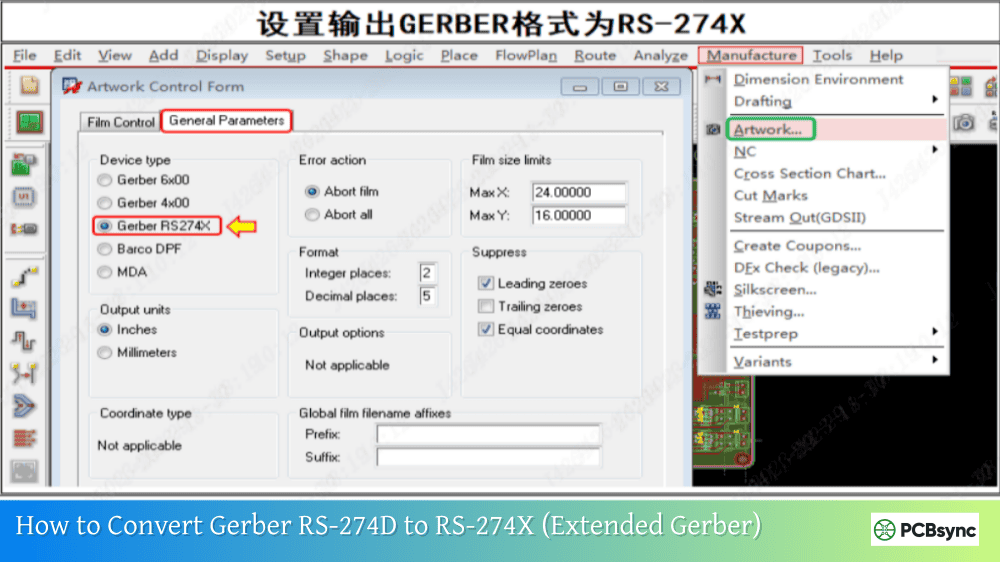
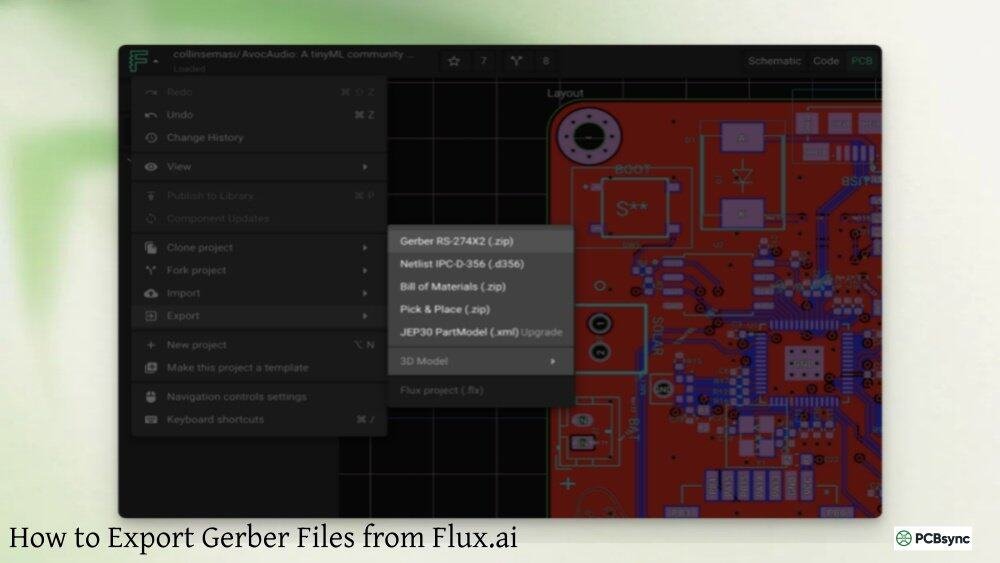
Before opening CopperCAM, you need properly formatted Gerber files from your PCB design software. CopperCAM works best with RS274-X extended Gerber format, which includes aperture definitions within the file itself. If you export older RS274-D format, you’ll need to manually define aperture shapes and sizes for each reference in the file.
Export these files from your PCB software:
Top copper layer (.gtl or similar)
Bottom copper layer if double-sided (.gbl or similar)
Board outline or edge cuts (.gm1, .gko, or similar)
Drill file in Excellon format (.drl, .xln, or .exc)
Pay attention to your export settings. CopperCAM handles various unit systems and scaling conventions, but mismatches between your Gerber and Excellon files cause alignment problems. When in doubt, use millimeters and ensure both file types use the same coordinate format.
Some PCB software exports ground planes as thousands of individual thin traces rather than filled polygons. CopperCAM calculates isolation paths track by track, so these hatched ground planes take extremely long to process. If your CAD software offers the option, export ground planes as G36/G37 polygon surfaces defined in the RS274-X specification instead.
Step-by-Step Gerber to G-Code Conversion in CopperCAM
The conversion process follows a logical sequence: import files, configure tools, calculate toolpaths, and export G-Code. Each step builds on the previous one, and CopperCAM provides visual feedback throughout so you can verify results before committing to actual machining.
Step 1: Import Your Gerber and Drill Files
Launch CopperCAM and navigate to File, then Open, and select New Circuit. Browse to your copper layer Gerber file and open it. The design appears in the main viewing area. If your board looks correct with proper trace widths and pad shapes, the import succeeded.
Next, add your drill file using File, Open, then Drills. CopperCAM prompts you to confirm whether the drill locations align with your copper layer. If holes appear offset from pads, you have a coordinate format mismatch between files. Check your export settings and regenerate the drill file with matching parameters.
For the board outline, use File, Open, then Additional Layer. Select your edge cuts file and confirm proper alignment. CopperCAM can automatically detect cutout contours from this layer or you can define them manually.
Step 2: Configure the Tool Library
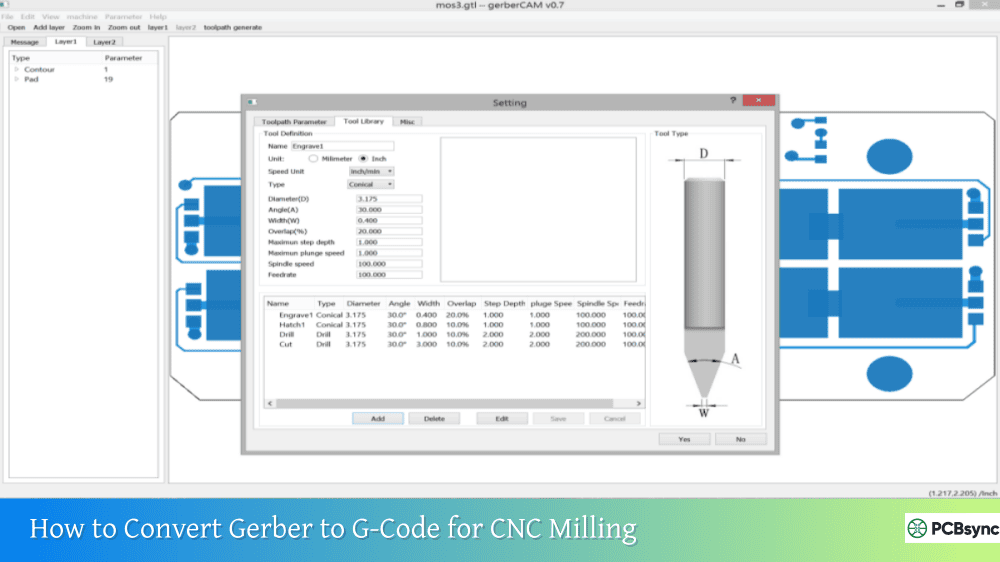
Before calculating any toolpaths, define the cutting tools you’ll actually use. Access the tool library through Parameters, then Tool Library. For each tool, specify its number (matching your tool rack if you have one), diameter, tip angle for V-bits, and other geometric characteristics.
Typical PCB milling requires three types of tools:
Tool Type
Typical Size
Purpose
V-bit engraving
0.1-0.4mm tip, 10-60°
Isolation routing
PCB drill bits
0.8mm, 1.0mm, 1.2mm
Through-hole drilling
End mill
0.8-2.0mm
Board cutout, large holes
V-bit diameter varies with cutting depth due to the conical shape. A 60-degree V-bit cutting 0.2mm deep produces approximately a 0.23mm cut width. CopperCAM calculates this automatically based on your depth settings, but understanding this relationship helps when troubleshooting trace isolation problems.
Step 3: Assign Tools to Operations
After defining your tools, tell CopperCAM which tool handles each operation. Go to Parameters, then Selected Tools. This window has separate sections for engraving, drilling, hatching, cutting, and centering operations.
For the Engraving Tool section, select your V-bit and set the cutting depth. A depth of 0.1mm to 0.2mm typically removes 1oz copper completely. Set the margin value if you want slightly wider isolation than the minimum calculated path. Configure the engraving speed appropriate for your machine and material.
For Drilling Tools, you have several options for handling multiple hole sizes with limited tool availability. Select either to use the closest larger tool with circular boring for oversized holes, or use a single tool for all drills. If you have multiple drill sizes available, specify each one and CopperCAM generates separate output files for each tool.
Step 4: Calculate Isolation Contours
Click the Calculate Contours button to generate isolation routing paths. A dialog appears asking for the number of successive contours. This determines how much copper CopperCAM removes around each trace.
Contour Setting
Result
1 contour
Minimum isolation, fastest milling
2-3 contours
Standard isolation, good reliability
4+ contours
Maximum clearance, slowest milling
The Extra Contours Around Pads setting adds additional isolation specifically around component pads where solder bridges are most likely to form. One or two extra passes around pads typically produces cleaner results without significantly increasing milling time.
Enable Force Isolation Between Close Pads if your design has fine-pitch components. This ensures CopperCAM attempts isolation even where traces run very close together, though physical tool limitations may prevent complete isolation in extreme cases.
After calculation completes, CopperCAM displays the isolation paths overlaid on your copper pattern. Red lines indicate where the tool will cut. Inspect these paths carefully, especially around dense trace areas and fine-pitch pads. If you see areas where traces lack isolation, you may need a finer tool or design modifications.
Step 5: Set Board Dimensions and Origin
Navigate to File, then Dimensions to configure your board setup. Set the Z-thickness to match your actual PCB material, typically 1.6mm for standard FR4. The margin setting adds space around your design area.
Configure the origin point through File, then Origin. This determines where coordinates (0,0) falls relative to your design. Setting X=2 and Y=2 offsets the origin so your CNC machine starts slightly away from the board corner, preventing collisions with clamps and reducing material waste.
Step 6: Export G-Code Files
Click the Mill icon to generate output files. CopperCAM presents a dialog where you select which operation to export. The Section dropdown lets you choose between engraving layers, drilling operations, and cutout paths.
For double-sided boards, check the Flip X box when exporting the bottom layer. This mirrors the design so it aligns correctly when you flip the physical board.
Each selection generates a separate G-Code file. Save them with descriptive names indicating the operation: “BoardName_Engrave_Top.nc”, “BoardName_Drill_0.8mm.nc”, “BoardName_Cutout.nc”, etc. This organization helps when loading files into your CNC controller.
Output Format Options in CopperCAM
CopperCAM supports multiple output formats beyond standard G-Code. Access these through Parameters, then Output Data Format. Available formats include G-Code, HPGL, DXF, Isel-NCP, and Roland RDGL.
For most CNC routers running GRBL, Mach3, LinuxCNC, or similar controllers, standard G-Code works directly. Roland desktop mills use RDGL format with their proprietary drivers. Some older machines require HPGL format.
The fully definable post-processor option lets you customize output for machines with non-standard requirements. You can modify header and footer commands, coordinate formats, and motion commands to match exactly what your controller expects.
Configuring CopperCAM for Different CNC Machines
CopperCAM can call your CNC controller software directly after generating output, or send data through COM/LPT ports for direct machine connection. Configure this through Parameters, then Output Data Format, where you specify the external program to launch or port to use.
For machines with virtual printer drivers, CopperCAM can route output through the Windows print system. This works particularly well with Roland SRM-20 and similar desktop mills that present themselves as printers to the operating system.
Settings for GRBL-Based Machines
Most hobby CNC routers use GRBL firmware. CopperCAM’s standard G-Code output works with GRBL controllers, but you may need to add specific initialization commands. Common additions include spindle speed commands (S10000 for example) and coordinate system selection.
Settings for Mach3 Controllers
Mach3 accepts CopperCAM’s G-Code directly. Configure Mach3 as the external program in CopperCAM’s output settings so files open automatically after generation. Ensure your Mach3 configuration matches the coordinate system and units CopperCAM uses.
Working with Double-Sided PCBs
Double-sided boards require careful attention to alignment between top and bottom patterns. CopperCAM provides centering hole functionality specifically for this purpose.
The workflow involves milling the top side first, then drilling centering holes at known positions. Flip the board onto alignment pins inserted in these holes, and the bottom pattern automatically aligns with the top.
When exporting bottom layer operations, always enable the Flip X option. This mirrors the design horizontally so it appears correct when viewed from above after physically flipping the board. Forgetting this step produces a board where top and bottom patterns are mirror images of each other rather than properly aligned.
Configure your XY-zero point appropriately for each side. Top side typically uses the South-West corner, while bottom side after flipping uses the South-East corner. This accounts for the coordinate system change when the board is inverted.
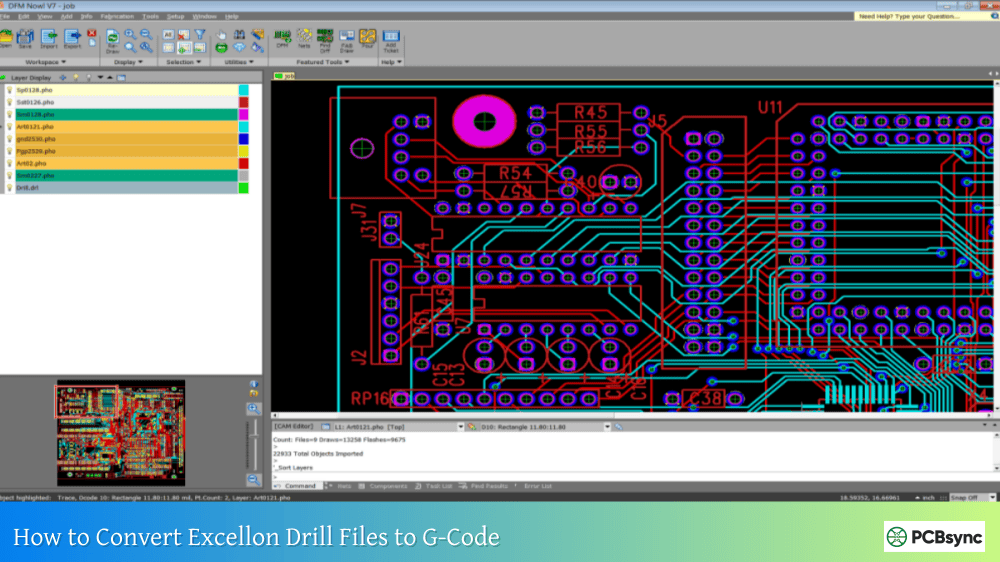
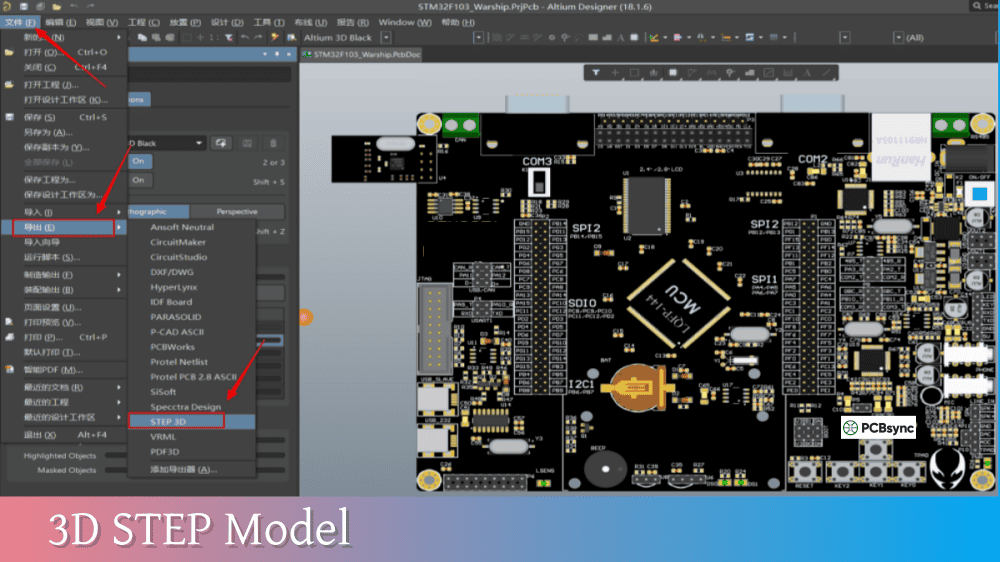
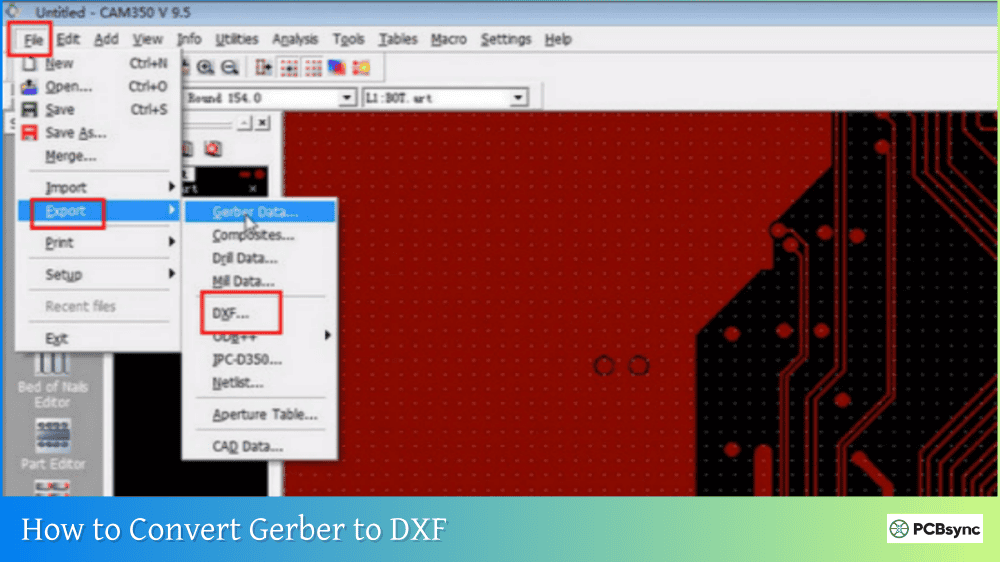
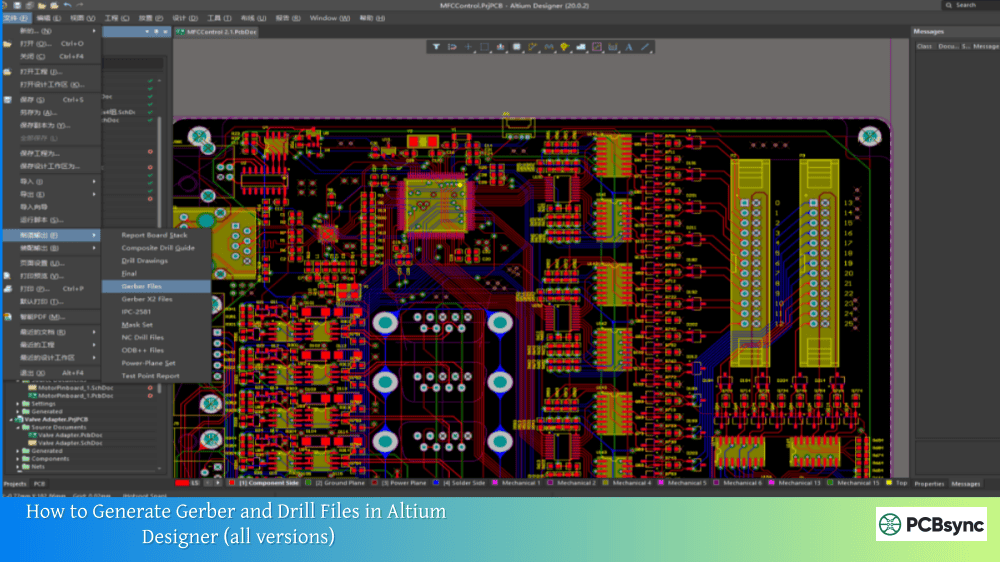
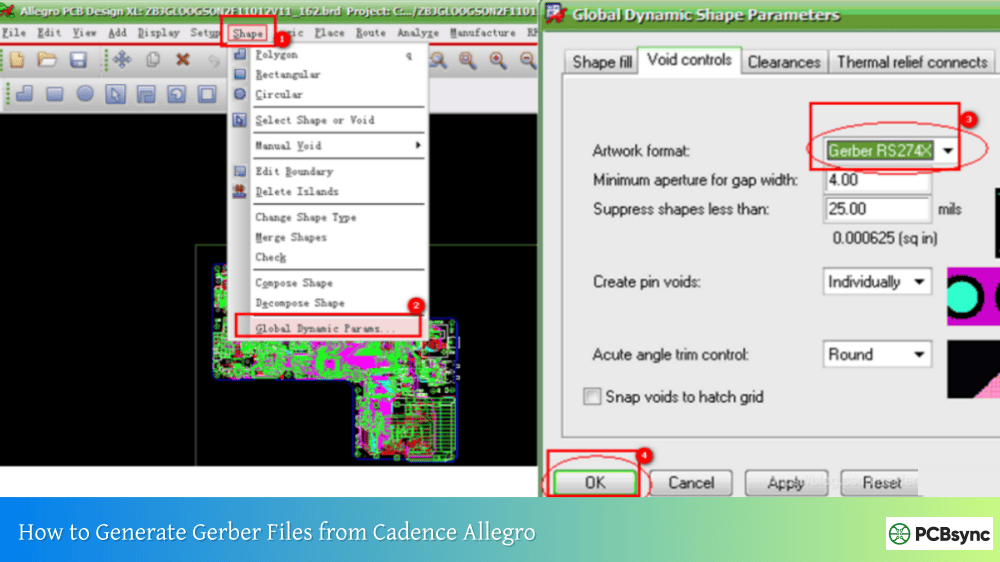
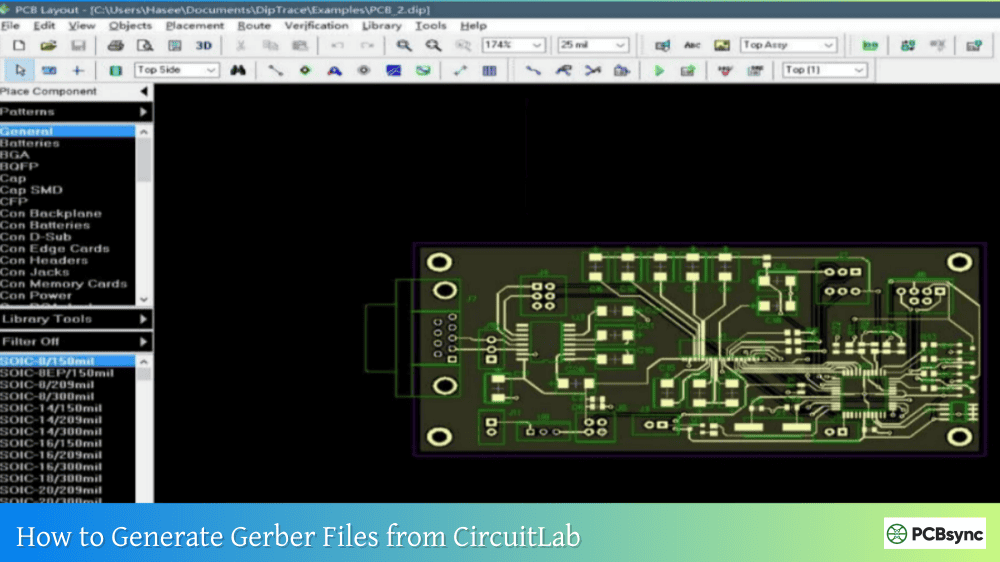
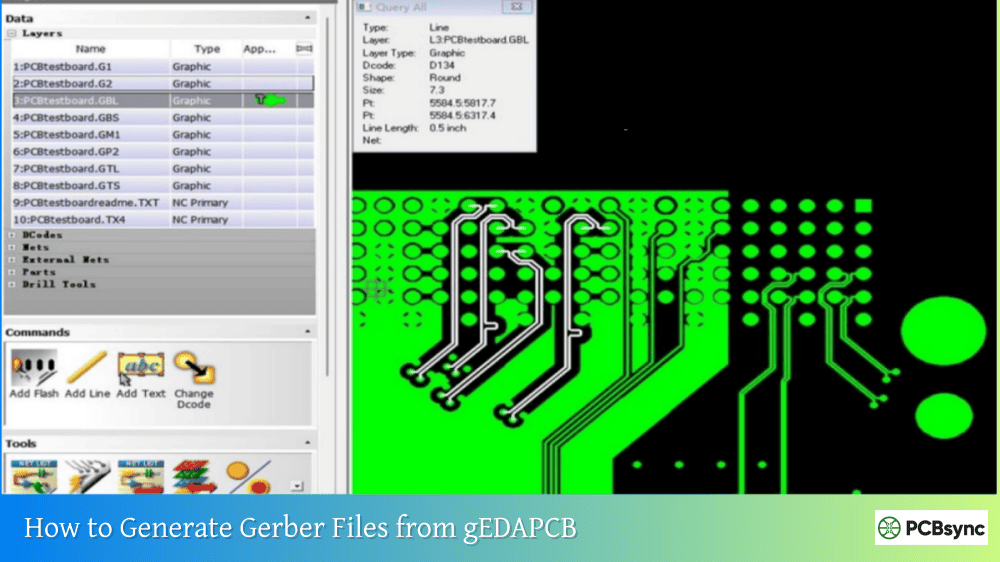
Read more How to convert PCB Files in different Design software:
If your Gerber file opens but appears incorrect with wrong trace widths or missing features, you likely have an RS274-D file without embedded aperture definitions. Switch to RS274-X export in your PCB software, or manually define apertures in CopperCAM after import.
Excellon Alignment Issues
Drill holes appearing offset from pads indicates a coordinate format mismatch. CopperCAM offers two Excellon format options in the open dialog. If your file looks wrong with one format, reload using the other option.
Isolation Path Failures
When CopperCAM cannot calculate isolation between close traces, the physical tool diameter exceeds the available space. Either use a finer cutting tool, increase trace clearance in your PCB design, or accept that those traces will remain connected.
Long Calculation Times
Ground planes made of hatched traces rather than solid polygons cause extremely long processing times. Regenerate Gerbers from your PCB software using polygon fill instead of hatching for ground planes.
Recommended Tool Settings for PCB Milling
These starting values work for typical hobby CNC setups milling standard FR4. Adjust based on your specific machine characteristics and cutting results.
Parameter
V-Bit Engraving
Drilling
Board Cutout
Tool Diameter
0.2-0.4mm at depth
Per hole size
0.8-1.0mm
Cutting Depth
0.1-0.2mm
Through board + 0.2mm
Through board + 0.2mm
Feed Rate
5-15mm/s
2-5mm/s
3-8mm/s
Spindle Speed
10,000-20,000 RPM
10,000-15,000 RPM
10,000-15,000 RPM
V-bit angles affect cut width significantly. Lower angles (10-30 degrees) produce finer cuts but require slower feed rates due to fragile tips. Higher angles (45-60 degrees) are more robust but limit minimum isolation width.
Useful Resources for CopperCAM Users
Official Documentation
The CopperCAM website at galaad.net/coppercam-eng.html provides the complete manual and download links. The documentation covers all features in detail though it assumes some familiarity with PCB fabrication concepts.
Software Download
Download CopperCAM directly from galaad.net/coppercam-download-eng.html. The trial version includes full functionality with output limitations. License purchases cost €80 and are processed through email with license files delivered electronically.
Tutorial Videos
Search YouTube for CopperCAM tutorials covering specific workflows. Video content from makers using various CNC machines demonstrates real-world application of the software with different hardware configurations.
Community Forums
CNCZone forums have active discussions about CopperCAM including troubleshooting threads and settings recommendations for specific machine types. The Fritzing forum also has CopperCAM content for users working with that PCB design software.
FAQs
How much does CopperCAM cost?
CopperCAM costs €80 (approximately $85-90 USD) for a permanent license with no subscription fees or time limits. The trial version is free with unlimited use but restricts output to 25 drill holes and 25 isolation contours per export. You can request a time-limited temporary license for extended testing on complex boards.
What Gerber formats does CopperCAM support?
CopperCAM reads both RS274-X extended Gerber format and older RS274-D format. RS274-X is strongly recommended because it includes aperture definitions within the file. With RS274-D files, you must manually define aperture shapes and sizes after import. Recent versions also support parametric macros with variables, such as KiCad’s rounded rectangle pads.
Can CopperCAM handle double-sided PCBs?
Yes, CopperCAM supports double-sided PCB fabrication with centering hole functionality for alignment. The workflow involves milling the top side, drilling centering holes, flipping the board onto alignment pins, then milling the bottom. Use the Flip X option when exporting bottom layer operations to properly mirror the design.
What output formats does CopperCAM generate?
CopperCAM exports G-Code, HPGL, DXF, Isel-NCP, and Roland RDGL formats. A customizable post-processor allows modification for machines with non-standard requirements. Most CNC routers running GRBL, Mach3, or LinuxCNC accept the standard G-Code output directly.
Why does CopperCAM take so long to calculate isolation paths?
Long calculation times typically occur with ground planes made of hatched traces rather than solid polygon fills. CopperCAM processes each trace individually, so a ground plane with thousands of hatch lines takes much longer than a single polygon surface. Export ground planes using G36/G37 polygon definitions in your Gerber files to dramatically reduce calculation time.
Conclusion
CopperCAM streamlines the entire workflow from Gerber files to machine-ready G-Code. The €80 license price is reasonable considering the time it saves compared to wrestling with free alternatives that weren’t designed specifically for PCB work. After the initial learning curve of understanding your tool parameters and machine settings, you can convert even complex multi-layer designs in minutes.
The software’s focus on PCB fabrication shows in details that general-purpose CAM programs miss. Automatic equipotential detection, intelligent isolation around pads, and proper handling of double-sided alignment are features you don’t realize you need until you’ve struggled without them.
For anyone doing regular PCB prototyping on a CNC mill, CopperCAM belongs in your toolchain alongside your PCB design software and CNC controller. The investment pays off quickly in faster iterations and more reliable results on every board you make.
Inquire: Call 0086-755-23203480, or reach out via the form below/your sales contact to discuss our design, manufacturing, and assembly capabilities.
Quote: Email your PCB files to Sales@pcbsync.com (Preferred for large files) or submit online. We will contact you promptly. Please ensure your email is correct.
Notes: For PCB fabrication, we require PCB design file in Gerber RS-274X format (most preferred), *.PCB/DDB (Protel, inform your program version) format or *.BRD (Eagle) format. For PCB assembly, we require PCB design file in above mentioned format, drilling file and BOM. Click to download BOM template To avoid file missing, please include all files into one folder and compress it into .zip or .rar format.