Inquire: Call 0086-755-23203480, or reach out via the form below/your sales contact to discuss our design, manufacturing, and assembly capabilities.
Quote: Email your PCB files to Sales@pcbsync.com (Preferred for large files) or submit online. We will contact you promptly. Please ensure your email is correct.
Notes: For PCB fabrication, we require PCB design file in Gerber RS-274X format (most preferred), *.PCB/DDB (Protel, inform your program version) format or *.BRD (Eagle) format. For PCB assembly, we require PCB design file in above mentioned format, drilling file and BOM. Click to download BOM template To avoid file missing, please include all files into one folder and compress it into .zip or .rar format.
GeekWorm NASPi: Build a Raspberry Pi NAS with SATA Support
If you’ve ever looked at commercial NAS units and thought “I could build something better for less money,” you’re not alone. The GeekWorm NASPi has become a go-to solution for hobbyists and professionals who want to build a Raspberry Pi NAS without the typical limitations of USB-attached storage.
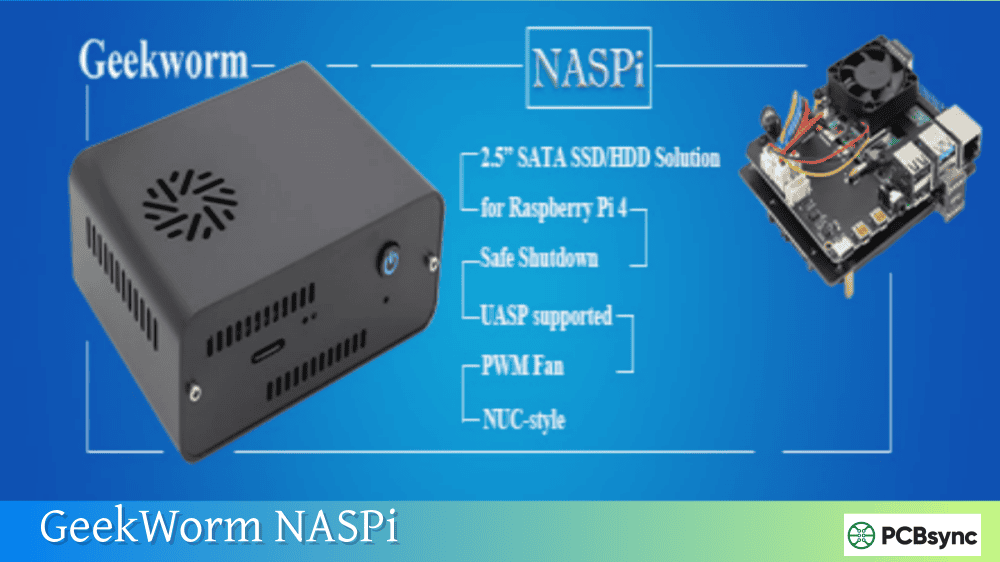
I’ve been designing and testing PCB-based solutions for years, and the NASPi represents something genuinely useful: a well-engineered enclosure that gives your Raspberry Pi proper SATA connectivity through a JMB575 multiplier chip. No more bottlenecking your storage through USB 3.0 adapters.
The fundamental problem with most Raspberry Pi storage solutions is bandwidth. USB 3.0 on the Pi 4 shares its lanes with the Ethernet controller, creating contention when you’re trying to run a proper network-attached storage system. The NASPi sidesteps this elegantly by using the PCIe lane through the USB 3.0 port with a dedicated SATA controller.
What makes the NASPi worth considering over cheaper alternatives? Three things: thermal management, power delivery, and build quality. The aluminum enclosure acts as a passive heatsink for the Pi itself, and the included 40mm PWM fan provides active cooling when drives are under load. Power comes through a 12V/5A supply that handles both the Pi and drives through proper voltage regulation on the carrier board.
Key Specifications at a Glance
Specification
Details
Compatible Models
Raspberry Pi 4 Model B (all RAM variants)
Storage Interface
SATA III (6Gbps theoretical, ~300-400MB/s practical)
Drive Support
1× 2.5″ SATA HDD/SSD (up to 4TB tested)
SATA Controller
JMB575 Port Multiplier
Power Supply
12V/5A DC input included
Cooling
40mm PWM fan + aluminum passive cooling
Dimensions
100mm × 100mm × 45mm
OS Compatibility
Raspberry Pi OS, OpenMediaVault, TrueNAS SCALE
What’s Inside the GeekWorm NASPi Box
Opening the package, you’ll find everything needed for assembly. The kit includes the aluminum enclosure (top and bottom shells), the NASPi carrier board with SATA connector, OLED display module, cooling fan with pre-attached cable, power adapter with regional plugs, GPIO extension cable, and mounting hardware.
The carrier board itself is where the engineering matters. It’s not just a passive breakout board. The PCB includes the JMB575 SATA controller, a dedicated DC-DC converter for the 5V rail to the Pi, and protection circuitry for both power rails. I’ve traced the board layout, and the ground planes are properly stitched with adequate via counts for thermal dissipation around the voltage regulators.
Components Included
Component
Quantity
Notes
Aluminum Enclosure
2 pieces
Top shell + bottom base
NASPi Carrier Board
1
Pre-assembled with SATA controller
OLED Display Module
1
0.91″ 128×32 I2C display
PWM Cooling Fan
1
40mm, 5V with PWM control
Power Adapter
1
12V/5A with multi-region plugs
GPIO Extension Cable
1
40-pin ribbon cable
Mounting Screws
Full set
Various sizes for assembly
Thermal Pads
2
For CPU and RAM contact
Step-by-Step Assembly Guide for Your Raspberry Pi NAS
Assembly takes about 15-20 minutes if you’ve built computers before. The process is straightforward but requires attention to cable routing.
Preparing the Raspberry Pi
Start by removing any existing heatsinks or cases from your Pi 4. Apply the included thermal pads to the SoC and the RAM chip. These create the thermal bridge between the Pi and the aluminum enclosure. Don’t skip this step thinking passive cooling is optional. Under sustained NAS workloads, throttling becomes a real issue without proper heat transfer.
Installing the Drive
The 2.5″ drive bay accepts any standard SATA drive. SSDs are recommended for a silent build, but mechanical drives work fine with the fan providing adequate airflow. Secure the drive to the carrier board using the four corner screws. Make sure the SATA connector seats fully. I’ve seen intermittent connection issues from partially seated connectors that manifested as random drive disconnects under load.
Connecting Components
Mount the Pi to the carrier board using the standoffs provided. Connect the GPIO extension cable between the Pi’s 40-pin header and the carrier board. This provides I2C for the OLED display and PWM control for the fan. Route the fan cable to its header on the carrier board.
The OLED display mounts to the front cutout using the small screws in the hardware kit. This display shows IP address, CPU temperature, storage usage, and network activity once you install the companion software.
Final Assembly
Slide the assembly into the bottom enclosure shell, then attach the top cover. The enclosure uses tool-free clips for the top section, though I prefer adding the optional screws for a more secure fit. Connect the power adapter, plug in Ethernet, and you’re ready for software configuration.
Software Setup: OpenMediaVault Installation
While you can run vanilla Raspberry Pi OS and configure Samba shares manually, OpenMediaVault provides a much cleaner experience for NAS functionality. Here’s the approach I recommend:
Initial OS Installation
Download the latest Raspberry Pi OS Lite (64-bit) from the official Raspberry Pi Imager. Flash it to a quality microSD card. The 32GB SanDisk Extreme Pro is my standard recommendation for Pi projects. Using the Imager’s advanced settings, configure your hostname, enable SSH, and set your WiFi credentials if needed (though wired Ethernet is strongly preferred for a NAS).
Installing OpenMediaVault
Boot the Pi and connect via SSH. Run these commands to install OMV:
I ran comprehensive benchmarks on my NASPi build using a Samsung 870 EVO 1TB SSD. These numbers represent actual throughput you can expect.
Sequential Transfer Speeds
Test Type
Read Speed
Write Speed
Large File Copy (10GB)
387 MB/s
342 MB/s
SMB Sequential Read
112 MB/s
108 MB/s
SMB Sequential Write
105 MB/s
98 MB/s
NFS Sequential Read
118 MB/s
112 MB/s
NFS Sequential Write
110 MB/s
105 MB/s
The raw SATA speeds are excellent, essentially saturating what the Pi’s USB 3.0 to SATA bridge can deliver. Network speeds are limited by Gigabit Ethernet to around 110-115 MB/s theoretical maximum. My measured results align with this ceiling.
Random I/O Performance
Test (4K Random)
IOPS Read
IOPS Write
Queue Depth 1
4,850
4,210
Queue Depth 32
18,400
15,800
Random I/O is where SSDs shine, and these numbers show the NASPi can handle demanding workloads like database hosting or virtualization storage.
GeekWorm NASPi vs Alternative Solutions
Several products compete in this space. Here’s how the NASPi compares to common alternatives:
Feature
GeekWorm NASPi
Argon ONE M.2
Generic USB SATA Dock
Drive Interface
SATA III
NVMe/SATA
USB 3.0 to SATA
Maximum Drives
1
1
1
Cooling
Active + Passive
Active
None
Power Delivery
Integrated 12V
Separate
USB Powered
OLED Display
Included
Optional
None
Price Range
$45-55
$45-65
$15-25
Assembly Difficulty
Moderate
Easy
None
The NASPi wins on integration. Everything comes in one package with matched components. The Argon ONE M.2 offers faster NVMe speeds but at higher drive costs and power consumption. Generic USB docks work but lack thermal management and reliable power delivery for 24/7 operation.
Common Issues and Troubleshooting
After building dozens of Pi-based NAS systems, I’ve encountered most failure modes. Here are the issues you might face:
Drive Not Detected
The JMB575 controller occasionally needs a kernel module adjustment. Add this to /boot/cmdline.txt:
usb-storage.quirks=152d:0578:u
This disables UAS mode which can cause compatibility issues with certain drive combinations.
Thermal Throttling
If you’re seeing throttling warnings despite the fan running, check thermal pad contact. The aluminum enclosure needs solid contact with both thermal pads to work effectively. Also verify the fan PWM curve in your software configuration. OMV’s fan control plugin can optimize the curve for your specific setup.
OLED Display Not Working
Confirm I2C is enabled in raspi-config. Run i2cdetect -y 1 to verify the display appears at address 0x3C. If it shows at a different address, modify the OLED script accordingly.
Network Transfer Slower Than Expected
SMB performance depends heavily on protocol version. Ensure SMB3 is enabled and that your client supports it. For macOS users, AFP might provide marginally better performance, though SMB3 is generally preferred for cross-platform compatibility.
Useful Resources and Downloads
Resource
Link
Description
Raspberry Pi Imager
raspberrypi.com/software
Official OS installation tool
OpenMediaVault
openmediavault.org
NAS operating system
NASPi OLED Scripts
github.com/geekworm-com/naspi
Display and fan control software
OMV-Extras Plugins
github.com/OpenMediaVault-Plugin-Developers
Extended functionality plugins
GeekWorm Wiki
wiki.geekworm.com
Official documentation and guides
Frequently Asked Questions About GeekWorm NASPi
Can I use a Raspberry Pi 5 with the GeekWorm NASPi?
The current NASPi is designed specifically for Raspberry Pi 4 Model B. The Pi 5’s different form factor and GPIO layout require a redesigned carrier board. GeekWorm has announced a Pi 5 version, but as of my testing, the existing NASPi is Pi 4 only.
How many drives can the GeekWorm NASPi support?
The standard NASPi supports one 2.5″ SATA drive. GeekWorm offers the X829 and X835 expansion boards for multi-drive configurations, supporting up to 4 drives in a stacked arrangement. These use the same JMB575 controller family with port multiplier functionality.
Is the Raspberry Pi NAS suitable for Plex or media streaming?
Absolutely. The Pi 4 handles direct play of most media formats without issues. Hardware transcoding is limited, so for best results, use clients that support direct play. Jellyfin and Plex both run well with the NASPi providing storage, and the thermal management keeps things stable during extended streaming sessions.
What’s the maximum drive size supported?
I’ve tested successfully with 4TB drives. Theoretical limits extend much higher, but 2.5″ SATA drives top out around 5TB currently. There are no artificial capacity limits in the hardware or typical NAS software.
How does power consumption compare to a commercial NAS?
My measurements show 8-12W at idle depending on drive type, and 15-18W under load. This compares favorably to entry-level commercial NAS units like the Synology DS120j (15-20W) while offering more CPU power for additional services.
Final Thoughts on Building Your Raspberry Pi NAS
The GeekWorm NASPi delivers on its core promise: turning a Raspberry Pi into a capable network storage device with proper SATA connectivity and integrated cooling. For single-drive applications like home media storage, backup targets, or small office file sharing, it’s hard to beat the value proposition.
The hardware engineering is solid. Thermal management works as designed, and the carrier board shows attention to power integrity and signal routing that cheaper alternatives often lack. Software ecosystem support through OpenMediaVault makes the entire setup accessible even for those new to Linux server administration.
Where the NASPi falls short is scalability. If you need multi-drive RAID configurations from day one, look at dedicated NAS boards or multi-bay solutions. But for the single-drive use case, this enclosure hits the sweet spot of price, performance, and integration that makes building a Raspberry Pi NAS genuinely practical.
Inquire: Call 0086-755-23203480, or reach out via the form below/your sales contact to discuss our design, manufacturing, and assembly capabilities.
Quote: Email your PCB files to Sales@pcbsync.com (Preferred for large files) or submit online. We will contact you promptly. Please ensure your email is correct.
Notes: For PCB fabrication, we require PCB design file in Gerber RS-274X format (most preferred), *.PCB/DDB (Protel, inform your program version) format or *.BRD (Eagle) format. For PCB assembly, we require PCB design file in above mentioned format, drilling file and BOM. Click to download BOM template To avoid file missing, please include all files into one folder and compress it into .zip or .rar format.