Inquire: Call 0086-755-23203480, or reach out via the form below/your sales contact to discuss our design, manufacturing, and assembly capabilities.
Quote: Email your PCB files to Sales@pcbsync.com (Preferred for large files) or submit online. We will contact you promptly. Please ensure your email is correct.
Notes: For PCB fabrication, we require PCB design file in Gerber RS-274X format (most preferred), *.PCB/DDB (Protel, inform your program version) format or *.BRD (Eagle) format. For PCB assembly, we require PCB design file in above mentioned format, drilling file and BOM. Click to download BOM template To avoid file missing, please include all files into one folder and compress it into .zip or .rar format.
If you’ve spent any time wrestling with the trade-offs between ASICs and FPGAs, you know the frustration. ASICs give you the performance and power efficiency you need, but they’re rigid—once you tape out, you’re locked in. FPGAs offer flexibility, but they come with a hefty price tag in terms of power consumption, board space, and unit cost at volume. That’s exactly the gap that Flex Logix FPGA technology was designed to fill.
I’ve been following embedded FPGA (eFPGA) technology for years, and Flex Logix has consistently been at the forefront of making this concept actually work in production silicon. Their EFLX platform has proven itself across more than 40 chip designs and multiple process nodes. Now, with Analog Devices acquiring Flex Logix in November 2024, this technology is poised to become even more accessible to design teams working on complex SoC and ASIC projects.
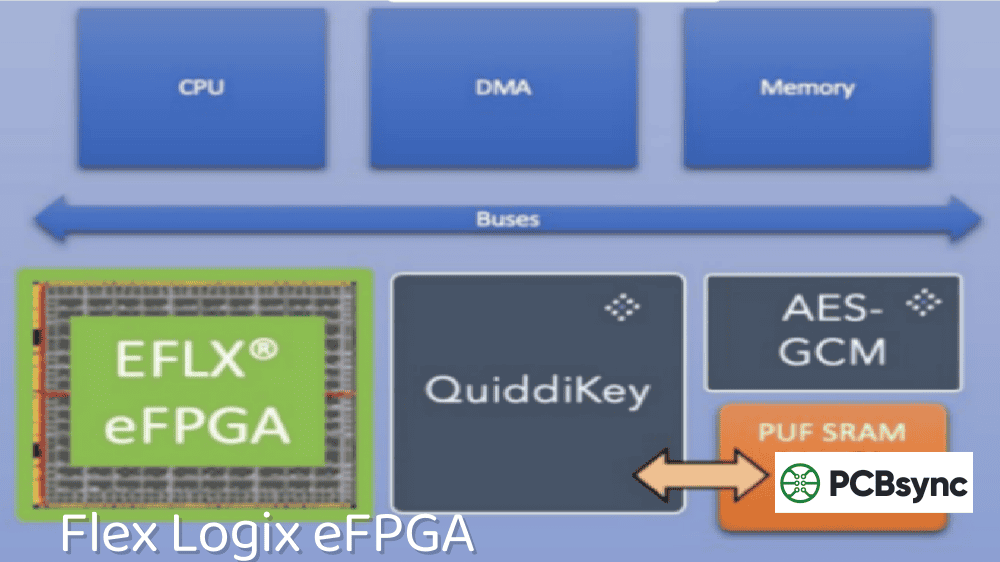
Flex Logix FPGA technology isn’t a standalone FPGA chip—it’s licensable IP that you embed directly into your ASIC or SoC. Think of it as getting the reconfigurable fabric of an FPGA, but without the external chip, the high-speed I/O overhead, and the associated power and board space penalties.
The company was founded in 2014 by CEO Geoff Tate (formerly of Rambus), CTO Cheng Wang, and UCLA professor Dejan Markovic. Their core innovation was the XFLX interconnect architecture—a hierarchical routing structure that uses roughly half the silicon area compared to traditional mesh interconnects found in standalone FPGAs. This density advantage is what makes eFPGA practical for embedding in production chips.
EFLX Core Architecture
The Flex Logix FPGA platform is built around two main IP cores: the EFLX1K and the EFLX4K. These cores can be tiled together to create larger arrays, giving designers flexibility in sizing the eFPGA to match their specific requirements.
Specification
EFLX1K
EFLX4K
LUT4 Equivalents
~1,000
~4,000
I/O Count
368 inputs / 368 outputs
632 inputs / 632 outputs
DSP Version
10 MACs
40 MACs
Max Array Size
Up to 4×4 tiles
Up to 7×7 tiles
Target Applications
Low-cost, low-power IoT
High-performance SoCs
Both cores come in Logic and DSP variants. The Logic version is pure reconfigurable fabric, while the DSP version trades some LUTs for multiply-accumulator (MAC) units—essential for signal processing and AI inference applications.
Supported Process Nodes and Foundry Partnerships
One of the practical advantages of the Flex Logix FPGA platform is its broad process node support. The company has been a TSMC IP Alliance Member, which speaks to the maturity of their technology and documentation. Here’s what’s available:
Process Node
Foundry
Status
Eval Board
7nm
TSMC N7
Production
Available
12nm
TSMC 12FFC, GF12LP
Silicon Proven
Available
16nm
TSMC 16FFC/FF+
Silicon Proven
Available
22nm
TSMC 22ULP, GF22FDX
Silicon Proven
Available
28nm
TSMC 28HPC/HPC+
Silicon Proven
Available
40nm
TSMC 40ULP/LP
Silicon Proven
Available
5nm/3nm/18A
TSMC/Intel
In Development
Planned
The operating temperature range spans -40°C to +125°C (Tj), which covers most industrial and automotive requirements. The company can port to new process nodes in 6-9 months, which is important if you’re targeting a foundry or node not listed above.
Why Embed an FPGA Instead of Using a Standalone Chip?
I get this question a lot from engineers who’ve only worked with discrete FPGAs. The value proposition comes down to several factors that compound in production:
Cost and Power Reduction
Flex Logix claims a 5-10x reduction in FPGA cost and power when integrating eFPGA versus using a standalone FPGA. Here’s where those savings come from:
No programmable I/O buffers: Standalone FPGAs dedicate roughly half their power consumption to I/O circuitry. With eFPGA, you connect directly to your SoC’s internal buses.
Right-sized fabric: You’re not paying for unused LUTs, DSP blocks, or memory. You configure exactly what you need.
Eliminated support components: No external voltage regulators, clock generators, level shifters, or configuration flash for the FPGA.
When you embed the FPGA, the connection between your processor and the reconfigurable logic is a wide, parallel, on-chip interface—not a constrained external bus. This translates to:
Single-digit clock cycle latency for communication between the eFPGA and other blocks
Higher bandwidth without the bottleneck of chip-to-chip interfaces
Better signal integrity—no package parasitics or PCB routing concerns
Real-World Applications of Flex Logix FPGA Technology
Over the years, I’ve seen eFPGA deployed in a wide range of applications. Here are the most common use cases where Flex Logix FPGA technology makes practical sense:
Configurable GPIO and Protocol Translation
There are countless variations of UARTs, SPIs, I2C, and other serial protocols. An SoC can only hardwire so many. In the past, large customers might request metal mask revisions for special interfaces—that’s not economical at FinFET nodes where mask costs can exceed $1M. With 4K-8K LUTs of eFPGA on a peripheral bus, any GPIO protocol can be implemented in the field.
Cryptographic Agility and Post-Quantum Security
Security algorithms have a shelf life. When new vulnerabilities are discovered or quantum computing threatens existing encryption, you need to update your cryptographic implementation. The Flex Logix FPGA platform enables crypto agility—the ability to swap in new encryption algorithms post-deployment. Companies like Xiphera have demonstrated NIST-approved post-quantum algorithms running on EFLX arrays.
AI Inference and Signal Processing Acceleration
AI models evolve rapidly. Most TPU architectures struggle when new operators or activation functions emerge—they fall back to much slower processor execution. eFPGA can implement these new functions at hardware speed, extending the useful life of your AI accelerator. The InferX IP, which Flex Logix developed for AI and DSP workloads, can reduce memory bandwidth requirements by more than 10x through on-the-fly data format conversion.
Defense and Aerospace Applications
U.S. defense customers face a unique challenge: most standalone FPGAs are manufactured in Taiwan, which presents supply chain risks. Flex Logix has ported EFLX to Sandia National Labs’ 180nm proprietary fab in Albuquerque, and has licenses with DARPA, Boeing, the Air Force Research Laboratory, and other defense entities. RadHard-by-Design versions have also been developed using customers’ radiation-hardened standard cells.
Software Tools: The EFLX Compiler and eXpreso
A common concern with any eFPGA is the toolchain. If the software isn’t mature, integration becomes a nightmare. Flex Logix provides the EFLX Compiler, which handles synthesis output, packing, placement, routing, timing analysis, and bitstream generation.
In 2024, they announced eXpreso, their second-generation compiler with significant improvements:
Up to 1.5x higher operating frequency
2x denser LUT packing
10x faster compile times
You write your reconfigurable logic in standard Verilog or VHDL, run it through a synthesis tool like Synopsys Synplify, and the EFLX Compiler handles the rest. The resulting bitstream programs the array to execute your RTL.
DARPA and multiple U.S. government agencies: Various defense applications
SiFive: RISC-V processor integration
The Analog Devices Acquisition: What It Means
In November 2024, Analog Devices (ADI) acquired Flex Logix, bringing the technology and engineering team in-house. For engineers evaluating Flex Logix FPGA technology, this has several implications:
Continued support: ADI has indicated they’re maintaining the technology and supporting existing customers
Broader integration: Expect to see eFPGA capabilities embedded in future ADI mixed-signal products
Analog + Digital convergence: ADI’s strength in precision analog combined with reconfigurable digital fabric opens new possibilities for intelligent edge devices
The acquisition makes strategic sense. ADI has been strong in analog but needed to expand its digital capabilities for AI, IoT, and 5G applications. eFPGA provides the flexibility their customers need to adapt to rapidly evolving requirements.
eFPGA vs. Standalone FPGA vs. Pure ASIC: Making the Right Choice
Here’s a practical comparison to help you decide which approach fits your project:
Factor
Standalone FPGA
ASIC + eFPGA
Pure ASIC
Unit Cost (Volume)
High
Medium
Low
NRE Cost
None
High + IP License
High
Power Consumption
High
Medium
Low
Board Space
Large
Small
Smallest
Reprogrammability
Full
Partial (eFPGA only)
None
Time to Market
Fast
Medium
Long
Best For
Prototyping, low volume
Medium-high volume with flexibility needs
High volume, fixed function
Getting Started with Flex Logix eFPGA Integration
If you’re considering Flex Logix FPGA technology for your next SoC project, here’s a practical roadmap:
Define your requirements: How many LUTs do you need? Do you require DSP/MAC resources? What process node are you targeting?
Request an evaluation: Flex Logix offers evaluation boards with working silicon for TSMC 16nm, 12nm, and 7nm nodes. These let you validate your RTL on real hardware.
Engage early: Integration works best when the eFPGA is considered from the start of your SoC architecture, not bolted on later.
Plan for testability: EFLX includes DFT features with special logic for test acceleration, but factor this into your overall DFT strategy.
Useful Resources and Documentation
Here are valuable resources for engineers exploring Flex Logix FPGA technology:
Frequently Asked Questions About Flex Logix FPGA Technology
Q1: How does Flex Logix eFPGA density compare to standalone FPGAs?
The EFLX architecture achieves LUT density (LUTs per square millimeter) comparable to standalone FPGAs from AMD/Xilinx and Intel at the same process node. The key innovation is the XFLX hierarchical interconnect, which uses approximately half the area of traditional mesh interconnects. This means you’re not sacrificing density when you embed the FPGA.
Q2: Can I use the same RTL code I’ve written for Xilinx or Intel FPGAs?
Your Verilog or VHDL code is portable, but you’ll need to re-synthesize and compile it with the EFLX Compiler. Any vendor-specific primitives (like Xilinx DSP48 macros) will need to be replaced with equivalent functionality. Standard RTL that doesn’t rely on vendor-specific IP should work with minimal changes.
Q3: What happens to Flex Logix support now that Analog Devices acquired them?
ADI has indicated that existing customers are being supported and the technology is being maintained. The technical team has joined ADI, so engineering expertise isn’t going away. Contact ADI directly for current licensing and support arrangements—the transition may actually expand access to this technology.
Q4: Is eFPGA practical for battery-powered or ultra-low-power applications?
Yes. The EFLX1K on TSMC 40nm ULP specifically targets IoT and battery-powered devices with power management circuitry for very low standby power. Without the external FPGA’s I/O power consumption and the ability to right-size the fabric, eFPGA can be significantly more power-efficient than standalone alternatives.
Q5: How long does it take to integrate eFPGA into an SoC design?
Multiple customers have achieved first-time working silicon within a year, including porting to new process nodes. The EFLX IP was architected for easy integration—Synapse Design and Global Unichip Corporation both reported successful tape-outs with minimal integration overhead. Plan for standard IP integration timelines, plus time to develop and validate your reconfigurable logic.
Final Thoughts: Is Flex Logix eFPGA Right for Your Design?
After a decade of development and real-world deployment, Flex Logix FPGA technology has proven that embedded FPGA isn’t just a research concept—it’s a practical solution for production silicon. The acquisition by Analog Devices validates the technology’s maturity and opens new possibilities for integration into mixed-signal systems.
From my perspective as someone who’s worked on PCB designs with FPGAs, the board-level benefits alone are compelling: fewer components, simpler routing, smaller form factors. Add the power savings and the ability to adapt to changing requirements post-deployment, and eFPGA becomes hard to ignore for medium-to-high volume applications where flexibility matters.
The technology isn’t for every project. If you’re building a one-off prototype or your algorithms are completely fixed, a standalone FPGA or pure ASIC might make more sense. But for products that need to adapt—whether to evolving protocols, new security threats, regional variations, or AI model updates—the Flex Logix FPGA platform deserves serious consideration.
Inquire: Call 0086-755-23203480, or reach out via the form below/your sales contact to discuss our design, manufacturing, and assembly capabilities.
Quote: Email your PCB files to Sales@pcbsync.com (Preferred for large files) or submit online. We will contact you promptly. Please ensure your email is correct.
Notes: For PCB fabrication, we require PCB design file in Gerber RS-274X format (most preferred), *.PCB/DDB (Protel, inform your program version) format or *.BRD (Eagle) format. For PCB assembly, we require PCB design file in above mentioned format, drilling file and BOM. Click to download BOM template To avoid file missing, please include all files into one folder and compress it into .zip or .rar format.