Inquire: Call 0086-755-23203480, or reach out via the form below/your sales contact to discuss our design, manufacturing, and assembly capabilities.
Quote: Email your PCB files to Sales@pcbsync.com (Preferred for large files) or submit online. We will contact you promptly. Please ensure your email is correct.
Notes: For PCB fabrication, we require PCB design file in Gerber RS-274X format (most preferred), *.PCB/DDB (Protel, inform your program version) format or *.BRD (Eagle) format. For PCB assembly, we require PCB design file in above mentioned format, drilling file and BOM. Click to download BOM template To avoid file missing, please include all files into one folder and compress it into .zip or .rar format.
If you’ve spent any time designing RF/microwave circuits or working with antenna PCBs, you’ve likely encountered situations where standard substrates just don’t cut it. The signal loss is too high, the weight is unacceptable, or the thermal performance falls short. That’s exactly where Evonik PCB materials come into play—specifically their ROHACELL structural foam that’s been quietly revolutionizing high-frequency circuit design for decades.
As a PCB engineer who has worked with various dielectric materials, I can tell you that ROHACELL stands in a category of its own. This polymethacrylimide (PMI) foam offers a combination of electrical properties and mechanical strength that simply isn’t available from conventional PCB materials. Let me walk you through what makes this material special and why it deserves a place in your design toolkit.
Evonik Industries, one of the world’s largest specialty chemical companies headquartered in Germany, has been manufacturing ROHACELL for over 50 years. This closed-cell rigid foam is based on polymethacrylimide (PMI) chemistry and was originally developed for aerospace composite structures. However, its exceptional dielectric properties quickly caught the attention of RF engineers.
What makes ROHACELL unique is its 100% closed-cell structure. Unlike open-cell foams that absorb resin throughout their volume, ROHACELL only takes up resin at the surface where cells have been cut open. This means you get predictable, consistent electrical performance without the weight penalty of resin infiltration.
The material looks somewhat like polystyrene foam (think Styrofoam), but that’s where the similarity ends. ROHACELL offers heat resistance up to 220°C, superior mechanical strength, excellent fatigue resistance, and—most importantly for us PCB folks—dielectric properties that rival air itself.
Key Properties That Matter for PCB Applications
Dielectric Performance
Here’s where ROHACELL really shines. The dielectric constant (Dk) ranges from approximately 1.04 to 1.12 depending on the grade and density—remarkably close to air (Dk = 1.0). The loss tangent (Df) is equally impressive, measuring below 0.005 at 10 GHz for most grades.
To put this in perspective, standard FR-4 has a Dk around 4.2-4.5 and a Df of approximately 0.02. Even high-frequency laminates like Rogers RO4003C sit around Dk 3.38. ROHACELL’s near-air dielectric constant means minimal signal distortion and maximum RF transparency.
Table 1: ROHACELL Dielectric Properties at 10 GHz
Grade
Density (kg/m³)
Dk @ 10 GHz
Loss Tangent
31 HF
32
1.046
0.0017
51 HF
52
1.067
0.0041
71 HF
75
1.093
0.0038
71 IG
75
1.09
0.0034
Mechanical Strength and Thermal Performance
Don’t let the word “foam” fool you. ROHACELL delivers compressive strength ranging from 0.4 MPa to 2.8 MPa depending on density, with tensile strength up to 3.2 MPa for higher-density grades. The heat distortion temperature reaches 190°C to 220°C, making it compatible with lead-free soldering processes and high-temperature autoclave curing.
The creep compression resistance is particularly noteworthy. You can process ROHACELL at temperatures up to 180°C and pressures up to 0.7 MPa without permanent deformation. This opens up compatibility with virtually all composite manufacturing processes including prepreg autoclave, RTM, vacuum infusion, and hand lay-up.
Evonik ROHACELL® Guide
PCBSync Engineering Tools
What is ROHACELL®?
ROHACELL® is a lightweight, closed-cell structural foam based on polymethacrylimide (PMI) chemistry by Evonik. It features extremely low dielectric constants (Dk ~1.04-1.16), making it ideal for RF/microwave PCB applications, antenna substrates, radomes, and dielectric spacers. The foam offers superior strength-to-weight ratio and excellent electromagnetic wave transparency.
Applications: Resin infusion, RTM, weight-critical parts
🎯 Find the Right ROHACELL® Grade
Answer these questions to get material recommendations for your application.
✅
Recommended ROHACELL® Grades
Grade
Density (kg/m³)
Compressive Strength (MPa)
Tensile Strength (MPa)
Shear Strength (MPa)
Tensile Modulus (MPa)
Max Process Temp (°C)
Application
ROHACELL® HF (Antenna Grade)
31 HF
32
0.4
1.0
0.4
36
130
RF/Antenna
51 HF
52
0.9
1.9
0.8
70
130
RF/Antenna
71 HF
75
1.5
2.8
1.3
92
130
RF/Antenna
ROHACELL® IG-F (Industrial Grade)
31 IG-F
32
0.4
1.0
0.4
36
130
Industrial
71 IG-F
75
1.5
2.8
1.3
92
130
Industrial
110 IG-F
110
3.0
3.5
2.4
160
130
Industrial
ROHACELL® HERO (Premium)
71 HERO
75
1.1
4.1
1.3
123
180
Premium
110 HERO
110
2.5
6.3
2.3
189
180
Premium
200 HERO
205
7.1
12.3
5.2
389
180
Premium
Note:Values are typical specifications. All ROHACELL® products are closed-cell PMI foams, CFC-free. Contact Evonik for specific application requirements.
📡 Why ROHACELL® for RF/Microwave PCBs?
ROHACELL® has dielectric properties very close to air (Dk ≈ 1.0), making it ideal for antenna substrates, radome cores, and dielectric spacers. The extremely low dielectric constant and loss tangent ensure minimal signal interference and maximum electromagnetic wave transparency.
Grade
Dk @2.5GHz
Dk @5GHz
Dk @10GHz
Dk @26.5GHz
Df @10GHz
ROHACELL® HF (Antenna Optimized)
31 HF
1.05
1.04
1.04
1.04
0.0017
51 HF
1.06
1.06
1.07
1.05
0.0041
71 HF
1.07
1.106
1.09
1.09
0.0038
ROHACELL® WF (Aerospace)
51 WF
1.06
1.08
1.07
1.07
0.0035
71 WF
1.07
1.10
1.10
1.08
0.0044
110 WF
1.09
1.19
1.16
1.12
0.0056
ROHACELL® IG/A (Industrial)
31 IG/A
–
–
1.05
–
0.0017
71 IG/A
–
–
1.09
–
0.0034
110 IG/A
–
–
1.12
–
0.0046
📊 Dielectric Comparison: ROHACELL® vs Other Materials
Evonik is a global specialty chemicals company headquartered in Essen, Germany. ROHACELL® has been the leading PMI structural foam for over 50 years, manufactured in Darmstadt (Germany) and Mobile, Alabama (USA).
🧪
PMI Chemistry
Polymethacrylimide
📅
50+ Years
Industry Experience
🌍
2 Facilities
Germany & USA
♻️
CFC-Free
Eco-Friendly
🔧 Design & Manufacturing Tips
✓
Use HF Grade for RF Applications
ROHACELL® HF is specifically designed for antenna applications with the lowest Dk values and finest cell structure for metallic panel compatibility.
✓
Attachment to PCB
ROHACELL® can be attached to antenna PCBs as a dielectric spacer. Use pressure-sensitive adhesives or thin adhesive films for bonding.
✓
CNC Machining
ROHACELL® can be easily CNC machined, drilled, and thermoformed. Complex geometries can be supplied pre-shaped by Evonik’s Shapes Department.
✓
Moisture Considerations
While PMI foam is closed-cell, seal all surfaces in humidity-sensitive applications to prevent moisture absorption and dimensional changes.
✓
Temperature Selection
Use XT or HERO grades for high-temperature processing (>130°C). Standard IG-F and HF grades are limited to 130°C max processing temperature.
Evonik offers multiple ROHACELL product lines, each optimized for specific applications. Here’s a breakdown of the grades most relevant to PCB engineers:
Table 2: ROHACELL Grade Selection Guide for PCB Applications
Grade
Best For
Max Temp
Key Feature
HF
Antenna PCBs, 5G, Radomes
130°C
Ultra-fine cell, lowest Dk
IG-F
Industrial, Medical, Automotive
130°C
Fine cell, minimal resin uptake
WF
Aerospace structures
180°C
MIL-PRF-46194A qualified
HERO
Aircraft primary structures
180°C
Highest elongation at break
RIMA
High-strength RF applications
180°C
Finest cell, minimum resin
EC
Stealth, EMI shielding
180°C
Electrically conductive
For most PCB antenna applications, ROHACELL HF is the go-to choice. Its ultra-fine cell structure ensures minimal resin uptake and problem-free compatibility with metallic facing materials. The grade is specifically engineered for high-frequency applications ranging from miniature cell phone antennas to large stationary communication systems.
Real-World Applications in PCB Design
RF/Microwave Antenna PCBs
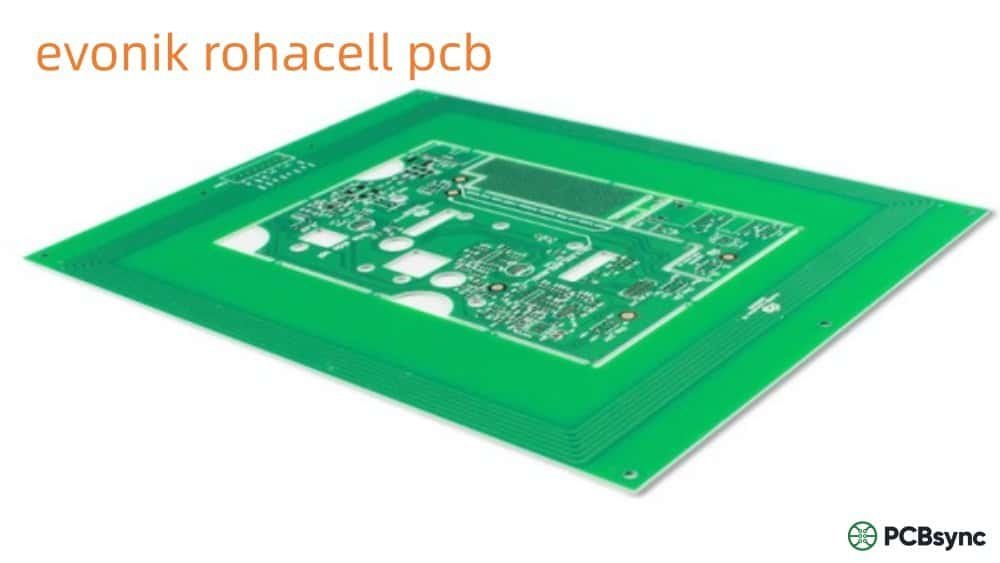
This is where ROHACELL truly excels. The foam serves as an ideal spacer between radome structures and antenna elements, providing a low-loss barrier that’s actually better than air in many configurations. PCB fabricators attach ROHACELL to advanced RF/Microwave circuit structures, often integrated with heat sinking and chassis hardware.
These antenna assemblies find homes in commercial and military aircraft, UAVs (unmanned aerial vehicles), satellite communications, and broadband/cellular equipment. The 5G rollout has particularly increased demand for ROHACELL-based PCB substrates capable of handling millimeter-wave frequencies without significant signal degradation.
Radome Construction
Radomes—the protective covers for radar equipment—demand materials that are mechanically robust yet electromagnetically transparent. ROHACELL sandwich cores meet both requirements. Since the foam’s dielectric properties closely match air, radar beams pass through without obstruction while the high strength and stiffness protect sensitive antenna designs.
The material can be thermoformed into complex double-curved shapes, making it suitable for aerodynamic radome designs on aircraft nose cones, helicopter systems, and ship-based radar installations.
Medical Electronics
An interesting application that many engineers overlook is medical imaging equipment. ROHACELL cores in X-ray tables and CT scanner beds reduce radiation exposure to patients. Because the foam offers high mechanical strength at low density, thinner cores with lower X-ray absorption can replace heavier alternatives while maintaining structural integrity.
The homogeneous cell structure also produces even surface resin distribution, leading to low-interference X-ray images for optimal diagnosis. It’s a case where electrical properties and mechanical performance combine to directly improve patient outcomes.
UAV and Defense Applications
The defense sector has embraced ROHACELL for multiple reasons. In unmanned aerial vehicles (UAVs), weight savings translate directly to extended flight time and payload capacity. The electrically conductive ROHACELL EC grade offers an additional benefit—radar absorption properties that make it ideal for stealth applications. By loading the polymer with carbon particles during processing, Evonik created a foam that combines mechanical performance with electromagnetic wave absorption at radar frequencies.
Military-grade radomes require materials that can withstand extreme environmental conditions while maintaining RF transparency. ROHACELL WF has accumulated over 25 years of successful service in aircraft applications, with qualifications including MIL-PRF-46194A and various Airbus specifications. This track record provides the design confidence that defense contractors require.
Wind Energy and Industrial Applications
While not strictly a PCB application, ROHACELL’s use in wind turbine blades demonstrates its versatility. The foam core reduces blade weight, which decreases loads on the hub and extends service life. Offshore wind installations particularly benefit from the material’s resistance to harsh environmental conditions.
For PCB engineers, understanding these broader applications provides context for supplier relationships and material availability. When you’re sourcing ROHACELL for antenna applications, you’re tapping into a well-established supply chain with proven quality control systems.
Processing Considerations
One of ROHACELL’s advantages is processing flexibility. The material can be machined using standard CNC equipment—milling, drilling, turning, and sanding all work without special tooling. For complex shapes, thermoforming at temperatures between 175°C and 220°C (depending on grade and density) produces precise 3D geometries.
When integrating ROHACELL with PCBs, engineers have developed several attachment methods. The closed-cell structure means adhesive bonding is straightforward, and the material is compatible with all common resin systems including polyester, vinyl ester, and epoxy.
Important moisture note: Like most foams, ROHACELL absorbs moisture from the environment through diffusion. While this process is slow due to the closed-cell structure, it can affect creep behavior and cause dimensional changes. Evonik recommends drying the material before high-temperature processing. Heat-treated (-HT) versions are available pre-dried and packaged in diffusion-proof aluminum bags.
Cost Considerations and ROI
Let’s address the elephant in the room: ROHACELL is not cheap. Compared to standard rigid foams, you’re paying a premium for those exceptional properties. However, the total cost equation often favors ROHACELL when you factor in the complete picture.
First, consider processing efficiency. ROHACELL’s high creep compression resistance means faster autoclave cycles and shorter curing times. Studies comparing ROHACELL HERO to honeycomb core alternatives showed potential cost savings of 21-25% on total part costs when factoring in material, labor, and machine time. The foam’s easy machinability also reduces setup time and tooling costs.
Second, think about performance-related costs. In antenna applications, using ROHACELL can eliminate the need for signal amplification circuitry that would otherwise compensate for substrate losses. In weight-critical aerospace applications, every gram saved translates to fuel savings over the aircraft’s operational lifetime.
For prototyping and low-volume production, material costs dominate. But as volumes increase, ROHACELL’s processing advantages become more significant. Work with your fabrication partner to model total costs for your specific application before dismissing the material based on raw material pricing alone.
How ROHACELL Compares to Alternative Materials
Understanding where ROHACELL fits in the broader materials landscape helps engineers make informed decisions. Here’s how it stacks up against common alternatives:
ROHACELL vs. Honeycomb (Nomex/Aluminum)
Honeycomb cores offer excellent strength-to-weight ratios but require more complex processing, including careful surface preparation and potting. ROHACELL’s closed-cell structure eliminates moisture ingress concerns and simplifies bonding. In fatigue testing, ROHACELL HERO outperformed Nomex honeycomb by approximately 52% in cycled load scenarios. However, honeycomb may be preferred where maximum compressive strength is the primary requirement.
ROHACELL vs. PVC Foam
Closed-cell PVC foams cost less than ROHACELL and work well for marine and industrial applications. However, ROHACELL’s dielectric properties are superior, and its temperature resistance (up to 220°C vs. typically 70-80°C for PVC) opens up high-temperature processing options. For RF applications, PVC simply doesn’t compete.
ROHACELL vs. Syntactic Foams
Syntactic foams (hollow microspheres in a resin matrix) offer good compressive strength and can be tailored for specific density requirements. They’re often used in deep-sea applications. However, their dielectric properties vary significantly based on composition, and they’re typically heavier than ROHACELL at comparable mechanical performance levels.
Beyond ROHACELL: Evonik’s PCB Etching Chemicals
While ROHACELL gets most of the attention, Evonik also supplies essential chemicals for PCB manufacturing. As the sole North American producer of high-quality ammonium, potassium, and sodium persulfates, Evonik provides etching solutions that are thermally stable, economical, and maintain extended shelf life.
Persulfates serve as powerful oxidizing agents that clean and micro-etch various PCB substrates. They’re also used in plating and coating processes, cleaning aluminum, brass, copper, and other metal surfaces prior to plating or adhesive bonding. For semiconductor applications, Evonik offers multiple grades of high-purity hydrogen peroxide under the PERTRONIC brand, conforming to SEMI specifications for the most advanced manufacturing processes.
After working with ROHACELL across multiple projects, here are some practical insights that don’t always make it into the datasheets:
Storage matters: Keep ROHACELL in its original packaging until ready for use. If you’ve opened a package, store the remainder in a sealed bag with desiccant. Moisture absorption is reversible through drying, but it’s easier to prevent than correct.
Start with HF grade: For most antenna PCB applications, ROHACELL HF provides the best balance of RF performance and cost. Only move to specialty grades like RIMA or XT if your application genuinely requires their enhanced properties.
Prototype early: ROHACELL’s machinability makes it practical for prototype quantities. Unlike some specialty materials that require minimum orders, distributors often stock common grades in small quantities for R&D work.
Work with experienced fabricators: Not all PCB houses are equipped to handle ROHACELL integration. Seek out fabricators with composite experience who understand the material’s characteristics. Companies like Cirexx International have published case studies specifically on ROHACELL antenna PCB assemblies.
Consider thickness options: Some distributors offer ROHACELL sliced to thicknesses as thin as 0.5mm to 1mm. These ultra-thin sheets open up applications in mobile devices and miniature antennas that weren’t practical with standard stock thicknesses.
Useful Resources and Downloads
For engineers looking to dive deeper into ROHACELL specifications and applications, here are the essential resources:
Material Distributors: Emkay Plastics (UK), CLARASONIC (US), Rock West Composites – Stock various grades for faster lead times
Frequently Asked Questions
1. What makes ROHACELL better than standard PCB substrates for RF applications?
ROHACELL’s dielectric constant (1.04-1.12) is dramatically lower than FR-4 (4.2-4.5) or even high-frequency laminates (3.0-3.5). This near-air permittivity means signals pass through with minimal loss and distortion. Combined with its lightweight structure and mechanical strength, it outperforms traditional substrates in antenna spacer and radome applications where RF transparency is critical.
2. Can ROHACELL withstand lead-free soldering temperatures?
Yes. Higher-grade ROHACELL materials (WF, HERO, XT) offer heat distortion temperatures up to 220°C and can be processed at 180°C under pressure. This makes them compatible with lead-free soldering profiles. However, always verify the specific grade’s thermal limits against your process requirements.
3. Which ROHACELL grade should I use for 5G antenna PCBs?
ROHACELL HF is specifically designed for high-frequency applications. Its ultra-fine cell structure provides the lowest dielectric constant and minimal signal interference across millimeter-wave frequencies used in 5G. For applications requiring higher mechanical strength, ROHACELL RIMA offers excellent RF transparency with enhanced structural properties.
PCB fabricators have developed multiple attachment methods depending on the application. Common approaches include adhesive bonding (compatible with epoxy, polyester, and vinyl ester systems), prepreg processing, vacuum infusion, and hand lay-up. The closed-cell structure ensures predictable bonding without excessive resin absorption. Consult with your fabrication partner or Evonik’s technical team for application-specific guidance.
5. Is ROHACELL environmentally safe?
ROHACELL contains no CFCs (chlorofluorocarbons) and has no known adverse effects on humans, animals, plants, or microorganisms under normal conditions. The material is not absorbed through skin, respiratory tract, or gastrointestinal tract due to its high molecular weight. Evonik also produces ROHACELL at their Darmstadt facility using 100% renewable energy sources, reducing CO2 emissions by approximately 3,400 tons annually.
Conclusion
For RF/microwave PCB applications where signal integrity and weight reduction matter, Evonik’s ROHACELL materials offer a compelling solution. The combination of near-air dielectric properties, robust mechanical strength, and processing flexibility makes this PMI foam a valuable addition to any high-frequency designer’s toolkit.
Whether you’re designing antenna assemblies for 5G infrastructure, building radomes for aerospace applications, or developing medical imaging equipment, ROHACELL provides performance characteristics that standard PCB materials simply cannot match. The key is selecting the right grade for your specific application—HF for pure RF transparency, IG-F for general industrial use, or specialized grades like HERO and RIMA for demanding aerospace requirements.
As wireless communication continues advancing toward higher frequencies and more demanding performance requirements, materials like ROHACELL will become increasingly important in the PCB engineer’s design arsenal. The 5G revolution, expanding satellite communications, and autonomous vehicle radar systems all demand substrates that can handle millimeter-wave frequencies with minimal loss. ROHACELL’s proven track record spanning five decades of aerospace applications provides confidence that this material will continue evolving alongside industry needs.
It’s worth investing time to understand these specialty options and build relationships with fabricators experienced in processing these materials. The learning curve pays dividends when you encounter applications where conventional substrates simply won’t deliver the performance your design requires. In the competitive landscape of high-frequency electronics, having ROHACELL in your materials toolkit can be the difference between meeting specifications and exceeding them.
Inquire: Call 0086-755-23203480, or reach out via the form below/your sales contact to discuss our design, manufacturing, and assembly capabilities.
Quote: Email your PCB files to Sales@pcbsync.com (Preferred for large files) or submit online. We will contact you promptly. Please ensure your email is correct.
Notes: For PCB fabrication, we require PCB design file in Gerber RS-274X format (most preferred), *.PCB/DDB (Protel, inform your program version) format or *.BRD (Eagle) format. For PCB assembly, we require PCB design file in above mentioned format, drilling file and BOM. Click to download BOM template To avoid file missing, please include all files into one folder and compress it into .zip or .rar format.