Inquire: Call 0086-755-23203480, or reach out via the form below/your sales contact to discuss our design, manufacturing, and assembly capabilities.
Quote: Email your PCB files to Sales@pcbsync.com (Preferred for large files) or submit online. We will contact you promptly. Please ensure your email is correct.
Notes: For PCB fabrication, we require PCB design file in Gerber RS-274X format (most preferred), *.PCB/DDB (Protel, inform your program version) format or *.BRD (Eagle) format. For PCB assembly, we require PCB design file in above mentioned format, drilling file and BOM. Click to download BOM template To avoid file missing, please include all files into one folder and compress it into .zip or .rar format.
When I first encountered Efinix FPGA devices at an embedded systems conference, I was skeptical. Another FPGA startup claiming to disrupt Xilinx and Lattice? We’ve seen that story before. But after spending considerable time evaluating their Trion and Titanium platforms for edge computing projects, I’ve come to appreciate what makes Efinix genuinely different.
Founded in 2012, Efinix developed a fundamentally different approach to FPGA architecture called Quantum technology. Unlike traditional FPGAs from established vendors that dedicate fixed silicon areas to either logic or routing, Efinix FPGA devices use their innovative eXchangeable Logic and Routing (XLR) cells. Each XLR cell can dynamically function as either a logic element (containing a LUT, register, and adder) or as a routing matrix. This flexibility allows the software tools to optimize silicon usage based on your actual design requirements rather than worst-case assumptions.
The practical result? Efinix claims up to 4X power-performance-area advantage over traditional FPGA architectures. From my testing, while the actual improvement varies by application, the efficiency gains are real and measurable, particularly in power-constrained edge computing scenarios.
Efinix currently offers two distinct FPGA families, each targeting different application requirements. Understanding the differences between Trion and Titanium is crucial for selecting the right device for your project.
Trion FPGA Family: Cost-Effective Edge Solutions
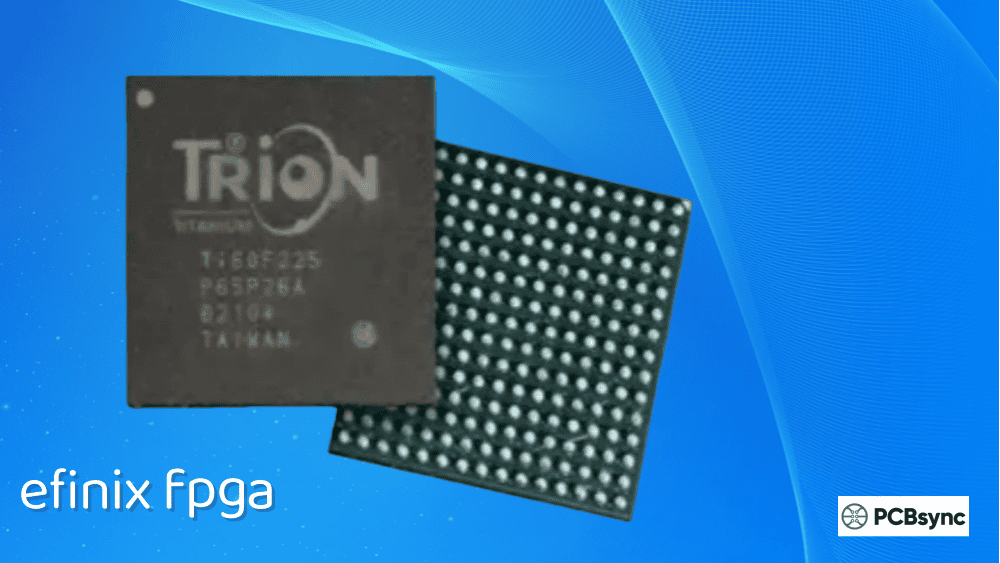
The Trion family represents Efinix’s first-generation products, fabricated on SMIC’s 40nm low-leakage process. These devices range from 4K to 120K logic elements and target applications where low power consumption and cost-effectiveness are priorities.
Key features of Trion FPGA devices:
Logic density from T4 (4K LEs) to T120 (120K LEs)
Hardened DDR3/LPDDR3 memory controllers on larger devices
MIPI CSI-2 interface support for camera applications
LVDS I/O for high-speed differential signaling
Available in LQFP packages for reduced PCB layer counts
Some packages include integrated SPI flash (16 Mbit)
From a PCB design perspective, the T8, T13, and T20 devices available in LQFP packages are particularly attractive for cost-sensitive projects. You can route these on 4-layer boards without the complexities of fine-pitch BGA escape routing.
Titanium FPGA Family: High-Performance Edge AI
Titanium represents Efinix’s next-generation platform, built on a 16nm process node. This family delivers significantly enhanced performance while consuming roughly one-third the power of equivalent Trion devices. The logic element range spans from 35K (Ti35) to an impressive 1M LEs (Ti1000).
Titanium advantages over Trion:
3X clock frequency improvement from 16nm process
2X efficiency improvement in Quantum compute fabric
Quarter the die size for equivalent logic
Hardened MIPI D-PHY supporting up to 2.5 Gbps per lane
LPDDR4/4x memory controller support
PCIe Gen4 on larger devices
SerDes up to 25.8 Gbps
Built-in SEU (Single Event Upset) detection and recovery
Efinix has committed to supporting the Titanium family until at least 2045, which provides the longevity assurance that industrial and automotive customers require for products with extended lifecycles.
Efinix FPGA Technical Specifications Comparison
The following table provides a side-by-side comparison of the Trion and Titanium Efinix FPGA families to help you make informed decisions for your projects.
Specification
Trion Family
Titanium Family
Process Node
40nm (SMIC 40LL)
16nm
Logic Elements
4K to 120K LEs
35K to 1M LEs
Memory Controller
DDR3/LPDDR3
LPDDR4/4x
MIPI Support
CSI-2 (soft PHY)
Hardened D-PHY up to 2.5 Gbps
High-Speed I/O
LVDS up to 800 Mbps
HSIO up to 1.5 Gbps, SerDes to 25.8 Gbps
Packages
LQFP, FineLine BGA
WLCSP (3.5mm), FineLine BGA
Target Applications
IoT, Consumer, Basic Vision
Edge AI, Sensor Fusion, Automotive
Power Consumption
Low (<150µA core leakage)
Ultra-low (1/3 of Trion)
Key Features of Efinix FPGA Architecture
Quantum Fabric Technology: The Core Innovation
The Quantum fabric represents a fundamental rethinking of FPGA architecture. Traditional FPGAs allocate fixed resources for logic blocks (CLBs) and separate interconnect routing. This architecture requires over-provisioning routing resources to handle worst-case scenarios, resulting in wasted silicon area in most real-world designs.
Efinix’s approach uses XLR cells that can transform between logic and routing functions during place-and-route. If your design is logic-heavy, more cells become logic elements. If it’s routing-intensive, cells transform into routing resources. This dynamic allocation means you’re not paying (in silicon area, power, or cost) for resources you don’t need.
RISC-V Integration: Sapphire SoC
Efinix provides comprehensive RISC-V support through their Sapphire SoC IP. Based on the VexRiscv core, Sapphire includes a 32-bit CPU with configurable pipeline stages, user peripherals (SPI, I2C, UART) on an APB bus, and memory controllers on an AXI bus. This enables you to implement complete embedded systems within the Efinix FPGA fabric.
What makes this particularly interesting for AI/ML applications is the custom instruction capability. You can extend the RISC-V instruction set with hardware accelerators for TensorFlow Lite operations, dramatically improving inference performance compared to pure software implementations.
Power Efficiency for Battery-Powered Designs
For battery-powered or thermally-constrained applications, the power profile of Efinix FPGA devices is compelling. The T8 device shows typical core leakage under 150µA at 1.1V, making it viable for always-on IoT applications where every milliwatt matters. The Titanium family extends this efficiency advantage with the 16nm process, achieving roughly one-third the power consumption of equivalent Trion designs.
The combination of small form factor, low power consumption, and sufficient compute capability positions Efinix FPGA devices for several growing market segments.
Machine Vision and AI Inference
With hardened MIPI interfaces and sufficient logic for image processing pipelines, Titanium devices excel in vision applications. Efinix provides their Edge Vision SoC framework, which includes camera interfaces, DMA controllers, display outputs, and a RISC-V core for system management. You can implement image preprocessing in the FPGA fabric while running TensorFlow Lite inference on the embedded processor.
Sensor Fusion and Industrial Automation
Industrial applications often require aggregating data from multiple sensors, performing real-time processing, and making control decisions with deterministic latency. The high I/O count and flexible interface capabilities of Efinix FPGA devices make them well-suited for sensor fusion applications in robotics, automated guided vehicles, and smart factory equipment.
Surveillance and Security Cameras
The surveillance camera market represents a significant opportunity for Efinix. These applications require MIPI camera interfaces, local image processing, video encoding support, and network connectivity. The T35, T55, and Ti60 devices provide the right balance of capability and cost for this segment.
Efinity Software Development Environment
The Efinity IDE provides a complete RTL-to-bitstream flow including synthesis, place-and-route, timing analysis, and programming. Unlike some competitors that restrict free versions to specific devices, Efinix offers free licenses for their complete Efinity software that supports all Efinix FPGA devices in their portfolio.
Key Efinity features:
Dashboard interface for automated or manual flow control
Interface Designer for peripheral configuration (GPIO, PLL, MIPI, DDR)
Package Planner for graphical pin assignment
Integrated debugger with concurrent TAP support
Command-line scripting for CI/CD integration
RISC-V IDE (Eclipse-based) powered by Ashling RiscFree
The place-and-route runtime has improved significantly in recent releases, with approximately 2X improvement in overall runtime. This matters when you’re iterating on timing closure for complex designs.
Development Kits for Getting Started with Efinix FPGA
Efinix offers several development kits ranging from the $35 Xyloni board for hobbyists to comprehensive kits for professional evaluation.
Development Kit
FPGA Device
Price Range
Target Use Case
Xyloni
T8F81 (8K LEs)
~$35
Hobbyist, Learning
T8 BGA81 Dev Kit
T8F81 (8K LEs)
~$99
Entry-level Professional
T20 MIPI Dev Kit
T20F256 (20K LEs)
~$299
Camera/Vision Prototyping
T120 BGA576 Dev Kit
T120F576 (120K LEs)
~$599
Full System Prototyping
Ti60 F225 Dev Kit
Ti60F225 (60K LEs)
~$399
Titanium Evaluation
Ti180 J484 Dev Kit
Ti180J484 (180K LEs)
~$699
AI/Vision Development
Each development kit includes a license for the Efinity software with one year of upgrades. The software license is renewable for free, which is refreshingly different from some vendors who charge annual maintenance fees.
PCB Design Considerations for Efinix FPGA
As a PCB engineer, you’ll appreciate several aspects of Efinix FPGA device packaging:
The FineLine BGA packages use familiar ball pitches (0.65mm to 0.8mm) that don’t require exotic PCB technology. For high-volume cost-sensitive designs, the availability of LQFP packages on smaller Trion devices can significantly reduce both PCB layer count and assembly costs.
Power supply design follows standard FPGA practices with separate core (1.0V-1.2V) and I/O voltage rails (1.8V, 2.5V, 3.3V depending on bank configuration). Efinix provides power calculator spreadsheets and reference designs to help estimate power requirements during design planning.
For high-speed interfaces like MIPI, LVDS, or SerDes, pay attention to the I/O bank assignments. Certain interfaces are only available on specific package pins, so early pin planning with the Interface Designer tool is essential. The datasheets provide detailed impedance requirements and routing guidelines for each interface type.
Efinix FPGA Resources and Downloads
Here are essential resources for working with Efinix FPGA devices:
How does Efinix FPGA compare to Lattice for low-power applications?
Both companies target the low-power FPGA market, but with different architectural approaches. Lattice uses Flash-based technology (non-volatile, instant-on) while Efinix uses SRAM-based configuration like Xilinx and Intel. Efinix claims superior area efficiency due to their Quantum fabric, potentially offering more logic density in a similar power envelope. For your specific application, I recommend requesting power estimates from both vendors with your actual resource requirements.
Is the Efinity software really free?
Yes. Unlike some competitors with feature-limited “web editions,” Efinix provides full-featured licenses supporting all their FPGA devices. You can register on their support portal to receive a free license with one year of maintenance. License renewals are also free upon request. The only cost is the development hardware itself.
Can Efinix FPGA devices be used in automotive applications?
Efinix has announced automotive-qualified versions of their devices and their Efinity tool suite has achieved ISO 26262 certification. However, specific automotive grades and temperature ranges should be confirmed with Efinix sales for your particular application requirements. The SEU detection feature in Titanium devices is particularly relevant for safety-critical automotive applications.
What’s the learning curve coming from Xilinx or Intel FPGAs?
The RTL design methodology is identical—your Verilog or VHDL code works unchanged. The main differences are in the tool flow and peripheral configuration. The Interface Designer for setting up I/O blocks is somewhat different from Xilinx’s IP Integrator or Intel’s Platform Designer, but engineers typically become productive within a few days. The Efinity IDE is straightforward and well-documented.
Where can I buy Efinix FPGA devices for production?
Efinix devices are available through major distributors including DigiKey and Mouser. For production volumes, you can work directly with Efinix or their authorized distribution partners. Lead times have been reasonable compared to some larger FPGA vendors, partly because Efinix uses standard CMOS processes at foundries like SMIC that don’t require specialized manufacturing steps.
Final Thoughts on Efinix FPGA Technology
Efinix represents a credible alternative in the FPGA market, particularly for edge computing, vision, and AI applications where power efficiency and cost matter. The Quantum architecture delivers measurable efficiency improvements over traditional FPGA fabrics, and the Titanium family’s 16nm process provides performance competitive with much larger devices from established vendors.
For PCB engineers evaluating FPGA options, the familiar BGA and LQFP packages, comprehensive documentation, and straightforward tool flow reduce adoption risk. The free software licensing removes a common barrier to evaluation. If your application fits within the 4K to 1M logic element range and prioritizes power efficiency over raw performance, Efinix deserves serious consideration alongside Lattice, Xilinx, and Intel solutions.
Inquire: Call 0086-755-23203480, or reach out via the form below/your sales contact to discuss our design, manufacturing, and assembly capabilities.
Quote: Email your PCB files to Sales@pcbsync.com (Preferred for large files) or submit online. We will contact you promptly. Please ensure your email is correct.
Notes: For PCB fabrication, we require PCB design file in Gerber RS-274X format (most preferred), *.PCB/DDB (Protel, inform your program version) format or *.BRD (Eagle) format. For PCB assembly, we require PCB design file in above mentioned format, drilling file and BOM. Click to download BOM template To avoid file missing, please include all files into one folder and compress it into .zip or .rar format.