Inquire: Call 0086-755-23203480, or reach out via the form below/your sales contact to discuss our design, manufacturing, and assembly capabilities.
Quote: Email your PCB files to Sales@pcbsync.com (Preferred for large files) or submit online. We will contact you promptly. Please ensure your email is correct.
Notes: For PCB fabrication, we require PCB design file in Gerber RS-274X format (most preferred), *.PCB/DDB (Protel, inform your program version) format or *.BRD (Eagle) format. For PCB assembly, we require PCB design file in above mentioned format, drilling file and BOM. Click to download BOM template To avoid file missing, please include all files into one folder and compress it into .zip or .rar format.
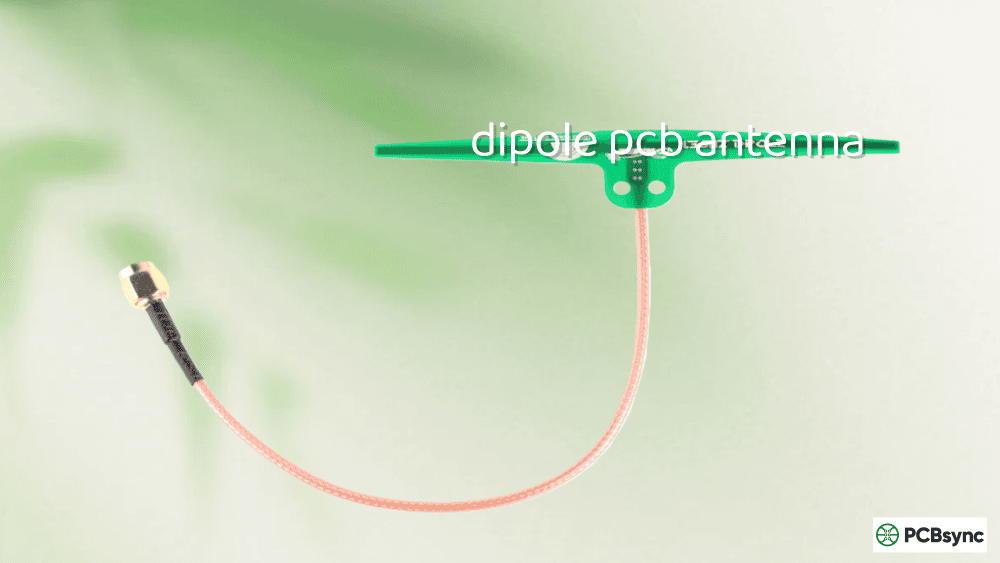
The dipole PCB antenna remains one of the most fundamental yet misunderstood antenna types in wireless product design. I’ve seen countless engineers default to monopole or IFA designs without considering that a printed dipole might actually deliver better performance for their application—particularly when omnidirectional coverage and balanced radiation patterns matter. Unlike monopoles that depend heavily on ground plane size and shape, dipole antennas create their own virtual ground through the second radiating element, offering more predictable performance across different product enclosures.
This guide covers practical dipole PCB antenna design from first principles through finished layout. Whether you’re designing for 433 MHz LoRa, 915 MHz ISM band, 2.4 GHz WiFi/Bluetooth, or 5.8 GHz applications, I’ll provide specific dimensions, balun implementations, and layout rules that work in real products. The dimension tables come from actual designs I’ve validated with VNA measurements—not just theoretical calculations that ignore substrate effects and feed parasitics.
A dipole PCB antenna consists of two conductive elements of equal length, fed at the center point where they meet. The name “dipole” literally means “two poles”—the two radiating arms that together form a complete antenna system. This symmetrical structure is what distinguishes dipoles from monopoles, which use a ground plane as the “missing” half of the antenna.
Half-Wave Dipole Theory
The classic half-wave dipole has a total length equal to one-half the wavelength (λ/2) of the operating frequency. Each arm is therefore λ/4 in length.
Parameter
Formula
Notes
Wavelength (λ)
c / f
c = 3×10⁸ m/s
Total dipole length
λ/2
Free space
Each arm length
λ/4
From center feed
Resonant impedance
~73Ω
Free space, ideal
Bandwidth (typical)
5-10%
Half-wave dipole
Critical point: These free-space values don’t apply directly to PCB dipoles. The substrate’s dielectric constant shortens the required length, and proximity to ground planes affects impedance. I’ll provide corrected dimensions for FR4 substrates later in this guide.
Dipole PCB Antenna Radiation Pattern
The radiation pattern of a dipole PCB antenna resembles a donut or torus shape when oriented vertically:
Direction
Radiation Level
Notes
Broadside (perpendicular to dipole axis)
Maximum
Main coverage area
End-fire (along dipole axis)
Null
Minimal radiation
Horizontal plane (vertical dipole)
Omnidirectional
360° coverage
Vertical plane
Figure-8
Two lobes
This pattern makes dipoles excellent for applications requiring coverage in all horizontal directions while the device orientation is predictable. For handheld devices with variable orientation, the nulls along the dipole axis can cause connectivity issues.
Dipole vs Monopole Impedance Characteristics
Parameter
Half-Wave Dipole
Quarter-Wave Monopole
Input impedance
73Ω
36.5Ω
Radiation resistance
73Ω
36.5Ω
Directivity
2.15 dBi
5.15 dBi (with infinite ground)
Ground plane required
No
Yes
Feed type
Balanced
Unbalanced
Length
λ/2 total
λ/4
The 73Ω impedance of dipoles doesn’t match 50Ω systems directly, requiring either a matching network or acceptance of some mismatch loss (~0.2 dB with proper design).
Types of Dipole PCB Antennas
Not all dipole PCB antenna designs look the same. The basic concept can be implemented in several ways, each with distinct advantages.
Straight Printed Dipole
The simplest form—two straight copper traces extending in opposite directions from a center feed point.
Characteristic
Value
Notes
Footprint
λ/2 × trace width
Longest dimension
Bandwidth
5-8%
Moderate
Gain
2.0-2.15 dBi
Near theoretical
Complexity
Low
Easy to design
Best for
External antennas, modules
Where space allows
Folded Dipole
A folded dipole connects the ends of both arms with an additional conductor, creating a closed loop structure.
Characteristic
Value
Notes
Input impedance
~292Ω (4× standard)
Requires matching
Bandwidth
10-15%
Wider than straight
Physical length
Slightly shorter
Due to end loading
Mechanical strength
Higher
Closed loop structure
Best for
Wide bandwidth applications
FM, TV, multi-band
The higher impedance of folded dipoles can be advantageous when matching to balanced transmission lines or when a 4:1 transformer provides better matching options.
Meander Dipole
Meander dipoles fold the radiating elements back and forth to reduce physical length while maintaining electrical length.
Characteristic
Value
Notes
Size reduction
30-50%
Vs straight dipole
Bandwidth
3-6%
Narrower
Efficiency
85-95%
Lower than straight
Complexity
Medium
Trace routing matters
Best for
Space-constrained PCBs
IoT, wearables
Comparison of Dipole PCB Antenna Types
Type
Size
Bandwidth
Gain
Impedance
Design Complexity
Straight
Large
Medium
High
73Ω
Low
Folded
Large
Wide
High
292Ω
Medium
Meander
Small
Narrow
Medium
Variable
High
Bow-tie
Medium
Very wide
Medium
Variable
Medium
Dipole PCB Antenna Dimensions by Frequency
Here are practical dipole PCB antenna dimensions for common wireless frequencies. These values account for FR4 substrate effects (εr ≈ 4.4) and assume 1.6mm board thickness with 1oz copper.
Formula: PCB length ≈ Free space length × Shortening factor
Balun Design for Dipole PCB Antenna
A critical aspect of dipole PCB antenna design that many engineers overlook is the balanced-to-unbalanced (balun) transition. Dipoles are inherently balanced antennas—both arms should carry equal and opposite currents. Coaxial cables and most RF ICs have unbalanced (single-ended) outputs.
A simple microstrip balun uses a quarter-wave transformer section:
Parameter
915 MHz
2.4 GHz
5.8 GHz
λ/4 length (FR4)
~49 mm
~19 mm
~8 mm
50Ω trace width (1.6mm FR4)
3.0 mm
3.0 mm
3.0 mm
100Ω trace width
0.8 mm
0.8 mm
0.8 mm
Coupled line gap
0.2 mm
0.2 mm
0.15 mm
Lumped Element Balun Values
For compact designs, a lumped LC balun works well:
Frequency
L (series)
C (shunt to GND)
Topology
433 MHz
56 nH
2.7 pF
Lattice
868 MHz
27 nH
1.5 pF
Lattice
915 MHz
24 nH
1.2 pF
Lattice
2.4 GHz
8.2 nH
0.5 pF
Lattice
Integrated Balun Options
Several IC manufacturers offer integrated baluns suitable for dipole PCB antenna feeds:
Part Number
Manufacturer
Frequency Range
Insertion Loss
HHM1595A1
TDK
2.4-2.5 GHz
0.5 dB
0896BM15A0001
Johanson
868-928 MHz
0.4 dB
2450BM15A0002
Johanson
2.4-2.5 GHz
0.5 dB
BAL-0006SMG
Mini-Circuits
DC-6 GHz
0.8 dB
Impedance Matching: 73Ω to 50Ω
The native 73Ω impedance of a half-wave dipole PCB antenna doesn’t perfectly match 50Ω systems. Here’s how to handle the mismatch.
Option 1: Accept the Mismatch
Parameter
Value
VSWR (73Ω into 50Ω)
1.46:1
Return loss
-14.5 dB
Mismatch loss
0.18 dB
Acceptable?
Yes, for most applications
For many applications, especially IoT devices where every dB doesn’t matter, simply accepting this mismatch is the pragmatic choice.
Option 2: Quarter-Wave Transformer
A quarter-wave transmission line section transforms impedance:
Parameter
Formula
Value
Required Z₀
√(73 × 50)
60.4Ω
Length
λ/4
Frequency dependent
Practical Z₀
60Ω (nearest standard)
Close enough
60Ω trace width on 1.6mm FR4: Approximately 2.0 mm
Option 3: L-Network Matching
Frequency
Series L
Shunt C
Notes
433 MHz
18 nH
5.6 pF
Q factor ~3
868 MHz
9.1 nH
2.7 pF
Q factor ~3
915 MHz
8.2 nH
2.4 pF
Q factor ~3
2.4 GHz
3.3 nH
1.0 pF
Q factor ~3
Option 4: Design for 50Ω Directly
Slightly shortening the dipole (by ~5%) reduces its impedance closer to 50Ω at the cost of some efficiency:
Dipole Length
Impedance
Efficiency Impact
0.50λ
73Ω
Reference (100%)
0.48λ
~65Ω
-0.1 dB
0.46λ
~55Ω
-0.3 dB
0.44λ
~48Ω
-0.5 dB
PCB Layout Guidelines for Dipole Antennas
Proper layout is essential for dipole PCB antenna performance. Unlike monopoles where the ground plane is part of the antenna, dipole layout focuses on maintaining symmetry and proper feed design.
Symmetry Requirements
Element
Requirement
Why
Arm lengths
Equal within 0.5%
Balanced currents
Arm widths
Identical
Consistent impedance
Routing
Mirror image
Radiation pattern
Component placement
Symmetric
Equal parasitic loading
Ground Plane Considerations
Configuration
Effect on Dipole
Notes
No ground under dipole
Best performance
Recommended
Ground parallel, λ/4 below
Enhanced gain
Acts as reflector
Ground parallel, < λ/10 below
Severe detuning
Avoid
Ground perpendicular to dipole
Minor effect
Usually acceptable
Keep-Out Zone Recommendations
Frequency
Keep-out from dipole arms
Keep-out from feed
433 MHz
20 mm
15 mm
868 MHz
12 mm
10 mm
915 MHz
10 mm
8 mm
2.4 GHz
5 mm
4 mm
5.8 GHz
3 mm
2 mm
Feed Point Layout
Parameter
Recommendation
Notes
Feed gap
0.5-2.0 mm
Frequency dependent
Transmission line
50Ω microstrip or CPWG
Maintain impedance
Via to ground
Not under dipole
Keep symmetry
Matching network
Close to feed
Minimize parasitics
Layer Stack Considerations
Layer
Content
Notes
Top
Dipole traces
Primary radiating elements
Layer 2
Ground plane (partial)
Keep out under dipole
Layer 3
Signal routing
Away from antenna
Bottom
Ground pour
Full coverage except under dipole
Dipole vs Monopole PCB Antenna: When to Choose Each
Understanding when a dipole PCB antenna outperforms a monopole—and vice versa—helps you make the right design choice.
Choose Dipole When:
Scenario
Why Dipole Wins
Small/irregular ground plane
Less sensitive to ground
Predictable device orientation
Can optimize pattern
External antenna module
Easier integration
Wide bandwidth needed
Folded dipole option
Balanced IC output
Direct connection possible
Choose Monopole When:
Scenario
Why Monopole Wins
Large consistent ground plane
Uses ground effectively
Minimum PCB space
Half the length
Variable device orientation
Less pattern nulls
Standard RF ICs
Unbalanced output
Cost sensitivity
No balun needed
Direct Comparison
Parameter
Half-Wave Dipole
Quarter-Wave Monopole
Total length
2× longer
Shorter
Ground dependence
Low
High
Balun required
Usually
No
Pattern symmetry
Better
Depends on ground
Design predictability
Higher
Lower
Common Dipole PCB Antenna Design Mistakes
After reviewing hundreds of dipole PCB antenna designs, these mistakes appear repeatedly:
Mistake 1: Ignoring the Balun
Problem: Connecting coax directly to dipole without balanced feed. Effect: Cable radiation, pattern distortion, hand sensitivity. Solution: Always include a balun, even a simple one.
Mistake 2: Asymmetric Layout
Problem: One arm has different routing or nearby components. Effect: Current imbalance, impedance shift, pattern tilt. Solution: Maintain mirror symmetry around feed point.
Mistake 3: Ground Plane Under Dipole
Problem: Solid ground pour directly beneath dipole arms. Effect: Massive detuning, bandwidth reduction, efficiency loss. Solution: Clear ground from dipole area on all layers.
Mistake 4: Using Free-Space Dimensions
Problem: Copying textbook λ/2 dimensions without substrate correction. Effect: Antenna resonates at wrong frequency. Solution: Apply shortening factor for your substrate (typically 0.77-0.85 for FR4).
Mistake 5: Inadequate Feed Gap
Problem: Feed gap too large or poorly defined. Effect: Impedance mismatch, difficult to tune. Solution: Use controlled gap (0.5-2mm depending on frequency) with proper transition from transmission line.
What is the main advantage of a dipole PCB antenna over a monopole?
The primary advantage of a dipole PCB antenna is its independence from ground plane size and shape. Monopole antennas use the ground plane as their “missing half,” making their performance highly dependent on ground plane geometry. In contrast, a dipole creates its own complete antenna system with both radiating elements present on the PCB. This makes dipoles more predictable when integrating into products with small, irregular, or plastic-enclosed boards. Additionally, dipoles offer a more symmetric radiation pattern without the asymmetry that ground plane edges introduce in monopole designs.
Why does a dipole PCB antenna need a balun?
Dipoles are balanced antennas—both arms should carry equal currents flowing in opposite directions. However, most RF sources (coaxial cables, IC outputs) are unbalanced, with signal on one conductor and ground on the other. Without a balun, connecting an unbalanced source to a balanced antenna causes common-mode currents to flow on the outside of the coax shield or along ground traces. These currents radiate unpredictably, distort the antenna pattern, and make the antenna sensitive to nearby objects including the user’s hand. A balun converts the unbalanced signal to balanced, ensuring symmetric antenna excitation.
How do I calculate dipole PCB antenna length for a specific frequency?
Start with the free-space half-wavelength formula: Length = c / (2 × f), where c = 3×10⁸ m/s and f is frequency in Hz. For 2.4 GHz, this gives 62.5 mm. Then apply the substrate shortening factor—typically 0.77-0.82 for FR4—resulting in approximately 48-51 mm total length. Divide by two for each arm length (24-25.5 mm per arm). Always verify with VNA measurements, as actual dimensions depend on trace width, substrate thickness, and nearby components. Cut the antenna slightly long initially and trim to tune.
Can I use a dipole PCB antenna without matching to 50Ω?
Yes, in many applications. A half-wave dipole has approximately 73Ω impedance, creating a 1.46:1 VSWR when connected to 50Ω. This represents only 0.18 dB mismatch loss—acceptable for most IoT and consumer applications. However, if maximum range is critical or you’re operating at power levels where reflected power matters, use a quarter-wave transformer (60Ω line) or simple L-network to match. For folded dipoles with ~292Ω impedance, matching is mandatory.
What’s the minimum PCB size for a dipole antenna at 2.4 GHz?
The dipole itself requires approximately 50-52 mm length on FR4 for 2.4 GHz—this is the minimum for a straight dipole. The PCB can extend beyond the dipole (for circuitry), but the dipole elements need this physical space. For smaller PCBs, consider a meander dipole, which can fit in approximately 18×8 mm by folding the elements. Alternatively, use an external dipole connected via U.FL connector, or switch to a chip antenna. Remember that ground plane clearance around the dipole (typically 5 mm at 2.4 GHz) adds to the total antenna area requirement.
Conclusion
Designing an effective dipole PCB antenna requires attention to several interconnected factors: accurate dimensions corrected for substrate effects, proper balun implementation for balanced feeding, impedance matching when necessary, and symmetric layout practices. The tables throughout this guide provide starting points for common frequencies from 433 MHz to 5.8 GHz, but always validate with VNA measurements on your actual PCB.
The decision between dipole and monopole antennas shouldn’t be automatic. Dipoles excel when ground plane control is limited, when balanced outputs are available, or when radiation pattern symmetry matters. Their higher input impedance (73Ω vs 36.5Ω) and requirement for balanced feed add complexity, but the performance benefits often justify the effort—especially for external antenna modules and applications where the device ground plane is small or unpredictable.
Start with the dimension tables provided, implement an appropriate balun from the options described, and follow the layout guidelines for ground plane clearance and symmetry. With these fundamentals in place, your dipole PCB antenna designs will deliver reliable performance across your target frequency bands.
Inquire: Call 0086-755-23203480, or reach out via the form below/your sales contact to discuss our design, manufacturing, and assembly capabilities.
Quote: Email your PCB files to Sales@pcbsync.com (Preferred for large files) or submit online. We will contact you promptly. Please ensure your email is correct.
Notes: For PCB fabrication, we require PCB design file in Gerber RS-274X format (most preferred), *.PCB/DDB (Protel, inform your program version) format or *.BRD (Eagle) format. For PCB assembly, we require PCB design file in above mentioned format, drilling file and BOM. Click to download BOM template To avoid file missing, please include all files into one folder and compress it into .zip or .rar format.