Inquire: Call 0086-755-23203480, or reach out via the form below/your sales contact to discuss our design, manufacturing, and assembly capabilities.
Quote: Email your PCB files to Sales@pcbsync.com (Preferred for large files) or submit online. We will contact you promptly. Please ensure your email is correct.
Notes: For PCB fabrication, we require PCB design file in Gerber RS-274X format (most preferred), *.PCB/DDB (Protel, inform your program version) format or *.BRD (Eagle) format. For PCB assembly, we require PCB design file in above mentioned format, drilling file and BOM. Click to download BOM template To avoid file missing, please include all files into one folder and compress it into .zip or .rar format.
BMS PCB Design: Complete Guide to Battery Management System & TP4056 Layout
If you’ve ever had a lithium battery pack fail prematurely or, worse, overheat dangerously, chances are the root cause traces back to the BMS PCB design. After spending over a decade laying out battery management circuits and troubleshooting failed prototypes, I can tell you that getting the PCB layout right is where most projects either succeed or go up in smoke—sometimes literally.
This guide walks you through everything you need to know about BMS PCB design, from fundamental architecture decisions to the nitty-gritty of TP4056 PCB layout for single-cell charging applications. Whether you’re building a custom e-bike battery pack or designing a simple 18650 charger for a weekend project, this is the practical knowledge that datasheets don’t always spell out clearly.
A Battery Management System PCB is the brain of any rechargeable battery pack. It’s responsible for monitoring cell voltages, managing charge and discharge cycles, balancing cells, protecting against overcurrent conditions, and keeping the entire pack within safe thermal limits. Unlike a typical signal processing board where a few millivolts of noise might cause minor glitches, mistakes in BMS PCB design can result in fires, explosions, or expensive battery replacements.
The layout matters more here than in most other PCB applications because you’re dealing with conflicting requirements simultaneously. High currents (sometimes exceeding 100A in automotive applications) need to flow through the same board that houses sensitive voltage measurement circuits accurate to within a few millivolts. Thermal management becomes critical when the same components that measure temperature can be affected by heat generated from nearby power electronics. Getting this balance right requires understanding both the electrical and thermal behavior of your layout.
BMS PCB Design Fundamentals: Understanding the Core Functions
Before touching your EDA software, you need to understand what functions your BMS needs to perform. This determines everything from layer count to copper weight.
Essential BMS Functions and Their PCB Implications
Function
Circuit Requirements
PCB Layout Considerations
Cell Voltage Monitoring
High-impedance analog inputs, precision references
Keep measurement traces short, route away from switching noise
Current Sensing
Shunt resistors or Hall sensors, high-accuracy ADC
Kelvin sensing connections, thermal isolation from power path
Cell Balancing
Passive (resistor) or active (switching)
Heat dissipation for passive, EMI containment for active
Overcurrent Protection
MOSFETs, gate drivers
Wide traces, thermal relief, fast switching paths
Temperature Monitoring
NTC thermistors or IC sensors
Place sensors near cells, route analog signals carefully
Each of these functions has specific layout requirements that, when ignored, lead to the kind of intermittent problems that make debugging a nightmare.
Choosing Your BMS Topology
The topology you choose affects the entire PCB architecture. For small packs (1-6 cells), a centralized topology where everything sits on one board makes sense. The wiring is simple, costs are low, and troubleshooting is straightforward. This is where ICs like the TP4056 shine for single-cell applications.
For larger packs (12+ cells), distributed or modular architectures become necessary. Each module handles a group of cells with its own PCB, and a master controller coordinates everything over a communication bus. This approach scales better but introduces complexity in inter-board connections and adds potential failure points at every connector.
TP4056 PCB Layout: Getting Single-Cell Charging Right
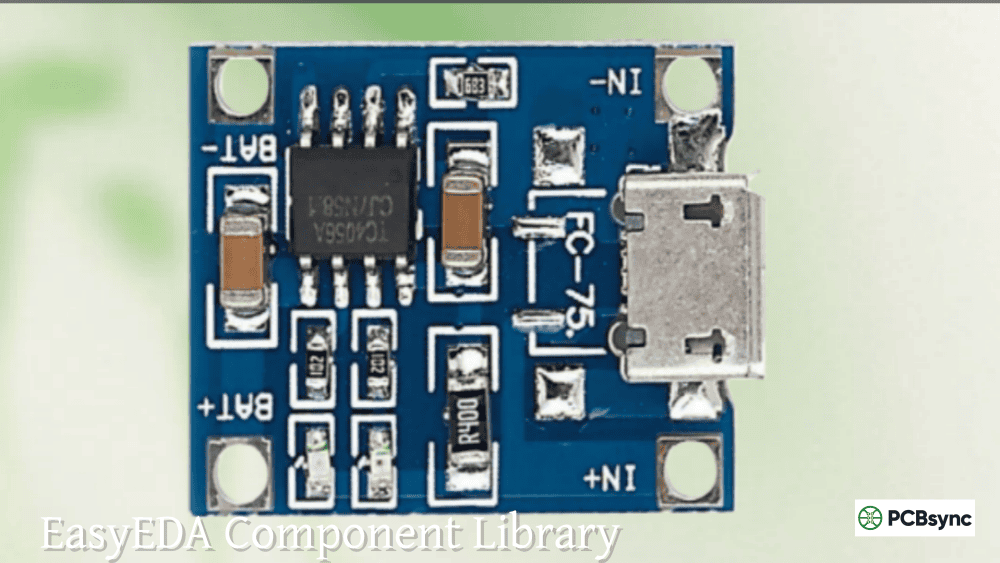
The TP4056 has become the go-to chip for DIY lithium battery chargers, and for good reason. It’s cheap, widely available, and handles the CC/CV charging profile that lithium cells need. But those blue breakout boards from online marketplaces often have layout compromises that can cause issues in production designs.
Pull high for normal operation, add filtering if noisy environment
CHRG (Pin 7)
Charging status output
Current-limited LED connection
STDBY (Pin 6)
Standby status output
Current-limited LED connection
Critical TP4056 Layout Guidelines
The thermal pad on the bottom of the TP4056 package isn’t just for mechanical stability—it’s the primary heat dissipation path. When charging at the full 1A rate, the chip can dissipate over 1.5W, and without proper thermal management, it will throttle or potentially fail.
Connect the thermal pad to ground using multiple vias (at least 4-6 vias with 0.3mm drill) to conduct heat to an internal ground plane or the bottom copper layer. The datasheet recommends making footprint copper pads as wide as possible and expanding them to larger copper areas for heat spreading. On cheap modules, I’ve seen the thermal pad connected to VIN+ instead of GND—this works electrically since VIN is decoupled to ground, but it’s not what the manufacturer intended.
For the PROG resistor that sets charging current, place it as close to the chip as possible. Long traces to this pin add parasitic capacitance that can confuse the current sensing, leading to inaccurate charge termination. The standard 1.2kΩ resistor gives 1A charging; adjust this based on your cell’s maximum recommended charge current.
Combining TP4056 with DW01A Protection
Most serious designs pair the TP4056 with a DW01A protection IC and dual N-channel MOSFETs (like the FS8205A). This combination provides overcurrent, overdischarge, and overcharge protection that the TP4056 alone doesn’t offer.
The key layout consideration here is that the DW01A should ideally be mounted near the battery, not near the charger. When mounted on the charger board (as seen on common modules), the DW01A’s voltage thresholds don’t align perfectly with the TP4056’s, so some protection features become redundant or ineffective. If you’re designing a custom board, consider whether you really need both ICs or whether the TP4056’s built-in protection is sufficient for your application.
High-Current Path Design in BMS PCBs
Once you move beyond single-cell chargers into multi-cell BMS designs, current handling becomes the dominant layout challenge. A 48V e-bike battery might see continuous currents of 20-30A, with peaks during acceleration reaching 50A or more.
Trace Width Calculations for BMS Applications
The IPC-2152 standard is the current reference for determining trace width based on current capacity. Unlike the older IPC-2221, it accounts for copper thickness variations and provides separate data for internal versus external layers.
Current (A)
1oz Copper External
1oz Copper Internal
2oz Copper External
1A
10 mil (0.25mm)
20 mil (0.5mm)
5 mil (0.13mm)
5A
50 mil (1.3mm)
100 mil (2.5mm)
25 mil (0.6mm)
10A
115 mil (2.9mm)
230 mil (5.8mm)
60 mil (1.5mm)
20A
250 mil (6.4mm)
500 mil (12.7mm)
130 mil (3.3mm)
50A
700 mil (17.8mm)
Use copper pours
360 mil (9.1mm)
Values based on 10°C temperature rise above ambient. For 20°C rise, traces can be approximately 30% narrower.
Internal layers require roughly twice the trace width of external layers for the same current because they can’t dissipate heat to the surrounding air. For high-current BMS designs, route power paths on external layers whenever possible, or use thermal vias to conduct heat from internal traces to outer copper.
Via Current Capacity and Thermal Management
A single via can handle approximately 0.5A to 1A depending on plating thickness. For high-current transitions between layers, you need multiple vias in parallel—a 10A path needs at least 15-20 vias. Space these evenly to ensure current shares properly; clustering vias in one spot can lead to uneven current distribution and hotspots.
Thermal vias under heat-generating components (MOSFETs, shunt resistors, analog front-end ICs) should be filled with conductive epoxy or plated shut if the budget allows. Standard open vias will fill with solder during reflow, which actually reduces their thermal effectiveness.
Ground Plane Architecture for Low-Noise BMS Design
In a 4-layer BMS PCB stack-up, dedicate the second layer entirely to ground. This provides a low-impedance return path for signals on layer 1 and shields the sensitive analog traces from digital switching noise.
Never cut slots or gaps in the ground plane under analog signal paths. Every break forces return current to flow around the gap, creating a loop that picks up EMI. I’ve seen BMS designs with voltage measurement errors of 50mV or more traced back to ground plane slots that looked innocent during layout review.
Separating Analog and Digital Grounds
The age-old question of whether to split grounds or keep them unified has a clear answer for BMS designs: keep one solid ground plane, but partition your component placement so analog and digital circuits have separate regions. Connect them at a single point near the analog-to-digital converter’s ground reference.
If you do use separate ground pours (for high-voltage isolation requirements, for example), connect them with a properly rated isolation barrier and ensure the return paths for each domain stay within their respective areas.
Component Placement Strategy for BMS PCBs
Component placement follows function. Start by placing the battery connectors and power path components (MOSFETs, fuses, shunt resistors), then work backward toward the analog front-end and microcontroller.
Placement Priority Order
Power connectors and protection MOSFETs — These determine the high-current path that everything else works around
Current sense resistor — Place in the power path with Kelvin sense connections to the AFE
Analog front-end (AFE) IC — Close to cell voltage sense points, away from switching noise
Decoupling capacitors — Each power pin gets its own cap within 3mm
Microcontroller — Central location with short paths to all peripherals
Communication interfaces — Near board edges for connector access
Status LEDs and test points — Last, wherever space allows
Cell Voltage Sensing Layout
The traces from battery cell taps to the AFE must be high-impedance, so trace width doesn’t matter for current capacity—but trace routing matters enormously for noise immunity. Run these traces as short as possible, keep them away from switching signals, and add small series resistors (100Ω to 1kΩ) at the AFE inputs for ESD protection without affecting the high-impedance measurement.
Thermal Design Considerations
Heat in a BMS comes from several sources: charging/discharging current through power paths, balancing resistors during active balancing, and switching losses in protection MOSFETs. Without proper thermal design, component temperatures can exceed ratings during normal operation.
Heat Dissipation Strategies
Source
Heat Generated
Mitigation Approach
Power MOSFETs
5-15W during high current
Thermal vias, copper pour heatsinks, possibly external heatsink
Shunt resistors
I²R (e.g., 10A through 1mΩ = 0.1W)
Usually negligible, but ensure adequate copper around pads
Balancing resistors
50-500mW per cell during balance
Space apart, use thick copper for heat spreading
AFE/Controller ICs
0.5-2W
Thermal pads with via arrays, airflow considerations
For the TP4056 specifically, plan for 1.5-2W of dissipation at full charge rate. A thermal pad of at least 10mm × 10mm connected to a ground plane through vias will keep temperatures manageable in still air.
Layer Stack-Up Recommendations
For simple single-cell chargers using the TP4056, a 2-layer board is sufficient if you provide adequate copper area for heat dissipation. For more complex BMS designs with multiple cells and communication interfaces, move to 4 layers minimum.
Recommended 4-Layer Stack-Up for BMS
Layer
Function
Copper Weight
L1 (Top)
Signal + Power
2oz for current paths
L2
Ground plane
1oz
L3
Power plane / Routing
1oz
L4 (Bottom)
Signal + Power
2oz for current paths
Using 2oz copper on the outer layers gives you flexibility for high-current traces while keeping manufacturing costs reasonable. The internal 1oz layers are adequate for planes and low-current signals.
Common BMS PCB Design Mistakes to Avoid
After reviewing hundreds of BMS layouts over the years, certain mistakes come up repeatedly:
Undersized power traces — Saving 5mm of trace width isn’t worth the voltage drop and heat generation. When in doubt, go wider.
Poor thermal pad connections — The thermal pad on ICs like the TP4056 needs real copper area and vias, not just a small pad connected to a thin trace.
Long sense traces routed near switching nodes — Cell voltage accuracy goes out the window when measurement traces pick up noise from nearby PWM signals.
Ground loops in current sensing — The sense resistor needs true Kelvin connections with the sense traces routed together as a pair back to the ADC.
Insufficient clearance for high voltage — In multi-cell packs, the potential difference between first and last cell can exceed 50V. Maintain at least 0.5mm/25V clearance (more in humid environments).
Missing test points — You can’t debug what you can’t measure. Add test points for key voltages, communication buses, and enable signals.
Design Verification and Testing
Before sending your BMS PCB to production, run through this verification checklist:
All high-current paths have adequate trace width per IPC-2152
Decoupling capacitors placed within 3mm of IC power pins
Ground plane is continuous under all sensitive analog signals
Thermal vias present under all power dissipating components
ESD protection on all external connections
Clearances meet safety requirements for maximum pack voltage
Test points accessible for key signals during bring-up
Useful Resources and Downloads for BMS PCB Design
Here are some resources I actually use when designing BMS boards:
IPC-2152 — Current standard for trace current capacity
IEC 62133 — Safety requirements for portable battery applications
UN 38.3 — Transportation requirements for lithium batteries
Frequently Asked Questions About BMS PCB Design
What trace width do I need for a 10A BMS design?
For 10A continuous current with a 10°C temperature rise using 1oz external copper, you need approximately 115 mil (2.9mm) trace width. Moving to 2oz copper reduces this to about 60 mil (1.5mm). Internal layers require roughly double these widths due to reduced heat dissipation. Always add margin for transient currents and manufacturing tolerances—if the calculator says 100 mil, use 120 mil if space allows.
Can I use the TP4056 for batteries larger than 1000mAh?
Yes, the TP4056 can charge any single-cell lithium battery, but you need to match the charge current to the battery’s specifications. Most lithium cells can safely charge at 0.5C to 1C rate. For a 2000mAh cell, 1A charging (the TP4056 maximum) is a 0.5C rate, which is perfectly safe. For smaller cells like 500mAh, you’d want to reduce the charge current by changing the PROG resistor to 2.4kΩ (for 500mA) or higher.
Should I use passive or active cell balancing?
For cost-sensitive applications and packs with less than 10 cells, passive balancing (burning off energy through resistors) is usually sufficient. It’s simpler to implement and less likely to fail. Active balancing, which transfers energy between cells rather than wasting it as heat, makes sense for large packs where the energy savings justify the added complexity. From a PCB perspective, passive balancing requires careful thermal design for the balancing resistors, while active balancing needs attention to the switching converter layout and EMI containment.
How do I protect my BMS from ESD during battery connection?
Add TVS diodes or dedicated ESD protection ICs on all cell sense lines and external communication interfaces. For the power path, the protection MOSFETs typically handle ESD, but add TVS diodes on gate drivers if the pack connectors will be exposed during assembly or service. On the PCB, ensure all ESD protection devices are placed close to the connector with direct traces to ground—long traces before the protection device defeat its purpose.
What’s the minimum number of layers for a BMS PCB?
A simple single-cell charger (like a TP4056 circuit) works fine on 2 layers with proper ground copper pour. For multi-cell BMS designs with analog front-ends, communication interfaces, and high-current paths, 4 layers is the practical minimum to achieve proper ground plane coverage and signal routing. Complex automotive BMS designs often use 6 or more layers to separate high-voltage, low-voltage, and signal domains while maintaining adequate clearances.
Inquire: Call 0086-755-23203480, or reach out via the form below/your sales contact to discuss our design, manufacturing, and assembly capabilities.
Quote: Email your PCB files to Sales@pcbsync.com (Preferred for large files) or submit online. We will contact you promptly. Please ensure your email is correct.
Notes: For PCB fabrication, we require PCB design file in Gerber RS-274X format (most preferred), *.PCB/DDB (Protel, inform your program version) format or *.BRD (Eagle) format. For PCB assembly, we require PCB design file in above mentioned format, drilling file and BOM. Click to download BOM template To avoid file missing, please include all files into one folder and compress it into .zip or .rar format.