Inquire: Call 0086-755-23203480, or reach out via the form below/your sales contact to discuss our design, manufacturing, and assembly capabilities.
Quote: Email your PCB files to Sales@pcbsync.com (Preferred for large files) or submit online. We will contact you promptly. Please ensure your email is correct.
Notes: For PCB fabrication, we require PCB design file in Gerber RS-274X format (most preferred), *.PCB/DDB (Protel, inform your program version) format or *.BRD (Eagle) format. For PCB assembly, we require PCB design file in above mentioned format, drilling file and BOM. Click to download BOM template To avoid file missing, please include all files into one folder and compress it into .zip or .rar format.
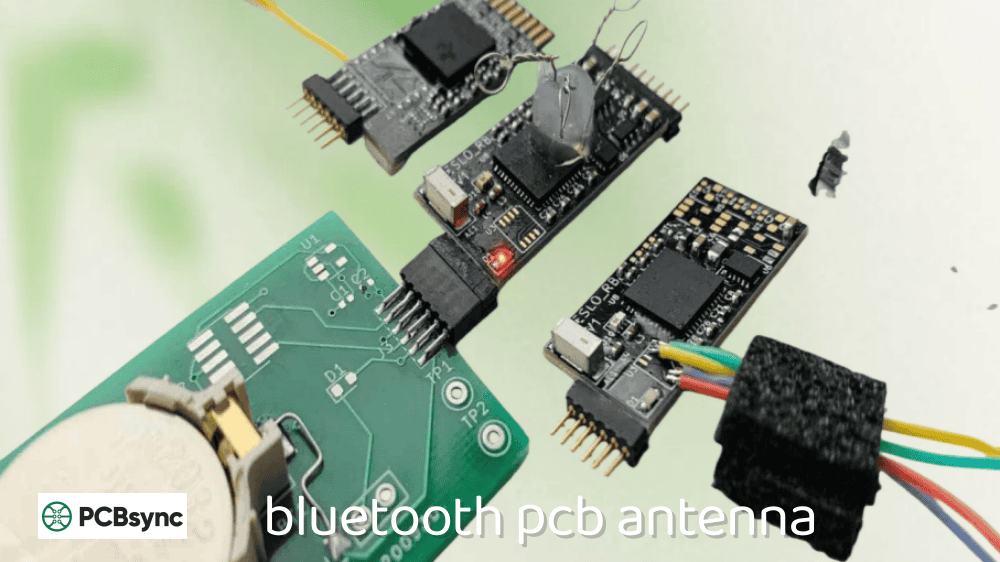
Designing a Bluetooth PCB antennathat actually works in your final product is trickier than most engineers expect. I’ve seen countless BLE designs where the antenna performed beautifully on the development board, then fell apart once integrated into a plastic enclosure or squeezed onto a smaller production PCB. The fundamentals aren’t complicated, but the details matter enormously.
This guide covers everything you need to design working Bluetooth PCB antennas for BLE (Bluetooth Low Energy) and Classic Bluetooth applications. I’ll give you actual dimensions you can use, ground plane requirements, layout rules that affect range, and integration tips for popular modules like Nordic nRF52 and ESP32. Whether you’re building a fitness tracker, a smart sensor, or a wireless peripheral, these principles apply.
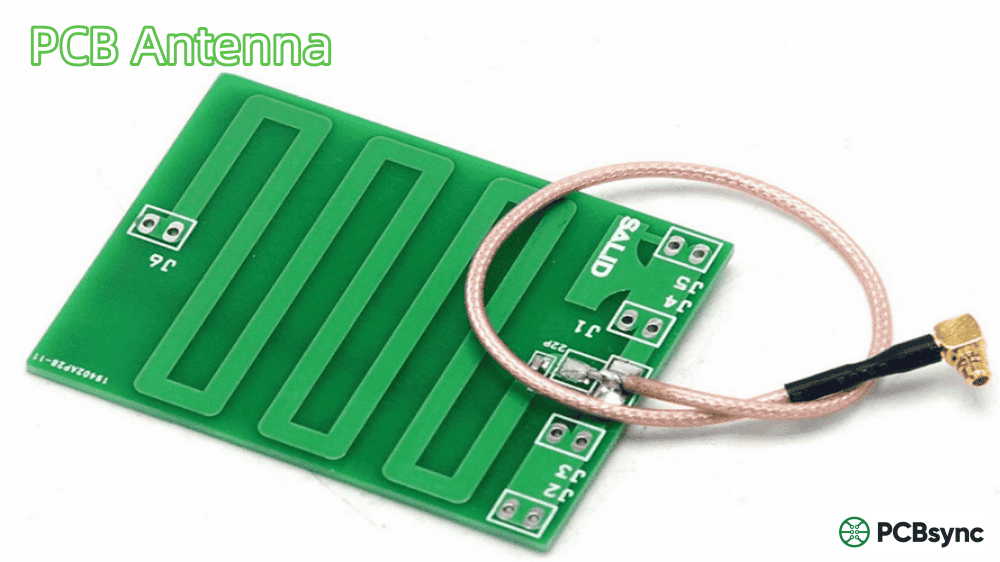
A Bluetooth PCB antenna is an antenna structure etched directly onto a printed circuit board, designed to operate in the 2.4 GHz ISM band used by Bluetooth technology. Instead of using an external antenna, a chip antenna, or a wire antenna, the antenna becomes part of your PCB—just copper traces in a specific pattern that radiates electromagnetic energy.
Bluetooth operates in the 2.4 GHz ISM (Industrial, Scientific, and Medical) band:
Parameter
Specification
Frequency Range
2.400–2.4835 GHz
Center Frequency
2.45 GHz (typical design target)
BLE Channels
40 channels, 2 MHz spacing
Classic Bluetooth Channels
79 channels, 1 MHz spacing
Wavelength (free space)
122.4 mm
Quarter Wavelength
30.6 mm
The quarter-wavelength dimension of approximately 31mm is the starting point for most PCB antenna designs. On FR4 substrate with a dielectric constant of 4.4, the effective length reduces to roughly 15–23mm depending on antenna geometry.
For most BLE applications—wireless mice, fitness trackers, smart sensors, beacons—a PCB antenna offers the best balance of cost, repeatability, and performance. The antenna costs nothing beyond the board space it occupies, and performance is consistent across production runs.
Bluetooth Frequency Band and BLE Specifics
Understanding the Bluetooth frequency allocation helps you design antennas with appropriate bandwidth.
Classic Bluetooth vs BLE Antenna Requirements
Parameter
Classic Bluetooth
Bluetooth Low Energy
Channels
79 (1 MHz each)
40 (2 MHz each)
Frequency Range
2.402–2.480 GHz
2.402–2.480 GHz
Required Bandwidth
78 MHz
78 MHz
Typical TX Power
0 to +20 dBm
-20 to +10 dBm
Range (typical)
10–100 m
10–50 m
Both Classic Bluetooth and BLE use the same frequency range, so the antenna requirements are essentially identical. The antenna must provide acceptable return loss (S11 ≤ -10 dB) across the full 2.400–2.4835 GHz band—approximately 84 MHz of bandwidth.
BLE Channel Hopping and Antenna Bandwidth
BLE uses frequency hopping across 40 channels to avoid interference. Your antenna must perform consistently across all channels. An antenna that resonates perfectly at 2.45 GHz but has poor performance at 2.40 GHz or 2.48 GHz will cause intermittent connection issues.
Well-designed PCB antennas like the IFA typically achieve 200–250 MHz bandwidth, providing excellent margin.
Bluetooth PCB Antenna Types Compared
Several antenna topologies work well for Bluetooth’s 2.4 GHz band. Each has tradeoffs between size, performance, and ease of implementation.
Inverted-F Antenna (IFA) for Bluetooth
The Inverted-F Antenna is the most popular choice for Bluetooth applications. You’ll find it on ESP32 modules, Nordic development kits, and countless commercial products.
Characteristics:
Footprint: Typically 15–25 mm × 5–8 mm
Inherently matched to 50Ω (often no external components needed)
Good omnidirectional radiation pattern
Bandwidth: 200–250 MHz
Efficiency: 70–80%
The IFA uses a shorting pin to ground that allows impedance matching without external components. The feed point location along the radiating element determines the input impedance.
Meandered Inverted-F Antenna (MIFA) for Bluetooth
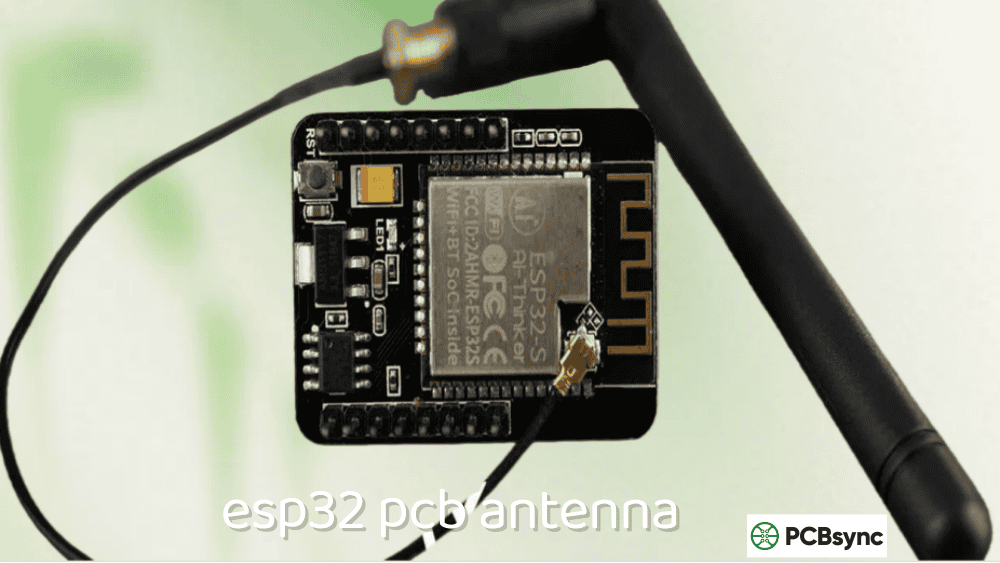
The MIFA compresses an IFA into a smaller footprint by folding the radiating element back and forth. This is what ESP8266/ESP32 modules and Nordic nRF52840 dongles use.
Characteristics:
Footprint: As small as 7 mm × 11 mm
Slightly lower efficiency than full-size IFA (60–75%)
Narrower bandwidth (150–200 MHz)
More sensitive to ground plane size
Ideal for space-constrained BLE devices
Cypress/Infineon MIFA Dimensions (from AN91445):
Parameter
Dimension
Overall footprint
7.2 mm × 11.1 mm
Trace width
0.5 mm typical
Ground clearance
10 mm minimum
Recommended for
Wireless mouse, keyboard, small IoT
Planar Inverted-F Antenna (PIFA) for Bluetooth
The PIFA uses a planar patch element instead of a trace, offering wider bandwidth at the cost of larger size.
Characteristics:
Footprint: 10–15 mm × 15–20 mm
Wider bandwidth than IFA (250–400 MHz)
Better for dual-band (WiFi + Bluetooth) designs
Higher efficiency (75–85%)
Common in smartphones and tablets
Meander Line Antenna for Bluetooth
A simple meander pattern that folds a quarter-wave element into a compact zigzag.
Characteristics:
Very compact footprint possible
Usually requires matching network
Narrower bandwidth than IFA
Lower efficiency
Good for extremely space-constrained designs
Bluetooth PCB Antenna Type Selection Guide
Application
Board Size
Recommended Antenna
Reason
Wireless mouse/keyboard
25×40 mm
MIFA
Smallest footprint
Fitness tracker
20×30 mm
Compact MIFA
Space + performance
Smart sensor
30×50 mm
IFA
Best performance
USB BLE dongle
15×30 mm
Compact IFA
Fits form factor
Beacon
25×25 mm
MIFA
Circular board compatible
Wearable
20×20 mm
Chip antenna
Extreme space constraint
Audio device
40×60 mm
Full-size IFA
Maximum range
Chip Antenna vs PCB Antenna for Bluetooth
One of the first decisions in BLE design is whether to use a chip antenna or a PCB antenna. Both have their place.
When to Use Chip Antennas
Choose chip antennas when:
Board space is extremely limited (< 20×25 mm)
You need a pre-certified solution
Design resources are limited
Fast time-to-market is critical
Ground plane space is insufficient for PCB antenna
Popular Bluetooth chip antennas:
Manufacturer
Part Number
Size
Notes
Johanson Technology
2450AT18B100E
1.2×2.0 mm
Widely used
Johanson Technology
2450AT45A100
4.5×1.0 mm
Higher gain
ACX
ACAG0201
2.0×1.0 mm
Very compact
Abracon
ACAG0201-2450-T
2.0×1.0 mm
Low cost
Pulse
W3011
6.0×2.0 mm
Easy matching
When to Use PCB Antennas
Choose PCB antennas when:
Cost per unit is critical (high volume)
Board space is available (≥ 25×35 mm)
Maximum design control is needed
Consistent performance across production is important
These dimension tables provide starting points for your designs. All values assume 1.6mm FR4 substrate with 1oz copper.
Full-Size IFA Dimensions for Bluetooth
Based on Silicon Labs AN1088 and Texas Instruments AN043 reference designs:
Parameter
Dimension
Tolerance
Radiating arm length
15.2–18.5 mm
±0.5 mm
Radiating arm width
0.8–1.2 mm
±0.1 mm
Feed arm length
2.5–4.0 mm
±0.3 mm
Feed arm width
0.5–1.0 mm
±0.1 mm
Shorting arm length
4.0–6.0 mm
±0.3 mm
Shorting arm width
0.5–1.0 mm
±0.1 mm
Ground clearance (height)
5.0–6.0 mm
±0.5 mm
Keep-out zone
15 × 6 mm minimum
—
Total footprint
15.2 × 5.7 mm
—
Compact MIFA Dimensions for Bluetooth
Based on Infineon/Cypress AN91445 for BLE HID applications:
Parameter
Dimension
Notes
Overall footprint
7.2 × 11.1 mm
Very compact
Total trace length
18–22 mm
Quarter-wave equivalent
Trace width
0.4–0.6 mm
Consistent throughout
Meander spacing
0.5–1.0 mm
Affects coupling
Number of meanders
4–6
Depends on space
Ground clearance
8–10 mm minimum
Critical parameter
Keep-out zone
12 × 8 mm
No copper
Dimensions for Small Boards (20×30mm)
For extremely compact BLE designs:
Parameter
Compact IFA
Ultra-Compact MIFA
Antenna footprint
12 × 5 mm
8 × 6 mm
Ground plane minimum
15 × 20 mm
12 × 18 mm
Matching required
Yes
Yes
Expected efficiency
60–70%
50–65%
Bandwidth
150–200 MHz
100–150 MHz
Note: Very small boards significantly compromise antenna performance. Consider chip antennas or external antennas for boards smaller than 20×25mm.
Ground Plane Requirements for Bluetooth PCB Antennas
The ground plane is half of your antenna system. Inadequate ground planes are the most common cause of poor Bluetooth range.
Minimum Ground Plane Dimensions
Board Type
Minimum Size
Recommended Size
USB dongle
15 × 25 mm
18 × 35 mm
IoT sensor
20 × 30 mm
25 × 40 mm
Wearable
15 × 20 mm
20 × 30 mm
Wireless mouse
25 × 35 mm
30 × 45 mm
General BLE
25 × 35 mm
30 × 50 mm
Ground Plane Design Rules
Rule 1: No copper under the antenna
The antenna keep-out zone must be free of copper on ALL layers. For a MIFA, this means approximately 12×8mm with no ground, power, or signal traces.
Rule 2: Ground plane edge position
The edge of the ground plane nearest the antenna significantly affects impedance and radiation pattern. Keep this edge straight and perpendicular to the antenna feed direction.
Rule 3: Via stitching
Place ground vias along the perimeter of the ground plane, especially near the antenna. At 2.4 GHz, via spacing should be less than 6mm (λ/20) to prevent slot radiation.
Rule 4: Multi-layer continuity
For 4-layer boards, ensure ground continuity between layers in the antenna region. Avoid routing signals through the antenna ground area on internal layers.
Ground Plane Size Effect on Performance
Ground Plane Size
Effect on Bluetooth Antenna
Undersized (<20×25mm)
Significant detuning, reduced efficiency
Minimum (20×30mm)
Acceptable performance, requires tuning
Recommended (25×40mm)
Good performance
Large (>35×50mm)
Optimal, diminishing returns
Feed Line Design for 50Ω Impedance
The transmission line from your Bluetooth chip to the antenna must maintain 50Ω characteristic impedance.
CPW provides better ground return and is often preferred for RF:
PCB Thickness
Trace Width
Gap to Ground
1.6 mm
1.5 mm
0.3 mm
1.6 mm
1.0 mm
0.2 mm
0.8 mm
0.8 mm
0.15 mm
Feed Line Best Practices
Keep feed lines as short as possible
Avoid sharp bends; use 45° miters or curves
Maintain consistent width throughout
Don’t route over split planes
Use via stitching along CPW edges
Nordic nRF52 and nRF53 Module Integration
Nordic Semiconductor’s nRF52 and nRF53 series are the most popular BLE chips. Here’s how to integrate PCB antennas with them.
Nordic Reference Antenna Designs
Reference Design
Antenna Type
Size
Notes
nRF52 DK
Monopole
~31 mm trace
Simple, good performance
nRF52840 Dongle
Meander
15 × 5 mm
Compact, USB form factor
nRF5340 DK
Monopole
~31 mm trace
Best performance
nRF52/nRF53 Antenna Interface
Parameter
Specification
Output impedance
50Ω single-ended
Matching network
Required (Pi network)
DC blocking
Required (series capacitor)
Typical matching
Series L + shunt C
Recommended Matching Network
Nordic recommends a Pi matching network:
nRF52 ANT pin ──[L1]──┬──[C2]── Antenna │ [C1] │ GND
Typical starting values:
L1: 2.7–3.9 nH
C1: 0.8–1.5 pF
C2: 0 pF (may not be needed)
Important: These values are starting points. Final values depend on your PCB layout, ground plane size, and enclosure. Always tune with a VNA.
ESP32 and ESP32-C3 Antenna Design
ESP32 modules are popular for WiFi + Bluetooth combo applications. The antenna must cover both 2.4 GHz WiFi and Bluetooth bands simultaneously.
ESP32 Module Options
Module
Antenna Type
External Antenna
ESP32-WROOM
Integrated MIFA
No
ESP32-WROVER
Integrated MIFA
Yes (U.FL)
ESP32-C3-MINI
Integrated MIFA
No
ESP32-C3-WROOM
Integrated MIFA
Yes (U.FL)
ESP32-S3-MINI
Integrated MIFA
No
Custom ESP32 Board Antenna Guidelines
When using ESP32 bare chips or designing custom boards:
Guideline
Requirement
Antenna placement
Board edge, extending past ground
Ground clearance
13+ mm from module RF section
Keep-out zone
No copper under antenna on any layer
Minimum ground plane
18 × 25 mm
Component clearance
10 mm from antenna traces
Critical: If using ESP32-WROOM/WROVER modules, the antenna portion must extend beyond your main PCB ground. Do not place the module in the center of your board with ground on all sides.
Compact Antenna Designs for Wearables
Wearable devices present unique challenges: tiny boards, plastic enclosures, proximity to human body, and battery constraints.
Wearable Antenna Challenges
Challenge
Impact
Mitigation
Small board size
Reduced ground plane, detuning
Use chip antenna or compact MIFA
Body proximity
Frequency shift, absorption
Design with body loading in mind
Plastic enclosure
Frequency shifts down
Tune with enclosure in place
Battery nearby
Potential interference
Maintain 5mm clearance
Metal components
Pattern distortion
Keep 10mm from antenna
Body Loading Effects
Human body tissue has high dielectric constant (~50) and conductivity. When a BLE device is worn:
Resonant frequency shifts down 50–150 MHz
Radiation efficiency drops 30–50%
Radiation pattern changes significantly
Design recommendation: Tune the antenna to resonate slightly high (2.50–2.55 GHz) in free space, so it shifts to the correct frequency when worn.
Recommended Antenna Placement for Wearables
Device Type
Antenna Location
Notes
Wrist band
Top surface, away from skin
Radiate upward
Chest strap
Front face
Radiate forward
Earbuds
External housing surface
Away from ear canal
Smart ring
Outer circumference
Minimize body contact
Testing and Range Optimization
Proper testing ensures your Bluetooth antenna performs as designed.
S11 (Return Loss) Requirements
S11 Value
Return Loss
Assessment
-6 dB
6 dB
Marginal, needs tuning
-10 dB
10 dB
Acceptable for production
-15 dB
15 dB
Good
-20 dB
20 dB
Excellent
Target: S11 ≤ -10 dB from 2.40 to 2.48 GHz
Bandwidth Verification
Check that S11 remains below -10 dB across the full Bluetooth band:
Low edge: 2.400 GHz
Center: 2.440 GHz
High edge: 2.4835 GHz
Range Testing for BLE
After electrical verification, perform practical range tests:
Indoor test: Measure RSSI at 1m, 5m, 10m distances
Obstruction test: Test through walls, furniture
Orientation test: Rotate device in all axes
Body loading test: Hold/wear device during measurement
Compare against reference: Use development kit as baseline
Expected BLE range (0 dBm TX power):
Line of sight: 30–50 meters
Indoor: 10–20 meters
Through one wall: 5–10 meters
Common Bluetooth PCB Antenna Mistakes
Mistake 1: Ground Copper Under Antenna
Problem: Ground pour extends into antenna keep-out zone. Result: Antenna becomes transmission line, severe detuning. Fix: Create explicit keep-out region on ALL layers.
Mistake 2: Insufficient Ground Plane
Problem: Ground plane too small or has gaps. Result: Poor efficiency, reduced range, difficult tuning. Fix: Maintain minimum 25×35mm continuous ground.
Mistake 3: Ignoring Enclosure Effects
Problem: Antenna tuned on bare PCB, enclosed in plastic. Result: Frequency shifts down 50–100 MHz. Fix: Always tune with production enclosure.
Mistake 4: Components Too Close to Antenna
Problem: Capacitors, crystals, or shielding near antenna. Result: Detuning, pattern distortion. Fix: Maintain 8–10mm clearance from all components.
Mistake 5: Wrong Transmission Line Impedance
Problem: Feed trace width doesn’t match 50Ω for stackup. Result: Reflections, reduced power transfer. Fix: Calculate trace width for your specific stackup.
Mistake 6: Missing Matching Network Footprints
Problem: No provision for tuning components. Result: Cannot adjust antenna without board respin. Fix: Always include Pi network footprints.
Useful Resources for Bluetooth PCB Antenna Design
Reference Design Documents
Document
Source
Description
AN91445
Infineon/Cypress
BLE antenna design & RF layout (essential)
AN1088
Silicon Labs
Inverted-F antenna reference
AN043 (SWRA117D)
Texas Instruments
Small 2.4 GHz PCB antenna
UM10992
NXP
BLE antenna design guide
AN5129
STMicroelectronics
Meander antenna for STM32WB
nwp_008
Nordic Semiconductor
Monopole antenna whitepaper
Design Tools
Saturn PCB Toolkit – Free impedance calculator
NanoVNA – Affordable antenna analyzer
AppCAD (Broadcom) – RF calculations
HFSS/CST – Professional EM simulation
openEMS – Free open-source EM simulator
Reference Design Downloads
Resource
URL
Contents
Nordic nRF52840 Dongle
nordicsemi.com
Gerber files, schematic
TI CC2511 USB Dongle
ti.com
IFA antenna Gerbers
ESP32 Reference Designs
espressif.com
Module integration examples
Cypress MIFA Reference
infineon.com
Layout files
Frequently Asked Questions
What is the minimum board size for a Bluetooth PCB antenna?
For a PCB antenna with acceptable performance, the minimum practical board size is approximately 20mm × 30mm. This provides enough ground plane area for a compact MIFA design. Smaller boards (down to 15mm × 25mm) can work but with significantly compromised efficiency and may require extensive tuning. For boards smaller than 20mm × 25mm, consider using a chip antenna instead, as the limited ground plane makes PCB antennas impractical.
Can I use the same antenna design for both WiFi and Bluetooth?
Yes, since both WiFi (2.4 GHz band) and Bluetooth operate in the 2.400–2.4835 GHz range, a single antenna can serve both protocols. This is exactly what ESP32 modules do. The antenna must provide sufficient bandwidth (at least 84 MHz) to cover the full band with acceptable return loss. Most IFA and MIFA designs achieve 150–250 MHz bandwidth, which comfortably covers both WiFi and Bluetooth. No modifications are needed—an antenna designed for 2.4 GHz WiFi works equally well for Bluetooth and BLE.
How much does a plastic enclosure affect Bluetooth antenna performance?
Plastic enclosures typically shift the resonant frequency down by 50–100 MHz at 2.4 GHz due to the increased effective dielectric constant. The exact shift depends on plastic type (ABS, polycarbonate, etc.), thickness, and proximity to the antenna. ABS causes moderate shift; materials with higher dielectric constants cause larger shifts. Always perform final antenna tuning with the production enclosure in place. Design the antenna to resonate slightly high (2.50–2.55 GHz) in free space so it shifts to the target 2.44 GHz when enclosed.
Should I use a chip antenna or PCB antenna for my BLE product?
Use a PCB antenna when: board space is available (≥25×35mm), cost per unit matters (high volume), you want consistent production performance, and you need design flexibility. Use a chip antenna when: board space is extremely limited (<20×25mm), you need a quick, pre-characterized solution, ground plane area is restricted, or design resources are limited. For most BLE products with moderate board sizes, PCB antennas offer better cost-performance balance. For wearables and ultra-compact devices, chip antennas are often the only practical choice.
Why is my Bluetooth range much shorter than expected?
Poor BLE range typically results from one of these issues: (1) Ground plane under the antenna—check ALL layers for copper in the keep-out zone; (2) Insufficient ground plane size—ensure at least 25×35mm of continuous ground; (3) Antenna detuned by enclosure—always tune with final housing; (4) Poor impedance matching—verify S11 ≤ -10 dB across 2.4–2.48 GHz with a VNA; (5) Components too close to antenna—maintain 10mm clearance; (6) Incorrect transmission line impedance—verify 50Ω feed line width. Start by measuring S11 to identify whether the issue is antenna matching or something else in the RF chain.
Conclusion
Designing a working Bluetooth PCB antenna requires attention to fundamentals: correct dimensions for 2.4 GHz, adequate ground plane, proper impedance matching, and testing in real-world conditions. The antenna is often the difference between a product with reliable 20-meter range and one that barely works across a room.
My recommendation for BLE designs: if you have board space (25×35mm or larger), use a PCB antenna—the MIFA or IFA designs from Infineon AN91445 or TI AN043 are proven starting points. Copy the reference design exactly, including ground plane dimensions and layer stackup, then tune from there. For smaller boards, don’t fight physics—use a quality chip antenna from Johanson or similar.
Always include matching network footprints in your design. The cost of three 0402 pads is zero compared to a board respin because your antenna doesn’t work in the final enclosure. And always, always tune with your production enclosure in place. The antenna that worked perfectly on your bare test board will shift frequency once enclosed in plastic.
BLE antenna design isn’t magic—it’s attention to detail and respect for the physics of electromagnetics at 2.4 GHz. Get the basics right, and your Bluetooth products will have the range and reliability users expect.
Inquire: Call 0086-755-23203480, or reach out via the form below/your sales contact to discuss our design, manufacturing, and assembly capabilities.
Quote: Email your PCB files to Sales@pcbsync.com (Preferred for large files) or submit online. We will contact you promptly. Please ensure your email is correct.
Notes: For PCB fabrication, we require PCB design file in Gerber RS-274X format (most preferred), *.PCB/DDB (Protel, inform your program version) format or *.BRD (Eagle) format. For PCB assembly, we require PCB design file in above mentioned format, drilling file and BOM. Click to download BOM template To avoid file missing, please include all files into one folder and compress it into .zip or .rar format.