Inquire: Call 0086-755-23203480, or reach out via the form below/your sales contact to discuss our design, manufacturing, and assembly capabilities.
Quote: Email your PCB files to Sales@pcbsync.com (Preferred for large files) or submit online. We will contact you promptly. Please ensure your email is correct.
Notes: For PCB fabrication, we require PCB design file in Gerber RS-274X format (most preferred), *.PCB/DDB (Protel, inform your program version) format or *.BRD (Eagle) format. For PCB assembly, we require PCB design file in above mentioned format, drilling file and BOM. Click to download BOM template To avoid file missing, please include all files into one folder and compress it into .zip or .rar format.
Automatic Water Level Controller PCB Layout: Complete Circuit Design
After designing dozens of water level controller boards over the years, I can tell you that getting the automatic water level controller PCB layout right makes the difference between a reliable system and one that fails when you need it most. Whether you’re building this for a home overhead tank or an industrial application, proper PCB design ensures consistent performance, reduced noise interference, and easy assembly.
In this guide, I’ll walk you through everything from circuit fundamentals to component placement strategies that actually work in real-world installations.
Understanding the Automatic Water Level Controller Circuit
Before jumping into PCB layout, let’s establish what we’re building. An automatic water level controller monitors water levels using conductive probes or float switches, then activates a pump motor when the level drops below a threshold and shuts it off when the tank is full.
The core circuit typically includes a sensing section that detects water contact, a control section built around a timer IC or transistor logic, and an output section with a relay to switch the pump. The beauty of this design lies in its simplicity, yet proper PCB implementation demands attention to several critical factors.
Core Components of the Water Level Controller
The typical circuit relies on these essential components working together seamlessly:
Component
Function
Common Values
NE555 Timer IC
Controls switching logic
8-pin DIP package
BC547/BC548 Transistors
Signal amplification
NPN, general purpose
Relay
Pump switching
12V DC, 5A-30A contacts
Resistors
Current limiting, biasing
1K to 100K range
Capacitors
Filtering, timing
1µF to 100µF
Diodes (1N4007/1N4148)
Flyback protection
Standard rectifier
LEDs
Status indication
3mm or 5mm
How the Circuit Works
The sensing probes dip into the water tank at three positions: common (bottom), low level, and high level. Water conducts electricity between these probes, creating a signal that triggers the control circuit.
When water falls below the low-level probe, the 555 timer’s trigger pin receives a LOW signal, causing the output to go HIGH. This energizes the relay coil through a driver transistor, switching on the pump. As water rises and contacts the high-level probe, the reset pin receives a signal that forces the output LOW, de-energizing the relay and stopping the pump.
Designing Your Automatic Water Level Controller PCB Layout
Now let’s get into the actual PCB design process. I’ve learned through trial and error that planning your layout before opening any CAD software saves hours of frustration later.
Pre-Layout Planning Essentials
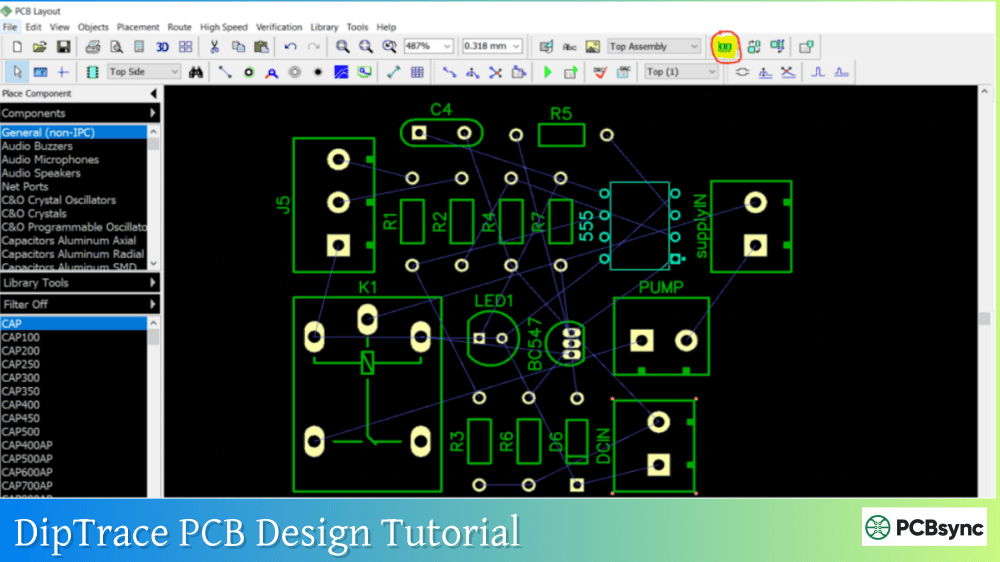
Start by sketching your board’s functional blocks on paper. Divide the circuit into three zones: input sensing, control logic, and power output. This modular approach keeps noise-sensitive circuits away from high-current switching components.
Consider your enclosure constraints early. Most water level controllers mount in weatherproof junction boxes, so factor in mounting hole positions and clearance for screw terminals. A typical single-sided board of 60mm x 80mm accommodates most designs comfortably.
Component Placement Strategy
Component placement determines 80% of your routing success. Follow this sequence for optimal results:
Step 1: Position Fixed Components First
Lock in positions for screw terminals, relay, and mounting holes. These have mechanical constraints that override electrical considerations. Place the relay toward the board edge nearest your power output wires.
Step 2: Place the NE555 Timer IC Centrally
The 555 IC acts as your circuit’s brain, connecting to multiple components. Central placement minimizes trace lengths to surrounding resistors and capacitors.
Step 3: Group Related Components
Keep timing components (R and C for the 555) close to their respective IC pins. Place driver transistors adjacent to the relay, with flyback diodes within 5mm of the relay coil pins.
Step 4: Position Power Components Last
Voltage regulator, filter capacitors, and power input terminals go along one board edge. This creates a clean power distribution path without routing power traces through sensitive areas.
Placement Priority
Component Type
Recommended Location
1
Connectors, mounting holes
Board edges
2
Relay
Near output terminals
3
NE555 IC
Board center
4
Transistors
Between IC and relay
5
Passive components
Adjacent to related ICs
6
Power supply
Separate board edge
Trace Routing Guidelines for the Controller PCB
With components placed, routing becomes straightforward if you follow proven practices.
Keep Power Traces Wide
For the relay coil circuit carrying 50-100mA, use 20-30 mil traces minimum. The pump switching contacts don’t pass through the PCB typically, but any high-current paths need at least 40 mils per ampere.
Minimize Sensor Input Trace Lengths
The probes connect to high-impedance inputs. Long traces act as antennas, picking up 50/60Hz interference from nearby AC wiring. Route sensor inputs directly to their destinations using the shortest possible paths.
Use Star Grounding
Instead of daisy-chaining ground connections, route separate ground returns from each circuit section back to a single point near the power input. This prevents relay switching currents from inducing noise in the sensing circuits.
Maintain Clearance from High Voltage
If your PCB includes mains voltage sections (for directly switching an AC pump), maintain minimum 3mm clearance between high and low voltage areas. Better yet, use a separate relay board for mains isolation.
Schematic to PCB: Practical Design Workflow
Let me walk you through my actual design workflow using freely available tools.
Software Selection for PCB Design
For hobbyists and professionals alike, these tools handle water level controller designs effectively:
Software
Best For
Learning Curve
Cost
KiCad
Full-featured open source
Moderate
Free
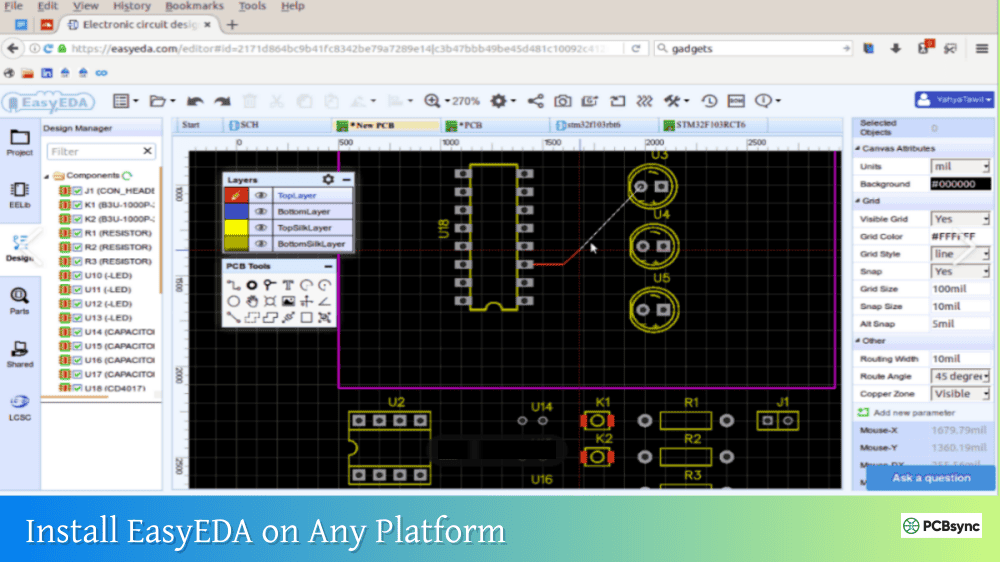
EasyEDA
Browser-based design
Easy
Free
Fritzing
Breadboard-to-PCB
Very Easy
Donation
Eagle
Professional features
Moderate
Limited free tier
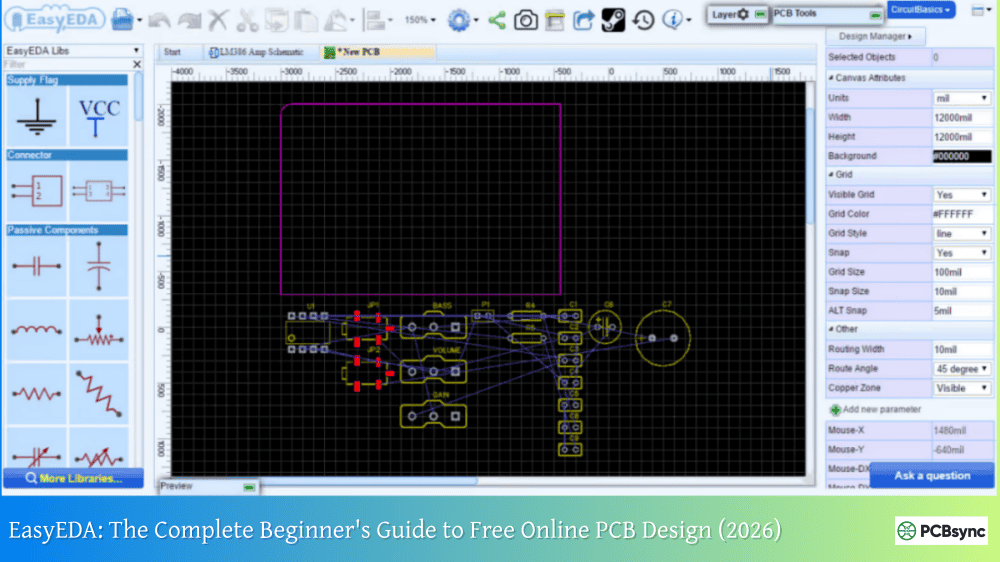
I typically use KiCad for production boards and EasyEDA for quick prototypes. Both export standard Gerber files that any PCB manufacturer accepts.
Step-by-Step PCB Creation Process
Creating the Schematic
Open your chosen software and draw the circuit. Use proper symbols for each component and add meaningful net labels (VCC, GND, SENSOR_LOW, SENSOR_HIGH, PUMP_CTRL). These labels carry into the PCB layout, making routing intuitive.
Defining Board Parameters
Set your board outline dimensions, copper layer count (single-sided works for most water controllers), and design rules. For a standard controller, I use: 10 mil minimum trace width, 10 mil minimum clearance, 0.4mm via drill size.
Component Import and Placement
Import your netlist from the schematic. The software places components randomly; rearrange them following the strategy outlined earlier. Don’t forget to rotate parts for optimal routing.
Routing the Traces
Route power and ground first, then signal traces. On single-layer boards, you’ll likely need a few jumper wires—mark these clearly in your silkscreen. For two-layer boards, route horizontal on top and vertical on bottom (or vice versa) to minimize crossovers.
Design Rule Check
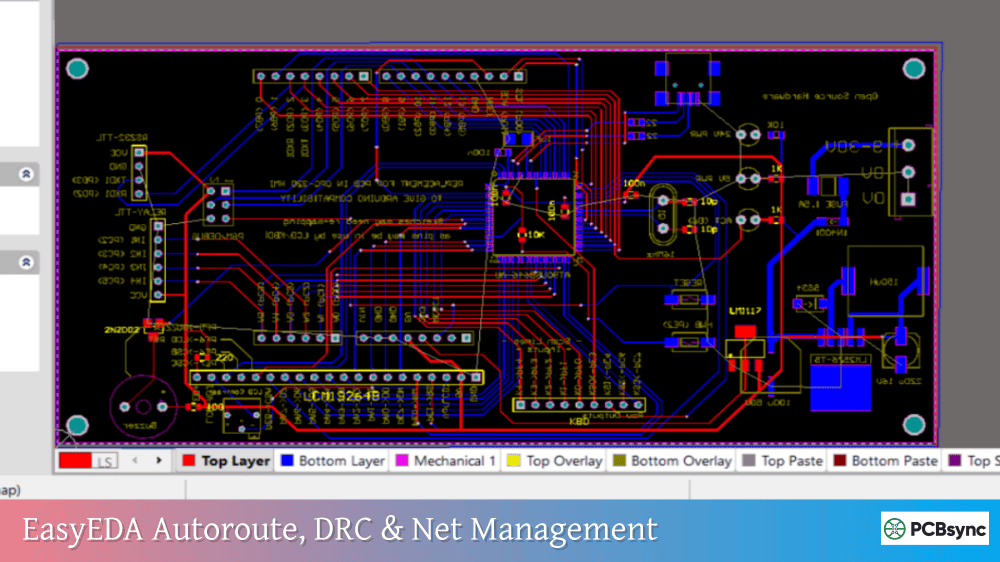
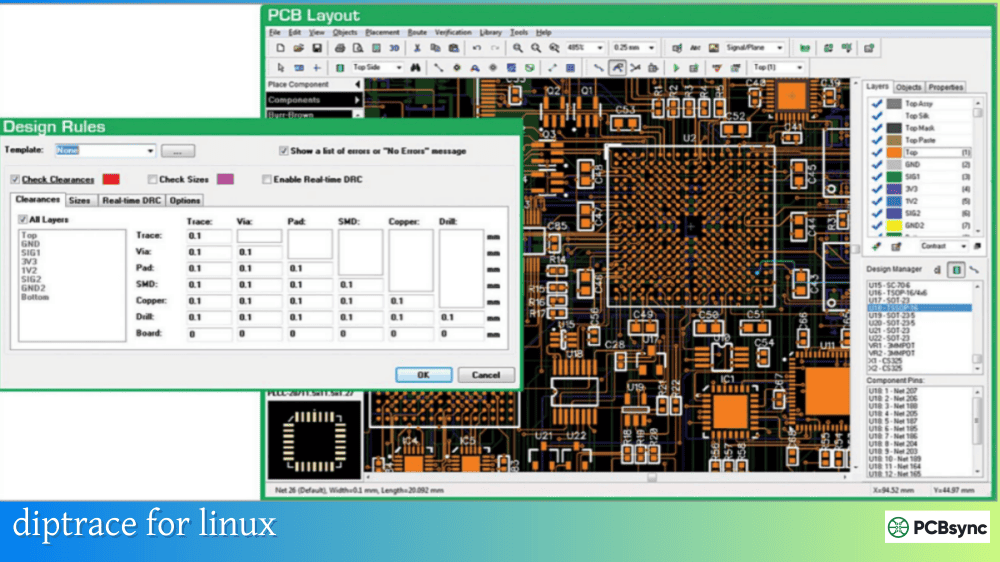
Run DRC before generating outputs. Fix any clearance violations, unconnected nets, or silk-to-copper overlaps. A clean DRC means fewer manufacturing issues.
Generating Manufacturing Files
Every PCB manufacturer requires Gerber files. Export these layers as a minimum: Top Copper (GTL), Bottom Copper (GBL) if applicable, Top Silkscreen (GTO), Solder Mask (GTS/GBS), Drill File (Excellon format), and Board Outline (GKO).
Compress these into a ZIP file for upload. Most fabricators (JLCPCB, PCBWay, NextPCB) offer online Gerber viewers to verify your design before ordering.
Advanced Automatic Water Level Controller PCB Layout Techniques
Once you’ve mastered the basics, these refinements elevate your design quality.
Adding Dry-Run Protection
Submersible pumps suffer damage when running without water. Incorporate an additional sensing probe at the source tank (underground sump) that disables the pump if that reservoir goes empty. On the PCB, this requires one more input terminal and a logic gate or transistor AND configuration.
Incorporating Voltage Protection
Power fluctuations destroy controllers. Add a simple comparator circuit using an LM393 that cuts power to the relay driver if input voltage exceeds or drops below safe limits. This requires minimal extra PCB space but dramatically improves reliability.
LED Status Indication Design
Include LEDs showing: Power On, Pump Running, Tank Full, Tank Empty, and Fault conditions. Route LED cathodes through a common resistor network to save component count. Place LEDs along one board edge for visibility through an enclosure window.
LED Color
Status Indication
Resistor Value (12V)
Green
Power On
1KΩ
Blue
Pump Running
680Ω
Yellow
Tank Half Full
1KΩ
Red
Fault/Dry Run
680Ω
Relay Selection and Layout Considerations
Relay choice impacts PCB layout significantly. A larger relay with 30A contacts requires more copper pour around its pins and adequate clearance for heat dissipation. I prefer socketed relays on through-hole designs—they make field replacement painless.
For pump control, calculate contact rating at 1.5x your pump’s running current. A 1HP motor draws roughly 7A at 220V, so specify a minimum 10A relay contact rating.
Thermal Management on the Controller PCB
Even small controllers generate heat. The voltage regulator, driver transistors, and relay coil all contribute.
Regulator Heat Dissipation
If using a 7812 or 7805 linear regulator with significant dropout voltage, calculate power dissipation: P = (Vin – Vout) × I. Anything over 0.5W needs a heatsink or copper pour. On the PCB, create a copper island under the regulator tab and connect it to ground.
Relay Coil Considerations
Relay coils consume power continuously while energized. A 12V relay with 400Ω coil resistance dissipates 0.36W. Not problematic alone, but in enclosed spaces, cumulative heating matters. Position relays away from temperature-sensitive components.
Testing Your Automatic Water Level Controller PCB
Before installing at the water tank, bench test thoroughly.
Power Supply Verification
Connect your 12V source and measure VCC at the IC pins. It should read within 5% of nominal. Check for excessive current draw—a correctly assembled board should pull under 100mA without the relay energized.
Probe Simulation Testing
Instead of dunking probes in water, simulate water contact with a 10KΩ resistor between probe terminals. This mimics the conductivity of typical tap water. Verify that the relay activates and deactivates at the correct probe combinations.
Relay Load Testing
Connect an AC lamp (not the pump) across the relay contacts. Cycle the controller multiple times, listening for solid relay clicks and observing lamp switching. Any hesitation indicates insufficient driver current or a marginal relay.
Endurance Testing
Run the controller for 24 hours with simulated inputs cycling every few minutes. Check for heating issues, erratic behavior, or relay chatter. This catches intermittent problems that brief testing misses.
Common PCB Layout Mistakes to Avoid
I’ve reviewed many failed water controller boards. These errors appear repeatedly:
Insufficient Ground Plane
Single-layer boards without adequate ground routing suffer noise problems. When possible, use the bottom layer as a ground plane on double-sided boards, or create thick ground buses on single-layer designs.
Probe Inputs Near Power Traces
Routing sensor inputs parallel to power supply traces couples noise directly into high-impedance circuits. Cross power and signal traces at 90 degrees when unavoidable.
Undersized Relay Traces
I’ve seen boards where the relay coil traces were thinner than signal traces. The relay coil draws more current than the IC—size those traces appropriately.
Missing Flyback Diode
Omitting the 1N4007 across the relay coil creates voltage spikes when the relay de-energizes, potentially damaging the driver transistor and introducing noise throughout the circuit.
Poor Silkscreen Planning
An unreadable silkscreen makes assembly and troubleshooting frustrating. Include clear component designators (R1, C2, Q1), polarity markers for diodes and capacitors, and probe connection labels.
Resources for PCB Design and Manufacturing
To help you get started or improve your designs, here are valuable resources:
NE555 Timer: Search “NE555 datasheet” from Texas Instruments for timing calculations and application circuits. BC547/BC548: ON Semiconductor’s datasheet covers gain curves and safe operating area. 1N4007 Diode: Any major supplier’s datasheet provides recovery time and surge ratings.
Frequently Asked Questions
What PCB thickness should I use for a water level controller?
Standard 1.6mm FR-4 works perfectly for typical controllers. Thinner boards (1.0mm) flex too easily when mounting, while thicker ones add unnecessary cost. The 1.6mm standard also provides adequate copper adhesion for through-hole soldering.
Can I design an automatic water level controller PCB layout on a single layer?
Yes, single-layer designs work well for basic controllers. Expect 2-4 wire jumpers where traces would otherwise cross. Place these jumpers in accessible locations and document them clearly on the silkscreen. Most hobbyist projects use single-sided boards successfully.
How do I size traces for the relay driver circuit?
Calculate maximum current through each trace. The relay coil typically draws 25-100mA depending on coil resistance. Use 15-20 mil traces for this range. For the contacts switching the pump (if routed through the PCB), follow IPC-2152 guidelines: roughly 10 mils per ampere for 1oz copper with 20°C temperature rise.
What’s the recommended clearance between high and low voltage circuits?
For 220-240V AC isolation from the 12V control circuit, maintain 3mm minimum clearance on the PCB surface. Use slot cutouts between voltage domains when possible. If mains voltage routes through the board (not recommended for beginners), follow IPC-2221 creepage distance requirements based on your pollution degree and material group.
Should I use SMD or through-hole components for DIY water level controllers?
Through-hole components remain preferable for hand assembly and field repair. The NE555 in DIP-8 package, through-hole transistors, and standard axial resistors solder easily with basic equipment. SMD offers size reduction but requires more skill and equipment for assembly and rework. For production runs above 50 units, SMD becomes cost-effective due to automated assembly.
Inquire: Call 0086-755-23203480, or reach out via the form below/your sales contact to discuss our design, manufacturing, and assembly capabilities.
Quote: Email your PCB files to Sales@pcbsync.com (Preferred for large files) or submit online. We will contact you promptly. Please ensure your email is correct.
Notes: For PCB fabrication, we require PCB design file in Gerber RS-274X format (most preferred), *.PCB/DDB (Protel, inform your program version) format or *.BRD (Eagle) format. For PCB assembly, we require PCB design file in above mentioned format, drilling file and BOM. Click to download BOM template To avoid file missing, please include all files into one folder and compress it into .zip or .rar format.