Inquire: Call 0086-755-23203480, or reach out via the form below/your sales contact to discuss our design, manufacturing, and assembly capabilities.
Quote: Email your PCB files to Sales@pcbsync.com (Preferred for large files) or submit online. We will contact you promptly. Please ensure your email is correct.
Notes: For PCB fabrication, we require PCB design file in Gerber RS-274X format (most preferred), *.PCB/DDB (Protel, inform your program version) format or *.BRD (Eagle) format. For PCB assembly, we require PCB design file in above mentioned format, drilling file and BOM. Click to download BOM template To avoid file missing, please include all files into one folder and compress it into .zip or .rar format.
As a PCB engineer who has spent countless hours debugging audio circuits and selecting components for various projects, I can tell you that choosing the right audio amplifier IC isn’t as straightforward as picking the highest wattage chip you can find. The reality is more nuanced, and understanding the different amplifier IC types can save you from headaches down the road—whether you’re working on a portable Bluetooth speaker or an automotive infotainment system.
This guide breaks down everything you need to know about audio amplifier integrated circuits, from the fundamentals of amplifier classes to practical selection criteria and real-world applications.
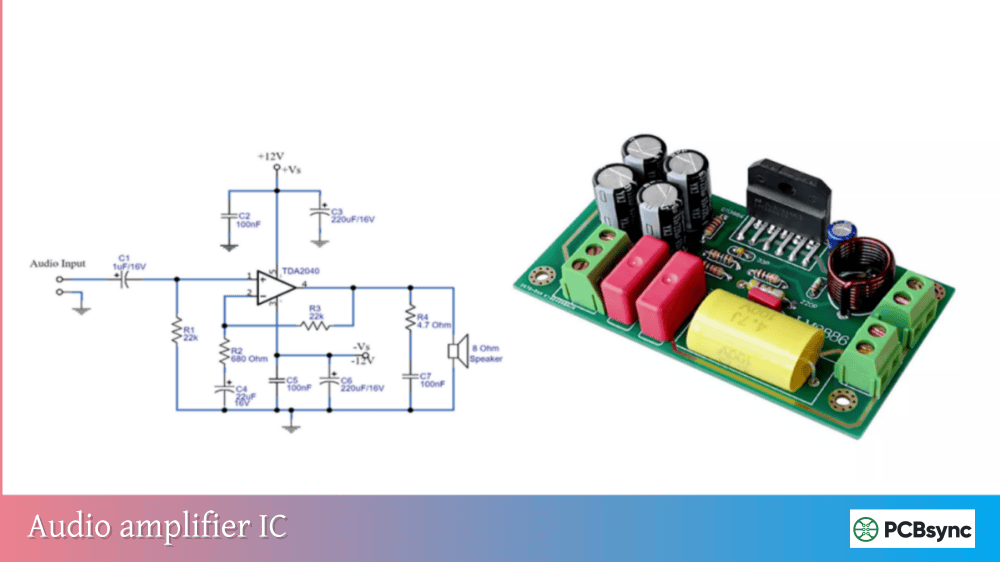
An audio amplifier IC is a specialized integrated circuit designed to take weak audio signals—typically in the millivolt range from sources like microphones, DACs, or audio processors—and boost them to levels sufficient to drive speakers or headphones. These chips integrate the complete amplification stage, including output transistors, protection circuits, and often additional features like volume control or diagnostic functions, into a single package.
The market for audio amplifier ICs has grown significantly, reaching approximately $5.2 billion in 2022 and projected to hit $10.3 billion by 2032. This growth reflects the increasing demand for quality audio in consumer electronics, automotive systems, and portable devices.
Modern audio amplifier ICs achieve impressive specifications: some deliver THD (Total Harmonic Distortion) as low as 0.00008%, rivaling discrete component designs. Top-tier devices now offer 130dB signal-to-noise ratios while consuming significantly less power than previous generations.
Understanding Amplifier IC Types and Classes
The “class” of an amplifier refers to its topology—specifically, how current flows through the output transistors and how efficiently they convert power into audio output. Each class has distinct characteristics that make it suitable for different applications.
Class A Amplifiers
Class A represents the simplest amplifier topology. The output transistors conduct current continuously, even when there’s no input signal. This means the transistors operate in their most linear region at all times.
The result is exceptionally low distortion and smooth signal reproduction. However, Class A amplifiers typically achieve only about 25% efficiency—the remaining 75% becomes heat. This makes them impractical for battery-powered devices and necessitates substantial heatsinking.
You’ll rarely encounter Class A amplifier ICs in modern consumer products. They’re primarily found in high-end audiophile equipment and certain guitar amplifiers where sound quality trumps efficiency concerns.
Class B Amplifiers
Class B designs use a push-pull configuration with two output transistors. One transistor handles the positive half of the audio waveform while the other handles the negative half. Each transistor is off during the opposite half-cycle.
This improves efficiency to around 50-60%, but creates a problem: during the transition between transistors (the “crossover” point), there’s a brief moment where neither device is fully conducting. This crossover distortion is audible and limits the usefulness of pure Class B designs in audio applications.
Class AB Amplifiers
Class AB combines the strengths of both previous designs. The output transistors are biased slightly into conduction even when idle, eliminating most crossover distortion while maintaining reasonable efficiency (typically 50-78%).
Key characteristics of Class AB amplifier ICs:
Parameter
Typical Value
Efficiency
50-78%
THD
0.01-0.1%
Idle Current
Moderate
Heat Generation
Moderate to High
Component Count
Low
Audio Quality
Excellent
Class AB remains the standard for many home audio applications, professional equipment, and scenarios where audio fidelity is paramount but power consumption is less critical.
Class D Amplifiers
Class D has become the dominant topology for modern audio amplifier ICs, and for good reason. These amplifiers use pulse-width modulation (PWM) to switch the output transistors on and off at high frequencies (typically 200kHz to 2MHz). The audio signal modulates the duty cycle of these pulses, and an LC filter reconstructs the analog waveform.
Why Class D dominates modern designs:
Parameter
Typical Value
Efficiency
85-95%
THD
0.006-0.1% (modern designs)
Idle Power
Very Low (<2.5W for high-power ICs)
Heat Generation
Minimal
Size
Compact
Cost
Competitive
The TPA3255 from Texas Instruments, for example, delivers up to 315W per channel with ultra-low THD+N of 0.006% at 1W—numbers that would have been impossible for Class D just a decade ago. Modern feedback techniques and advanced gate driver designs have largely eliminated the audio quality concerns that once plagued this topology.
Class D amplifier ICs are now found everywhere: smartphones, portable speakers, soundbars, automotive systems, and even high-end home audio equipment.
Class G and Class H Amplifiers
These are variations on the linear amplifier concept designed to improve efficiency without fully embracing switching topologies.
Class G uses multiple power supply rails and switches between them based on the output signal level. When playing quiet passages, the amplifier draws from a lower-voltage rail, reducing waste.
Class H takes this further by continuously varying the supply voltage to track the audio envelope. Both approaches can achieve 70-80% efficiency while maintaining the smooth, predictable behavior of linear amplifiers.
STMicroelectronics offers their “Class-SB” topology in automotive applications, which adjusts biasing dynamically to balance efficiency and sound quality.
Comparison of Audio Amplifier IC Types
When selecting an audio amplifier IC for your project, understanding the trade-offs between different amplifier IC types is essential:
Class
Efficiency
THD (Typical)
Idle Power
Best For
A
~25%
Very Low
Very High
High-end audiophile equipment
AB
50-78%
Low
Moderate
Home audio, professional gear
D
85-95%
Low-Moderate
Very Low
Portable, automotive, high-power
G/H
70-80%
Low
Low-Moderate
Power-constrained quality apps
How to Select the Right Audio Amplifier IC
Selecting an audio amplifier IC involves balancing multiple parameters against your specific requirements. Here’s a practical framework I use when specifying components.
Define Your Output Power Requirements
Start with your speaker impedance and target output power. Remember that manufacturers often specify power at 10% THD—a level that sounds terrible. Look for specifications at 1% or lower THD for realistic expectations.
For a stereo bookshelf speaker system, you might target 2×25W at 8Ω. A car audio subwoofer might need 100W or more into a 4Ω or 2Ω load.
Common power tiers and typical applications:
Power Range
Typical Applications
Example ICs
1-5W
Portable speakers, IoT devices
TPA2016D2, PAM8403
15-50W
Bookshelf speakers, desktop audio
TPA3116D2, TPA3118D2
50-100W
Home theater, car audio
TPA3255, TDA7850
100W+
Professional audio, subwoofers
Multi-IC configurations
Consider Supply Voltage
Your available power supply constrains your IC choices significantly. Battery-powered devices typically work with 3.3V to 12V, while automotive applications must handle the 6-18V range that cars present during normal operation (including cranking and load dumps).
For example, the TPA3116D2 operates from 4.5V to 26V, making it versatile for various applications. Automotive-grade parts like those from STMicroelectronics and NXP include transient protection for ISO 7637-2 compliance.
Evaluate Thermal Requirements
Even efficient Class D amplifiers generate heat at high power levels. The TPA3116D2 can run 2×15W at 8Ω without a heatsink on a single-layer PCB, but pushing 2×50W at 4Ω requires thermal management.
Consider:
Ambient temperature range
Enclosure constraints
PCB thermal relief capabilities
Heatsink options
Check Protection Features
Modern audio amplifier ICs include various protection mechanisms:
Protection Type
Purpose
Over-temperature
Shuts down before thermal damage
Over-current
Protects against short circuits
Under-voltage lockout
Prevents erratic behavior at low supply
DC offset detection
Protects speakers from DC at output
Clip detection
Indicates when output is saturating
For automotive applications, look for diagnostic features like speaker wire short/open detection and I²C status reporting.
Assess Input Options
Audio amplifier ICs accept either analog or digital inputs. Analog inputs (typically differential or single-ended) are simpler to implement and work with any audio source. Digital inputs (I²S, TDM, or PDM) can eliminate analog front-end components and reduce noise, but require a digital audio source.
For complex systems with DSP processing, digital input amplifiers make sense. For simple retrofit or DIY projects, analog inputs are more straightforward.
Factor in EMI Considerations
Class D amplifiers switch at high frequencies and can generate significant electromagnetic interference. Modern ICs include features to mitigate this:
Spread-spectrum modulation
Synchronized switching for multi-channel systems
Configurable switching frequencies to avoid AM radio interference
The TPA3116D2 series, for instance, includes a multi-function PLL that can shift switching frequency to avoid interfering with AM radio reception—critical for automotive applications.
Popular Audio Amplifier ICs and Their Applications
Texas Instruments TPA3116D2
This Class D stereo amplifier delivers up to 2×50W at 4Ω with efficiency exceeding 90%. It’s become the go-to choice for DIY audio projects and commercial products alike due to its excellent performance-to-price ratio.
Key specifications:
Supply voltage: 4.5V to 26V
Output power: 2×50W @ 4Ω, 2×30W @ 8Ω
THD+N: <0.03%
Package: 32-pin HTSSOP
Texas Instruments TPA3255
For applications requiring higher power, the TPA3255 delivers up to 315W stereo or 600W mono with Texas Instruments’ PurePath Ultra-HD technology. It achieves THD+N below 0.01% to clipping.
Key specifications:
Supply voltage: 18V to 53.5V
Output power: 2×315W @ 4Ω
THD+N: 0.006% at 1W
Signal bandwidth: Up to 100kHz
STMicroelectronics TDA7498E
STMicroelectronics offers comprehensive audio amplifier portfolios. The TDA7498E provides flexible configuration options for stereo, mono, and 2.1 systems with high current capability for low-impedance loads down to 2Ω.
LM386 (Legacy)
The LM386 remains popular for educational purposes and simple low-power applications despite its age. It’s a Class AB design limited to milliwatt-level output and higher distortion than modern alternatives. For new designs, consider modern replacements that offer better performance in similar packages.
Audio Amplifier IC Applications
Portable Audio Devices
Smartphones, tablets, and Bluetooth speakers demand compact, efficient amplifier ICs. Class D dominates here, with devices like the PAM8403 delivering 3W per channel from a tiny package while running from a single lithium cell.
Key requirements include low idle power consumption, small package size, and built-in pop/click suppression for clean turn-on and shutdown.
Home Audio Systems
Soundbars, powered speakers, and A/V receivers use a mix of Class D and Class AB amplifiers depending on the quality tier. Entry-level products typically use integrated Class D solutions, while premium equipment may use higher-voltage Class D or Class AB for the main channels.
Multi-channel configurations (5.1, 7.1, or Atmos setups) benefit from Class D’s efficiency, as it reduces heat generation in compact enclosures.
Automotive Audio Systems
Automotive applications present unique challenges: wide supply voltage variations, extreme temperatures, and stringent EMC requirements. Just as you’d carefully select an Altera FPGA for signal processing tasks, choosing the right automotive-grade amplifier IC requires attention to qualification standards.
Look for AEC-Q100 qualified parts with:
Wide operating temperature range (-40°C to +85°C or higher)
ISO 7637-2 transient protection
Start-stop compatibility
Diagnostic capabilities (I²C interface for speaker fault detection)
STMicroelectronics, NXP, Texas Instruments, and Toshiba all offer automotive-qualified audio amplifier portfolios.
Industrial and PA Systems
Public address and industrial audio applications require reliable, high-power amplification. These systems often use multi-channel amplifier ICs with monitoring capabilities and redundancy features.
Power output requirements can range from modest (conference rooms) to substantial (outdoor venues), with thermal management becoming critical at higher power levels.
Poor PCB layout can undermine even the best amplifier IC. Here are essential guidelines from my experience:
Grounding Strategy
Use a solid ground plane and implement star-point grounding where possible. Keep analog signal grounds separate from power grounds, connecting them at a single point near the power input. This prevents ground loops that cause hum and noise.
Power Supply Decoupling
Place decoupling capacitors as close as possible to the IC power pins. Use a combination of values: 0.1µF ceramic for high-frequency noise and 10-100µF for bulk energy storage. The return path should connect directly to the same ground point as the IC.
Signal Routing
Keep input traces short and away from switching nodes. For Class D amplifiers, the high-frequency switching signals (SW nodes) should not be routed parallel to sensitive analog inputs. Use ground shields or physical separation.
Thermal Management
Class D amplifiers concentrate heat in the IC package. Use thermal vias under the exposed pad to conduct heat to internal or bottom copper layers. Copper pours near power devices help spread heat.
Essential layout practices:
Practice
Purpose
Thermal vias under IC pad
Heat conduction to inner/bottom layers
Wide output traces (30+ mils)
Handle high currents without voltage drop
LC filter close to IC
Minimize EMI from switching node traces
Separate analog/digital grounds
Prevent noise coupling
Decoupling caps at power pins
Stable supply voltage
EMI Control
For Class D amplifiers, place the output LC filter components as close as possible to the IC output pins. This minimizes the loop area for high-frequency switching currents. Consider adding ferrite beads on power supply lines and using shielding for particularly sensitive applications.
Useful Resources for Audio Amplifier IC Selection
When you’re deep into a design project, having reliable resources saves time. Here are the databases and tools I regularly use:
Manufacturer Selection Tools
Manufacturer
Resource
URL
Texas Instruments
Audio Amplifier Selection Tool
ti.com/audio-ic/amplifiers/products.html
STMicroelectronics
Audio Amplifier Portfolio
st.com/en/audio-ics/audio-amplifiers.html
Analog Devices
Audio Product Selection
analog.com/en/products/audio-video.html
Component Distributors
Distributor
Strengths
Mouser
Comprehensive inventory, fast shipping
Digi-Key
Extensive parametric search, datasheets
Octopart
Cross-distributor search, price comparison
LCSC
Cost-effective for volume orders
Technical Documentation
Always download and study the manufacturer’s datasheet and application notes before committing to a design. Reference designs and evaluation modules (EVMs) provide proven layouts that can accelerate your development.
FAQs
What is the difference between Class AB and Class D audio amplifier ICs?
Class AB amplifiers use linear output stages where transistors conduct continuously, achieving 50-78% efficiency with excellent audio quality. Class D amplifiers use high-frequency switching (PWM) and achieve 85-95% efficiency, running cooler and enabling smaller designs. Modern Class D ICs approach Class AB sound quality while consuming far less power.
Which audio amplifier IC is best for battery-powered devices?
For portable applications, look for Class D amplifiers with low idle current and boost converter options. Devices like the TPA2016D2 include built-in boost converters for operation from single-cell lithium batteries. The PAM8403 offers minimal external components for simple designs. Prioritize efficiency and low quiescent current over raw power output.
How do I calculate the power output I need from an audio amplifier IC?
Consider your speaker sensitivity (typically 85-90 dB/W/m), desired listening level, and listening distance. For most home applications, 15-50W per channel is sufficient. Double the power adds only 3dB of headroom. Also account for speaker impedance—a 4Ω speaker draws twice the current of an 8Ω speaker at the same power, affecting your IC choice.
Can I use automotive audio amplifier ICs in non-automotive applications?
Automotive-grade ICs (AEC-Q100 qualified) work perfectly in non-automotive applications and often provide enhanced reliability and protection features. However, they may cost more than consumer-grade equivalents. The robust transient protection and wide temperature range can be beneficial in industrial or outdoor applications where conditions are demanding.
What causes noise and hum in audio amplifier circuits?
Common causes include ground loops, inadequate decoupling, poor PCB layout, and interference from nearby digital circuits. Solutions include star-point grounding, proper capacitor placement close to IC power pins, physical separation of analog and digital sections, and shielding. For Class D amplifiers, improper LC filter design can also introduce audible switching artifacts.
Conclusion
Selecting the right audio amplifier IC requires balancing power requirements, efficiency, audio quality, thermal constraints, and available features. Class D has become the default choice for most applications, offering excellent efficiency and increasingly competitive sound quality. Class AB remains relevant for specific high-fidelity applications where absolute audio purity matters more than efficiency.
Focus on understanding your application requirements first: output power, supply voltage, thermal environment, and protection needs. Then evaluate ICs against those criteria, using manufacturer selection tools and reference designs to shortcut the development process. Proper PCB layout is equally important—even the best IC will underperform on a poorly designed board.
The audio amplifier IC market continues to evolve rapidly, with manufacturers pushing efficiency higher and distortion lower. Whether you’re building a compact Bluetooth speaker or a multi-channel automotive system, there’s almost certainly an integrated solution that meets your needs better than discrete designs.
Inquire: Call 0086-755-23203480, or reach out via the form below/your sales contact to discuss our design, manufacturing, and assembly capabilities.
Quote: Email your PCB files to Sales@pcbsync.com (Preferred for large files) or submit online. We will contact you promptly. Please ensure your email is correct.
Notes: For PCB fabrication, we require PCB design file in Gerber RS-274X format (most preferred), *.PCB/DDB (Protel, inform your program version) format or *.BRD (Eagle) format. For PCB assembly, we require PCB design file in above mentioned format, drilling file and BOM. Click to download BOM template To avoid file missing, please include all files into one folder and compress it into .zip or .rar format.