Inquire: Call 0086-755-23203480, or reach out via the form below/your sales contact to discuss our design, manufacturing, and assembly capabilities.
Quote: Email your PCB files to Sales@pcbsync.com (Preferred for large files) or submit online. We will contact you promptly. Please ensure your email is correct.
Notes: For PCB fabrication, we require PCB design file in Gerber RS-274X format (most preferred), *.PCB/DDB (Protel, inform your program version) format or *.BRD (Eagle) format. For PCB assembly, we require PCB design file in above mentioned format, drilling file and BOM. Click to download BOM template To avoid file missing, please include all files into one folder and compress it into .zip or .rar format.
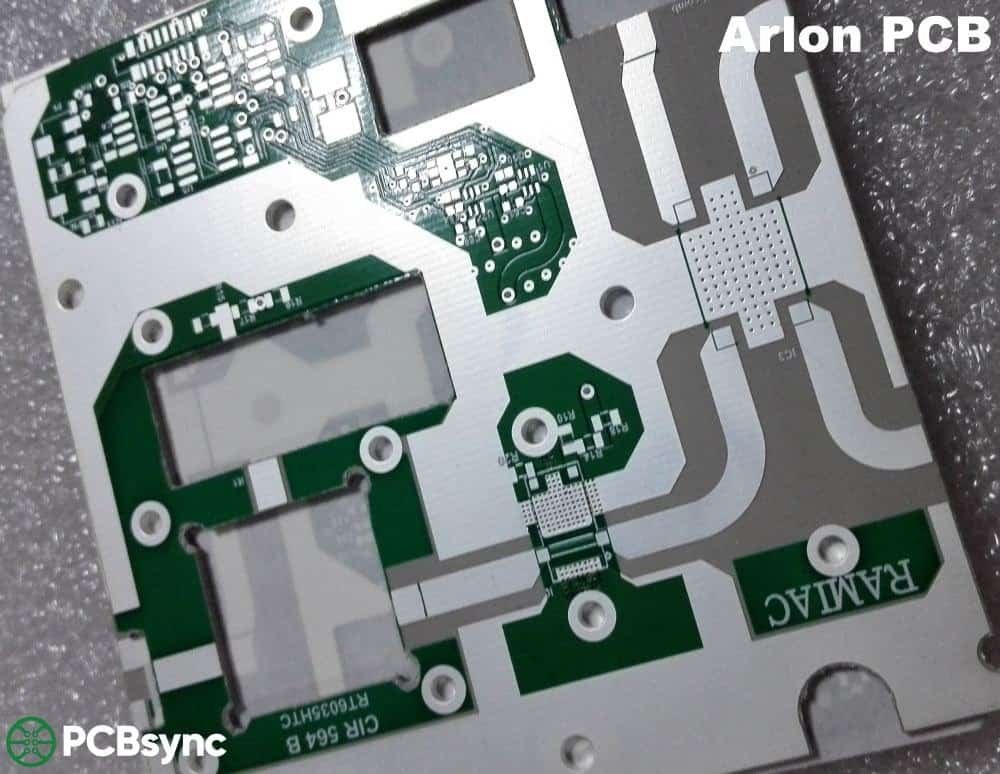
I’ve been working with high-frequency PCB designs for over a decade now, and if there’s one thing I’ve learned, it’s that material selection can make or break your project. When standard FR-4 just doesn’t cut it anymore—whether you’re dealing with RF circuits, aerospace applications, or anything that runs hot—Arlon materials have consistently been my go-to choice.
This guide covers everything you need to know about Arlon PCB materials: the different product families, their key properties, where they excel, and practical tips for working with them. Whether you’re specifying materials for a new design or trying to solve a performance problem on an existing board, you’ll find actionable information here.
Arlon Electronic Materials Division, a veteran-owned business founded in 1969, manufactures specialty high-performance laminate and prepreg materials for demanding PCB applications. The company has built over 50 years of experience in PTFE-based microwave laminates and more than 30 years in polyimide and specialty epoxy systems.
Unlike commodity FR-4, Arlon materials are engineered for specific performance characteristics—whether that’s surviving extreme temperatures, maintaining signal integrity at microwave frequencies, or providing dimensional stability in multilayer constructions. The tradeoff is cost and sometimes processing complexity, but when your application demands it, there’s really no substitute.
Arlon PCB Calculator
PCBSync Engineering Tools
Arlon Material Selection Guide
AD Series (AD255C, AD260A, AD300A, AD350A)RF/Microwave
Woven fiberglass reinforced PTFE composites. Ideal for high-frequency applications requiring excellent electrical properties and dimensional stability.
Dk: 2.55 - 3.50Df: 0.0018 - 0.0035Freq: Up to 40 GHzTg: 280°C+
CLTE Series (CLTE-XT, CLTE-AT)Thermal Management
Controlled Low Thermal Expansion materials with ceramic-filled PTFE. Excellent for applications requiring matched CTE with components.
Note: Material selection depends on frequency, thermal requirements, and cost constraints. Contact PCBSync for detailed material datasheets and recommendations.
Microstrip Impedance Calculator
Calculated Results
50.0 Ω
Effective Dk
2.12
Wavelength (λ)
20.6 mm
Propagation Delay
4.86 ps/mm
Conductor Loss
0.12 dB/in
PCB Stack-up Designer
0.5 mil
Solder Mask
1.4 mil
L1 - Signal (Top)
10 mil
Core - AD255C
1.4 mil
L2 - GND
6 mil
Prepreg - FR4
1.4 mil
L3 - Power
10 mil
Core - AD255C
1.4 mil
L4 - Signal (Bottom)
0.5 mil
Solder Mask
Stack-up Summary
Total Thickness
32.6 mils
Arlon Core Layers
2
Prepreg Layers
1
Manufacturing Cost Estimator
×
Estimated Total Cost
$485.00
Material Cost
$280.00
Fabrication
$155.00
Per Unit
$48.50
Disclaimer: This is an estimate only. Actual costs may vary based on specifications, tolerances, and current material availability. Contact PCBSync for an accurate quote.
For applications below 6 GHz, DiClad series offers excellent cost-performance. For 6-20 GHz, use AD series. Above 20 GHz, consider CLTE or CuClad series for lowest loss. Always verify Dk tolerance with manufacturer specs.
🔥 Thermal Management Considerations
PTFE materials have lower thermal conductivity than FR4. Use thermal vias (0.3mm diameter, 1mm pitch) under power components. TC series materials provide 3-5x better thermal conductivity for high-power applications.
⚡ Impedance Control Guidelines
Arlon materials have tighter Dk tolerance (±0.04) vs FR4 (±0.2). Design for nominal Dk value. Request impedance testing on production lots. Allow ±5% impedance tolerance in your design margins.
🔧 Drilling & Via Recommendations
PTFE materials require specialized drill bits with lower feed rates. Minimum via diameter: 8 mils. Maintain aspect ratio below 8:1. Plasma desmear is recommended over chemical processes for PTFE.
📏 Trace Width Compensation
PTFE has higher CTE than copper. Add +0.5 mil to trace width specifications to compensate for etching variations. Use trapezoidal trace models for accurate impedance calculations above 10 GHz.
🔗 Hybrid Stack-up Design
Combine Arlon RF cores with FR4 prepreg for cost optimization. Place high-frequency signals on Arlon layers. Use FR4 bonding films compatible with PTFE (e.g., FEP or low-flow prepreg).
✨ Surface Finish Selection
ENIG provides best solderability for fine-pitch components on PTFE. For RF applications, immersion silver or OSP minimize conductor loss. Avoid HASL on thin PTFE cores (<10 mil).
📦 Storage & Handling
Store Arlon laminates at <30°C and <50% RH. PTFE materials absorb minimal moisture but cleanliness is critical. Handle with gloves to prevent contamination affecting solder mask adhesion.
Arlon Material Comparison Chart
Material
Dk @ 10GHz
Df @ 10GHz
Tg (°C)
CTE Z-axis
Best For
AD255C
2.55 ± 0.04
0.0018
>280
280 ppm/°C
General RF
AD260A
2.60 ± 0.04
0.0017
>280
265 ppm/°C
Antennas
AD300A
3.00 ± 0.04
0.0020
>280
250 ppm/°C
Size reduction
AD350A
3.50 ± 0.05
0.0035
>280
230 ppm/°C
Compact RF
CLTE-XT
2.94 ± 0.04
0.0012
288
12 ppm/°C
CTE matching
DiClad 527
2.50 ± 0.04
0.0018
N/A
170 ppm/°C
Cost-effective
DiClad 880
2.55 ± 0.04
0.0022
N/A
170 ppm/°C
Multi-layer
CuClad 217
2.17 ± 0.02
0.0009
N/A
24 ppm/°C
Low loss
CuClad 250GT
2.50 ± 0.04
0.0018
N/A
24 ppm/°C
High-speed
TC350
3.50 ± 0.05
0.0020
N/A
24 ppm/°C
Thermal mgmt
TC600
6.15 ± 0.15
0.0025
N/A
20 ppm/°C
High Dk apps
Selection Guide: Lower Dk = faster signal propagation, wider traces. Lower Df = less signal loss. Matched CTE = better reliability under thermal cycling.
Why Choose Arlon Over Standard FR-4?
FR-4 works fine for most consumer electronics operating below a few hundred MHz. But push it into the GHz range, subject it to repeated thermal cycling, or try to maintain tight impedance tolerances, and you’ll quickly see its limitations. Here’s where Arlon materials provide clear advantages:
Thermal stability: Glass transition temperatures (Tg) up to 250°C vs. 130-180°C for standard FR-4
Electrical performance: Dielectric constants from 2.1 to 10.2 with much tighter tolerances
Signal integrity: Loss tangent values as low as 0.0009 compared to 0.02+ for FR-4
Dimensional control: Lower CTE values for reliable plated through-holes in thick multilayers
Environmental resistance: Lower moisture absorption for stable performance in humid conditions
Key Properties of Arlon PCB Materials
Understanding the core properties helps you match materials to your specific requirements. Let me break down what matters most.
Thermal Properties
Thermal management is critical for reliability. Three parameters tell the story:
Glass Transition Temperature (Tg): This is the temperature where the resin transitions from rigid to rubbery. Arlon polyimides like 85N hit 250°C, while their epoxies range from 135-175°C. For lead-free soldering, you want at least 170°C Tg.
Decomposition Temperature (Td): This indicates when the material starts breaking down chemically. Arlon 85N reaches 407°C at 5% weight loss—crucial for repeated reflow cycles.
Coefficient of Thermal Expansion (CTE): Lower CTE in the Z-axis means less stress on plated through-holes during thermal cycling. Arlon 85N achieves 1.2% Z-expansion from 50-260°C, excellent for high-layer-count boards.
Electrical Properties
For RF and high-speed digital designs, electrical properties drive material selection:
Dielectric Constant (Dk): Arlon offers materials from Dk 2.1 (PTFE-based) to 10.2 (ceramic-filled). Lower Dk means faster signal propagation; higher Dk allows smaller antenna elements.
Dissipation Factor (Df): This measures signal loss. Arlon’s CLTE-XT achieves Df as low as 0.0009—critical for maintaining signal integrity at mmWave frequencies.
Dk Stability: Unlike FR-4 where Dk drifts with temperature and frequency, Arlon microwave materials maintain consistent Dk across wide ranges—essential for impedance-sensitive circuits.
Mechanical Properties
Boards need to survive handling, assembly, and operational stress:
Flexural strength: Determines resistance to bending and mechanical stress
Peel strength: Copper adhesion is critical for reliability—Arlon materials bond well even with smooth copper foils
Moisture absorption: Lower is better. Arlon polyimides typically achieve 0.2-0.3%—important for maintaining performance in humid environments
When you need maximum thermal performance, polyimides are the answer. These materials handle the toughest environments:
Material
Tg (°C)
Td (°C)
UL Rating
Best Applications
Arlon 33N
250
389
V-0
Flame-retardant applications
Arlon 35N
250
406
V-1
Reduced cure time requirements
Arlon 85N
250
407
HB
Aerospace, military, high-layer MLBs
Arlon 85HP
>250
430
HB
2x thermal conductivity, downhole
Pro tip: Arlon 85N is the gold standard for long-term high-temperature reliability. Its pure polyimide formulation (no flame retardants or additives) means it won’t degrade over time like modified polyimides.
Low-Flow Products (Rigid-Flex and Multilayer)
Low-flow prepregs control resin movement during lamination—critical for rigid-flex designs and applications requiring precise layer-to-layer registration:
Material
Tg (°C)
Td (°C)
Best Applications
Arlon 37N
200
320
Rigid-flex bonding, heat sink attachment
Arlon 38N
200
330
Improved adhesion rigid-flex applications
Arlon 49N
170
302
Heat sink bonding to epoxy MLBs
Arlon 51N
170
>300
Lead-free compatible rigid-flex
Epoxy Products (General High-Performance)
When you need better-than-FR-4 performance without going to full polyimide, Arlon’s epoxy systems fill the gap. They’re easier to process and more cost-effective while still delivering improved thermal and electrical properties.
Arlon 44N: Filled epoxy prepreg for clearance hole filling in metal core boards
Arlon 45N: Multifunctional epoxy with 175°C Tg, processes like FR-4
Arlon 47N: Low-flow tetrafunctional epoxy for controlled resin movement
SMT/Controlled Thermal Expansion Products
These aramid-reinforced materials are engineered for surface mount technology where CTE matching matters:
This is where Arlon really shines. Their PTFE-based and ceramic-filled materials deliver the electrical performance needed for demanding RF applications:
Material
Dk
Df
Best Applications
CLTE-XT
2.94
0.0009
Satellite comms, phased arrays (up to 64 layers)
TC350
3.5
0.002
Power amplifiers, thermal management critical
AD255A
2.55
0.0014
Low-loss RF, next-gen microwave
AD1000
10.2
0.003
mmWave 5G, compact antenna design
CuClad 250GX
2.5
0.0018
Ultra-low loss, traditional PTFE
Key insight: TC350 is particularly interesting because it combines excellent thermal conductivity (1.0 W/mK) with low loss—perfect for power amplifiers where heat dissipation and signal integrity both matter.
Applications by Industry
Let me walk you through where Arlon materials make the most sense, based on real-world project requirements.
Aerospace and Defense
This sector demands the highest reliability and performance. Typical applications include:
Avionics systems: Control systems requiring long service life at elevated temperatures (85N, 85HP)
Radar systems: Phased array antennas needing stable Dk across temperature ranges (CLTE-XT)
Satellite communications: Multilayer microwave boards up to 64 layers (CLTE series)
Missile guidance: High-G survival and thermal cycling resistance (polyimide products)
Telecommunications and 5G
The push to higher frequencies drives material requirements:
Base station antennas: Low loss at operating frequencies (CLTE, TC350)
Power amplifier boards: Thermal management and signal integrity (TC350)
mmWave 5G: Performance at 28 GHz and beyond (AD1000, CLTE-XT)
Tower-mounted amplifiers: Outdoor reliability and thermal cycling (TC350)
Automotive Electronics
Modern vehicles contain dozens of electronic control units operating in harsh conditions:
Engine control units: High under-hood temperatures (85N, epoxy products)
Automotive radar: 77 GHz ADAS sensors (CLTE-XT, AD series)
EV power electronics: High-current thermal management (thermal conductivity products)
Infotainment systems: Reliability across temperature extremes
Medical Devices
Medical applications demand reliability and signal integrity:
MRI systems: Non-magnetic materials with stable electrical properties
Diagnostic equipment: Long service life and consistent performance
Implantable devices: Biocompatibility and miniaturization (55NT for thin, lightweight designs)
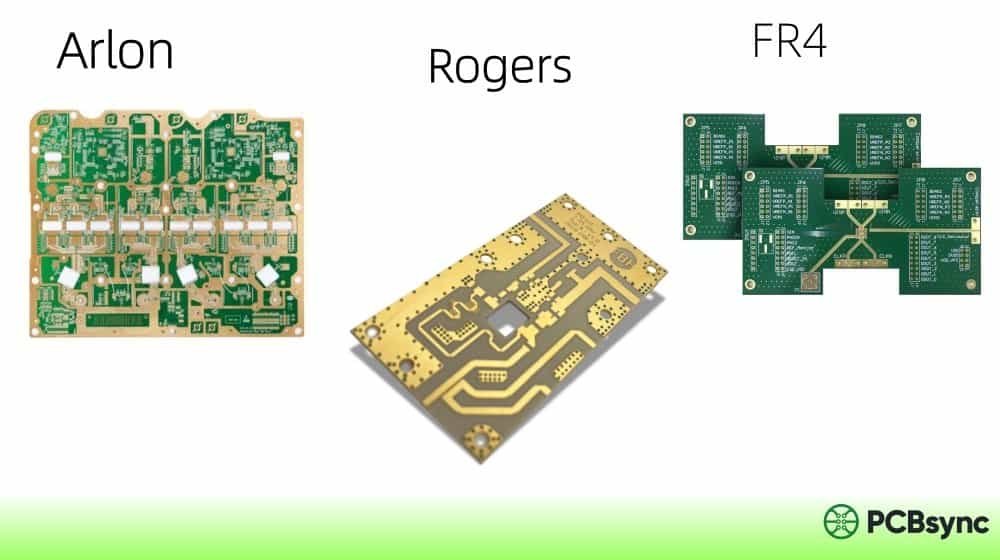
Arlon vs. Rogers vs. FR-4: How to Choose
One of the most common questions I get: “When should I use Arlon instead of Rogers or standard FR-4?” Here’s my practical decision framework:
Factor
FR-4
Arlon
Rogers
Cost
Lowest ($)
Medium ($$)
Highest ($$$)
Frequency Range
<1 GHz typical
Up to 77+ GHz
Up to 100+ GHz
Tg Range
130-180°C
135-250°C
280-350°C
Processing
Standard
Similar to FR-4
Special handling
Loss (Df)
0.02-0.03
0.0009-0.01
0.0012-0.004
When to Choose Each:
Use FR-4 when: Operating below 1 GHz, standard temperature requirements, cost is primary driver
Use Arlon when: Need better-than-FR-4 but with easier processing than Rogers, high temperature applications, rigid-flex designs
Use Rogers when: Absolute best RF performance required, ultra-high frequencies, PTFE-specific properties needed
Hybrid approach: For many designs, I use Arlon or Rogers only for the RF layers and standard FR-4 for digital/power layers. This balances performance and cost effectively.
Manufacturing and Processing Tips
Working with Arlon materials isn’t dramatically different from FR-4, but there are some key considerations to ensure quality results.
Material Handling and Storage
Store properly: Keep materials in climate-controlled environments. Polyimides are sensitive to moisture—use sealed bags or vacuum packaging
Handle carefully: Materials like 25N/FR are softer than FR-4. Use guide plates and antistatic equipment
Pre-bake if needed: For HASL processes, bake at 110°C for one hour to drive out absorbed moisture
Lamination Guidelines
Inner layer prep: Brown oxide treatment recommended before laminating
Vacuum first: 30 minutes vacuum before heating for materials like 25N/FR
Temperature ramp: Control rise at 2-3°C per minute
Cure profile: Follow manufacturer specs—85N requires slightly higher temperatures and longer cure than 33N/35N
Drilling and Machining
Drilling: Polyimides drill well with standard equipment. No special through-hole treatment required
Hole cleaning: Potassium permanganate and plasma effectively remove smear
Contour routing: Double-groove milling cutters work best
V-scoring: 30-degree cutters are most efficient
Surface Finishes
Arlon materials accept all standard finishes: immersion tin, ENIG, electrolytic tin, and HASL. Just remember to pre-bake for HASL as mentioned above.
Resources and Further Reading
Here are the most useful resources I’ve found for working with Arlon materials:
Arlon Official Website: www.arlonemd.com – Datasheets, technical guides, and material selection tools
Arlon Laminate FAQ Guide: “Everything You Wanted to Know About Laminates” – Comprehensive technical reference (available on Arlon’s site)
IPC Standards: IPC-4101 for laminate specifications, IPC-6012 for qualification requirements
Insulectro: www.insulectro.com – Major Arlon distributor with technical support
PCB Directory Material Database: Searchable database for comparing laminate properties
Frequently Asked Questions
1. What is the difference between Arlon 85N and Arlon 33N?
Both are polyimide materials with 250°C Tg, but they serve different purposes. Arlon 33N is flame-retardant (UL94 V-0 rated) for applications requiring fire safety certification—think commercial avionics or automotive. Arlon 85N is a pure, unmodified polyimide without flame retardants, which gives it better long-term thermal stability. If you need UL certification, go with 33N. If maximum thermal performance for aerospace or military is the priority, choose 85N.
2. Can Arlon materials be used with lead-free soldering?
Yes, but choose your material carefully. Lead-free soldering typically peaks around 260°C. Arlon polyimides (33N, 35N, 85N) with their 250°C Tg and 380-430°C Td handle this easily. For epoxy-based Arlon products, check that the Tg exceeds 170°C—materials like 45N and 49N are specifically designed for lead-free compatibility. The Arlon 51N was developed explicitly for lead-free rigid-flex applications.
3. How does Arlon compare to Rogers for RF applications?
Both are excellent for RF/microwave, but with different strengths. Rogers PTFE materials (like RO5880) achieve the lowest possible loss tangent—essential for the most demanding RF applications. Arlon’s CLTE and TC350 series offer comparable electrical performance with advantages in processability (more like FR-4 handling) and thermal management. TC350, for example, has best-in-class thermal conductivity combined with low loss. For most applications up to 40 GHz, Arlon microwave materials perform comparably to Rogers at potentially lower cost.
4. What certifications do Arlon materials meet?
Arlon materials comply with major industry standards. Their electronic substrate products meet relevant IPC-4101 specifications (like /40, /41 for polyimides). They comply with RoHS and REACH environmental regulations. Many products have UL certification for flammability (V-0, V-1, or HB ratings). For aerospace applications, Arlon supports AS9100 certified supply chains. Specific MIL-spec qualifications depend on the material—85N, for instance, is commonly used in MIL-PRF-31032 qualified boards.
5. Is Arlon more expensive than FR-4? How much?
Yes, Arlon materials cost more than standard FR-4—typically 2-5x for electronic substrates and 5-10x for microwave materials. The exact premium depends on the specific product and order volume. However, consider total cost: for high-reliability applications, the cost of field failures, rework, or warranty claims often far exceeds the material premium. Many engineers use a hybrid approach—Arlon for performance-critical layers, FR-4 for standard routing layers—to optimize the cost-performance balance.
Conclusion
Arlon PCB materials fill a critical need in the materials spectrum—delivering performance that exceeds FR-4 while often being easier to work with than pure PTFE alternatives. Whether you’re designing high-frequency RF systems, building boards for extreme temperatures, or creating rigid-flex assemblies, there’s likely an Arlon product that fits your requirements.
The key is matching material properties to your specific application requirements. Don’t over-specify (and overpay), but don’t underestimate what your design demands either. When in doubt, reach out to Arlon’s technical support or your PCB fabricator—they deal with these material choices daily and can provide valuable guidance.For your next high-performance PCB project, take time to evaluate whether Arlon materials can help you achieve better thermal management, improved signal
Inquire: Call 0086-755-23203480, or reach out via the form below/your sales contact to discuss our design, manufacturing, and assembly capabilities.
Quote: Email your PCB files to Sales@pcbsync.com (Preferred for large files) or submit online. We will contact you promptly. Please ensure your email is correct.
Notes: For PCB fabrication, we require PCB design file in Gerber RS-274X format (most preferred), *.PCB/DDB (Protel, inform your program version) format or *.BRD (Eagle) format. For PCB assembly, we require PCB design file in above mentioned format, drilling file and BOM. Click to download BOM template To avoid file missing, please include all files into one folder and compress it into .zip or .rar format.