Inquire: Call 0086-755-23203480, or reach out via the form below/your sales contact to discuss our design, manufacturing, and assembly capabilities.
Quote: Email your PCB files to Sales@pcbsync.com (Preferred for large files) or submit online. We will contact you promptly. Please ensure your email is correct.
Notes: For PCB fabrication, we require PCB design file in Gerber RS-274X format (most preferred), *.PCB/DDB (Protel, inform your program version) format or *.BRD (Eagle) format. For PCB assembly, we require PCB design file in above mentioned format, drilling file and BOM. Click to download BOM template To avoid file missing, please include all files into one folder and compress it into .zip or .rar format.
After years of debugging tangled Arduino sketches that look like spaghetti code, I’ve learned that state machines aren’t just computer science theory—they’re essential for writing maintainable embedded systems. As a PCB engineer who’s debugged countless firmware issues at 2 AM, I can tell you that proper state machine implementation is the difference between a project that ships and one that doesn’t.
Understanding Arduino State Machine Fundamentals
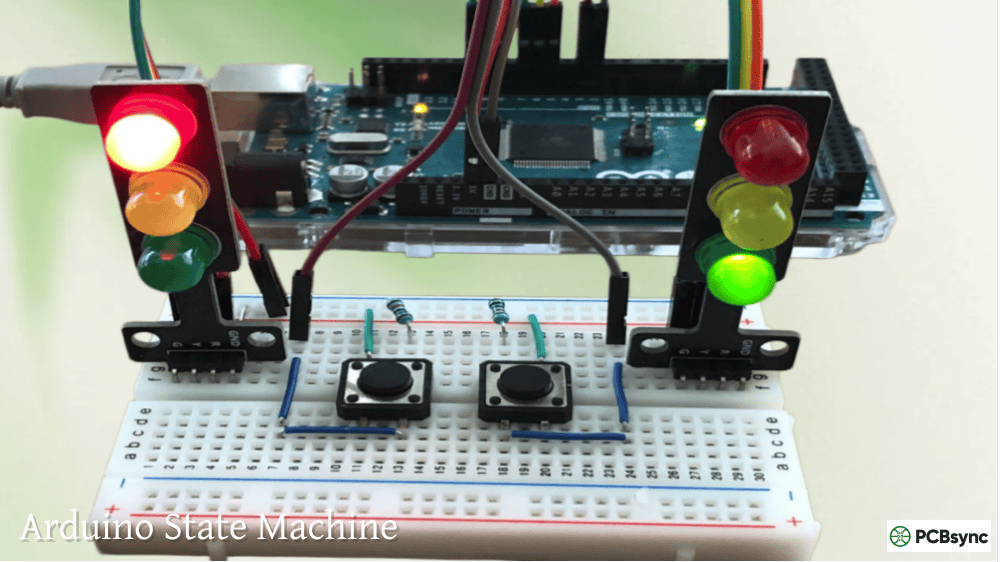
An Arduino state machine is a programming pattern where your system can exist in one of several defined states at any given time. The machine transitions between states based on specific conditions or events. Think of it like a traffic light: it’s always in exactly one state (red, yellow, or green), and it transitions between states following predetermined rules.
The beauty of state machines becomes apparent when you’re managing complex behaviors. Instead of writing nested if-else statements that become impossible to follow, you organize your code into discrete states with clear transition logic.
In real-world PCB designs with microcontrollers, you’re constantly juggling multiple concurrent operations: reading sensors, controlling actuators, managing communication protocols, and handling user input. Without structure, this quickly becomes unmanageable.
State machines provide:
Predictable behavior: You always know what state your system is in
Easier debugging: Isolate issues to specific states
Maintainable code: Add or modify states without breaking existing logic
Better documentation: State diagrams serve as executable documentation
Reduced bugs: Eliminate race conditions and unexpected state combinations
Moore vs Mealy State Machines
There are two primary types of finite state machines that you’ll encounter in embedded development.
Moore State Machine Characteristics
Feature
Moore Machine
Output Determination
Based only on current state
Output Stability
More stable, changes only on state transitions
Typical State Count
Usually requires more states
Best Use Case
When output stability is critical
Implementation Complexity
Simpler to implement and understand
In a Moore machine, outputs are determined solely by which state you’re in. The LED is either ON or OFF based on the state, not based on how you got there.
Mealy State Machine Characteristics
Feature
Mealy Machine
Output Determination
Based on current state AND input
Output Stability
Can change during state execution
Typical State Count
Usually requires fewer states
Best Use Case
When you need immediate response to inputs
Implementation Complexity
More complex transition logic
Mealy machines trigger outputs during state transitions. They tend to be more responsive but can be trickier to implement correctly.
Practical Comparison Example
Consider a motor control system. With Moore, you’d have states like MOTOR_FORWARD, MOTOR_REVERSE, MOTOR_STOPPED. The motor action is determined by the state itself. With Mealy, you might have fewer states but the motor action depends on both the current state and the sensor input that triggered the transition.
For most Arduino projects, I recommend starting with Moore machines—they’re easier to reason about and debug.
Implementing Arduino State Machine with Enums and Switch/Case
The cleanest way to implement a state machine in Arduino uses enumerations (enums) combined with switch/case statements. This approach provides readable code and efficient execution.
Basic Structure: Enum Definition
// Define all possible states
enum SystemState {
STATE_INIT,
STATE_IDLE,
STATE_RUNNING,
STATE_PAUSED,
STATE_ERROR,
STATE_SHUTDOWN
};
// Create state variable
SystemState currentState = STATE_INIT;
Enums give you human-readable names instead of magic numbers. The compiler treats these as your custom type, providing type safety while still using efficient integer values under the hood.
Complete State Machine Template
enum State {
IDLE,
ACTIVE,
ERROR
};
State currentState = IDLE;
unsigned long stateStartTime = 0;
void setup() {
Serial.begin(9600);
// Initialize hardware
pinMode(LED_BUILTIN, OUTPUT);
}
void loop() {
// State machine execution
switch(currentState) {
case IDLE:
handleIdleState();
break;
case ACTIVE:
handleActiveState();
break;
case ERROR:
handleErrorState();
break;
default:
// Defensive programming – handle unexpected state
Serial.println(“ERROR: Unknown state!”);
currentState = IDLE;
break;
}
}
void handleIdleState() {
digitalWrite(LED_BUILTIN, LOW);
// Transition logic
if (Serial.available()) {
currentState = ACTIVE;
stateStartTime = millis();
Serial.println(“Transitioning to ACTIVE”);
}
}
void handleActiveState() {
digitalWrite(LED_BUILTIN, HIGH);
// Timeout after 5 seconds
if (millis() – stateStartTime > 5000) {
currentState = IDLE;
Serial.println(“Timeout – returning to IDLE”);
}
}
void handleErrorState() {
// Blink LED to indicate error
digitalWrite(LED_BUILTIN, (millis() / 250) % 2);
// Reset on button press
if (digitalRead(RESET_BUTTON) == LOW) {
currentState = IDLE;
Serial.println(“Error cleared”);
}
}
Real-World Implementation: LED Sequence Controller
Let me show you a practical example that demonstrates proper state machine design—a multi-pattern LED controller.
“Design Patterns for Embedded Systems in C” by Bruce Powel Douglass
UML State Machine Specifications: OMG standards documentation
Embedded Systems Programming: Magazine articles on FSM design
Arduino State Machine Tutorials: SparkFun and Adafruit learning resources
Example Projects Repository
GitHub Arduino Examples: Search for “arduino state machine examples”
Instructables: Community-contributed state machine projects
Hackster.io: Professional embedded projects using state machines
Hardware Testing Tools
Logic Analyzers: For debugging state transitions (Saleae, DSLogic)
Oscilloscopes: Verify timing requirements
Serial Protocol Analyzers: Debug communication state machines
Frequently Asked Questions
Q1: When should I use a state machine instead of simple if-else statements?
Use a state machine when your code needs to remember what it was doing and make decisions based on that history. If you find yourself writing nested if-else statements checking multiple boolean flags, or if you’re tracking “what mode am I in”, you need a state machine. Generally, if your system has more than 3-4 distinct operational modes or behaviors, a state machine will make your code cleaner and more maintainable. Simple one-off decisions can stay as if-else, but sequential operations or complex workflows benefit tremendously from state machine organization.
Q2: How do I handle multiple concurrent state machines in one Arduino sketch?
Run multiple state machines by executing each one’s switch/case block in sequence within your loop(). Each state machine should have its own enum type and state variable. For example, you might have a MotorState motorState and a LEDState ledState that operate independently. The key is ensuring each state machine is non-blocking so they all get CPU time. If the state machines need to interact, use shared variables or event flags that one machine sets and another checks. Avoid having state machines directly modify each other’s state variables—use a messaging or event system instead.
Q3: What’s the performance impact of using state machines on Arduino?
State machines implemented with switch/case statements are extremely efficient—the compiler typically generates a jump table that executes in constant time regardless of how many states you have. A well-designed state machine actually improves performance compared to nested if-else chains because the switch/case is optimized at compile time. The enum values are just integers, so there’s no memory overhead. The main performance consideration is how much work you do within each state—keep state handlers lean and avoid blocking operations. On an Arduino Uno, you can easily handle multiple state machines with dozens of states each without noticeable performance impact.
Q4: Can I use state machines with interrupts and how do I handle state changes from ISRs?
Yes, but with caution. Interrupt Service Routines should be as short as possible, so don’t put your entire state machine execution in an ISR. Instead, use the ISR to set a flag or change a simple state variable, then handle the actual state machine logic in your main loop. Declare any variables shared between ISRs and main code as volatile to prevent compiler optimization issues. A common pattern is to have an interrupt set a “requestedState” variable, then your main loop checks this and performs the actual transition. This keeps your ISRs fast while maintaining proper state machine behavior.
Q5: How do I document and visualize my state machines for team collaboration?
Start with a state diagram showing all states as circles/boxes and transitions as arrows. Label each transition with the condition that triggers it. I recommend using tools like Draw.io or PlantUML that can be version controlled alongside your code. In your code, add a comment block at the top of your state machine implementation showing the ASCII art state diagram or linking to the diagram file. Include a state transition table in your documentation showing each valid transition. For production code, maintain this documentation as you modify the state machine—outdated diagrams are worse than no diagrams. Many teams keep state diagrams as part of their technical design documents and reference them during code reviews.
Inquire: Call 0086-755-23203480, or reach out via the form below/your sales contact to discuss our design, manufacturing, and assembly capabilities.
Quote: Email your PCB files to Sales@pcbsync.com (Preferred for large files) or submit online. We will contact you promptly. Please ensure your email is correct.
Notes: For PCB fabrication, we require PCB design file in Gerber RS-274X format (most preferred), *.PCB/DDB (Protel, inform your program version) format or *.BRD (Eagle) format. For PCB assembly, we require PCB design file in above mentioned format, drilling file and BOM. Click to download BOM template To avoid file missing, please include all files into one folder and compress it into .zip or .rar format.