Inquire: Call 0086-755-23203480, or reach out via the form below/your sales contact to discuss our design, manufacturing, and assembly capabilities.
Quote: Email your PCB files to Sales@pcbsync.com (Preferred for large files) or submit online. We will contact you promptly. Please ensure your email is correct.
Notes: For PCB fabrication, we require PCB design file in Gerber RS-274X format (most preferred), *.PCB/DDB (Protel, inform your program version) format or *.BRD (Eagle) format. For PCB assembly, we require PCB design file in above mentioned format, drilling file and BOM. Click to download BOM template To avoid file missing, please include all files into one folder and compress it into .zip or .rar format.
Arduino Pro Mini: Compact Projects & Low Power Applications
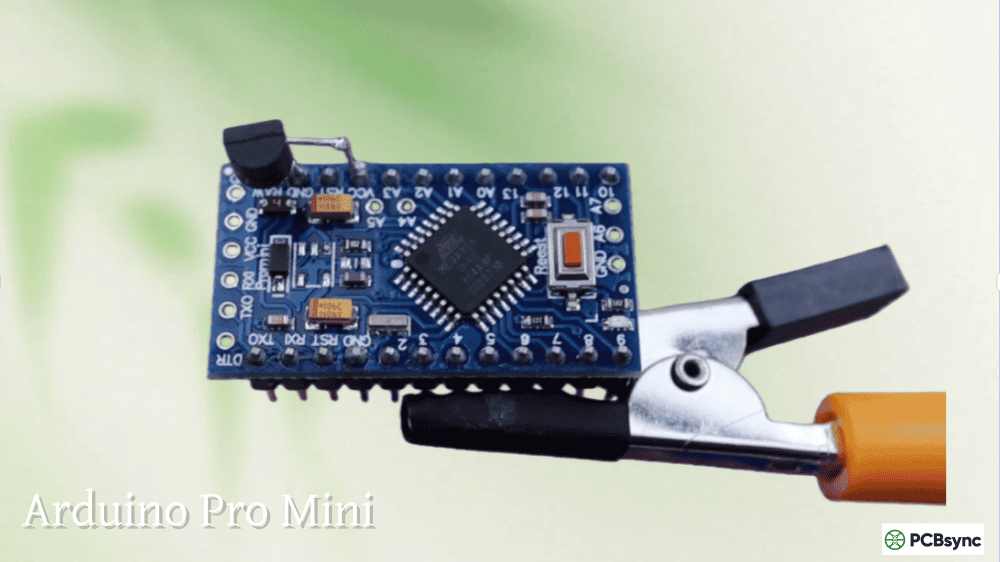
When I first started designing battery-powered embedded systems, I kept running into the same problem: the Arduino Uno was simply too big and too power-hungry. Then I discovered the Arduino Pro Mini, and it fundamentally changed how I approach compact, long-running projects. At roughly 1/6th the size of an Uno and with potential standby currents measured in microamps rather than milliamps, this tiny board has become my go-to choice for anything destined to run on batteries.
The Pro Mini strips away everything you don’t need for a deployed application—no USB port, no bulky connectors, no power-hungry secondary chips—leaving you with a lean, efficient platform that fits where other boards simply can’t. Let me walk you through what makes this board special and how to squeeze every last bit of efficiency from it.
The Arduino Pro Mini represents a fundamental philosophy shift from boards like the Uno. Rather than being designed as a development platform with all the bells and whistles, it’s optimized for permanent installation in finished projects.
The key difference lies in what’s missing: there’s no onboard USB-to-serial converter. The Uno dedicates an entire ATmega16U2 chip just to handle USB communication—a chip that draws current continuously even when you’re not programming. The Pro Mini eliminates this entirely, offloading programming duties to an external FTDI adapter that you connect only when needed.
This architectural decision has cascading benefits. The board is dramatically smaller, significantly cheaper, and—most importantly for battery applications—substantially more power-efficient.
Arduino Pro Mini Technical Specifications
The Pro Mini comes in two variants, and choosing the right one matters significantly for your application:
Specification
5V Version
3.3V Version
Microcontroller
ATmega328P
ATmega328P
Operating Voltage
5V
3.3V
Clock Speed
16 MHz
8 MHz
Digital I/O Pins
14
14
PWM Pins
6
6
Analog Input Pins
8 (A0-A7)
8 (A0-A7)
Flash Memory
32 KB (2 KB bootloader)
32 KB (2 KB bootloader)
SRAM
2 KB
2 KB
EEPROM
1 KB
1 KB
Input Voltage (RAW pin)
5-12V
3.4-12V
Board Dimensions
33 × 18 mm
33 × 18 mm
Weight
~2g
~2g
For battery-powered applications, the 3.3V/8MHz version is almost always the better choice. Running at lower voltage and slower clock speed translates directly to reduced power consumption—often by a factor of 4x or more compared to the 5V variant.
Programming the Arduino Pro Mini
Since there’s no onboard USB, you’ll need an external programmer. The most common approach uses an FTDI adapter (FT232RL or similar), which connects to the six-pin programming header on the Pro Mini.
FTDI Connection Pinout
FTDI Pin
Pro Mini Pin
Function
DTR
GRN/DTR
Auto-reset trigger
RX
TXO
Data from Pro Mini
TX
RXI
Data to Pro Mini
VCC
VCC
Power supply
GND
GND
Ground
CTS
GND
(Optional, tie to ground)
Critical Note: Match your FTDI adapter’s voltage to your Pro Mini version. Using a 5V FTDI with a 3.3V Pro Mini won’t immediately destroy it, but you’re operating outside specifications and may encounter stability issues.
Arduino IDE Configuration
In the Arduino IDE, navigate to Tools → Board → Arduino Pro or Pro Mini, then select the correct processor:
ATmega328P (5V, 16 MHz) for the 5V version
ATmega328P (3.3V, 8 MHz) for the 3.3V version
Getting this wrong is a common source of “failed to upload” errors.
Achieving Ultra-Low Power Consumption
Here’s where things get interesting for engineers building battery-powered systems. A stock Arduino Pro Mini 3.3V draws approximately 4-5mA when running a simple blink sketch. That might sound low, but it translates to roughly one month of runtime on a 3000mAh battery—before you’ve even connected any sensors.
The good news is that with some modifications and smart programming, you can reduce standby current to single-digit microamps, extending battery life from weeks to years.
Hardware Modifications for Low Power
Three components on the Pro Mini waste significant power in battery applications:
Component
Current Draw
Modification
Power LED
200µA – 2mA
Desolder or cut trace
Voltage Regulator
2-4mA quiescent
Desolder or bypass
Status LED (Pin 13)
~1mA when lit
Remove if always-on in your code
Removing the Power LED is the easiest win. This LED serves no purpose in a deployed application and constantly drains current. Simply desolder it or cut the trace feeding it.
Bypassing the Voltage Regulator is more involved but yields the biggest gains. The onboard MIC5205 regulator has relatively poor quiescent current—it draws milliamps even with no load. If you’re powering from a lithium cell (3.2V-4.2V) and your sensors are 3.3V tolerant, you can bypass the regulator entirely by feeding power directly to the VCC pin.
For applications requiring regulated voltage, consider replacing the stock regulator with a low-quiescent-current alternative like the MCP1700 (2µA quiescent) or HT7333 (4µA quiescent).
Software Power Optimization
Hardware modifications only tell half the story. The ATmega328P supports several sleep modes that dramatically reduce current consumption:
Sleep Mode
Current Draw
Wake Sources
Active
~5-8mA
N/A
Idle
~1.5mA
Any interrupt
Power-Down
~0.1µA
External interrupt, WDT
The LowPower library by RocketScream makes implementing sleep modes straightforward:
#include “LowPower.h”
void loop() {
// Do your sensing/transmission work here
readSensor();
transmitData();
// Sleep for 8 seconds (watchdog timer maximum)
LowPower.powerDown(SLEEP_8S, ADC_OFF, BOD_OFF);
}
With hardware modifications and proper sleep implementation, I’ve achieved standby currents of 4-7µA on modified Pro Minis—a 640x improvement over stock.
Compact Arduino Pro Mini Project Ideas
The Pro Mini’s small footprint opens possibilities that larger boards simply can’t address.
Project 1: Wireless Sensor Node
Perhaps the most popular Pro Mini application is building battery-powered sensor nodes for home automation or environmental monitoring. Combined with an NRF24L01+ radio module (which operates down to 1.9V), you can create wireless sensors that run for over a year on 2 AA batteries.
Key Components:
Arduino Pro Mini 3.3V
NRF24L01+ radio module
DHT22 or DS18B20 temperature sensor
2×AA or 18650 lithium battery
Project 2: Wearable Electronics
At just 2 grams, the Pro Mini disappears into wearable projects. I’ve embedded them in everything from LED-enhanced costumes to fitness trackers. The lack of bulky USB connectors makes integration into custom enclosures vastly easier.
Project 3: Data Logger
For scientific applications requiring months of unattended operation, a Pro Mini paired with an SD card module and RTC can log sensor data continuously. With proper sleep cycling, you can achieve 6-12 months of runtime on modest batteries.
Project 4: RC Model Controller
The compact size and light weight make Pro Minis ideal for RC aircraft, drones, and robots where every gram counts. Combined with a radio receiver and servo outputs, you can build remarkably capable flight controllers.
Project 5: IoT Gateway Node
Paired with an RFM69 or LoRa radio module, Pro Minis make excellent long-range wireless nodes for IoT applications. The modified low-power variants can transmit sensor data for years on a single battery charge.
Power Budget Calculation Example
Let me walk through a real power budget for a wireless temperature sensor:
State
Current
Duration
Duty Cycle
Deep Sleep
7µA
59.9 seconds
99.83%
Active (sensing)
8mA
50ms
0.08%
Transmitting
45mA
50ms
0.08%
Average Current Calculation: (7µA × 0.9983) + (8mA × 0.0008) + (45mA × 0.0008) = 49.4µA
With a 3000mAh battery: 3000mAh ÷ 0.0494mA = 60,728 hours ≈ 6.9 years
Obviously, battery self-discharge limits practical runtime to 2-3 years maximum, but this demonstrates why proper power management matters so dramatically.
Common Arduino Pro Mini Issues and Solutions
Problem
Likely Cause
Solution
Won’t upload
Wrong board/processor selected
Verify Tools → Board and Processor settings
Upload fails mid-transfer
Poor FTDI connection
Check pin alignment, try different USB port
Inconsistent behavior
Insufficient power
Ensure adequate current capacity, add capacitors
Random resets
Brown-out detection
Disable BOD in fuses or ensure stable voltage
High power consumption
Stock regulator/LEDs
Perform hardware modifications
Analog readings unstable
No reference voltage
Use external AREF or connect VCC properly
Arduino Pro Mini vs. Other Compact Boards
Feature
Pro Mini
Nano
Pro Micro
MCU
ATmega328P
ATmega328P
ATmega32U4
Onboard USB
No
Yes
Yes
Size (mm)
33×18
45×18
33×18
Low Power Potential
Excellent
Poor
Moderate
Price
$2-4
$3-5
$4-8
USB HID Support
No
No
Yes
Best For
Battery projects
Prototyping
USB devices
The Pro Mini wins decisively for battery-powered and space-constrained applications. The Nano offers more convenience for development but carries the penalty of always-on USB circuitry.
SparkFun Pro Mini Guide: learn.sparkfun.com/tutorials/using-the-arduino-pro-mini-33v
Community Resources
Arduino Forum: forum.arduino.cc
MySensors Community: forum.mysensors.org
Low Power Project Examples: github.com/JackGruber/Arduino-Pro-Mini-LoRa-Sensor-Node
FAQs About Arduino Pro Mini
Can I program an Arduino Pro Mini without an FTDI adapter?
Yes, you have alternatives. You can use an Arduino Uno as an ISP programmer by removing the ATmega328P from the Uno and connecting TX, RX, Reset, VCC, and GND between the boards. Some USB-to-serial adapters with CP2102 or CH340 chips also work, though FTDI adapters tend to be most reliable. Additionally, you can use a USBasp programmer connected to the ICSP header, though this requires a different upload process.
What’s the actual battery life I can expect from a Pro Mini project?
This varies enormously based on your implementation. An unmodified Pro Mini running continuously will drain a 3000mAh battery in about a month. With hardware modifications (LED and regulator removed) and proper sleep mode implementation, the same battery can last 2+ years. The key factors are: how often you wake up, how long you stay awake, and whether you’ve eliminated parasitic current drains from the board.
Should I choose the 3.3V or 5V Arduino Pro Mini?
For battery-powered applications, almost always choose the 3.3V version. It consumes significantly less power (roughly 4x less than the 5V version), and most modern sensors support 3.3V logic. The main reasons to choose 5V are: you’re interfacing with 5V-only sensors, you’re powering from a regulated 5V supply, or you need the faster 16MHz clock speed for time-critical applications.
Why does my Pro Mini draw more current than expected in sleep mode?
Several culprits commonly cause this. First, check that you’ve disabled the ADC and Brown-Out Detection in your sleep call (use ADC_OFF and BOD_OFF flags). Second, verify that no floating input pins are oscillating—set unused pins as outputs or enable internal pull-ups. Third, ensure your sensors aren’t continuously drawing current; many sensors have their own sleep modes or should be powered via a GPIO pin so you can cut their supply entirely during sleep.
Is the Arduino Pro Mini still worth using when ESP32 and ESP8266 exist?
Absolutely, for the right applications. While ESP boards offer WiFi and more processing power, they consume significantly more current—even in deep sleep, an ESP32 draws 10-150µA compared to the Pro Mini’s potential 1-5µA. For applications requiring months or years of battery operation, minimal size, or simple reliable operation without wireless connectivity, the Pro Mini remains an excellent choice. They’re also significantly cheaper and have a well-understood, stable codebase.
Final Thoughts on the Arduino Pro Mini
After years of embedding Pro Minis in projects ranging from garden sensors to wearable electronics, I’ve developed genuine appreciation for this board’s elegant simplicity. It does one thing—run your code efficiently in a tiny footprint—and it does it exceptionally well.
Yes, programming requires an extra adapter. Yes, you’ll need to do some soldering. But these minor inconveniences are small prices to pay for a platform that can run for years on batteries and fit into enclosures smaller than a matchbox.
If you’re building anything that needs to be compact, battery-powered, or permanently deployed, the Arduino Pro Mini deserves serious consideration. With the modifications and techniques covered here, you can build systems that genuinely approach “install and forget” territory—sensor nodes that outlast their batteries’ self-discharge rates, wearables that run all day on coin cells, and data loggers that operate unattended for entire growing seasons.
Start with the 3.3V version, learn to love your FTDI adapter, and don’t be afraid to break out the soldering iron. The rewards are worth it.
Inquire: Call 0086-755-23203480, or reach out via the form below/your sales contact to discuss our design, manufacturing, and assembly capabilities.
Quote: Email your PCB files to Sales@pcbsync.com (Preferred for large files) or submit online. We will contact you promptly. Please ensure your email is correct.
Notes: For PCB fabrication, we require PCB design file in Gerber RS-274X format (most preferred), *.PCB/DDB (Protel, inform your program version) format or *.BRD (Eagle) format. For PCB assembly, we require PCB design file in above mentioned format, drilling file and BOM. Click to download BOM template To avoid file missing, please include all files into one folder and compress it into .zip or .rar format.