Inquire: Call 0086-755-23203480, or reach out via the form below/your sales contact to discuss our design, manufacturing, and assembly capabilities.
Quote: Email your PCB files to Sales@pcbsync.com (Preferred for large files) or submit online. We will contact you promptly. Please ensure your email is correct.
Notes: For PCB fabrication, we require PCB design file in Gerber RS-274X format (most preferred), *.PCB/DDB (Protel, inform your program version) format or *.BRD (Eagle) format. For PCB assembly, we require PCB design file in above mentioned format, drilling file and BOM. Click to download BOM template To avoid file missing, please include all files into one folder and compress it into .zip or .rar format.
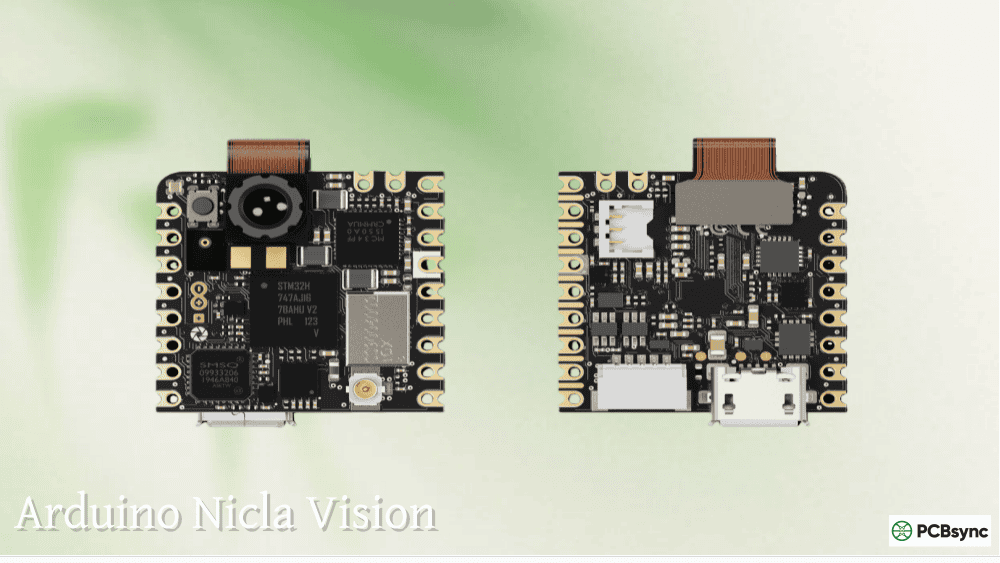
The moment I unpacked the Arduino Nicla Vision for the first time, I was struck by how much technology was crammed into something barely larger than a postage stamp. A 2MP camera, dual-core processor, six-axis IMU, Time-of-Flight sensor, microphone, WiFi, Bluetooth—all in a 22.86 × 22.86 mm package. After years of building computer vision prototypes that required dedicated cameras, separate processors, and rats’ nests of wiring, holding this self-contained vision module felt like the future arriving ahead of schedule.
The Arduino Nicla Vision isn’t just another development board with a camera tacked on. It’s a purpose-built edge AI platform designed from the ground up for machine learning and computer vision applications. Whether you’re building quality inspection systems for manufacturing, smart doorbells for home automation, or gesture recognition interfaces for kiosks, the Nicla Vision provides everything you need in a single, battery-powered package.
The Arduino Nicla Vision emerged from a collaboration between Arduino and OpenMV, combining Arduino’s accessible ecosystem with OpenMV’s computer vision expertise. The result is a board that bridges the gap between traditional embedded development and sophisticated machine learning deployment.
Unlike general-purpose microcontroller boards that can be adapted for vision tasks, the Nicla Vision was architected specifically for image processing and edge AI. The sensor selection, memory configuration, and software support all target a single goal: enabling machines to see, understand, and act on visual information without cloud connectivity.
The Nicla form factor itself represents Arduino’s standard for wireless sensor networks—a compact, modular design that enables integration into virtually any application while maintaining compatibility with the broader Arduino ecosystem including Portenta and MKR boards.
Arduino Nicla Vision Technical Specifications
Understanding the Nicla Vision’s hardware reveals how it achieves such impressive functionality in such a small package:
Specification
Details
Microcontroller
STM32H747AII6
Primary Core
Arm Cortex-M7 @ 480 MHz
Secondary Core
Arm Cortex-M4 @ 240 MHz
Internal RAM
1 MB (shared between cores)
Internal Flash
2 MB
External Flash
16 MB QSPI
Camera
GC2145 2MP Color CMOS
IMU
LSM6DSOX 6-axis (accelerometer + gyroscope)
Distance Sensor
VL53L1CBV0FY Time-of-Flight
Microphone
MP34DT05 omnidirectional MEMS
Security
NXP SE050C2 Crypto Chip
WiFi
802.11 b/g/n
Bluetooth
BLE 4.2
Dimensions
22.86 × 22.86 mm
Battery Support
3.7V Li-Po with integrated charging
The dual-core STM32H747 deserves special attention. The Cortex-M7 running at 480MHz provides the computational power for image processing and ML inference, while the M4 core can handle real-time tasks like sensor fusion or motor control independently. This asymmetric architecture enables sophisticated applications that would otherwise require multiple boards.
Integrated Sensor Suite for Multi-Modal AI
What sets the Nicla Vision apart from camera-only modules is its comprehensive sensor suite:
GC2145 2MP Color Camera
Camera Specification
Details
Resolution
1600 × 1200 (UXGA)
Active Pixels
2 Megapixels
Pixel Size
1.75 µm
Output Formats
RAW, RGB, YCbCr
Frame Rate
Up to 30 fps at full resolution
Interface
MIPI CSI
The GC2145 provides sufficient resolution for most embedded vision tasks while maintaining reasonable frame rates. For machine learning applications, images are typically downscaled to 96×96 or 160×160 pixels for inference, so the full 2MP capability primarily benefits applications requiring higher detail like barcode scanning or document capture.
LSM6DSOX 6-Axis IMU
The LSM6DSOX isn’t just an accelerometer and gyroscope—it’s a “smart” IMU with an embedded Machine Learning Core (MLC). This dedicated hardware can run simple classification models directly on the sensor itself, detecting activities like walking, running, or vibration patterns without involving the main processor.
IMU Feature
Specification
Accelerometer Range
±2/±4/±8/±16 g
Gyroscope Range
±125/±250/±500/±1000/±2000 dps
Machine Learning Core
Yes (embedded)
Finite State Machine
16 programmable states
This enables sophisticated gesture detection or predictive maintenance applications that combine visual and motion data while minimizing power consumption.
VL53L1CBV0FY Time-of-Flight Sensor
The ToF sensor adds accurate distance measurement to the Nicla Vision’s capabilities:
ToF Specification
Details
Range
Up to 4 meters
Accuracy
±3%
Field of View
27°
Technology
Invisible near-infrared VCSEL
Positioned below the camera, the ToF sensor enables applications like automatic focus triggering, presence detection, or ensuring consistent image capture distance for quality inspection systems.
MP34DT05 MEMS Microphone
The omnidirectional digital microphone adds audio capture capability:
Microphone Feature
Specification
Type
Digital MEMS
Pattern
Omnidirectional
SNR
64 dB
Sensitivity
-26 dBFS
Combined with the camera, this enables multi-modal AI applications that respond to both visual and audio cues—think smart doorbells that recognize faces AND voices, or industrial systems that correlate visual defects with unusual sounds.
Machine Learning Platforms for Arduino Nicla Vision
The Nicla Vision integrates seamlessly with multiple ML development platforms:
Edge Impulse Integration
Edge Impulse provides the most comprehensive ML development experience for the Nicla Vision:
Edge Impulse Feature
Support Level
Camera Data Collection
Full support
IMU Data Collection
Full support
Microphone Data Collection
8 kHz sampling
Image Classification
Full support
Object Detection (FOMO)
Full support
Motion Classification
Full support
Anomaly Detection
Full support
Deployment Format
OpenMV firmware
The Edge Impulse workflow enables you to:
Collect training data directly from the Nicla Vision
Label and process data in the cloud studio
Train models using transfer learning
Deploy optimized firmware back to the device
Edge Impulse’s FOMO (Faster Objects, More Objects) algorithm is particularly valuable for the Nicla Vision, enabling object detection that runs efficiently within the board’s 1MB RAM constraint.
OpenMV IDE Integration
The Nicla Vision was developed in collaboration with OpenMV, and the OpenMV IDE provides an excellent development environment for vision applications:
OpenMV Feature
Description
Live Preview
Real-time camera feed in IDE
MicroPython Support
Full scripting capability
Dataset Editor
Built-in image collection tools
Frame Buffer Analysis
Visual debugging tools
Model Deployment
TensorFlow Lite support
OpenMV IDE excels at rapid prototyping—you can write MicroPython scripts that capture images, run inference, and display results without the compile-upload cycle required by the Arduino IDE.
Arduino IDE Support
For traditional Arduino development, the Nicla Vision works with the standard Arduino IDE:
Arduino Feature
Support
Board Package
Arduino Mbed OS Nicla Boards
Standard Libraries
Full compatibility
TensorFlow Lite
Via TFLite Micro library
Serial Debugging
USB Serial
The Arduino IDE approach is best when you need to integrate the Nicla Vision with other Arduino boards or when your application extends beyond pure vision tasks.
TinyML Workflow: From Data to Deployment
Building a machine learning model for the Nicla Vision follows a structured workflow:
Step 1: Define Your Classification Task
Successful ML projects start with clear objectives. Common Nicla Vision applications include:
For images: use 96×96 grayscale for FOMO, 96×96 or 160×160 for classification
Train using transfer learning (MobileNet V1/V2)
Validate on test set
Step 4: Deploy to Device
Edge Impulse generates optimized firmware for the Nicla Vision:
Deployment → OpenMV Firmware → Build → Download
The resulting .bin file and Python script can be flashed via OpenMV IDE, giving you a standalone vision system running entirely at the edge.
Practical Arduino Nicla Vision Applications
The Nicla Vision’s combination of sensors and processing power enables diverse applications:
Industrial Quality Inspection
Feature
Implementation
Defect Detection
Train image classifier on good/bad samples
Label Verification
OCR or pattern matching on product labels
Assembly Confirmation
Object detection for component presence
Measurement
ToF sensor for dimensional verification
The Nicla Vision’s small size allows mounting directly on production lines, while WiFi connectivity enables real-time alerts when defects are detected.
Predictive Maintenance
Capability
Sensor Used
Vibration Analysis
LSM6DSOX IMU
Visual Wear Detection
GC2145 Camera
Acoustic Anomaly
MP34DT05 Microphone
Proximity Triggering
VL53L1 ToF
Combining motion and visual data enables sophisticated predictive maintenance that catches problems before equipment fails.
Smart Building Applications
Occupancy Detection: Count people entering/exiting spaces
Access Control: Face recognition for authorized personnel
Analog Meter Reading: Train classifier to read legacy gauges
Gesture Interfaces: Touchless control for hygiene-sensitive environments
Agricultural Monitoring
Crop Health Assessment: Visual classification of plant conditions
Pest Detection: Identify insects or disease symptoms
Irrigation Control: Combine visual soil assessment with action triggers
The Nicla Vision supports true standalone operation:
Power Feature
Specification
Input Voltage
3.7V (Li-Po) or 5V (USB)
Battery Connector
JST 3-pin
Charging
Integrated charger
Fuel Gauge
Battery level monitoring
Low Power Modes
Multiple sleep states
For battery-powered deployments, the ToF sensor can serve as a low-power wake-up trigger—the system sleeps until something enters its detection range, then activates the camera for identification.
Connectivity Options for Cloud Integration
While the Nicla Vision excels at edge processing, it includes robust connectivity for cloud integration:
Connectivity
Capability
WiFi
Data upload to Arduino IoT Cloud or third-party services
BLE
Communication with smartphones or gateways
WebBLE
OTA firmware updates via browser
USB
Development and debugging
The Arduino IoT Cloud integration enables dashboards that display inference results, track detections over time, and trigger alerts when specific conditions are detected.
How much RAM is available for machine learning models on the Nicla Vision?
The STM32H747 includes 1MB of internal SRAM shared between the M7 and M4 cores. For practical ML deployment, this limits you to smaller, optimized models. Edge Impulse’s FOMO algorithm was specifically designed for this constraint, enabling object detection within ~100-200KB RAM. Image classification models using transfer learning (MobileNet V1 0.1) can run inference on 96×96 grayscale images within these limits. The 16MB external QSPI flash stores model weights and code, but inference must fit in internal RAM. Always check Edge Impulse’s RAM usage estimates before deployment—if your model exceeds available memory, reduce image resolution or simplify the network architecture.
Can the Nicla Vision run object detection, or only image classification?
Yes, the Nicla Vision can run object detection using Edge Impulse’s FOMO (Faster Objects, More Objects) algorithm. Unlike traditional object detection algorithms like YOLO that require significant RAM and processing power, FOMO provides a lightweight alternative that identifies object locations (centroids) rather than bounding boxes. This approach runs efficiently on the Nicla Vision’s Cortex-M7 processor with inference times around 70-140ms depending on model complexity. FOMO works best for counting objects or detecting their approximate locations—it won’t give you precise bounding boxes, but for many industrial applications like inventory counting or presence detection, centroids are sufficient.
What’s the difference between using Arduino IDE and OpenMV IDE for Nicla Vision projects?
The Arduino IDE uses C/C++ and follows the traditional compile-upload-run workflow. It’s best when you need tight integration with other Arduino code, maximum performance, or when your project extends beyond pure vision tasks. The OpenMV IDE uses MicroPython and provides a more interactive development experience with live camera preview, visual debugging tools, and rapid iteration without compilation. For pure computer vision projects, OpenMV IDE is generally faster to develop with and provides better visualization tools. For production deployments where every millisecond matters, Arduino IDE offers slightly better performance. Many developers prototype in OpenMV IDE, then port to Arduino IDE for final deployment if performance is critical.
Can I use the Nicla Vision with third-party cloud services instead of Arduino IoT Cloud?
Absolutely. The Nicla Vision’s WiFi and Bluetooth connectivity work with any cloud platform that supports standard protocols. You can connect to AWS IoT, Azure IoT Hub, Google Cloud IoT, or any service accepting HTTP/HTTPS requests or MQTT connections. The Arduino IoT Cloud is convenient because it’s pre-integrated, but there’s no lock-in. For BLE applications, you can communicate with any BLE-compatible smartphone app or gateway. Some developers use the Nicla Vision as a pure edge device with no cloud connectivity at all—processing everything locally and only outputting results via GPIO or serial communication to other systems.
Is the Nicla Vision suitable for outdoor or harsh environment deployments?
The Nicla Vision is designed for industrial applications but doesn’t include environmental protection out of the box. For outdoor or harsh environment deployments, you’ll need appropriate enclosures. The board itself operates within standard temperature ranges and has no specified IP rating for water or dust ingress. For outdoor applications, consider 3D-printed or commercial enclosures with appropriate sealing—several community-designed cases are available for the Nicla form factor. The battery operation capability is valuable for remote deployments, but ensure your enclosure provides adequate heat dissipation, especially if the camera and WiFi operate continuously. For truly harsh industrial environments (extreme temperatures, vibration, EMI), additional protective measures or custom carrier boards may be necessary.
Final Thoughts on Arduino Nicla Vision
After building multiple production systems with the Nicla Vision, I’ve come to appreciate its particular strengths. This isn’t a board trying to do everything—it’s laser-focused on enabling machine vision at the edge, and it executes that mission remarkably well.
The integration of camera, IMU, ToF sensor, and microphone in such a compact package opens application possibilities that would otherwise require custom PCB design. The Edge Impulse and OpenMV integrations lower the barrier to ML development dramatically—you can go from concept to deployed model in hours rather than weeks.
Is it perfect? No. The 1MB RAM constraint limits model complexity, and the 2MP camera won’t compete with dedicated machine vision cameras in industrial settings requiring high resolution or specialized optics. But for the vast majority of edge AI vision applications—quality inspection, presence detection, gesture recognition, predictive maintenance—the Nicla Vision provides more than enough capability.
What truly sets the Nicla Vision apart is how it democratizes computer vision. Tasks that once required expensive industrial cameras, dedicated vision processors, and specialized engineering expertise can now be accomplished by anyone familiar with the Arduino ecosystem. That’s not just a technical achievement—it’s a fundamental shift in who can build intelligent, vision-enabled systems.
For engineers and makers looking to add machine vision to their projects, the Arduino Nicla Vision deserves serious consideration. It’s compact, capable, and surprisingly approachable for such sophisticated technology.
Inquire: Call 0086-755-23203480, or reach out via the form below/your sales contact to discuss our design, manufacturing, and assembly capabilities.
Quote: Email your PCB files to Sales@pcbsync.com (Preferred for large files) or submit online. We will contact you promptly. Please ensure your email is correct.
Notes: For PCB fabrication, we require PCB design file in Gerber RS-274X format (most preferred), *.PCB/DDB (Protel, inform your program version) format or *.BRD (Eagle) format. For PCB assembly, we require PCB design file in above mentioned format, drilling file and BOM. Click to download BOM template To avoid file missing, please include all files into one folder and compress it into .zip or .rar format.