Inquire: Call 0086-755-23203480, or reach out via the form below/your sales contact to discuss our design, manufacturing, and assembly capabilities.
Quote: Email your PCB files to Sales@pcbsync.com (Preferred for large files) or submit online. We will contact you promptly. Please ensure your email is correct.
Notes: For PCB fabrication, we require PCB design file in Gerber RS-274X format (most preferred), *.PCB/DDB (Protel, inform your program version) format or *.BRD (Eagle) format. For PCB assembly, we require PCB design file in above mentioned format, drilling file and BOM. Click to download BOM template To avoid file missing, please include all files into one folder and compress it into .zip or .rar format.
After spending hundreds of hours designing PCBs and writing firmware for embedded systems, I’ve dealt with the frustrations of choosing the right development environment. Whether you’re prototyping a new sensor board or debugging a complex multi-microcontroller system, your IDE choice directly impacts your productivity and debugging capabilities.
The Arduino IDE vs PlatformIO debate isn’t just about preference—it’s about matching your workflow to your project requirements. I’ve migrated projects between both platforms, and in this guide, I’ll share what I’ve learned from real-world hardware development.
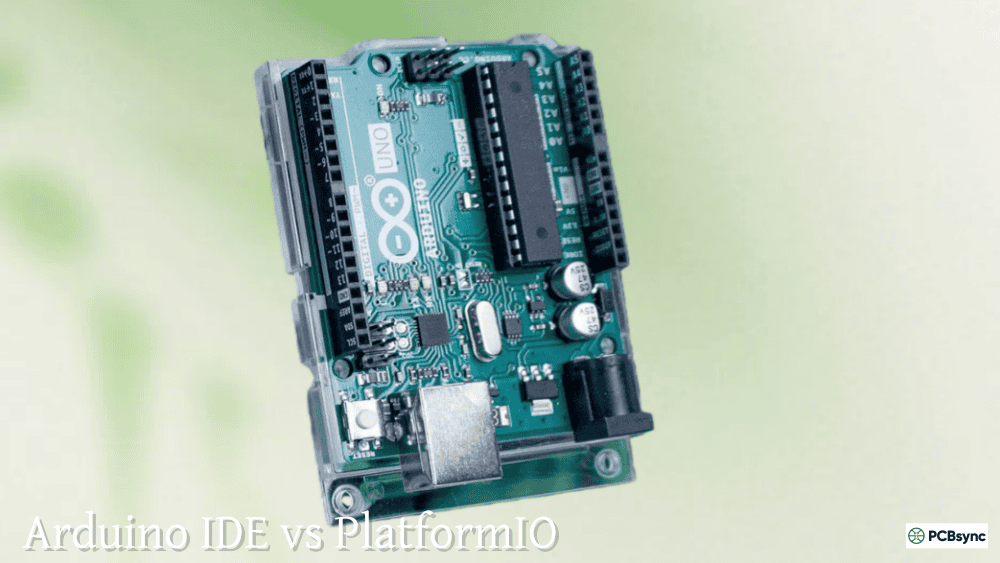
The Arduino IDE has been the gateway for millions into embedded development. Launched in 2005, it provides a straightforward interface specifically designed for Arduino boards. The current version, Arduino IDE 2.0, represents a significant overhaul from its predecessor, introducing features that were previously only available in professional development environments.
Arduino IDE operates as a standalone application built on the Eclipse Theia framework. It handles code editing, compilation, and uploading sketches to your board through a simple interface that prioritizes accessibility over advanced features.
What is PlatformIO?
PlatformIO takes a fundamentally different approach. Rather than being a standalone IDE, it functions as a plugin ecosystem that integrates with professional code editors like Visual Studio Code, Atom, or CLion. Written in Python with a powerful command-line interface, PlatformIO transforms your code editor into a comprehensive embedded development environment.
PlatformIO supports over 900 development boards and 33 different microcontroller platforms, making it platform-agnostic rather than Arduino-specific. This architectural difference has profound implications for how you structure projects and manage dependencies.
Key Differences: Arduino IDE vs PlatformIO
Development Environment Architecture
Feature
Arduino IDE
PlatformIO
Installation Type
Standalone application
Editor plugin/extension
Base Editor
Custom (Eclipse Theia)
VSCode, Atom, CLion, others
Language Support
Arduino C/C++
Arduino, ESP-IDF, mbed, STM32Cube, and more
Project Structure
Flat sketch files
Hierarchical with platformio.ini
File Organization
Single .ino file focus
Multiple files with src/ and include/ folders
From a PCB engineer’s perspective, PlatformIO’s project structure aligns better with professional firmware development. When I’m working on a custom board with multiple peripherals, separating drivers, hardware abstraction layers, and application logic into distinct files prevents the spaghetti code that plague large Arduino sketches.
Board and Platform Support
Arduino IDE excels at simplicity for Arduino boards. Adding support for ESP32, STM32, or other platforms requires manually installing board packages through the Boards Manager. Each platform maintains its own tools, libraries, and compilation settings.
PlatformIO handles this differently. A single platformio.ini configuration file defines your target board, framework, and dependencies. Switching between an Arduino Uno and an ESP32 project requires changing a few lines of configuration rather than reinstalling board packages. For engineers managing multiple hardware revisions or product variants, this flexibility significantly reduces setup overhead.
Library Management Systems
This is where the Arduino IDE vs PlatformIO debate becomes critical for production work.
Arduino IDE Library Management:
Manual installation through Library Manager
Libraries installed globally and shared between projects
Version conflicts common when different projects need different library versions
Limited dependency resolution
PlatformIO Library Management:
Declarative dependencies in platformio.ini
Project-isolated libraries prevent version conflicts
Semantic versioning support (^6.19.4, ~1.2.0)
Automatic dependency resolution
Support for Git repositories and specific commits/tags
Here’s a practical example. When I designed a custom environmental monitoring board, different sensor libraries had conflicting dependencies on the Wire library. Arduino IDE forced me to manually manage which library version worked with which sensor. PlatformIO’s isolated environments let me define exact versions per project:
[env:sensor_board_v1]
lib_deps =
adafruit/Adafruit BME280 Library @ ^2.2.2
adafruit/Adafruit Unified Sensor @ ^1.1.9
paulstoffregen/Time @ ^1.6.1
[env:sensor_board_v2]
lib_deps =
adafruit/Adafruit BME680 Library @ ^2.0.2
bblanchon/ArduinoJson @ ^6.19.4
Debugging Capabilities Comparison
Debugging Feature
Arduino IDE 2.0
PlatformIO
Hardware Debugger Support
Limited (SAMD, mbed boards only)
Extensive (JTAG, SWD, OpenOCD)
Breakpoints
Yes (supported boards)
Yes (most platforms)
Variable Inspection
Yes
Yes with detailed views
Call Stack
Yes
Yes
Memory Viewer
Limited
Available
Supported Boards
MKR family, Nano 33 IoT/BLE, Zero, Portenta
ESP32, STM32, SAMD, nRF52, and more
External Debugger Required
J-Link, Atmel-ICE
J-Link, ST-Link, Black Magic Probe, others
Arduino IDE 2.0 added debugging capabilities that were previously unavailable, but they’re limited to specific board families. For PCB design work involving STM32 microcontrollers or ESP32 modules—common choices for production hardware—PlatformIO provides superior debugging support.
When I was tracking down an I2C timing issue on a custom STM32-based board, PlatformIO’s integration with OpenOCD and ST-Link let me set conditional breakpoints on specific register values. Arduino IDE couldn’t debug this board at all, forcing me to rely on Serial.println() statements—a time-consuming process when dealing with timing-sensitive communication protocols.
Build System and Compilation
PlatformIO’s build system offers significant advantages for professional development:
Faster Compilation:
Incremental builds that only recompile changed files
Parallel compilation across multiple cores
Build flags easily configured in platformio.ini
Arduino IDE Compilation:
Full recompilation more common
Limited build configuration options
Slower for large projects
In practice, when working on a 5,000-line firmware project for a custom IoT device, PlatformIO’s compilation was 3-4 times faster than Arduino IDE. These seconds multiply across hundreds of compile cycles during development.
Code Intelligence Features
Feature
Arduino IDE 2.0
PlatformIO (with VSCode)
Autocomplete
Basic
Advanced with IntelliSense
Code Navigation
Limited
Jump to definition, find references
Inline Error Detection
Yes
Yes with detailed explanations
Refactoring Tools
Minimal
Rename, extract function, etc.
Code Snippets
Limited
Extensive
Multi-file Support
Basic
Excellent
For PCB engineers writing drivers for custom hardware, these features matter. When implementing SPI communication for a custom display controller, VSCode’s IntelliSense showed me exactly which parameters each HAL function expected, while Arduino IDE required constant reference to documentation.
Practical Workflow Comparison
Starting a New Project
Arduino IDE Workflow:
Open Arduino IDE
Select board from Tools menu
Start writing in .ino file
Manually add libraries as needed
PlatformIO Workflow:
Create new project via PlatformIO Home
Select board from 900+ options
Configure platformio.ini
Organize code in src/ and include/ folders
For quick prototypes on standard Arduino boards, Arduino IDE’s workflow is faster. For production firmware on custom PCBs, PlatformIO’s structure pays dividends as complexity grows.
Managing Multiple Boards
I frequently work with hardware that uses different microcontrollers at different stages:
Prototyping: Arduino Mega for breadboard testing
Production V1: ESP32 for WiFi connectivity
Production V2: STM32 for cost optimization
Arduino IDE requires manually switching board settings and managing separate sketch folders. PlatformIO lets me define multiple environments in one project:
[env:prototype]
platform = atmelavr
board = megaatmega2560
[env:production_v1]
platform = espressif32
board = esp32dev
[env:production_v2]
platform = ststm32
board = nucleo_f411re
This configuration-as-code approach prevents the “worked on my machine” problems common with Arduino IDE’s GUI-based settings.
When to Choose Arduino IDE
Despite PlatformIO’s advantages, Arduino IDE remains the better choice for specific scenarios:
Beginners and Education
If you’re teaching embedded systems or just starting with microcontrollers, Arduino IDE’s simplicity reduces cognitive load. Students can focus on learning C++ syntax and hardware concepts rather than build systems and project configuration.
Quick Prototypes and Simple Projects
For one-off projects or simple sketches under 500 lines, Arduino IDE gets you running faster. Opening the IDE, selecting your board, and uploading code takes minutes.
Standard Arduino Boards
When working exclusively with official Arduino boards (Uno, Mega, Nano), Arduino IDE provides an optimized experience. Board selection is straightforward, and you’re unlikely to encounter compatibility issues.
Limited Computer Resources
Arduino IDE has a smaller footprint than VSCode + PlatformIO. On older laptops or systems with limited RAM, Arduino IDE may run more smoothly.
Casual Makers and Hobbyists
If you’re building projects occasionally rather than professionally, Arduino IDE’s straightforward interface requires less investment in learning tools.
PlatformIO becomes essential when your work involves:
Professional Firmware Development
Production firmware demands version control integration, automated testing, and reproducible builds. PlatformIO’s platformio.ini makes projects portable across team members and build servers.
Custom PCB Development
When designing custom boards with non-Arduino microcontrollers (STM32, nRF52, ESP32), PlatformIO provides better toolchain support and debugging capabilities. I’ve used PlatformIO for boards ranging from simple sensor nodes to complex multi-processor systems.
Large Codebases
Projects exceeding 1,000 lines benefit from PlatformIO’s code navigation, refactoring tools, and multi-file organization. Breaking firmware into logical modules (drivers/, hal/, app/) becomes manageable.
Multiple Board Variants
Managing firmware that targets different hardware revisions or microcontroller families is significantly easier with PlatformIO’s environment system.
Team Development
PlatformIO’s configuration-as-code approach ensures everyone on the team uses the same compiler versions, libraries, and build settings. This eliminates “works on my computer” debugging sessions.
Continuous Integration
Integrating automated testing and builds with services like GitHub Actions, Travis CI, or Jenkins is straightforward with PlatformIO’s command-line interface.
Migration Path: Arduino IDE to PlatformIO
Moving existing Arduino projects to PlatformIO is more straightforward than you might expect:
Install PlatformIO: Add the extension to VSCode
Create New Project: Select your target board
Copy Code: Move .ino file contents to src/main.cpp
Add Libraries: List dependencies in platformio.ini
Test Build: Compile and verify functionality
The main code change required is adding #include <Arduino.h> at the top of your file—PlatformIO doesn’t automatically include it like Arduino IDE does.
Performance and Resource Usage
Aspect
Arduino IDE
PlatformIO
Installation Size
~250-400 MB
VSCode: ~200 MB + PlatformIO: ~500 MB
RAM Usage
~150-250 MB
~400-600 MB
First Build Time
Moderate
Slower (downloads toolchains)
Incremental Builds
Slower
Faster
Disk Space (per project)
Minimal
~50-200 MB (includes toolchains)
PlatformIO’s larger footprint trades off against better performance for larger projects. The initial setup time pays dividends on subsequent builds.
Real-World Use Cases from PCB Engineering
Case 1: Custom STM32 Data Logger
For a battery-powered data logger using an STM32L4, Arduino IDE couldn’t provide debugging support. PlatformIO’s ST-Link integration let me optimize power consumption by inspecting register values during sleep modes.
Winner: PlatformIO
Case 2: Simple Arduino Uno LED Controller
A straightforward project controlling WS2812B LEDs with an Arduino Uno. Total code: 150 lines.
Winner: Arduino IDE (faster setup, adequate features)
Case 3: Multi-Sensor IoT Gateway
ESP32-based gateway reading multiple I2C sensors, publishing to MQTT, with OTA updates. Required managing five library dependencies with specific versions.
Winner: PlatformIO (dependency management, build flags for OTA)
Case 4: Educational Workshop Project
Teaching high school students basic Arduino programming with provided example sketches.
Winner: Arduino IDE (simpler interface, less overwhelming)
PlatformIO Community forums: Active developer discussions
Official documentation: Detailed technical references
GitHub repository: Direct developer interaction
For troubleshooting complex build issues or platform-specific problems, PlatformIO’s community tends to provide more technical depth, while Arduino’s community excels at beginner guidance.
Frequently Asked Questions
Can I use Arduino libraries with PlatformIO?
Yes, PlatformIO fully supports Arduino libraries. Simply add them to your lib_deps in platformio.ini. Most Arduino libraries work without modification. PlatformIO can even pull libraries directly from the Arduino Library Manager registry.
Do I need to learn command line tools for PlatformIO?
No. While PlatformIO offers powerful CLI tools, the VSCode extension provides a complete GUI interface. You can manage projects, libraries, and builds entirely through menus and buttons. The CLI becomes useful for automation and CI/CD, but it’s optional.
Will my Arduino code work in PlatformIO without changes?
Almost always. The main requirement is adding #include <Arduino.h> at the top of your file. If you’re using multiple files, you may need to add function prototypes—something Arduino IDE generates automatically but PlatformIO requires explicitly.
Which is better for learning embedded programming?
Arduino IDE is better for absolute beginners due to its simpler interface and lower cognitive load. Once you’re comfortable with basic programming concepts, transitioning to PlatformIO provides professional-grade tools that match industry practices.
Can I switch between Arduino IDE and PlatformIO for the same project?
Yes, but it requires manual synchronization. You’ll need to copy code between the different project structures and manually track library dependencies. Many developers keep projects exclusively in one environment to avoid this overhead.
Download and Installation Resources
Arduino IDE Downloads
Official Site: https://www.arduino.cc/en/software
Supported Platforms: Windows, macOS, Linux
Latest Version: Arduino IDE 2.3.x
Size: ~400 MB
PlatformIO Installation
VSCode Extension: Search “PlatformIO IDE” in VSCode marketplace
Official Docs: https://docs.platformio.org/
Supported Editors: VSCode, Atom, CLion, Eclipse, Sublime Text
CLI Installation: pip install platformio
Useful Developer Tools
VSCode: https://code.visualstudio.com/
Git: https://git-scm.com/ (recommended for version control)
Python 3.6+: https://www.python.org/ (required for PlatformIO)
The Arduino IDE vs PlatformIO choice ultimately depends on your specific needs:
Choose Arduino IDE if you:
Are just starting with embedded programming
Work primarily with standard Arduino boards
Need a lightweight, simple environment
Build small projects (under 500 lines)
Prioritize quick setup over advanced features
Choose PlatformIO if you:
Develop professional or production firmware
Design custom PCBs with various microcontrollers
Manage large codebases or multiple projects
Need advanced debugging capabilities
Work in teams requiring reproducible builds
Want modern IDE features and workflows
For PCB engineers and professional developers, I recommend investing time to learn PlatformIO. The initial learning curve pays dividends in productivity, especially when working with custom hardware. The ability to precisely control build flags, manage dependencies, and debug complex issues makes it the professional choice.
However, Arduino IDE remains valuable for quick tests, teaching, and simple projects. Many experienced developers keep both installed—Arduino IDE for rapid prototyping and PlatformIO for serious development work.
Your development environment should serve your projects, not constrain them. Understanding both tools allows you to choose the right one for each situation, ultimately making you a more effective embedded systems developer.
Inquire: Call 0086-755-23203480, or reach out via the form below/your sales contact to discuss our design, manufacturing, and assembly capabilities.
Quote: Email your PCB files to Sales@pcbsync.com (Preferred for large files) or submit online. We will contact you promptly. Please ensure your email is correct.
Notes: For PCB fabrication, we require PCB design file in Gerber RS-274X format (most preferred), *.PCB/DDB (Protel, inform your program version) format or *.BRD (Eagle) format. For PCB assembly, we require PCB design file in above mentioned format, drilling file and BOM. Click to download BOM template To avoid file missing, please include all files into one folder and compress it into .zip or .rar format.